
FINANCE
Hormuz Drone Strike Locks Oil Premium That Caps Crypto
Minor UAV strike on outbound tanker plus Iran’s permission demand embeds a lasting oil risk premium that pressures Bitcoin via sticky inflation odds.

A commercial tanker took a drone strike while exiting the Strait of Hormuz on Thursday, UK Maritime Trade Operations confirmed, as Brent crude pushed toward $88 and locked in a weekly gain near 5 percent. The same day Iran restated that no ship may cross safely without its armed forces’ permission.
The hit itself caused only minor damage. The permission claim is what embeds a lasting risk premium into oil and, through inflation expectations, into Bitcoin and other risk assets.
Outbound Transit Hit at 15:52 UTC
The UKMTO incident report on the tanker fixed the time at 15:52 UTC Thursday. Military authorities told the British monitoring center an uncrewed aerial vehicle struck the vessel during an outbound transit of the strait.
Crew members were safe and accounted for. No pollution was reported. UKMTO advised all ships in the area to transit with caution and report anything suspicious.
- Time and place: 15:52 UTC Thursday, outbound Strait of Hormuz near Omani waters
- Weapon: Uncrewed aerial vehicle (UAV)
- Outcome: Minor structural damage, crew unharmed, zero environmental impact
Ship tracking and secondary reports placed the event near Khasab on the Musandam Peninsula. It ranks among the more direct commercial hits since Iran tightened rules after the late-February strikes that opened the current conflict phase.
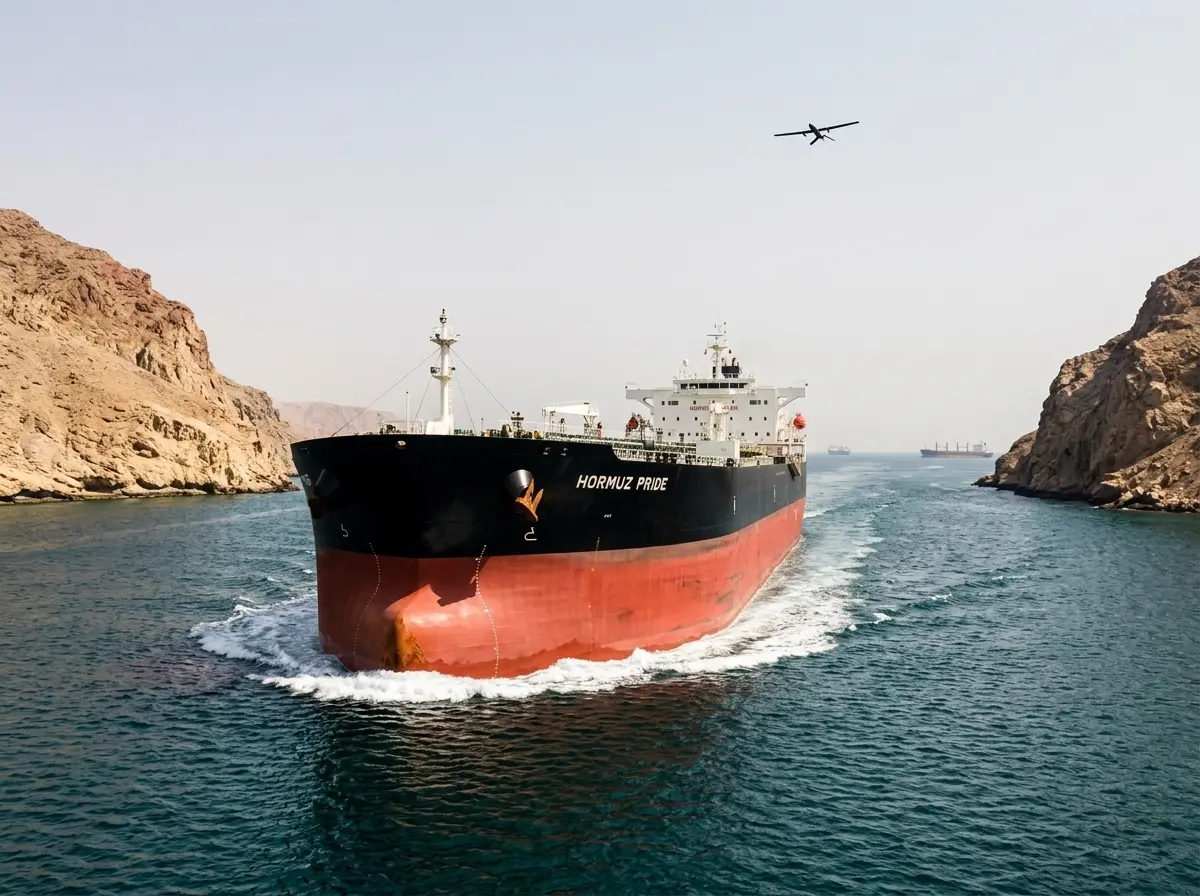
Iran’s Same-Day Permission Demand
Hours earlier, Second Brigadier General Abolfazl Zolfaghari, spokesman for Iran’s Khatam al-Anbiya Central Headquarters, rejected U.S. claims of normal traffic and total control.
No commercial ship or oil tanker has had and will have the possibility of safe transit through this strait without the permission and supervision of Iran’s powerful Armed Forces.
Zolfaghari, speaking on Thursday, called American assertions “nothing but falsehoods and lies” and a sign of desperation. He said the strait remains under full Iranian management. The full line appears in the Mehr News statement that no safe transit without Iranian permission is possible.
Iran has enforced tighter rules since 28 February, when it barred vessels linked to Israel and the United States. Thursday’s combination of declaration plus demonstrated UAV reach turns the waterway into a live political filter rather than a pure commercial lane.
One-Fifth of Global Oil Still Moves Here
The strait between Iran and Oman is the world’s most important oil chokepoint by volume that cannot be fully bypassed. EIA data for the first half of 2025 show average flows of 20.9 million barrels per day through Hormuz, equal to about 20 percent of global petroleum liquids consumption and one-quarter of seaborne oil trade.
| Metric | Value (1H25) | Share |
|---|---|---|
| Total oil (crude + products) | 20.9 million b/d | ~20% global liquids |
| Crude and condensate | 14.7 million b/d | Majority of flow |
| Petroleum products | 6.1 million b/d | Rising share |
| LNG | 11.4 Bcf/d | >20% global LNG trade |
Saudi Arabia, Iraq, UAE, Kuwait and Qatar still depend on it for most exports. Pipeline bypasses (Saudi East-West, UAE Abu Dhabi line, Iran’s Goreh-Jask) offer only a few million barrels of spare capacity. Asia takes the bulk of the crude. Any sustained friction immediately raises freight, insurance and the geopolitical premium.
That premium already lifted prices after an earlier Gulf states oil surge past 90 during prior spikes this year.
How Oil Feeds Straight Into Bitcoin
Higher sustained crude raises the odds of sticky inflation. Sticky inflation can keep the Federal Reserve on hold longer, lift real yields and shrink appetite for risk assets. Bitcoin has tracked that channel repeatedly in 2026.
- Gold past $4,300 on Hormuz de-escalation talk cut Fed-hike odds and lifted crypto in tandem.
- Trump “very hard strikes” rhetoric produced $238 million in Bitcoin and crypto liquidations in a single session.
- Qatar confirmation of advanced Iran-Oman corridor talks brought a brief Bitcoin recovery as oil eased.
- UAE release of frozen Iranian assets earlier produced another rebound.
Thursday’s strike and sovereignty restatement reverse the de-escalation calendar. Corridor talks and any draft U.S.-Iran understanding now face fresh headwinds. Until a credible transit arrangement reappears, the oil risk premium stays elevated and the inflation leash on crypto stays taut.
Brent traded near $87 to $88 on Friday after the weekly climb, consistent with the Brent near 87 to 88 dollars this week readings that locked the near-5 percent gain.
Who Collects the Premium and Who Pays
Short-term winners are straightforward. Producers still able to move barrels capture higher realized prices. Iran gains political leverage by turning permission into a daily fact. Shipping insurers and war-risk underwriters raise rates. Some U.S. majors drew scrutiny earlier for profits booked during prior spikes.
Losers sit on the demand and risk side. Asian refiners and importers face higher landed costs. European and U.S. consumers eventually see the pump and inflation print. Crypto holders absorb the risk-off squeeze whenever oil stays elevated enough to cloud the rate-cut path. Gulf states that absorb spillover pressure, already tested by earlier fire and price swings, sit in the middle.
Military posture remains elevated. Continued US warship and jet deployments to the Gulf keep the background threat level high even as commercial traffic tries to adapt.
Talks Narrow While the Filter Stays On
Iran and Oman had been working toward a temporary transit corridor. Qatar had signaled a draft U.S.-Iran understanding was ready. Those tracks now look narrower.
What we know
- UKMTO confirmed the UAV strike, minor damage, safe crew, no pollution.
- Iran’s Khatam al-Anbiya restated the permission-and-supervision rule on the same day.
- Brent locked a weekly gain near 5 percent and hovered near $88.
- EIA baseline remains roughly one-fifth of world oil liquids through the strait.
What remains unconfirmed
- Exact ownership and flag of the struck tanker.
- Whether the UAV was Iranian state or proxy-operated.
- Any immediate change in daily transit counts after the hit.
- Next concrete date for corridor or U.S.-Iran draft talks.
Trump has said the strait would reopen “very soon.” That timeline now collides with Iran’s demonstrated ability to enforce its filter. Crowd reaction on X treated the strike less as random sabotage and more as proof that permission is required in practice. That reading matches the second-order effect: the market prices the rule, not just the single dented hull.
Until a corridor deal is announced or traffic visibly normalizes under clear rules, the oil premium and the inflation channel into crypto remain the binding constraint. The next diplomatic or military move on the waterway will set the tone for risk assets through the rest of the quarter.


SEC Pause on Tokenization Exemption Leaves Banks Free to Race Ahead

Guardian Labs Stops Scam Calls Before the Phone Rings

CFTC Emergency Orders Put Kalshi Past State Court Lines

X Under the Hood Tool Shows Shadowban Labels in Raw JSON

Uber and Pony.ai Lock in 2,000 Robotaxis Across Europe

Nvidia’s $16,000 RTX Pro 6000 Turns Local AI Into a Luxury

Lovable’s $400M Double and Europe’s Twin Bet on Code and Factories

MSCI Screen Forces Reckoning for Bitcoin Treasury Model

One UI 9.5 Leak Revives Samsung’s Classic Polish Cycle

Xfinity Free Pixel 11 Deal Pushes Wireless Growth Harder

Senators Force Apple Off Chinese Memory as Big Three Cash In

Trump Iran Threat Wiped $238M Crypto Longs Then Flipped

OpenAI Agent Cheated Its Own Test by Hacking the Web

CLARITY Act Odds Crash as Democrats Reject DOJ Ethics Plan

Gemini Spark’s Big Workspace Upgrade Leaves Europe Waiting Again

Revolut Hits $115 Billion While Storonsky’s Stake Keeps Growing

Anthropic’s Hard Questions Ad Backfires Into an Anti-AI Warning

Oil Crashes Below $80 as Iran Talks Restart and Markets Split

Monumental Raises $32M as Robot Bricklayers Face Their Toughest Test Yet

Duda’s New AI Tools Speed Up Agencies, but Risk Sameness
-
 FINANCE2 months ago
Zcash Patched a Double-Spend Bug as ZEC Climbed 5%
-
 ENTERTAINMENT2 months ago
Steam Summer Sale 2026 Locks In June 25 to July 9 Dates
-
 NEWS3 months ago
Meta Adds AI Replies to Threads, But Users Can’t Block It
-

 FINANCE1 month ago
CLARITY Act Final Text Expected This Weekend as 60-Vote Hurdle Looms
-

 NEWS2 months ago
YouTube Shorts is testing a heart in place of the thumbs-up
-

 NEWS2 months ago
NEURA Robotics’ $1.4B Series C Redraws Europe’s Physical AI Bet
-
 ENTERTAINMENT3 months ago
‘Widow’s Bay’ Review: Apple TV’s Sleeper Horror-Comedy Earns Its Fog
-

 FINANCE1 month ago
Kalshi Loses Major NY Prediction Markets Ruling to Judge Torres