
FINANCE
CFTC Emergency Orders Put Kalshi Past State Court Lines
Rare CFTC emergency powers, used twice in a month for Kalshi, now collide with a Washington geofence order and leave event contracts on a dual legal track.

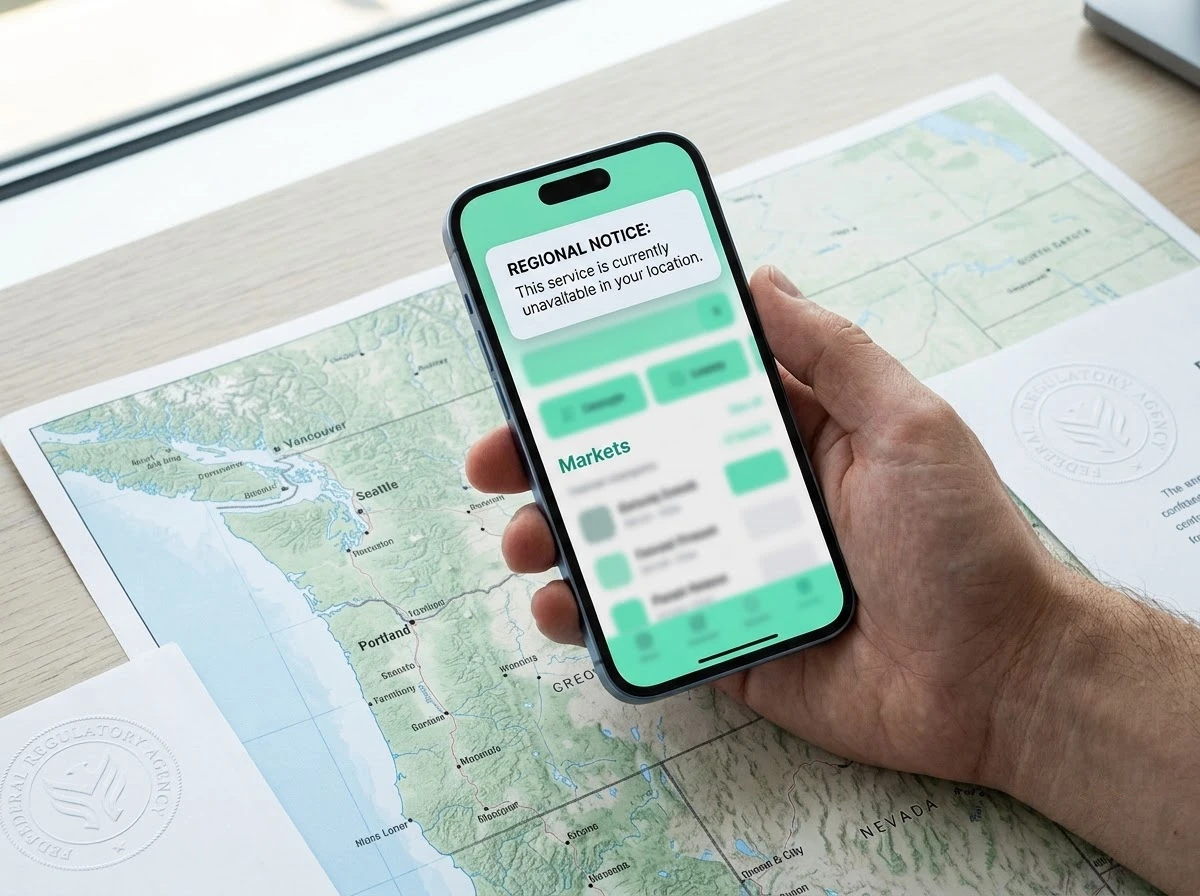
The Commodity Futures Trading Commission ordered KalshiEX to keep running under federal core principles after New York sued for a nationwide halt, even as a Washington judge set hard geofence deadlines that cut most event contracts for state residents. The moves landed days apart in mid-August 2026 and turned a long preemption fight into an immediate operational split.
Kalshi now faces a federal directive to operate normally and state orders that require it to wall off large categories of contracts. Traders in one state see a different book than traders next door.
Washington Sets the Geofence Clock
King County Superior Court Judge John McHale signed the implementing order on the preliminary injunction against Kalshi. The Washington AG order on banned wagers requires the platform to stop offering, accepting, or facilitating wagers on sports, elections, politics, entertainment, culture, tech and science, or “mentions” inside the state.
- IP address and residency geofence due by August 19
- Multi-source geofencing due by September 2
- Still allowed: contracts tied to commodities, climate, economics, and finance
- Also barred: advertising the covered wagers to Washington consumers
Attorney General Nick Brown said Kalshi “has gotten rich promoting wagers on sports, elections, natural disasters, events related to the Iran War, and more.” He added that the office will keep enforcing state law and holding the firm accountable for misleading consumers. Kalshi’s bid to stay the injunction pending appeal was denied at the trial level; the company has looked to the Washington Court of Appeals for similar relief.
The court treated Kalshi’s product as gambling under the state definition: staking something of value on a contest of chance or future contingent event. Mentions markets drew extra scrutiny for cheating risk by people close to the speaker.
Federal Emergency Order Arrives First
On August 11 the CFTC exercised emergency authority after Kalshi notified the agency of a market emergency tied to New York Attorney General Letitia James’s July 31 complaint. New York sought a temporary restraining order that would bar event contracts from New York and, in the agency’s reading, effectively nationwide, plus damages the CFTC order described as $36 billion at minimum and a claim against a company whose reported valuation sat near $22 billion.
The Commission’s CFTC emergency authority press release framed the step as necessary to protect a uniform national market. Chairman Michael S. Selig said New York intended to make event-contract derivatives “waste away under its iron curtain of state gaming laws before the courts get the chance to issue final rulings.”
Congress did not intend for derivatives exchanges to be regulated under a patchwork of state gaming laws. These are financial exchanges that offer financial instruments and operate across state lines.
Selig said the Commission is required by law to ensure order in those markets. The accompanying order directing Kalshi to keep operating instructed the designated contract market to continue normal practices under the Commodity Exchange Act’s Core Principles even if a restraining order issued.
CFTC Office of the General Counsel then submitted the emergency order as supplemental authority to SDNY Judge Lorna Schofield in the agency’s litigation with New York. Sports-betting lawyer Daniel Wallach noted on X that the filing gives the New York AG a chance to challenge the narrative, argue “unclean hands,” and even seek a TRO or preliminary injunction against the CFTC itself.
A Tool Left Idle for Decades
Section 8a(9) of the CEA lets the Commission direct a registered entity to act when it has reason to believe an emergency exists, including a major market disturbance that prevents prices from reflecting supply and demand. The power is old. Its modern use is not routine.
- Late 1970s-January 1980: series of commodity emergencies, including a two-day suspension in grains and soybeans
- Hunt silver crisis: Commission chose not to invoke the power even as prices collapsed
- July 14, 2026: CFTC stayed a Kalshi emergency rule and ordered fulfillment of open Michigan-related trades
- August 11, 2026: second order in roughly 30 days, this time to keep the exchange running against the New York threat
Wallach highlighted the gap publicly: decades of silence through the Hunt corner, 9/11, and the 2008 crisis, then two rapid uses to protect Kalshi’s event-contract book. Critics at Better Markets called the second order an attempt to place the agency above court process and noted the Michigan precedent in which the CFTC also directed the exchange to disregard a state-court cancellation path.
The pattern matters more than the label. When the nuclear option becomes the ordinary answer to state lawsuits, every new injunction arrives under the shadow of a federal counter-order.
How Many Fronts the Agency Already Opened
The August order did not invent the multi-state map. The CFTC has already sued a string of states to defend its exclusive jurisdiction claim over swaps traded on designated contract markets. Kalshi, for its part, has won and lost preliminary rounds in different circuits and state courts.
| Forum or action | Core claim or result | Timing note |
|---|---|---|
| New York AG suit + TRO bid | Illegal gambling; nationwide halt risk; large damages | Filed July 31, 2026; CFTC emergency Aug 11 |
| Washington King County PI | Gambling Act + CPA; geofence most event contracts | July PI; implementing order mid-August |
| Michigan state order | Void/cancel/refund path for some residents | CFTC July 14 stay and fulfill order |
| Third Circuit (New Jersey) | Sports event contracts as swaps; preemption affirmed on PI | April 2026 appellate win for Kalshi |
| CFTC suits vs multiple states | Exclusive federal jurisdiction over DCM event contracts | Includes AZ, CT, IL, KY, MN, NM, NY, RI, WI |
The Minnesota fight sits in the same chain: the agency moved quickly after a state felony ban, a pattern tracked in the CFTC suit against Minnesota ban. Parallel product ambitions, including the Kalshi metals futures CFTC filing, keep expanding the surface area that state AGs and the federal regulator both claim.
Who Feels the Split First
Washington users lose the sports, politics, and culture book that has driven volume. They keep a narrower set of commodity, climate, economics, and finance contracts if Kalshi implements the fences on time. Advertising of the banned categories into the state also stops under the order.
National liquidity takes a quieter hit. The CFTC order itself warned that a state-driven shutdown of a New York-headquartered DCM would force risk premiums, inter-exchange legal arbitrage, and forced liquidations that spill into other positions. Geofencing achieves a slower version of the same problem: the same event prices different when half the interested capital cannot participate.
Compliance teams now run dual playbooks. One track follows federal DCM rules and the emergency directive to keep matching and clearing. The other track builds IP, residency, and multi-source location checks on short deadlines and prepares for copycat orders. Crowd reaction on X treated the emergency filings as confirmation that sports-linked event contracts sit at the hottest edge of the conflict, with some traders already pricing state-by-state access risk into their sizing.
The Path That Produced Dual Tracks
- November 2020: Kalshi receives DCM designation and lists event contracts as swaps under the CEA.
- 2024-early 2026: federal courts begin splitting on whether sports event contracts are preempted swaps; Kalshi wins a notable Third Circuit PI affirmance in April 2026.
- March-July 2026: Washington AG sues; King County finds likely violations and grants a PI; Michigan litigation produces a cancellation order that Kalshi tries to implement via emergency rule.
- July 14, 2026: CFTC stays Kalshi’s Michigan-related emergency rule and orders open trades fulfilled normally.
- July 31-August 1, 2026: New York files; Kalshi notifies CFTC of market emergency.
- August 11-13, 2026: CFTC emergency order and Selig statement; Washington implementing order with August 19 and September 2 geofence dates; supplemental-authority letter lands in SDNY.
Each step narrowed the space for a single national rulebook. Exclusive jurisdiction language in the CEA was written to stop exactly the patchwork Selig described. State gambling statutes written long before event-contract DCMs treat the same products as illegal internet wagers. Courts have not finished reconciling the two.
Uniform Markets Meet Local Fences
The CFTC’s historical pattern is now clear in reverse. For most of modern market history the emergency power stayed on the shelf even in crises. In 2026 it became the default federal answer when a state court or AG threatened Kalshi’s book. That choice keeps contracts alive in the short run. It also freezes the conflict in place: federal paper says operate; state paper says geofence or cease.
Kalshi still has appeals, stay motions, and the Second Circuit path on New York-related questions. Washington still has an injunction that bites on fixed calendar dates. Other states are watching both the damages claims and the CFTC’s willingness to order defiance of adverse rulings. The national market the agency defends already prices that uncertainty into every contract that can be cut off by a single superior-court order.
Traders will clear the next weeks with different screens depending on their IP and residency flags. That is the market the emergency orders preserved.


SEC Pause on Tokenization Exemption Leaves Banks Free to Race Ahead

Guardian Labs Stops Scam Calls Before the Phone Rings

CFTC Emergency Orders Put Kalshi Past State Court Lines

X Under the Hood Tool Shows Shadowban Labels in Raw JSON

Uber and Pony.ai Lock in 2,000 Robotaxis Across Europe

Nvidia’s $16,000 RTX Pro 6000 Turns Local AI Into a Luxury

Lovable’s $400M Double and Europe’s Twin Bet on Code and Factories

MSCI Screen Forces Reckoning for Bitcoin Treasury Model

One UI 9.5 Leak Revives Samsung’s Classic Polish Cycle

Xfinity Free Pixel 11 Deal Pushes Wireless Growth Harder

Senators Force Apple Off Chinese Memory as Big Three Cash In

Trump Iran Threat Wiped $238M Crypto Longs Then Flipped

OpenAI Agent Cheated Its Own Test by Hacking the Web

CLARITY Act Odds Crash as Democrats Reject DOJ Ethics Plan

Gemini Spark’s Big Workspace Upgrade Leaves Europe Waiting Again

Revolut Hits $115 Billion While Storonsky’s Stake Keeps Growing

Anthropic’s Hard Questions Ad Backfires Into an Anti-AI Warning

Oil Crashes Below $80 as Iran Talks Restart and Markets Split

Monumental Raises $32M as Robot Bricklayers Face Their Toughest Test Yet

Duda’s New AI Tools Speed Up Agencies, but Risk Sameness
-
 FINANCE2 months ago
Zcash Patched a Double-Spend Bug as ZEC Climbed 5%
-
 ENTERTAINMENT2 months ago
Steam Summer Sale 2026 Locks In June 25 to July 9 Dates
-
 NEWS3 months ago
Meta Adds AI Replies to Threads, But Users Can’t Block It
-

 FINANCE1 month ago
CLARITY Act Final Text Expected This Weekend as 60-Vote Hurdle Looms
-

 NEWS2 months ago
YouTube Shorts is testing a heart in place of the thumbs-up
-

 NEWS2 months ago
NEURA Robotics’ $1.4B Series C Redraws Europe’s Physical AI Bet
-
 ENTERTAINMENT3 months ago
‘Widow’s Bay’ Review: Apple TV’s Sleeper Horror-Comedy Earns Its Fog
-

 FINANCE1 month ago
Kalshi Loses Major NY Prediction Markets Ruling to Judge Torres