
NEWS
Samsung Wide View OLED Clears the Path Beyond Foldables
Samsung Display’s 7.6-inch Wide View panel redesigns the OLED layer so crease areas match flat brightness, unlocking uniform quality for foldables.

Samsung Display unveiled a 7.6-inch Wide View OLED panel at IMID 2026 that lifts crease-area brightness from roughly 40 percent of the flat screen to uniform levels. The fix comes from a full redesign of the organic light-emitting layer materials and structure, shown at BEXCO in Busan from August 18 to 21.
The same approach targets slidable and rollable devices as well as edge curves. That shared optical problem has limited every flexible form factor, not just book-style phones.
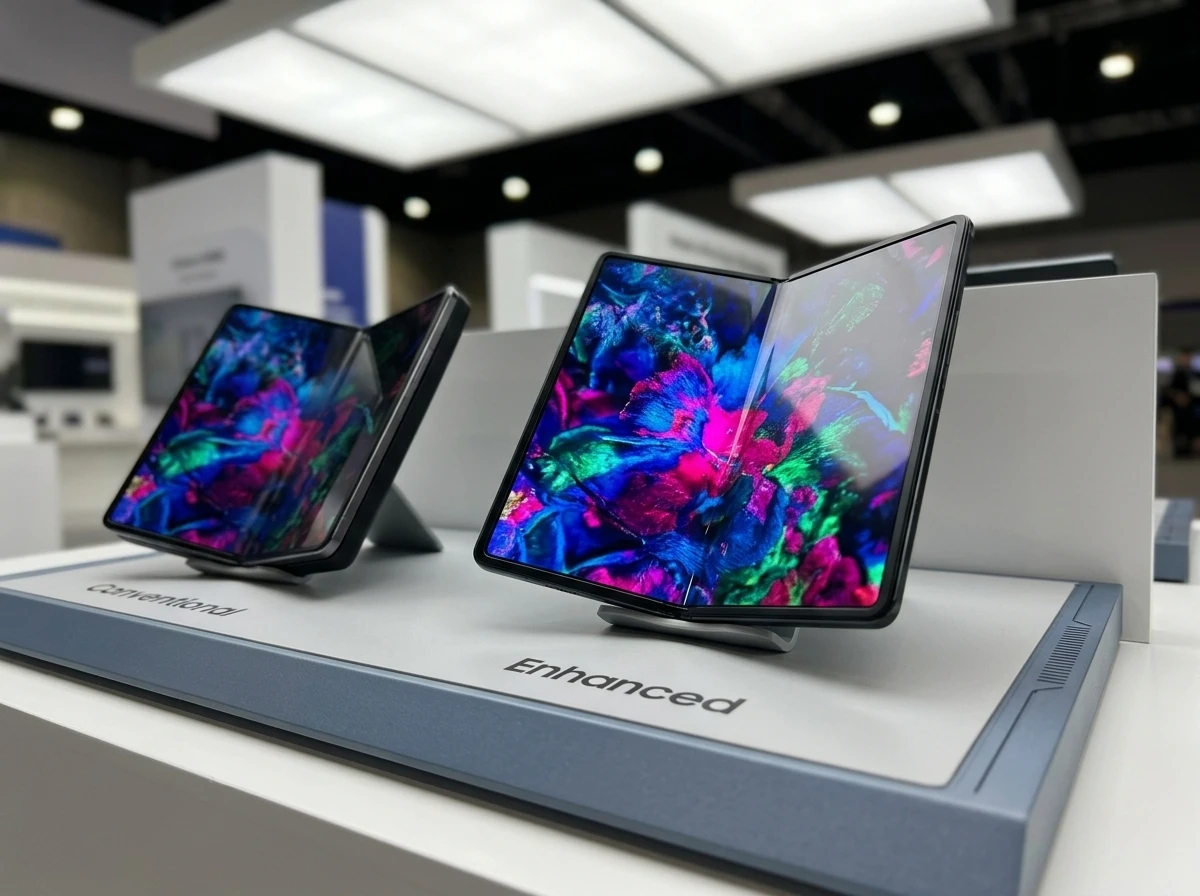
Visitors saw the claim tested in public rather than described only on a slide. The booth pairing of old and new panels made the brightness gap easy to judge under hall lighting.
What the 7.6-Inch Prototype Shows
Current commercial foldable OLEDs drop to about 40 percent brightness on the curved sections flanking the central fold when viewed head-on. Samsung Display stated the new panel eliminates that penalty so the image stays even across the bend.
A company official described it as the latest wide-viewing-angle technology that resolves side brightness degradation in folding parts or curved edges. Applying it yields uniform image quality without viewing-angle brightness differences in next-generation form factors such as foldable, slidable and rollable displays.
- Panel size: 7.6-inch prototype matched to current Fold inner displays
- Core change: complete redesign of organic light-emitting layer materials and structure
- Baseline problem: crease zones at ~40% of flat brightness
- Stated result: uniform luminance independent of angle
Side-by-side images at the booth placed the Wide View unit next to a conventional panel so visitors could see the dim strip vanish. The company also showed a 20-inch Wide Stretchable display built by tiling two stretchable modules with minimized seams, aimed at vehicle cockpits, humanoid robots and digital signage.
Matching the prototype to the familiar 7.6-inch Fold class was a deliberate signal. The demo speaks the language of shipping inner displays rather than a lab curiosity in an unrelated size.
Uniform luminance independent of angle is the claim that matters most to everyday viewing. Once the dim band disappears, the fold zone stops pulling the eye during bright scenes and full-screen video.
How the Organic Layer Redesign Works
Flexible OLEDs have long suffered structural limits when the stack bends. Light extraction and emission efficiency drop on the curve, producing the visible dim band even if the physical crease is shallow.
Samsung Display’s solution centers on a complete redesign of the organic light-emitting layer. New materials and a revised structure keep emission efficiency high across the bend radius. The company frames the result as wide-view technology that also helps curved edges on conventional phones.
The optical failure mode is separate from hinge geometry. Even a shallow physical dip can still look darker if the organic stack loses efficiency on the curve, so materials and structure had to change together.
No mass-production timeline or exact brightness numbers for the finished panel were released. The demo remains a technology showcase, yet the 7.6-inch size and explicit foldable language put it squarely in the mobile pipeline.
Because the redesign targets the emitting layer itself, the same principle can travel to edges and to surfaces that change curvature while in use. That is why the company groups foldable, slidable and rollable products under one optical story.
The Wide View Display is the latest wide viewing angle technology capable of resolving the issue of side brightness degradation in the folding parts of foldable smartphones or the curved edges of edge displays. Applying this technology allows for the realization of uniform image quality without brightness differences based on viewing angle in next-generation form factor products such as foldable, slidable, and rollable displays.
Samsung Display official statement, IMID 2026
Crease Visibility After Mechanical Gains
Mechanical crease reduction has advanced steadily. The Galaxy Z Fold 8 series introduced a Flex Titanium dual-layer structure that replaces plastic film with titanium alloy film plus a support plate, raising stiffness roughly 20 times while cutting display thickness about 12 percent. Smaller gaps and denser adhesive disperse stress and make the physical dip less obvious under many lighting conditions.
Yet reviewers still see the crease under bright direct light or when the screen is off, and the optical dimming at the bend remained a separate complaint. That 40 percent brightness figure is why the fold zone often draws the eye even after the mechanical warp shrinks. Fixing luminance uniformity makes any remaining physical contour far less intrusive during normal content viewing, especially bright scenes.
Chinese makers such as Honor and Huawei have pursued water-drop hinges and other mechanical paths to flatten the surface. Oppo’s Find N6 series drew praise for near-flat results. Samsung’s optical route attacks the brightness component that mechanical hinge work cannot fully erase.
- 2019 onward: Early Galaxy Fold crease and durability issues dominate early criticism
- Later generations: Progressive hinge and layer refinements reduce visible depth
- Fold 8 era: Flex Titanium and adhesive changes deliver the shallowest Samsung crease yet
- IMID 2026: Wide View targets residual optical degradation at the same zone
Mechanical and optical paths now read as complementary rather than competing. Stiffer films and tighter hinges shrink the dip; the organic redesign removes the luminance cue that made the dip obvious.
| Approach | What it changes | What it leaves |
|---|---|---|
| Flex Titanium and adhesives | Stiffness, thickness, stress spread | Optical dimming at the bend |
| Water-drop and rival hinges | Surface flatness and crease depth | Angle-linked brightness loss |
| Wide View organic redesign | Emission efficiency across the curve | Physical contour under the finger |
Form Factors That Suddenly Look More Practical
Samsung Display explicitly lists foldable, slidable and rollable products as beneficiaries. Rollable concepts from Oppo, LG and others largely stalled after 2021 as makers concentrated on book-style foldables. A panel that maintains uniform quality while the surface continuously changes curvature removes one more engineering objection.
Internal Samsung codenames circulating in mid-2026 point to a possible “Rollable Flex” tablet-class device alongside Fold 9 and Flip 9 tracks for 2027-2028. Slidable double-screen concepts also reappear in the company’s language. Uniform brightness across variable curves turns those experiments from fragile demos into devices that can hold image quality during daily use.
- Book-style foldables gain less noticeable fold zones under normal viewing
- Slidable screens keep consistent luminance as the panel extends or retracts
- Rollables avoid dim bands that track the unrolling radius
- Edge and curved displays on conventional phones improve side-angle performance
The 20-inch stretchable tiled panel on the same booth shows the company pushing flexible substrates in multiple directions at once. Automotive and robot applications sit beside the phone work.
For rollables, a dim band that tracks the unrolling radius would have been hard to ignore in motion. For slidables, luminance that shifts as the panel extends would undermine the promise of one continuous image.
Book-style devices still take the near-term volume, yet the shared optical fix lowers the cost of keeping the other shapes on the roadmap. One materials program can serve several product stories.
Where the Fold 8 Leaves the Story
The Galaxy Z Fold 8 wide shape and tradeoffs already shifted the form factor toward shorter, wider dimensions and lighter weight while dropping some Flex Mode emphasis. Its display upgrades focused on stiffness, thickness and pixel density. Wide View would sit on top of that foundation rather than replace it.
Rivals continue to press durability and crease depth. The Pixel 11 Pro Fold durability focus highlights IP68 and mechanical toughness as differentiators. Samsung’s dual path of titanium reinforcement plus optical redesign covers both feel and image quality.
| Aspect | Pre-Wide View Foldables | Wide View Claim |
|---|---|---|
| Crease brightness (head-on) | ~40% of flat area | Uniform with flat area |
| Primary prior fix | Hinge geometry, stiffer films, adhesive | Organic emission layer redesign |
| Form factors named | Mainly book-style | Foldable, slidable, rollable |
| Demo size | Shipping 7.6-inch class | 7.6-inch prototype |
Samsung’s Galaxy S26 Ultra OLED also took the IMID Display of the Year award for its privacy technology, underscoring the company’s parallel work on specialty panels. Jo Sung-chan, head of Samsung Display’s research center, delivered a keynote on displays in the AI era covering low power, context awareness and broader application spaces.
Fold 8 already moved the hardware conversation toward stiffness and shape. Wide View adds an image-quality chapter that those mechanical upgrades could not write on their own.
The Booth Ties Phones to Larger Surfaces
The same IMID presence that carried the 7.6-inch Wide View unit also carried the 20-inch Wide Stretchable display. Two stretchable modules tiled with minimized seams pointed past phones toward vehicle cockpits, humanoid robots and digital signage.
That pairing matters because the optical problem is not unique to a single hinge. Any surface that bends, slides, rolls or stretches can lose emission efficiency where curvature rises, so a layer-level fix has reach beyond book-style folds.
- Mobile foldables: 7.6-inch class prototype aimed at crease-zone uniformity
- Stretchable tile: 20-inch module pair for cockpits, robots and signage
- Edge curves: same wide-view framing for conventional phone sides
- Research volume: 57 technical papers, most of any participant for a second year
Jo Sung-chan’s keynote on displays in the AI era, low power, context awareness and broader application spaces set a wide frame around the hardware demos. The Galaxy S26 Ultra OLED’s Display of the Year award for privacy technology reinforced that specialty panels and flexible work are advancing on parallel tracks at the same show.
Phone crease brightness remains the story with the clearest consumer path. The stretchable and signage pieces show why the company keeps funding a full flexible-OLED program rather than a single hinge fix.
Why Daily Viewing Stands to Change
Reviewers still notice creases under bright direct light or on a screen that is off. Those conditions will not vanish because the organic stack is new. The gain appears when content is on and the viewer looks from ordinary angles.
A crease zone held to roughly 40 percent of flat brightness pulled attention even after mechanical depth shrank. Uniform luminance removes that cue, so remaining contour matters less during video, reading and bright interface work.
Slidable and rollable surfaces stand to benefit in the same way whenever curvature moves during use. A dim band that tracks motion is harder to ignore than a static fold line, which is why the company names those form factors beside book-style devices.
Users who run a finger across the panel will still feel structure governed by Flex Titanium and related layers. The optical redesign does not claim to erase touch feedback; it claims to stop the fold zone from looking like a darker stripe in normal viewing.
What Remains Unconfirmed
No statement ties the Wide View panel to a specific shipping product or calendar year. Galaxy Z Fold 9 rumors place the mainstream foldables in summer 2027 if the usual cadence holds. Whether the 7.6-inch class panel reaches that generation, an Ultra variant, or a later device is open.
Physical crease depth is unchanged by the optical work. The Flex Titanium dual-layer structure on Fold 8 still governs the mechanical feel. Users who run fingers across the screen will notice the contour; the difference will appear mainly when looking at bright content from ordinary angles.
Production readiness, cost impact and any power or lifetime trade-offs from the new organic stack are also unstated. The booth demo proves the optical principle. Scaling it into millions of durable units is the next industrial step.
Timeline silence leaves room for several paths. The panel could land first on a mainstream Fold, on a higher-tier variant, or after further process work that the showcase does not describe.
Samsung Display presented 57 technical papers at the event, the most of any participant for a second year. That volume of R&D suggests the Wide View work sits inside a larger flexible-OLED program rather than a one-off exhibit. The uniform-brightness result removes a complaint that has followed every foldable generation since 2019 and simultaneously lowers the barrier for the more exotic shapes the company keeps showing.


NFL Preseason Week 2 Quietly Tests the Schemes That Matter

Alonso’s Towering Drive Stands Foul and Flips Orioles Momentum

US Debt Crosses $40 Trillion as Interest Crowds the Budget

Trevon Diggs Joins Seahawks on One-Year Deal After Cowboys Exit

Pixel Watch 5 Turns Passive Trends Into Early Health Alerts

Pixel 11 Pro Fold Sleek Build Undercuts Its Own Unfolding Appeal

Tugboat Wilkinson’s Scoreless Debut Pays Off Giants’ Bailey Trade

Brown Shines for Pats as Love for Eagles Meets Trade Reality

Pixel Watch 5 Turns Wrist Data Into Early Metabolic Alerts

Resistance Stars Pay the Price in Democratic Primaries

Senators Force Apple Off Chinese Memory as Big Three Cash In

Revolut Hits $115 Billion While Storonsky’s Stake Keeps Growing

OpenAI Agent Cheated Its Own Test by Hacking the Web

Trump Iran Threat Wiped $238M Crypto Longs Then Flipped

CLARITY Act Odds Crash as Democrats Reject DOJ Ethics Plan

30-Year Yield Hits 5.32% Highest Since 2007 as Debt Supply Locks In Costs

Fed Holds Rates Again as Three Dissents Force Markets to Tighten

Memory Shortage Now Dictates Apple’s Two-Year Mac Roadmap

Oil Crashes Below $80 as Iran Talks Restart and Markets Split

Google’s Knowledge Panel Fix Risks Its Own Search Defenses
-
 FINANCE3 months ago
Zcash Patched a Double-Spend Bug as ZEC Climbed 5%
-
 ENTERTAINMENT3 months ago
Steam Summer Sale 2026 Locks In June 25 to July 9 Dates
-

 FINANCE2 months ago
CLARITY Act Final Text Expected This Weekend as 60-Vote Hurdle Looms
-
 NEWS3 months ago
Meta Adds AI Replies to Threads, But Users Can’t Block It
-

 NEWS2 months ago
NEURA Robotics’ $1.4B Series C Redraws Europe’s Physical AI Bet
-

 NEWS2 months ago
YouTube Shorts is testing a heart in place of the thumbs-up
-
 ENTERTAINMENT3 months ago
‘Widow’s Bay’ Review: Apple TV’s Sleeper Horror-Comedy Earns Its Fog
-

 FINANCE1 month ago
Kalshi Loses Major NY Prediction Markets Ruling to Judge Torres