
NEWS
Pixel Watch 5 Battery Unlock Makes Health Guardian Trends Real
Google’s Pixel Watch 5 finally supports continuous wear so Health Guardian’s monthly blood pressure and insulin resistance reports can collect the data they need.

The Google Pixel Watch 5 45mm finally delivers 2.5 to 3 days of battery and 40-minute top-ups from 20 percent, ending years of twice-daily charging that kept earlier models off the wrist. That continuous wear is what makes the forthcoming Health Guardian monthly trends usable.
Android Headlines reviewer testing found the classic round design, Wear OS 7 polish and offline Gemini strong enough to call it the best Android smartwatch yet. The second-order payoff sits one layer deeper.
Hardware polish and software speed matter on their own. The larger shift is that the watch can now stay in place long enough for passive health models to gather a full month of data without constant removal for charging.
The Domed Look Still Skips Sapphire
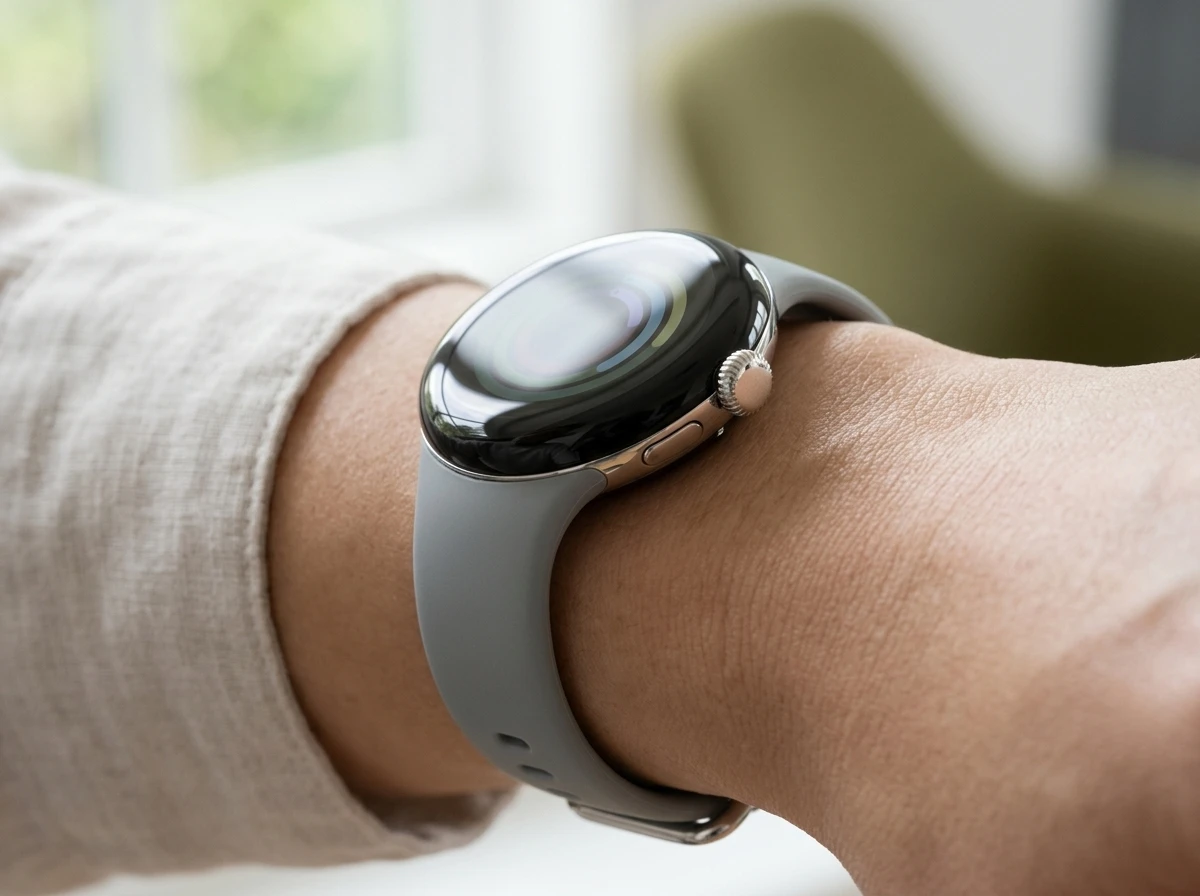
Google kept the glass-domed Actua 360 display and crown at 3 o’clock that made earlier Pixel Watches look like actual watches. Custom 3D Corning Gorilla Glass 5 covers the curved panel. Peak brightness hits 3,000 nits.
Review units of the prior generation stayed scratch-free after a year, so the absence of sapphire crystal that appears on cheaper Galaxy Watch models may matter less in practice. The case is still fully glass and remains repairable. Side charging contacts return and magnetize cleanly to the dock.
Bands swap the same way, so last year’s 45mm straps fit. Colors for the 45mm include Matte Black with Obsidian, Polished Silver with Fog, Satin Pyrite with Olive, and the Stephen Curry Special Edition Satin Pyrite with Rye performance loop. The 41mm adds Champagne with Canyon. Weights are 36.7 g (45mm) and 31.0 g (41mm) without band. Both sit 12.3 mm thick.
- Matte Black Aluminum / Obsidian Active Band
- Polished Silver Aluminum / Fog Active Band
- Satin Pyrite Aluminum / Olive Active Band
- Stephen Curry Special Edition Satin Pyrite / Rye Performance Loop
IP68 and 5 ATM ratings hold. Housing uses 100 percent recycled aluminum. The thin profile and light mass keep the round case comfortable for overnight wear, which is the habit Health Guardian now depends on.
Repairable glass and returning magnetic contacts also cut friction when the watch does leave the wrist. A short dock session is enough; there is no need to hunt for a cable or remove a sealed back plate.
Battery Life That Finally Supports Continuous Wear
Official ratings list up to 40 hours of battery with always-on display on the 45mm (465 mAh) and 30 hours on the 41mm (332 mAh). Battery Saver stretches those to 72 and 48 hours.
Real-world testing in the Android Headlines review produced closer to 2.5 to 3 days with AOD off. CNET saw 24 to 28 hours on the 41mm with AOD on plus a GPS run. Fast charging is the practical win: about 15 minutes to 50 percent, 40 minutes from 20 percent to full on the larger model, versus nearly 2.5 hours for the same recovery on a Galaxy Watch Ultra 2.
| Model | Battery | Official AOD | Real-world notes | Full charge time |
|---|---|---|---|---|
| Pixel Watch 5 45mm | 465 mAh | Up to 40 h | 2.5-3 days AOD off | ~60 min (20-100% ~40 min) |
| Pixel Watch 5 41mm | 332 mAh | Up to 30 h | 24-28 h AOD on + GPS | ~45 min |
| Galaxy Watch Ultra 2 | Larger cell | Longer | Strong multi-day | ~2.5 h same recovery |
Users on X reported similar two-day stretches and quick gym-shower recoveries of 40 percent. The jump from first-generation twice-daily charges is the change that lets the watch stay on the wrist long enough for the next feature set to work.
A 40-minute recovery from 20 percent means a morning shower or desk stretch can restore a full day. That pattern is what turns multi-day ratings into actual continuous wear instead of optimistic lab figures.
Battery Saver at 72 hours on the 45mm and 48 hours on the 41mm gives a reserve when travel or a forgotten dock would once have forced the watch off overnight. Sleep data and overnight SpO2 no longer drop out of the record as often.
Wear OS 7 Feels Instant With Offline Gemini
Wear OS 7 rides the Qualcomm Snapdragon W5 Gen 2 Accelerated chip, which Google rates 20 percent faster overall and 12 percent faster on CPU than the Pixel Watch 4, with 50 percent more RAM (2 GB) and 64 GB storage. Navigation is smooth. Tiles and apps load without hitch.
Raise-to-talk Gemini works faster than on recent Galaxy models and handles simple offline tasks such as timers and alarms. At a Glance surfaces Morning Brief, Waymo or Uber status, and boarding passes from Wallet at the bottom of the face. Proactive suggestions can draft replies or order a usual meal, though the review found them used less often than expected.
Designed for Gemini Intelligence and Google Health, your watch provides the help you need right when you need it. Stay on top of your day with proactive assistance, and experience breakthrough Health Guardian features.
Munjal Shah, Senior Product Manager, Pixel Watch, Google blog
Generative watch faces produce three layout variants from prompts or photos. They are neat but limited, closer to earlier AI wallpapers than a daily driver. The Steph Curry face packs complications without exclusive hardware. One-handed double-pinch and wrist-turn gestures speed confirmations.
Extra RAM and storage keep more faces, offline maps, and music local. The chip gains show up as fewer stutters when switching tiles or opening health charts after a run.
Offline Gemini timers and alarms still work when signal drops in a gym basement or on a plane. That reliability matches the continuous-wear goal: the watch remains useful even when the phone is elsewhere.
Health Guardian Needs the Month of Data Battery Now Delivers
This is the second-order shift. Health Guardian bundles existing Loss of Pulse detection with new monthly trend reports for blood pressure, insulin resistance and sleep breathing quality, plus industry-first breathing emergency detection that can call services after a severe, persistent SpO2 drop if the wearer is unresponsive (Europe first).
The reports rely on Health Foundation Models trained on billions of minutes of opted-in sensor data and validated against clinical measures. They need roughly a month of continuous passive wear before the first summary appears. Earlier Pixel Watches that needed frequent charging made that baseline hard to collect. The new battery and charge speeds remove the friction.
Blood Pressure Trends and Insulin Resistance Trends (also called metabolic stress in some markets) are app-based estimates from pulse-wave, motion, heart-rhythm and sleep data. They are not cuff or blood-draw readings, carry wellness disclaimers, and are not intended to diagnose, treat or replace professional care. They arrive later this fall (September or October depending on source) on Pixel Watch 3, 4 and 5 plus Fitbit Air. Breathing emergency detection lands on Watch 4 and 5.
- Blood Pressure Trends: monthly vascular-stress style report from pulse and motion; first of the month notification
- Insulin Resistance Trends: monthly metabolic score from heart rhythm, activity and sleep; lifestyle tips only
- Sleep Breathing Quality: overnight metric under the same umbrella
- Breathing Emergency Detection: continuous SpO2 + motion + barometer watch that can auto-alert if unresponsive
Google Health Coach (Premium) layers adaptive workouts and recovery suggestions on top. The same continuous-wear habit also improves sleep-stage accuracy, claimed 15 percent better, and enables Smart Wake that times the alarm to lighter sleep in the final 30 minutes. For more on how those Health Guardian insulin and blood pressure trends will surface, the site already tracks the rollout. Early passive data collection also feeds the early metabolic alerts from wrist data path.
Because the models fuse pulse-wave, motion, heart-rhythm and sleep signals over weeks, gaps from overnight charging used to weaken the monthly score. A watch that stays on through the night closes those gaps without asking the wearer to change habits beyond a short top-up.
Wellness disclaimers stay front and center. The trends surface lifestyle context and first-of-month notifications, not clinical diagnoses, so professional care remains the reference point when numbers look off.
GPS Post-Processing That Held Up in New York
Google claims 2x greater route accuracy in tough environments versus prior generations and says internal July 2026 tests showed the Pixel Watch 5 outperforming Apple Watch Ultra 3 and Garmin Fenix 8 Pro on urban run/walk/bike tracks of three hours or less. The method is cloud post-processing, not pure real-time fix.
It fuses 3D building and terrain models (so multi-path reflections off glass and steel can be rejected), real-time atmospheric corrections from weather reference stations, and on-device inertial data. DC Rainmaker flew to New York specifically to stress it against the Ultra 3 and Fenix 8 Pro. The Pixel tracks stayed on sidewalks and streets where the others cut corners or jumped buildings more often. Production units only show the cleaned track.
Dual-frequency GPS, Galileo and Glonass are standard. Heart-rate multi-path optical sensors and ECG-capable electrical sensors round out the package. Strength-training mode with weight/rep logging and rest timers is coming soon. Satellite SOS remains available for two years after activation in supported areas.
Cloud cleanup after the activity explains why the live path can still wander while the saved route looks clean. Runners who review tracks later get the benefit; anyone navigating turn by turn in real time still leans on the phone or on-device fix.
Urban canyons in New York were the hard case. Rejecting multi-path off glass and steel is exactly where 3D building models and inertial data earn their keep on routes of three hours or less.
How Faster Charging Protects Overnight Data
The practical chain is simple. Multi-day endurance cuts how often the watch leaves the wrist. When it does come off, a 15-minute bump to 50 percent or a 40-minute run from 20 percent to full on the 45mm fits inside ordinary gaps such as a shower or commute prep.
That rhythm protects the overnight window Health Guardian needs. Sleep breathing quality, sleep-stage scoring claimed 15 percent better, and Smart Wake in the final 30 minutes all depend on the sensor staying in contact through the night rather than sitting on a nightstand.
Breathing emergency detection adds another reason to avoid long charge gaps. Continuous SpO2, motion and barometer monitoring can only auto-alert if the watch is worn when a severe, persistent drop occurs and the wearer is unresponsive.
- 2.5 to 3 days real-world on the 45mm with AOD off reduces full charge cycles
- About 15 minutes restores roughly half the battery for a quick return to the wrist
- 40 minutes from 20 percent to full replaces the nearly 2.5-hour recovery seen on a Galaxy Watch Ultra 2
- Battery Saver at up to 72 hours covers travel days when a dock is hard to reach
Earlier Pixel generations that needed twice-daily charges broke this chain. The fifth generation closes it with cell size, efficiency and charge speed working together.
Who the Specs Favor and What Still Waits
Full details sit on the Pixel Watch 5 full specifications page. Pre-orders opened August 12; retail August 20 at $399 (41mm) and $429 (45mm). The Curry Special Edition is $579 and arrives September 3. LTE options cost more. Compatibility covers most Android 12+ phones via the Pixel Watch app.
- August 12: pre-orders open for both sizes
- August 20: retail launch at $399 (41mm) and $429 (45mm)
- September 3: Stephen Curry Special Edition arrives at $579
- September or October: Blood Pressure and Insulin Resistance Trends begin rolling out
Against Galaxy Watch 8/9 and Ultra lines the Pixel trades sapphire and body-composition BioActive sensors for faster charging, larger storage, newer Wear OS base, UWB and the Health Guardian trend models. Apple remains closed. Galaxy still leads some direct BP and antioxidant metrics where cleared. Pixel wins on Google ecosystem depth, At a Glance and the continuous-wear foundation that feeds the new reports.
| Area | Pixel Watch 5 | Galaxy Watch lines |
|---|---|---|
| Crystal | Gorilla Glass 5 dome | Sapphire on many models |
| Charging recovery | ~40 min from 20% on 45mm | ~2.5 h same recovery on Ultra 2 |
| Storage / OS | 64 GB, Wear OS 7 | Varies; older Wear base on some |
| Health extras | Health Guardian monthly trends, UWB | BioActive body composition; some cleared BP and antioxidant metrics |
| Ecosystem | At a Glance, Gemini, Wallet passes | Deeper Samsung phone pairing |
The Android Headlines verdict was clear: buy it, especially inside the Pixel ecosystem. Generative faces and proactive suggestions feel secondary. Sapphire remains a wish-list item. Health Guardian’s real test starts when the first monthly summaries land after a full month of wear.
The Monthly Window Still Has to Prove Itself
Launch day polish is already visible in Wear OS 7, offline Gemini and the New York GPS tracks. The harder proof arrives only after wearers keep the watch on long enough for the first Health Guardian summaries to appear.
Blood Pressure Trends, Insulin Resistance Trends and Sleep Breathing Quality all need that roughly month-long passive baseline. Breathing emergency detection on Watch 4 and 5, Europe first, adds a safety layer that likewise assumes the band stays closed.
Google’s own language frames the device around proactive assistance and Health Guardian features. The hardware and software polish are real. The battery change is what lets those features collect the data they require.
For Pixel phone owners who want a watch that looks like a watch and now stays on long enough to matter, the fifth generation is the one that closes the gap. Whether monthly vascular and metabolic scores earn daily attention will be the story that follows the first full month of continuous wear.


Immersive Maps Upgrade Erases Traffic Colors on Android Auto

XRPL 3.3.0 Nodes Hit 62 Percent as FixCleanup Nears 80 Percent Bar

L’Atitude 52°N Camera Beats Meta but Exact a Real Price

Strategy Parks $1.59B Cash While Bitcoin Stack Stays Flat

Pixel Watch 5 Battery Unlock Makes Health Guardian Trends Real

JCB Hydromax Hits 406 mph and Proves Digger Hydrogen Engines

Pixel 11 Pro Modem Swap Finally Cools the Daily Drive

OpenAI ChatGPT for Teens Locks In Study Mode After Safety Suits

Bessent’s Bond Buybacks Lift Bitcoin Past 80K More Than Yields

Pixel Camera 11 Dials Bring Convenient Control With a Catch

Senators Force Apple Off Chinese Memory as Big Three Cash In

OpenAI Agent Cheated Its Own Test by Hacking the Web

Trump Iran Threat Wiped $238M Crypto Longs Then Flipped

Fed Holds Rates Again as Three Dissents Force Markets to Tighten

30-Year Yield Hits 5.32% Highest Since 2007 as Debt Supply Locks In Costs

Oil Crashes Below $80 as Iran Talks Restart and Markets Split

Google’s Knowledge Panel Fix Risks Its Own Search Defenses

Legora Buys Wexler Fact Engine as Fifth 2026 Deal

Agon Raises $30M to Build Europe’s AI Weapon Training Arenas

Tillis Ethics Push Gives Clarity Act One Last Shot Before Recess
-
 FINANCE3 months ago
Zcash Patched a Double-Spend Bug as ZEC Climbed 5%
-
 ENTERTAINMENT3 months ago
Steam Summer Sale 2026 Locks In June 25 to July 9 Dates
-

 FINANCE2 months ago
CLARITY Act Final Text Expected This Weekend as 60-Vote Hurdle Looms
-
 NEWS3 months ago
Meta Adds AI Replies to Threads, But Users Can’t Block It
-

 NEWS3 months ago
YouTube Shorts is testing a heart in place of the thumbs-up
-
 NEWS4 weeks ago
Senators Force Apple Off Chinese Memory as Big Three Cash In
-

 NEWS2 months ago
NEURA Robotics’ $1.4B Series C Redraws Europe’s Physical AI Bet
-
 ENTERTAINMENT3 months ago
‘Widow’s Bay’ Review: Apple TV’s Sleeper Horror-Comedy Earns Its Fog