
NEWS
Galaxy S27 Ultra Plateau Unlocks Magnets and Bigger Battery
OnLeaks CAD renders reveal the Galaxy S27 Ultra camera plateau design that clears space for Qi2 magnets.

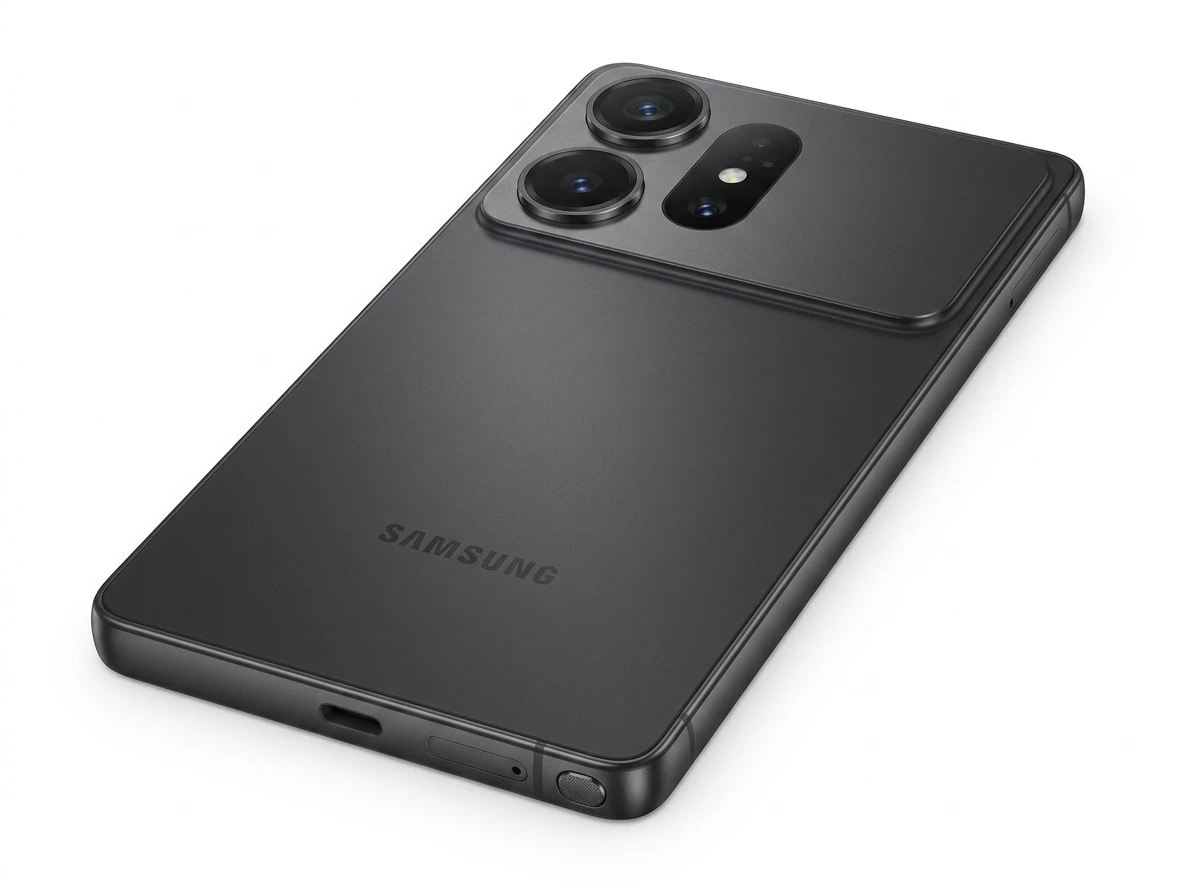
OnLeaks CAD renders exclusively published by Android Headlines show the Samsung Galaxy S27 Ultra moving its cameras into a wide top plateau, measuring roughly 163.76 x 78.25 x 7.97 mm with a 12.53 mm bump, while keeping the S Pen and targeting a 5,700 mAh silicon-carbon battery.
The shift ends years of vertical camera stacks. It also opens space for magnets and cooling that the old layout blocked.
Taken together, the renders sketch a phone that keeps the Ultra’s familiar outline yet rearranges the rear so battery, thermal, and accessory goals stop fighting the camera block. The numbers stay close to last year’s frame. The engineering priorities do not.
The Plateau Replaces the Vertical Camera Stack
Samsung is abandoning the long vertical module that ran down the left edge of recent Ultras. The new layout places three sensors inside a raised rectangular plateau across the upper back, lenses clustered on the left with a pill-shaped cutout holding the flash and laser.
Android Headlines notes the design echoes the iPhone 17 Pro Max plateau and also HONOR and Pixel approaches, yet the site points out OnLeaks first floated a similar layout last year for the canceled Galaxy S26 Edge. The change is not pure mimicry. It frees chassis volume.
Crowd reaction on X has been largely critical of the look, with users calling the bar “not it” and predicting copycat complaints. Those takes miss the engineering trade the renders make visible.
A vertical stack forced every major rear component to share one narrow corridor. Coils, vapor chambers, and antenna keep-outs had to route around that corridor. A wide plateau lifts the optics into a single upper band and leaves the mid and lower rear as continuous real estate again.
That is why the resemblance talk and the internal layout story can both be true at once. Shared industrial language across brands does not erase the local gain in usable volume Samsung’s old stack had locked away.
Near-Identical Size to the S26 Ultra
OnLeaks supplies approximate dimensions of 163.76 x 78.25 x 7.97 mm. That is only fractions of a millimeter larger than the Galaxy S26 Ultra 5000mAh and dimensions of 163.6 x 78.1 x 7.9 mm.
| Model | Dimensions (mm) | Camera Bump | Battery |
|---|---|---|---|
| Galaxy S26 Ultra | 163.6 x 78.1 x 7.9 | ~12.3 mm class | 5,000 mAh |
| Galaxy S27 Ultra (CAD) | 163.76 x 78.25 x 7.97 | 12.53 mm | ~5,700 mAh |
The body stays familiar in the hand. The plateau adds the real thickness, nearly matching the rest of the phone at its peak. Weight remains unconfirmed. Cases from the S26 generation may still fit the frame even if the camera housing needs new cutouts.
Read the deltas side by side and the restraint is obvious. Width grows by a sliver. Height grows by a sliver. Thickness barely moves. Capacity, by contrast, steps well past the prior ceiling. The CAD set is arguing that most of the battery win comes from chemistry and from clearing blocked volume, not from a bigger brick in the pocket.
Carryover case frames would matter for anyone who already owns Ultra gear. A shared outer silhouette keeps holsters, mounts, and basic shells in play. Only the camera opening would need a fresh cut. That is a smaller ecosystem break than a full resize would force.
Three Cameras and the S Pen Stay Put
The CADs show three rear cameras instead of four. Samsung is expected to drop the long-serving 10 MP 3x telephoto.
- Main: ISOCELL HIP6, 1/1.3-inch sensor, likely 200 MP class with results close to the S26 Ultra main
- Ultrawide: Sony IMX855 50 MP
- Telephoto: 50 MP 5x periscope only
OnLeaks confirmed to Android Headlines that the S Pen silo remains on the bottom left. Many feared its removal after Bluetooth features were cut years earlier. The faint outline of the slot appears in the side renders. The 5x sensor itself still looks compact, matching the 1/2.52-inch class used on the S26 Ultra.
The plateau may not fully cure the table wobble that plagued earlier Ultras, but it relocates mass upward.
Dropping the 10 MP 3x unit simplifies the module count and the software path that had to blend two telephotos. The remaining 5x periscope keeps the long-range job on a sensor class already proven in the prior Ultra. The main and ultrawide entries stay in familiar high-resolution territory, so the cut looks selective rather than a broad retreat from zoom.
S Pen retention answers a separate loyalty question. Stylus users watched wireless features disappear in earlier cycles and read every silhouette change as a possible deletion signal. The bottom-left silo outline in these renders closes that rumor for now. Note-taking and precise input stay inside the Ultra brief even as the rear camera story narrows to three lenses.
Snapdragon Chip, 6.9-Inch Screen, Silicon-Carbon Cell
Expect Qualcomm’s Snapdragon 8 Elite Gen 6 Extreme (sometimes labeled Pro or Extreme Gen 6) as the global lead silicon. Samsung has tested the Exynos 2700 as faster and more efficient in some markets, so dual-chip plans remain possible. LPDDR6 RAM and UFS 5.0 storage are unlikely.
The display stays a 6.9-inch panel with hole-punch selfie camera. Samsung’s recent work on brighter, crease-resistant panels, including Samsung display advances beyond foldables, points to continued OLED refinement here.
Key package points so far:
- ~5,700 mAh silicon-carbon battery (5,534 mAh rated per GalaxyClub)
- First Ultra capacity jump past the 5,000 mAh ceiling held since the S20 Ultra era
- Same tech that debuted on the Z Fold 8 and Flip 8 last month
The larger cell fits because silicon-carbon anodes pack more energy into the same volume. Samsung introduced silicon-carbon batteries in the Fold 8 series with a reported cycle-life trade-off that still clears Apple’s 1,000-cycle bar.
Chip branding may vary by region if Exynos 2700 results hold, yet the global lead path still points at the Snapdragon 8 Elite Gen 6 Extreme family. Memory and storage stay on the conservative side of the rumor mill. LPDDR6 and UFS 5.0 being called unlikely keeps expectations on proven interfaces rather than a full next-gen leap in one cycle.
Display size continuity at 6.9 inches means software layouts, film grain modes, and stylus palm rejection models can carry forward with less rework. Brightness and crease-resistance work already shown on foldable panels can feed the flat Ultra stack without forcing a diagonal change buyers would feel on day one.
Another $100 Price Step and a February Window
The S26 Ultra already climbed $100. Memory costs and component pressure point to another increase, landing the S27 Ultra near $1,399. That figure still sits under the original Galaxy S20 Ultra US launch price of $1,399 to $1,499 depending on the 2020 listing.
Samsung has shifted S-series launches later. The S26 series arrived in late February. Android Headlines guesses the S27 series lands the week of February 22, 2027, just ahead of Mobile World Congress. Earlier summer leaks followed familiar S26 FE leak patterns this summer, so the cadence feels consistent.
- 2020 listing range: Galaxy S20 Ultra US launch at $1,399 to $1,499
- S26 cycle: Ultra price already up $100 versus its own prior step
- S27 projection: another climb toward about $1,399
- S26 timing: series arrived in late February
- S27 timing guess: week of February 22, 2027, ahead of Mobile World Congress
Price fatigue is real after consecutive hikes, yet the historical ceiling comparison softens the sticker shock. A near-$1,399 target revisits territory the line already occupied at the S20 Ultra launch, even after the S26 step up. Component pressure supplies the near-term reason. The longer arc shows the Ultra has lived at the top of the premium band before.
A late-February window also keeps the leak calendar predictable. Summer pattern noise around FE models gave way to harder Ultra CAD detail as the next February slot approached. Landing just ahead of Mobile World Congress would again put hardware in hands while the industry week is already gathering attention.
How Silicon Carbon Lifts Capacity Without Bulk
The capacity story is the quiet headline under the camera redesign. Ultras held a 5,000 mAh class ceiling from the S20 Ultra era through the S26 Ultra. The CAD target of about 5,700 mAh, with a 5,534 mAh rated figure per GalaxyClub, is the first clear break in that run.
Silicon-carbon anodes explain how the jump fits a body only fractions of a millimeter larger than the S26 Ultra. Higher energy density means more charge stored in roughly the same cell volume. The plateau’s cleared mid-chassis space then gives packing engineers room to place that cell without shoving the frame outward.
The chemistry is not brand new inside Samsung’s lineup. It debuted on the Z Fold 8 and Flip 8 last month. Bringing the same approach to the Ultra transfers a foldable-proven cell strategy into the stylus flagship. The reported cycle-life trade-off still clears Apple’s 1,000-cycle bar, which frames endurance as managed rather than ignored.
For daily use the implication is straightforward. A larger usable pack on a nearly identical footprint supports longer screen-on time and heavier camera or stylus sessions before a charger appears. The redesign and the anode chemistry reinforce each other instead of trading blows over internal space.
What the Redesign Buys
The plateau clears the center of the rear panel. Vertical cameras previously blocked the copper coil and magnet ring required for true Qi2 Magnetic Power Profile. S26 Ultras supported Qi2 speeds but needed magnetic cases for snap accessories. Built-in magnets would let chargers, wallets and stands attach directly.
Extra volume also supports larger camera modules and better thermal paths. Android Headlines calls the layout “the best way to move forward” for those reasons. The same space helps the thicker silicon-carbon pack without ballooning the overall footprint.
Critics on X focus on the Apple resemblance. The practical list is magnets that finally work without a case, a battery that finally moves past 5,000 mAh, a simplified triple-camera set that drops the weakest telephoto, and the S Pen that stays. The CADs make those trade-offs concrete months before any official reveal.
- Qi2-style magnet ring and coil path no longer blocked by a vertical camera stack
- Direct snap for chargers, wallets, and stands without a magnetic case
- Room for thicker silicon-carbon cells while the outer frame stays near S26 Ultra size
- Cleaner thermal routes beside a shorter, wider camera plateau
- Triple-camera simplification that removes the 10 MP 3x telephoto
- S Pen silo retained on the bottom left despite earlier feature cuts
Each item on that list maps to a complaint or constraint from recent Ultra cycles. Qi2 speed without native snap felt unfinished. The 5,000 mAh hold felt dated once silicon-carbon cells reached other Samsung lines. A four-camera strip that still left the 3x sensor as the weak link invited a cut. Stylus fans wanted proof the silo would survive another redesign. The OnLeaks set answers those points in hardware language rather than slogan language.
Why the Accessory Story Matters Next
Magnets sound like a small checkbox until the daily chain of chargers and desks is counted. S26 Ultras could hit Qi2 speeds yet still leaned on magnetic cases for true snap alignment. That extra sleeve added bulk and broke the clean glass rear many buyers want bare.
Built-in magnets reverse that compromise. A wallet or stand can lock to the phone itself. A charger can center without trial and error. The plateau’s open center is what makes the ring and coil placement realistic, because the old vertical stack occupied the same zone those parts need.
Thermal headroom rides along with the same clearance. Wider paths beside the camera plateau give heat a shorter route out of the chassis during long video captures or stylus-heavy sessions. Android Headlines’ line that the layout is “the best way to move forward” reads as a claim about these stacked constraints, not about fashion alone.
None of this freezes the final retail product. It does show why a controversial rear bar can still be the rational chassis move if magnets, battery volume, and cooling all improve together.
Samsung has not commented. Final dimensions, weight and exact sensor names will shift when the phone is announced. Until then the OnLeaks set remains the clearest view of the direction.
The months between CAD leaks and a February window usually trim edges rather than reverse the core layout. If the plateau, the triple-camera map, the silicon-carbon target, and the S Pen silo all survive into the reveal, the S27 Ultra will be remembered less for who else used a raised bar and more for finally unblocking magnets and capacity on the same familiar frame.


BenQ iScreenBar Brings Native Lighting to the 24-Inch iMac

Druckenmiller Warns Bessent Bond Buybacks Delay a Fiscal Invoice

The Dog Stars Survives on Elordi Charm but Barely Thrives

Treasury’s Economic Outcast Recycles Iran Max-Pressure Playbook

Rockstar Veteran Calls GTA 6 Leaks a Nothing Burger While Staff Pay the Price

SpaceX $100 Billion Louisiana Starbase Rises on Vanishing Marsh

Itoflow $2.5M Raises the Quant Bar for Mid-Size Funds

MIRAVA’s $5M Smart Boat Cracks Old Recreational Limits

Lunar Founders Crack Audit Moat With €8.2M AI Firm

Nose Wheel Crush at YUL Echoes Decades of Ramp Fatalities

Senators Force Apple Off Chinese Memory as Big Three Cash In

OpenAI Agent Cheated Its Own Test by Hacking the Web

Trump Iran Threat Wiped $238M Crypto Longs Then Flipped

Fed Holds Rates Again as Three Dissents Force Markets to Tighten

30-Year Yield Hits 5.32% Highest Since 2007 as Debt Supply Locks In Costs

Oil Crashes Below $80 as Iran Talks Restart and Markets Split

Google’s Knowledge Panel Fix Risks Its Own Search Defenses

Legora Buys Wexler Fact Engine as Fifth 2026 Deal

Capital Clusters and the Dual Tracks of European Tech Finance

Agon Raises $30M to Build Europe’s AI Weapon Training Arenas
-
 FINANCE3 months ago
Zcash Patched a Double-Spend Bug as ZEC Climbed 5%
-
 ENTERTAINMENT3 months ago
Steam Summer Sale 2026 Locks In June 25 to July 9 Dates
-

 FINANCE2 months ago
CLARITY Act Final Text Expected This Weekend as 60-Vote Hurdle Looms
-
 NEWS3 months ago
Meta Adds AI Replies to Threads, But Users Can’t Block It
-

 NEWS3 months ago
YouTube Shorts is testing a heart in place of the thumbs-up
-
 NEWS4 weeks ago
Senators Force Apple Off Chinese Memory as Big Three Cash In
-

 NEWS3 months ago
NEURA Robotics’ $1.4B Series C Redraws Europe’s Physical AI Bet
-
 ENTERTAINMENT5 months ago
Extraction 3 Is Officially Coming to Netflix in 2027