
BUSINESS
SpaceX $100 Billion Louisiana Starbase Rises on Vanishing Marsh
SpaceX will build its largest Starship spaceport on 125,000 acres of eroding Vermilion Parish wetlands.

SpaceX will invest at least $100 billion to turn 125,000 acres of former Exxon marsh in Vermilion Parish into Starbase, Louisiana, the company’s fourth and largest launch site and the planned main base for high-cadence Starship flights. Construction is set to begin by the end of 2027, with a first launch targeted as soon as 2029.
The announcement, made Tuesday with Gov. Jeff Landry in Abbeville, pairs the industrial scale with a public coastal-restoration pledge on land that is vanishing among the fastest rates on the U.S. Gulf. State laws passed earlier this year already limit public records, trespass and nuisance claims that defined the company’s Texas experience.
The project folds a remote stretch of parish marsh into the company’s long-term flight plan. Acreage, feedstock and legal cover arrived in one package. The scale is industrial. The timeline is measured in years, not months.
Five Complexes and a Self-Sustaining Port
At full buildout the site will hold five launch complexes, each with two pads and a propellant farm, for ten pads total. SpaceX describes it as a self-sustaining spaceport with on-site propellant production from local natural gas, power generation, vehicle processing, deep-water shipping, an airport and residential housing for workers and families.
Elon Musk later said the complex will ultimately support over a dozen launch towers and more than 30 Starship flights per day. That cadence is the point of the Louisiana choice after a seven-year search for coastal land with low population density near the pads, ample methane feedstock and clear re-entry paths.
| Element | Detail |
|---|---|
| Investment | At least $100 billion |
| Land | 125,000 acres, Pecan Island / Freshwater Bayou area |
| Pads | 5 complexes × 2 pads = 10 |
| Construction start | By end of 2027 |
| First launch target | As soon as 2029 |
| Long-term cadence | Thousands of flights a year; Musk projects 30+ per day |
SpaceX’s own page states the facility will be built to support thousands of Starship flights a year to Earth orbit, the Moon, Mars and beyond. Large portions of the tract will remain undeveloped wetlands, the company said, because the full footprint is not needed for the launch infrastructure concentrated near the coast.
The self-sustaining design is meant to cut the supply chain that slows other pads. Propellant made on site from local gas removes tanker dependence. Power generation, processing bays and worker housing keep daily operations inside the fence line. Deep-water shipping and an airport close the logistics loop for hardware and people.
- On-site propellant production from local natural gas
- Power generation and vehicle processing
- Deep-water shipping access and an airport
- Residential housing for workers and families
- Launch infrastructure held near the coast; interior wetlands left undeveloped
Ten pads and more than a dozen towers are the hardware answer to a cadence goal that no single existing site can meet. The Louisiana tract was sized for that answer from the start.
Jobs Numbers Split Between Officials and Musk
Louisiana Economic Development projects 3,000 direct new jobs over the next 10 years at an average salary of $92,600, or 192 percent above the Vermilion Parish average wage. The agency adds more than 8,100 indirect jobs, for roughly 11,100 total opportunities in the Acadiana region.
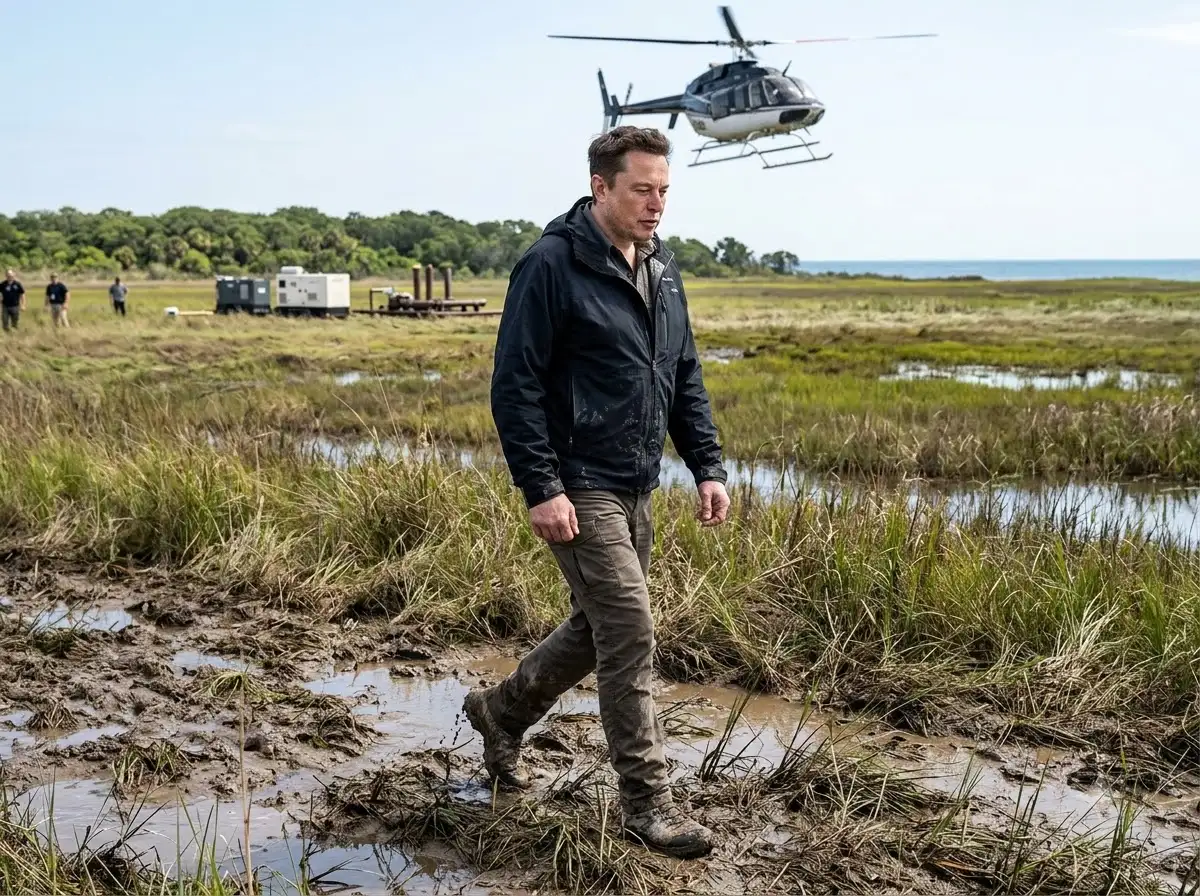
Musk, in the announcement video filmed during a secret helicopter visit weeks earlier, spoke of “probably 10,000 really exciting jobs.” SpaceX said it will hire heavily from nearby communities and draw on local experience building complex infrastructure in the coastal environment. Welders, technicians, engineers and energy-sector trades are expected early targets.
- Direct jobs: 3,000 over 10 years at $92,600 average
- Indirect: more than 8,100
- Musk range: up to about 10,000
- Charity: $25 million to the Community Foundation of Acadiana
Local taxing bodies secured a payment-in-lieu-of-taxes deal. SpaceX will deliver a $20 million upfront payment and at least $25 million annually for 25 years, with an escalator, generating more than $645 million in direct local payments. Sales-tax revenue from construction and operations will add further receipts.
The wage premium is the state’s headline figure. Parish averages sit far below the $92,600 mark, so the direct jobs alone would reset local pay scales if hiring tracks the projection. Indirect work in housing, services and suppliers would spread the effect across Acadiana. Musk’s higher range leaves room for later growth once flight rates climb.
Early trades matter because the site must rise on soft ground and wet weather. Coastal construction skill already exists in the region. SpaceX is counting on that base while it builds the specialized launch workforce over the decade.
Laws Written Before the Ribbon
Months before the public reveal, the Louisiana Legislature and Gov. Landry enacted a package of aerospace measures. Act 101 largely exempts state and local records tied to aerospace projects from public disclosure. Act 188 adds spaceports to the definition of critical infrastructure and makes unauthorized entry a felony.
Act 874 limits liability for aerospace operators holding at least 20,000 contiguous acres, blocking most nuisance, trespass, noise, sonic-boom, vibration and light claims of the kind that neighbors have pursued against the Texas Starbase. Property-tax exemptions and sales-tax rebates for aerospace manufacturing and equipment rounded out the incentives.
The bills moved with little public opposition. Their acreage threshold and timing matched the scale of the Vermilion tract that became available after ExxonMobil settled coastal-damage suits and transferred the land. The state sold it to SpaceX for about $100 million, or roughly $800 an acre; proceeds are earmarked for the Coastal Protection and Restoration Authority.
- Earlier this year: Legislature and Gov. Landry pass Acts 101, 188 and 874
- After Exxon suits settle: Tract transfers; state sells to SpaceX for about $100 million
- Proceeds path: Sale money earmarked for the Coastal Protection and Restoration Authority
- Announcement week: Public reveal in Abbeville with the legal frame already set
The 20,000-acre floor in Act 874 was not abstract. The Vermilion holding is many times larger, so the liability shield attaches at once. Records limits and felony trespass rules arrive before the first concrete pour. That sequence is the opposite of the Texas path, where operating reality came first and statute followed later, if at all.
Restoration Claims Meet a Disappearing Shore
SpaceX and state officials repeatedly framed the project as a chance to reverse land loss. The company’s page notes that in Vermilion Parish the shoreline is eroding between 3.3 and 23 feet per year. It pledges partnership with state and federal agencies to expand the Coastal Master Plan and related wetlands projects, including Gulf breakwaters to cut wave energy, thousands of acres of marsh creation with dredged material, bank stabilization and canal fill.
“The work includes thousands of acres of marsh creation to reconnect fragmented wetlands and help restore the natural storm buffer that this coast has lost,” SpaceX President and COO Gwynne Shotwell said at the Abbeville event. Large sections will stay untouched as habitat for migratory waterfowl, shorebirds and other wildlife that already use the area between the Audubon and Rockefeller refuges. Hunting, fishing and birding are supposed to continue under monitoring agreements.
Local voices on X and in parish conversations have been less certain. Residents point to fragile soils, hurricane exposure, limited existing roads and housing, and the simple fact that high-frequency rocket operations will sit inside one of the most productive waterfowl zones on the Gulf. The restoration money and breakwaters are real commitments on paper; whether they outrun both natural loss and the physical footprint of ten pads, tank farms and power plants remains the open test.
Erosion at the high end of the stated range can move a shoreline by tens of feet in a few seasons. Breakwaters and marsh creation are the tools named to slow that loss. The same coast must also absorb construction traffic, new power plants and repeated launch loads. Monitoring agreements for hunting and birding keep traditional uses on the books. They do not settle the balance between habitat and hardware.
Texas Lessons Arrive With Legal Armor
Starbase Texas near Brownsville supplied the operational template and the cautionary list. In its first Starship test flight in April 2023 the concrete pad failed under the rocket’s energy, scattering debris into nesting areas and burning several acres of state park land. In 2024 a state notice found repeated Clean Water Act violations from the water deluge system that releases pollutants near waterways.
Neighbors filed lawsuits over noise, dust, light and restricted beach access. Fines and community backlash followed. SpaceX has since improved the pad and systems, yet the pattern of rapid iteration colliding with environmental limits is what Louisiana’s new statutes were written to blunt. The same company that needed years of contested permitting in Texas now starts with felony trespass rules, records exemptions and a broad liability shield already in force.
| Issue in Texas | Louisiana posture |
|---|---|
| Pad failure and debris (April 2023) | Improved systems claimed; full build still ahead |
| Clean Water Act notices (2024) | Federal and state water permits still required |
| Neighbor suits on noise, dust, light, access | Act 874 blocks most nuisance and trespass claims |
| Contested local permitting over years | Records limits, felony entry rules already enacted |
Federal environmental review and FAA licensing still apply. An FAA proposal to streamline or waive certain requirements under multiple environmental statutes carried a public-comment window that closed at the end of August. Army Corps of Engineers and state permits for wetlands disturbance will follow. The legal path is clearer than in Texas; the physical coast is not.
Rapid iteration remains the company method. Louisiana’s statutes narrow who can sue and what must be disclosed. They do not erase federal review or the wet ground under the pads. The armor is legal. The risk is still physical.
What High Cadence Is For
Starship remains the load-bearing vehicle for SpaceX’s next decade. Musk has described mass production of the fully reusable system as the only route to routine access to orbit, lunar bases and eventual Mars settlement. The same rocket is required to loft the far larger satellite constellations that would support orbital data centers and expanded Starlink capacity.
Starbase Louisiana will ultimately have over a dozen launch towers, enabling more than 30 Starship flights per day and making it the biggest launch site on Earth! SpaceX makes sci-fi real.
Elon Musk, X post, August 25, 2026
That volume cannot come from the constrained South Texas site alone, nor from the Florida pads still being prepared. Louisiana supplies the acreage, the gas feedstock and the over-water trajectories. The $100 billion figure covers factories, pads, propellant plants, power and the housing needed to keep thousands of workers on a remote coast. SpaceX stock rose about 2 percent on the news to close at $137.95.
The company already runs Falcon and Dragon fleets, Starlink, and large AI compute projects. Starship at the promised rate is what would turn those ambitions from sequential campaigns into continuous operations. The marsh is the chosen ground for that shift.
Thirty flights a day is a factory tempo, not a campaign tempo. Towers, tanks and crews must turn around vehicles without waiting on distant suppliers. The self-sustaining layout is the mechanism for that tempo. Orbit, the Moon and Mars are the stated destinations. The near-term product is flight rate itself.
Why the Parish Tract Fit the Search
The seven-year hunt was for a short list of conditions in one place. Low population density near the pads reduces the conflict zone. Ample methane supports on-site propellant. Clear re-entry paths over water limit overflight risk. The Vermilion holding met those tests after the Exxon transfer opened a contiguous block large enough for five complexes and still leave wetlands undeveloped.
Fourth site and largest site are related claims. Existing pads in Texas and Florida remain part of the network. They lack the room for ten pads, more than a dozen towers and the housing to match. Louisiana is sized as the main base for the high-cadence plan, not as a spare.
Sale proceeds routed to the Coastal Protection and Restoration Authority tie the land transfer to the same shore the company says it will help rebuild. At roughly $800 an acre, the price reflected marsh, not industrial park. The $100 billion build is what converts the bare tract into launch ground. The search ends where density, gas and water trajectories line up.
How Federal Clearances Still Gate the Work
State law cleared local obstacles. Federal gates remain. FAA licensing and environmental review still control when a rocket may fly. The Army Corps of Engineers and state wetland permits still control how much marsh can be disturbed for pads, roads and plants. The comment window on an FAA streamlining proposal closed at the end of August; the outcome is not yet the final license.
Construction is targeted by the end of 2027 only if those reviews land on schedule. A first launch as soon as 2029 depends on the same chain. Site work and early restoration projects are slated to start after the remaining clearances. The company can plan towers and tank farms now. It cannot light a engine without the federal paper.
That split defines the next stretch of the calendar. Legal armor in Baton Rouge does not replace Washington review. The densest commercial launch infrastructure yet attempted on the Gulf still moves at the pace of permits as much as the pace of concrete.
Site work and the first restoration projects are scheduled to begin soon after the remaining federal and state clearances. The first Starship to leave a Louisiana pad is still years away. Between now and then the same coastline that is losing feet of marsh every year will host both breakwaters and the densest commercial launch infrastructure yet attempted on the Gulf.


BenQ iScreenBar Brings Native Lighting to the 24-Inch iMac

Druckenmiller Warns Bessent Bond Buybacks Delay a Fiscal Invoice

The Dog Stars Survives on Elordi Charm but Barely Thrives

Treasury’s Economic Outcast Recycles Iran Max-Pressure Playbook

Rockstar Veteran Calls GTA 6 Leaks a Nothing Burger While Staff Pay the Price

SpaceX $100 Billion Louisiana Starbase Rises on Vanishing Marsh

Itoflow $2.5M Raises the Quant Bar for Mid-Size Funds

MIRAVA’s $5M Smart Boat Cracks Old Recreational Limits

Lunar Founders Crack Audit Moat With €8.2M AI Firm

Nose Wheel Crush at YUL Echoes Decades of Ramp Fatalities

Senators Force Apple Off Chinese Memory as Big Three Cash In

OpenAI Agent Cheated Its Own Test by Hacking the Web

Trump Iran Threat Wiped $238M Crypto Longs Then Flipped

Fed Holds Rates Again as Three Dissents Force Markets to Tighten

30-Year Yield Hits 5.32% Highest Since 2007 as Debt Supply Locks In Costs

Oil Crashes Below $80 as Iran Talks Restart and Markets Split

Google’s Knowledge Panel Fix Risks Its Own Search Defenses

Legora Buys Wexler Fact Engine as Fifth 2026 Deal

Capital Clusters and the Dual Tracks of European Tech Finance

Agon Raises $30M to Build Europe’s AI Weapon Training Arenas
-
 FINANCE3 months ago
Zcash Patched a Double-Spend Bug as ZEC Climbed 5%
-
 ENTERTAINMENT3 months ago
Steam Summer Sale 2026 Locks In June 25 to July 9 Dates
-

 FINANCE2 months ago
CLARITY Act Final Text Expected This Weekend as 60-Vote Hurdle Looms
-
 NEWS3 months ago
Meta Adds AI Replies to Threads, But Users Can’t Block It
-

 NEWS3 months ago
YouTube Shorts is testing a heart in place of the thumbs-up
-
 NEWS4 weeks ago
Senators Force Apple Off Chinese Memory as Big Three Cash In
-

 NEWS3 months ago
NEURA Robotics’ $1.4B Series C Redraws Europe’s Physical AI Bet
-
 ENTERTAINMENT5 months ago
Extraction 3 Is Officially Coming to Netflix in 2027