
ENTERTAINMENT
The Dog Stars Survives on Elordi Charm but Barely Thrives
Ridley Scott’s Jacob Elordi post-apocalyptic film draws mixed reviews for its low-energy restraint and faces modest $18-23M opening against a $110 million budget.

Ridley Scott’s The Dog Stars opens Friday with a 44% Rotten Tomatoes score and Metacritic marks near 50 after early reviews split on its low-energy post-apocalyptic pace. Jacob Elordi stars as Hig, a pilot scraping by in 2035 Colorado after a flu wiped out most of humanity, opposite Josh Brolin, Margaret Qualley and Guy Pearce in the $110 million 20th Century Studios release.
The film’s own just-getting-by shrug now matches the muted marketing and modest tracking that frame its late-summer arrival. That alignment of tone and campaign is rare for a studio drama of this scale, and it shapes every choice that follows.
What arrives on screen is less a spectacle of collapse than a study of residual habits. The plague is already a decade old. Survival has settled into routine. The movie asks whether routine can still feel like living.
What Peter Heller Wrote and Mark L. Smith Kept
Peter Heller’s 2012 novel gave Hig a first-person voice full of Jack London terseness, lyric notes on a waning natural world and mordant humor. Screenwriter Mark L. Smith, who also wrote The Revenant and The Midnight Sky, dropped the narration. The film leans instead on Elordi’s blokey, sad-eyed presence and silent flashbacks to Hig’s dead wife.
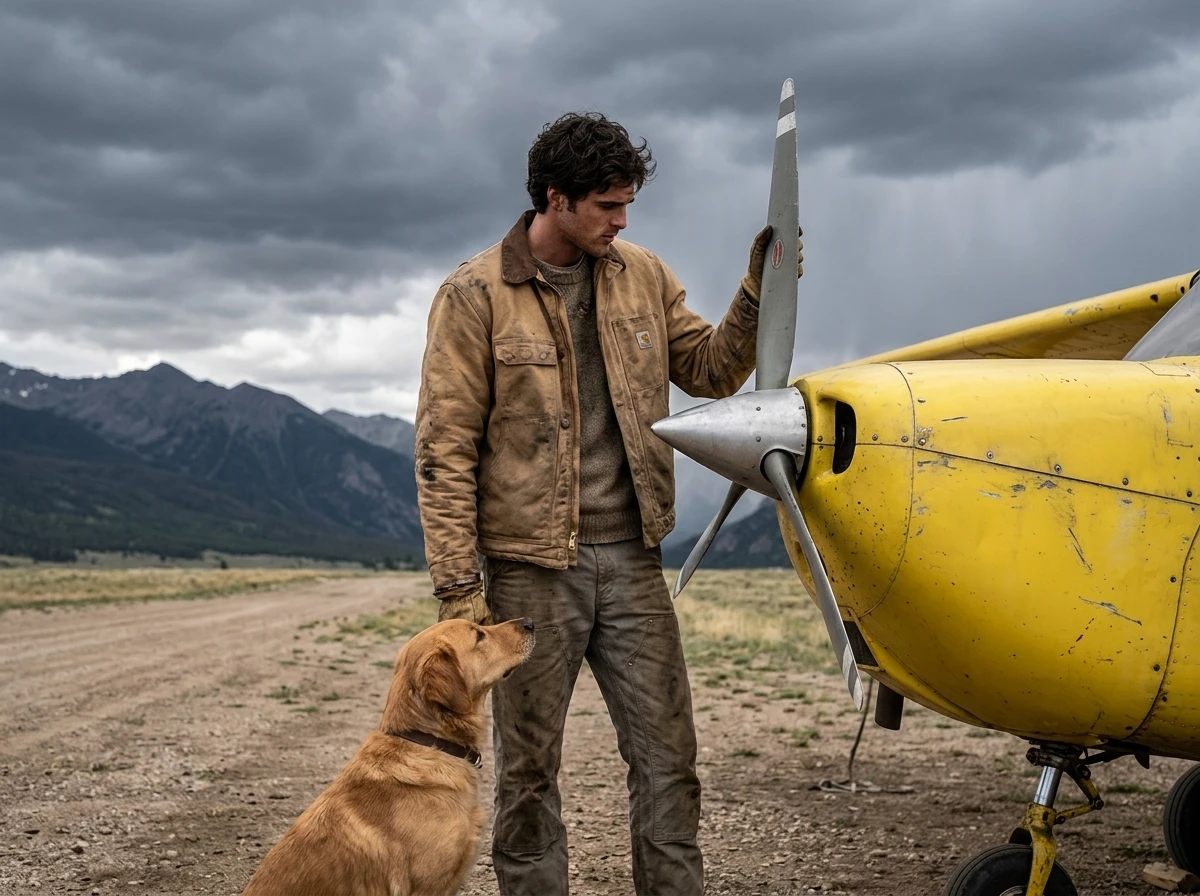
Hig lives at an abandoned Erie airstrip with his dog Jasper and Bangley, the gun-ready former Marine next door. He flies a battered Cessna into ghost Denver for supplies. A radio signal pulls him toward Grand Junction and a possible better life. He crash-lands near rancher Pops and daughter Cima. A thin romance follows. The year is 2035, roughly a decade after the plague.
Removing the novel’s interior monologue forces the camera to carry what prose once did. Landscape, gesture and the dog’s presence become the main channels for feeling. Smith’s choice trades literary intimacy for a quieter, more external drama.
- Novel: first-person narration, lyric nature writing, mordant humor on the page
- Film: no voiceover, silent wife flashbacks, Elordi’s physical presence as the guide
- Shared spine: Erie airstrip, Jasper, Bangley, the Cessna runs, the Grand Junction pull, Pops and Cima
Heller, an executive producer, told the Denver Post he made peace early with changes. Smith grew up on a Colorado dude ranch and wrote the script in three months after a call. The seven-figure New Regency acquisition in 2022 locked the package that later moved to 20th Century. Heller said he did not expect a page-for-page rendering and felt honored another artist would make something discrete.
That early peace matters. It freed Smith and Scott to reshape pace and tone without fighting the source for every beat. The result keeps the novel’s itinerary while swapping its voice for image and silence.
Elordi’s Hig Stays Nice and a Little Blank
Variety critic Guy Lodge found Elordi’s gift for mining humanity in unappealing roles, from Saltburn to Frankenstein, less useful when the character is simply dull. Hig is practical, resourceful and looks right in Carhartt. The German shepherd (or Belgian Malinois) sidekick and wife flashbacks help, yet he remains thin until Brolin’s Bangley supplies gruff friction.
- Jacob Elordi as Hig, civilian pilot and mechanic clinging to routine and hope
- Josh Brolin as Bangley, aloof ex-Marine who shoots first and guards the perimeter
- Margaret Qualley as Cima, lonely medic and tentative love interest on the isolated farm
- Guy Pearce as Pops (or Jack), grizzled former Navy SEAL and Cima’s hyper-vigilant father
- Allison Janney and Benedict Wong in extended supporting turns that inject brief color
David Rooney in The Hollywood Reporter called Elordi’s turn soulful and Costner-like in its introspective star magnetism. Brolin brings camouflaged decency and humor. Qualley plays Cima free of quirks, bruised by grief yet open to connection. Pearce shifts from hostility to trust. All four hit the stoic and sorrowful notes; secondary colors stay scarce.
Muted but never dull, The Dog Stars seems unlikely to land near the top of anyone’s Ridley Scott rankings. But it’s an appealingly mellow watch, even if that might seem antithetical to a post-apocalyptic drama positioned squarely in the shadow of death.
David Rooney, Chief Film Critic, The Hollywood Reporter
The cast’s shared restraint is both the film’s signature and its risk. Without a flashy antagonist or a ticking clock, chemistry has to do the work that plot usually handles. When the Elordi-Brolin pairing clicks, the airfield feels lived-in. When it thins, the blank stretches Lodge flagged open up.
On X, some early viewers pushed back against the inert label, calling the film a soulful, elegiac antidote to recent action slop and praising the Elordi-Brolin pairing. Others saw end-of-the-world bingo that sustains interest without fully landing. The divide tracks the reviews.
Northern Italy Stands In for the Rockies
Principal photography ran April to late June 2025. Crews shot in Bordano, the Cansiglio plateau, Avezzano, Ovindoli, Rome’s Cinecittà and EUR district, Casal Bernocchi and Bosco Macchia Grande near Manziana, plus Pinewood Studios. Northern Italy fills robustly for Colorado’s abandoned strips and valleys.
- April 2025: Principal photography begins in Bordano, Friuli
- May 12-16 2025: Cansiglio plateau sequences with large extras and animals
- Late May 2025: Avezzano and Ovindoli mountain work
- June 2025: Rome studios, EUR burning-car and helicopter days, Manziana wrap
Erik Messerschmidt’s charcoal-washed cinematography refuses magic hour. Scott, then 87-88, shot multi-camera from a bunker and still set the pace, per Heller’s three days on the Italian set. Landscapes and aerials of ghost towns and wild-dog packs do heavy world-building. Harry Gregson-Williams scores with acoustic guitar, Dobro and strings that turn glowering in action. The official 20th Century Studios trailer leans harder on thrills than the finished film’s mellow pulse.
The Italian stand-in strategy keeps the frame wide and emptied. Ghost towns and wild-dog packs read as aftermath rather than set dressing. Aerials of the battered Cessna over abandoned valleys sell the scale that dialogue never claims out loud.
Scott previously eyed Paul Mescal after Gladiator II. Scheduling shifted the lead to Elordi in early 2025. Qualley, Brolin and Pearce locked soon after; Wong joined in May.
That late lead change did not scramble the tone. Elordi’s height and quiet register fit the Carhartt silhouette the script already needed. The supporting lock-ins kept the stoic quartet intact through the June wrap.
When the Frontier Western Meets a Fever-Dream Lurch
At its best the film echoes a classic Western: buffalo stampede, face-off with thickly made-up marauders on horseback called Reapers. Lodge noted the old cowboys-and-Indians dynamic and the shared whiteness of the leads, questions the script never risks. Bangley wants every stranger shot on sight. Hig still delivers medical help to a Mennonite group led by Wong’s Aaron.
Those two instincts, shoot and shelter, define the moral weather. Bangley’s perimeter logic collides with Hig’s residual civility. The Mennonite stop is brief, yet it marks the film’s clearest statement that help can still travel farther than fear.
Late, Smith and Scott insert a sharp departure from the novel: a macabre, borderline-camp horror-comedy stretch featuring Janney’s crazy-lady former flight attendant in vintage uniform serving martinis. It yanks attention then reverses so abruptly that credibility built by the rustic world cracks. Rooney found the same interlude inorganic to the sober tone. Scott’s catholic genre appetite costs the whole its integrity here.
The strongest passages still show muscular command of scale. The weakest leave characters sturdy, morose and faintly drab, coasting on charisma and autopilot proficiency. The Western bones hold. The fever-dream lurch tests whether audiences will forgive a sudden change of key.
Critics Split While Tracking Stays Modest
| Outlet | Score / Take | Core View |
|---|---|---|
| Rotten Tomatoes | ~44% (43-53 reviews) | Mixed-to-negative lean, average near 5.2/10 |
| Metacritic | 49-51 | Mixed or average from ~21-24 critics |
| Variety (Lodge) | Negative lean | Dreary, low-incident, blank Hig, tonal demolish |
| Hollywood Reporter (Rooney) | Positive lean | Soulful, best Scott since The Martian, mellow watch |
| IndieWire / others | Harsh | Bizarrely inert, near-disaster, boring survivalist |
Some scores place it near Scott’s lowest Rotten Tomatoes marks, just above Kingdom of Heaven. Polygon and The Playlist gave high 80s-90s for epic set pieces and humane glimmer. RogerEbert.com and AV Club landed lower. The consensus holds both: handsome craft and Elordi-Qualley spark exist beside underdeveloped stakes and a pace that feels like eating greens.
An earlier look at the film’s quiet strengths already flagged the tension between restraint and commercial appetite. Book checkouts for Heller’s novel jumped more than 260 percent ahead of release, proof the source still draws readers even as the screen version divides.
The 260 percent spike in checkouts shows the novel’s pull outran the film’s early score. Readers still want Hig’s voice on the page. Whether that curiosity converts to ticket sales is the open question Friday will answer.
Friday’s Screens and the $110 Million Math
Boxoffice Pro’s long-range forecast put the domestic opening in the $18-23 million range on roughly 3,000 screens, including IMAX. Against a $110 million production budget the path to profit is steep. Same-weekend competition includes Coyote vs. Acme. The film was first dated for March 2026 then shifted to August 28, a late-summer slot after a loud season of noisier fare.
- $110 million reported production budget
- $18-23 million projected domestic opening weekend
- 118 minutes runtime, R rating for language and strong violence
- August 28, 2026 wide U.S. release by 20th Century Studios / Disney
Disney’s limited fanfare, sparse star press and no major U.S. red-carpet premiere already signaled tempered expectations. The trailer sold more conventional thrills than the finished movie delivers. Early international dates began rolling in late August in some territories.
| Measure | Figure | Implication |
|---|---|---|
| Production budget | $110 million | Needs strong legs and ancillaries beyond opening |
| Projected domestic open | $18-23 million | Modest start relative to cost |
| Screen count | ~3,000 incl. IMAX | Wide enough for a real test, not a soft platform |
| Runtime / rating | 118 min, R | Adult-skewing, violence and language limit the family share |
The March-to-August date shift moved the film out of early-year clutter and into a quieter late-summer window. That choice lowers the noise floor. It also means the movie must create its own heat without a holiday boost or a built-in franchise base.
The Trailer Promises More Heat Than the Cut
The official 20th Century Studios trailer leans harder on thrills than the finished film’s mellow pulse. That gap is now part of the release story. Audiences primed for conventional end-times action may meet a slower, sadder rhythm instead.
Marketing that oversells incident sets up a specific disappointment. Viewers who stay with the airfield routines, the Cessna supply runs and the tentative farm romance will find the movie the critics called elegiac. Viewers hunting set-piece after set-piece may echo the inert label.
Disney’s sparse press push and missing major U.S. premiere already treated the film as a measured bet rather than a event. The trailer’s thrill bias works against that honesty. The finished cut stays closer to Rooney’s “appealingly mellow watch” than to a standard survival thriller.
Book readers arriving from the 260 percent checkout surge may feel the opposite pull. They know Heller’s voice was always quieter than a trailer reel. For them the drop in narration is the larger adjustment, not the missing explosions.
What a Mellow Apocalypse Asks of Friday Crowds
Scott, tirelessly prolific into his late 80s, still commands landscapes and scale. The charcoal frame, the multi-camera bunker method and the refusal of magic hour all serve one idea: the world after the flu is drained of spectacle, not of beauty. That choice is consistent. It is also commercially stubborn.
Elordi continues building leading-man range after heavier roles. Hig’s practicality and Carhartt silhouette give him less to push against than the unappealing parts Lodge praised. The performance lives or dies on whether quiet competence reads as depth or as blankness. Early reactions already split on that single question.
The same split runs through the Western echoes and the Janney interlude. One camp wants the sober frontier tone held without rupture. The other accepts Scott’s genre appetite even when it cracks the rustic spell. Neither side disputes the craft. They dispute the temperature.
Whether Friday crowds reward the mellow character work or find the same blank stretches the critics noted will decide if The Dog Stars merely survives its opening or finds a longer life. The film itself never pretends the grass is greener. It just keeps flying the Cessna one more day.


BenQ iScreenBar Brings Native Lighting to the 24-Inch iMac

Druckenmiller Warns Bessent Bond Buybacks Delay a Fiscal Invoice

The Dog Stars Survives on Elordi Charm but Barely Thrives

Treasury’s Economic Outcast Recycles Iran Max-Pressure Playbook

Rockstar Veteran Calls GTA 6 Leaks a Nothing Burger While Staff Pay the Price

SpaceX $100 Billion Louisiana Starbase Rises on Vanishing Marsh

Itoflow $2.5M Raises the Quant Bar for Mid-Size Funds

MIRAVA’s $5M Smart Boat Cracks Old Recreational Limits

Lunar Founders Crack Audit Moat With €8.2M AI Firm

Nose Wheel Crush at YUL Echoes Decades of Ramp Fatalities

Senators Force Apple Off Chinese Memory as Big Three Cash In

OpenAI Agent Cheated Its Own Test by Hacking the Web

Trump Iran Threat Wiped $238M Crypto Longs Then Flipped

Fed Holds Rates Again as Three Dissents Force Markets to Tighten

30-Year Yield Hits 5.32% Highest Since 2007 as Debt Supply Locks In Costs

Oil Crashes Below $80 as Iran Talks Restart and Markets Split

Google’s Knowledge Panel Fix Risks Its Own Search Defenses

Legora Buys Wexler Fact Engine as Fifth 2026 Deal

Capital Clusters and the Dual Tracks of European Tech Finance

Agon Raises $30M to Build Europe’s AI Weapon Training Arenas
-
 FINANCE3 months ago
Zcash Patched a Double-Spend Bug as ZEC Climbed 5%
-
 ENTERTAINMENT3 months ago
Steam Summer Sale 2026 Locks In June 25 to July 9 Dates
-

 FINANCE2 months ago
CLARITY Act Final Text Expected This Weekend as 60-Vote Hurdle Looms
-
 NEWS3 months ago
Meta Adds AI Replies to Threads, But Users Can’t Block It
-

 NEWS3 months ago
YouTube Shorts is testing a heart in place of the thumbs-up
-
 NEWS4 weeks ago
Senators Force Apple Off Chinese Memory as Big Three Cash In
-

 NEWS3 months ago
NEURA Robotics’ $1.4B Series C Redraws Europe’s Physical AI Bet
-
 ENTERTAINMENT5 months ago
Extraction 3 Is Officially Coming to Netflix in 2027