
NEWS
Swift Telescopes Restart as Orbit Drop Accelerates
NASA’s Swift turned two instruments back on Aug. 26 after the LINK boost abort, buying final gamma-ray burst data before the 300 km threshold arrives in weeks.

NASA’s Neil Gehrels Swift Observatory turned on the Ultraviolet/Optical and X-ray telescopes on Aug. 26, restoring two of its three science instruments after months of low-drag operations. The move follows the Aug. 19 scrub of Katalyst Space’s planned orbital boost.
The restart buys a final stretch of multiwavelength data on gamma-ray bursts and other transients. It also speeds the satellite’s fall toward the 300-kilometer line where control grows hard.
Two Telescopes Live Again on Aug. 26
The Ultraviolet/Optical Telescope (UVOT) and X-ray Telescope (XRT) had been powered down in February. Controllers wanted to cut atmospheric drag and stretch the time available for a commercial rendezvous and lift.
The Burst Alert Telescope (BAT), Swift’s wide-field gamma-ray detector, stayed off longer. It was halted in April so solar panels could sit at the lowest-drag angle. The team aims to bring BAT back online within a few weeks.
On the first day back, XRT imaged Tycho’s supernova remnant in Cassiopeia, about 13,000 light-years away. Each white dot in the released frame is an X-ray photon.
- UVOT and XRT: returned to science Aug. 26
- BAT: still offline, return targeted in coming weeks
- First light target: Tycho remnant X-ray map
- Altitude at restart window: near 302 km and falling
Swift’s strength has always been the rapid autonomous slew from BAT trigger to the narrow-field instruments. That chain is only half restored for now.
UVOT and XRT can still track known targets and join coordinated campaigns on their own. Without BAT, though, the observatory cannot generate the fresh triggers that once defined its edge. The weeks until BAT returns will decide whether the final stretch feels like full Swift science or a limited rerun of its narrow-field tools.
Drag, Solar Maximum and the Race Below 300 km
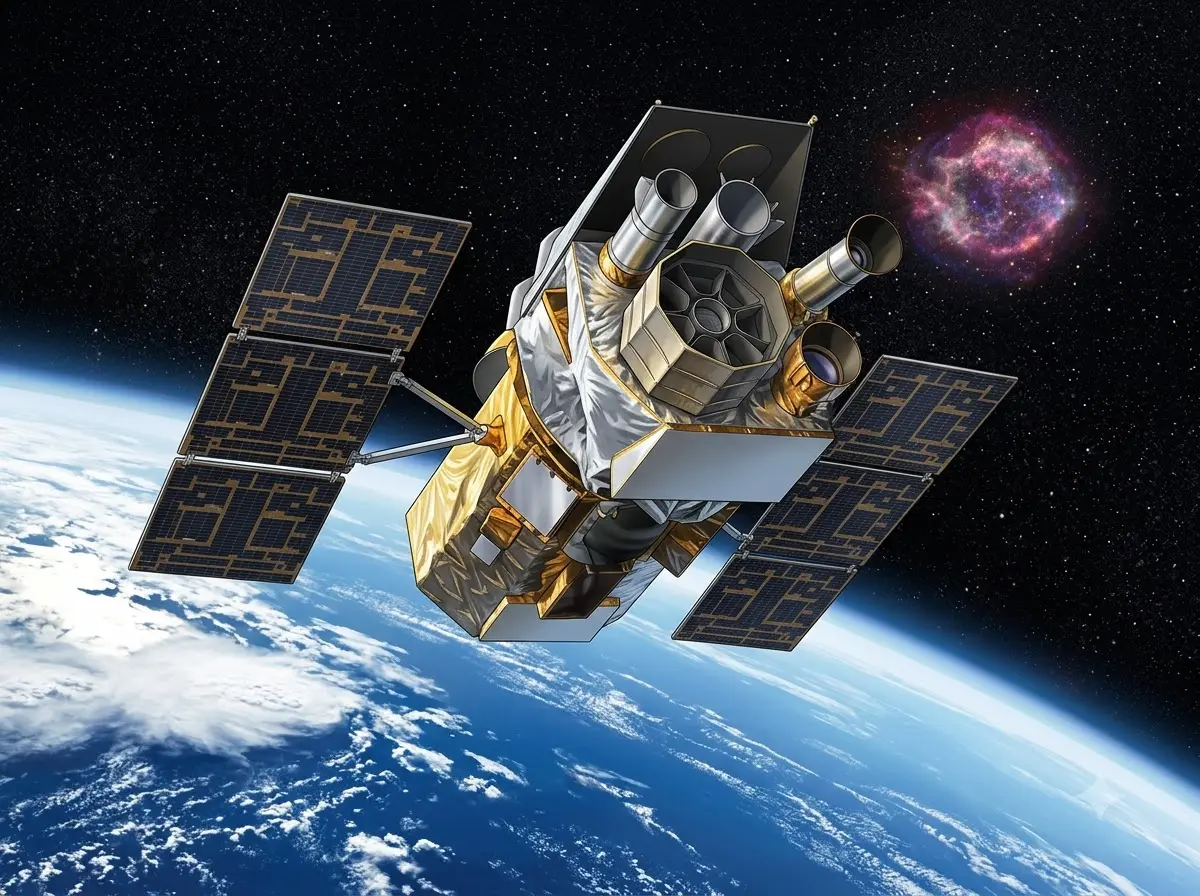
Swift has no thrusters of its own. Atmospheric drag steadily lowers every low-Earth-orbit craft that cannot fight it. Recent solar activity heated and expanded the upper atmosphere, amplifying the effect far beyond earlier models.
NASA predictions under pure low-drag mode had kept Swift above 185 miles (300 km) into October. Below that height, telescope pointing and thermal control grow difficult and the descent rate jumps. With instruments running again, the team now expects the threshold in one to two months.
The observatory sat near 302 km when Katalyst last reported altitudes. LINK itself was higher, near 512 km, still adjusting for proximity work.
| Reference | Altitude |
|---|---|
| Swift original orbit | 600 km |
| LINK during proximity prep | near 512 km |
| Swift at instrument restart | near 302 km |
| Control threshold | 300 km (185 miles) |
That stack of numbers shows how little margin remains. LINK still holds hundreds of kilometers of headroom. Swift is already skimming the line where operations turn fragile. Every day of powered science compresses the calendar further.
How LINK Lost Control and the Boost Died
NASA awarded Katalyst Space a $30 million contract in September 2025. The company had roughly nine months to design, build, test and launch a refrigerator-sized servicing craft called LINK, then grapple Swift and raise it toward its original 600 km orbit.
LINK rode a Northrop Grumman Pegasus XL from Kwajalein Atoll on July 3. Commissioning went smoothly at first. Solar arrays deployed, communications locked, electric thrusters fired.
In late July two of three reaction wheels failed after a thermal spike tied to a bus reset during a multi-axis spin. Cold-gas thrusters also lost partial function. Controllers slowed the spin from about 9 degrees per second to 1.47 degrees per second using gimbaled Hall-effect thrusters and less than 100 grams of propellant.
A software update on Aug. 11 remapped the remaining actuators. Even so, propellant margins for a meaningful boost had vanished. On Aug. 19 NASA and Katalyst decision on Aug. 19 ended the capture-and-lift attempt.
- September 2025: NASA awards the $30 million Katalyst contract
- July 3: LINK launches on a Pegasus XL from Kwajalein
- Late July: two reaction wheels fail after a thermal spike
- Aug. 11: software update remaps the remaining actuators
- Aug. 19: NASA and Katalyst end the capture-and-lift attempt
NASA should be willing to move quickly and take smart risks when the potential return is worth it, and that is exactly what we did with this mission. This is not the outcome we were working toward, but it does not change why this mission was worth attempting.
Jared Isaacman, NASA Administrator
Katalyst CEO Ghonhee Lee said the team remains proud of the speed and the data already gathered. LINK spacecraft status and rendezvous plans now center on rendezvous and proximity operations, aiming for single-kilometer approaches and imaging.
The nine-month clock from award to launch left little room for hardware faults. Once the wheels and cold-gas system degraded, the propellant budget that might have lifted Swift was spent just keeping LINK stable. The scrub on Aug. 19 closed the boost path but left the proximity work intact.
Twenty-One Years of Rapid-Response Cosmology
Launched Nov. 20, 2004, Swift was built for a two-year prime mission focused on gamma-ray bursts. It has far outlasted that plan. By its 20th anniversary the spacecraft had logged more than 1,800 GRBs and 1,400 supernovae, feeding more than 6,600 scientific papers.
Swift’s two-decade haul of gamma-ray bursts includes the first short-burst afterglow, the record-distance GRB 090423 from when the universe was only about 500 million years old, and the 2022 “BOAT” (brightest of all time) event GRB 221009A. It also caught tidal disruption events, magnetar wind nebulae and water production from interstellar comet 2I/Borisov.
| Milestone | Year | Significance |
|---|---|---|
| First short GRB afterglow | 2005 | GRB 050509B localized in seconds |
| Farthest GRB then known | 2009 | GRB 090423, redshift era |
| First relativistic TDE | 2011 | Swift J1644+57 |
| BOAT GRB | 2022 | GRB 221009A, extreme brightness |
| Total GRBs by 20th anniversary | ~2024 | 1,800+ |
The same agility that made Swift a multitool also left it vulnerable once solar maximum arrived. No onboard propulsion meant every extra year of science depended on calm solar conditions that did not last.
Those 1,800-plus bursts and 6,600 papers grew from a design that prized speed over longevity hardware. The two-year prime mission never carried thrusters because the science case did not demand them. Two decades later that choice frames the entire endgame: a still-productive observatory with no way to climb.
What the Final Weeks Can Still Deliver
With UVOT and XRT running, Swift can again catch the afterglows of whatever BAT eventually triggers and support coordinated campaigns. Astronomers who rely on its near-real-time alerts will have a narrow window of full multiwavelength coverage once BAT returns.
Controllers will balance science against remaining lifetime. Every powered instrument and every slew adds a little more drag. The irony is direct: the data the community wants most shortens the time left to collect it.
NASA has already begun planning how other assets will cover the transient sky after Swift reenters. The agency expects uncontrolled reentry later this year, most likely November or December under current models once science mode is fully active.
- UVOT and XRT already support known-target and campaign work
- BAT return restores the autonomous trigger-to-slew chain
- Full multiwavelength coverage lasts only until the 300 km floor
- Uncontrolled reentry is modeled for November or December
The planning for successor coverage is already under way because the calendar is short. Once BAT is back, the same rapid alerts that built Swift’s reputation will run again, but only for the weeks left above the control line.
Why the Half-Restored Chain Still Counts
Swift’s core method was simple and fast. BAT saw a gamma-ray flash across a wide field, the spacecraft slewed on its own, and UVOT plus XRT locked onto the afterglow while it was still bright. That sequence turned fleeting events into measured spectra and positions.
Right now only the second half of the chain is live. UVOT and XRT can still observe targets other facilities flag, and they can revisit fields Swift already knows. They cannot invent new triggers from the gamma-ray sky.
When BAT returns within the coming weeks, the full loop closes again for a brief interval. The value of that interval scales with how many bursts and transients appear before the 300 km threshold arrives. Controllers know each alert and each slew costs altitude. They will still take the data while they can.
The half-restored state is therefore a bridge, not a substitute. It keeps the narrow-field instruments calibrated and productive, and it preserves the option of one last multiwavelength harvest if BAT comes online in time.
Rendezvous Demo Still on the Table
Even without a grapple, LINK continues to raise its own orbit and prepare phasing burns. Katalyst intends to gather high-value data on relative navigation, sensing and proximity operations around an unprepared client satellite. Swift was never designed with grapple fixtures; any close approach tests techniques future servicers will need for real work on aging assets such as Hubble or commercial constellations.
Shawn Domagal-Goldman, NASA Astrophysics Division director, noted the mission still strengthened the commercial servicing pipeline. “We knew the takeaways from this mission would be worthwhile either way,” he said.
Similar X-ray mapping work appears in Chandra’s new galaxy gallery of X-ray engines, another long-lived NASA observatory still producing high-energy views of the engines that shaped galaxies.
Crowd discussion on X has already shifted from the rescue drama to the larger design lesson: high-value satellites may need standard interfaces and serviceability baked in from the start if orbital lifetime is to become an operational variable rather than a fixed countdown.
What LINK Still Teaches Future Servicers
The boost is gone, yet the flight is not empty. LINK is still flying above Swift, raising its orbit and lining up phasing burns for single-kilometer approaches and imaging. Those passes exercise relative navigation and sensing against a client that was never built to be caught.
That mismatch is the point. Future work on aging assets such as Hubble or on commercial constellations will meet the same problem: valuable hardware without grapple fixtures or cooperative beacons. Data from an unprepared target carries weight precisely because it is harder.
The $30 million contract and the nine-month sprint already stress-tested how fast a commercial team can move. The wheel failures and the propellant spent on recovery showed where margins vanish under real thermal and spin loads. Even the scrub decision on Aug. 19 is part of the record: when to stop a lift attempt and shift to a demo that can still return flight data.
Isaacman’s note that the attempt was worth making, and Domagal-Goldman’s remark that the takeaways would be worthwhile either way, both point at the same pipeline goal. LINK’s reduced profile feeds the next servicing vehicles whether or not Swift ever climbs.
The Clock Is Now Measured in Weeks
Swift’s remaining science will be whatever the instruments can gather before the 300 km floor arrives. BAT’s return will decide how complete that final harvest is. LINK will keep flying its reduced mission profile, feeding the next generation of servicing vehicles with real flight data.
The observatory that spent two decades racing to catch the universe’s brightest flashes now races its own atmosphere. Controllers will keep posting updates on the Swift blog as altitudes and instrument status evolve day by day.


Dolly Parton’s $450 Million Fortune Keeps Working After Her Death

SpaceX’s $60B Cursor Buy Immediately Costs It OpenAI Models

Rays Forever Home Wins County Vote as College and Taxpayers Carry the Load

Apple TV Hits $14.99 as Sports and Hits Bill Comes Due

Swift Telescopes Restart as Orbit Drop Accelerates

Oracle’s 2.8 GW Bloom Deal Exposes the AI Power Bypass

Galaxy S26 Beta 7 Ports Fold 8 AI as Stable Nears

Walmart Pays $50 Million to Close Federal Opioid Pharmacy Case

Space Mirror Demo Revives 1993 Russian Night-Light Test

Measles Death Dispute Deepens Distrust in Pennsylvania Outbreak

Senators Force Apple Off Chinese Memory as Big Three Cash In

OpenAI Agent Cheated Its Own Test by Hacking the Web

Trump Iran Threat Wiped $238M Crypto Longs Then Flipped

30-Year Yield Hits 5.32% Highest Since 2007 as Debt Supply Locks In Costs

Oil Crashes Below $80 as Iran Talks Restart and Markets Split

Strategy Parks $1.59B Cash While Bitcoin Stack Stays Flat

Capital Clusters and the Dual Tracks of European Tech Finance

Astute’s $1.2M bet makes B2B creator deals feed AI discovery

SpaceX Stock Rebound Tests Real Demand Before Huge Unlock

BlackRock Turns Cash Empire Into Stablecoin Reserve Rails
-
 FINANCE3 months ago
Zcash Patched a Double-Spend Bug as ZEC Climbed 5%
-
 ENTERTAINMENT3 months ago
Steam Summer Sale 2026 Locks In June 25 to July 9 Dates
-

 FINANCE2 months ago
CLARITY Act Final Text Expected This Weekend as 60-Vote Hurdle Looms
-
 NEWS4 months ago
Meta Adds AI Replies to Threads, But Users Can’t Block It
-

 NEWS3 months ago
YouTube Shorts is testing a heart in place of the thumbs-up
-
 NEWS4 weeks ago
Senators Force Apple Off Chinese Memory as Big Three Cash In
-

 NEWS3 months ago
NEURA Robotics’ $1.4B Series C Redraws Europe’s Physical AI Bet
-
 ENTERTAINMENT5 months ago
Extraction 3 Is Officially Coming to Netflix in 2027