
NEWS
CoreWeave Leases UK Halls and Leaves the Build Clock Running
CoreWeave leased UK halls to skip a two to three year build, leaving new AI megawatts on DataVita’s clock under a 15-year state-backed lease.

CoreWeave is leasing UK data centre halls rather than building them, its international strategy chief said, because a new site can take two to three years.
Ben Richardson, VP of strategy at the Nvidia-backed cloud firm, said in June 2026 that speed is the greatest currency in the AI market, and that subleasing space inside an existing facility is the fastest way to put compute in front of customers.
Two Halls Went Live Before a New Building Could
In May 2024 CoreWeave committed £1 billion to UK operations. In October 2024 a hall inside Digital Realty’s Crawley campus went live with Nvidia H200 GPUs. In December 2024 a second hall went live at Global Switch in London Docklands.
The company announced both sites as operational on January 13, 2025. Mike Mattacola, then chief business officer, said the UK holds CoreWeave’s European headquarters and that the pair formed part of the 2024 commitment. CoreWeave said that first cheque brought two AI data centres online in six months.
GPU counts at Crawley and Docklands were not disclosed. Digital Realty’s two Crawley buildings, LGW15 and LGW16, opened in 2015 and 2019 and together hold more than 200,000 sq ft and 24 MW. That is the landlord’s campus, not CoreWeave’s published take. Global Switch already ran London East and London North in the Docklands and had planned a London South hall of 40 MW, with 224 MVA of power secured over five years for the wider campus.
By the end of 2024 CoreWeave said it had opened 28 data centres worldwide, with 10 more planned for 2025. The UK pair were tenant fits in halls that already had power and shells, which is the whole point of the model Richardson later described.
COREWEAVE’S FIRST UK FOOTPRINT
- May 2024: Commits £1 billion to establish and expand UK operations.
- October 2024: First UK hall goes live in Crawley inside a Digital Realty facility, on Nvidia H200 GPUs.
- December 2024: Second hall goes live at Global Switch in London Docklands.
- January 13, 2025: Company says both sites are operational and that they host some of Europe’s largest Nvidia GPU deployments.
CoreWeave posted the same two-site launch on its own account, naming Digital Realty, Global Switch, H200 chips and renewable power.
We’re excited to announce that our two initial data centers in the UK are now operational in Crawley and London Docklands, partnering with @DigitalRealty and @GlobalSwitch, with AI deployments powered by @NVIDIA H200 Tensor Core GPUs and renewable energy.https://t.co/mYVlbraQWR
— CoreWeave (@CoreWeave) January 14, 2025
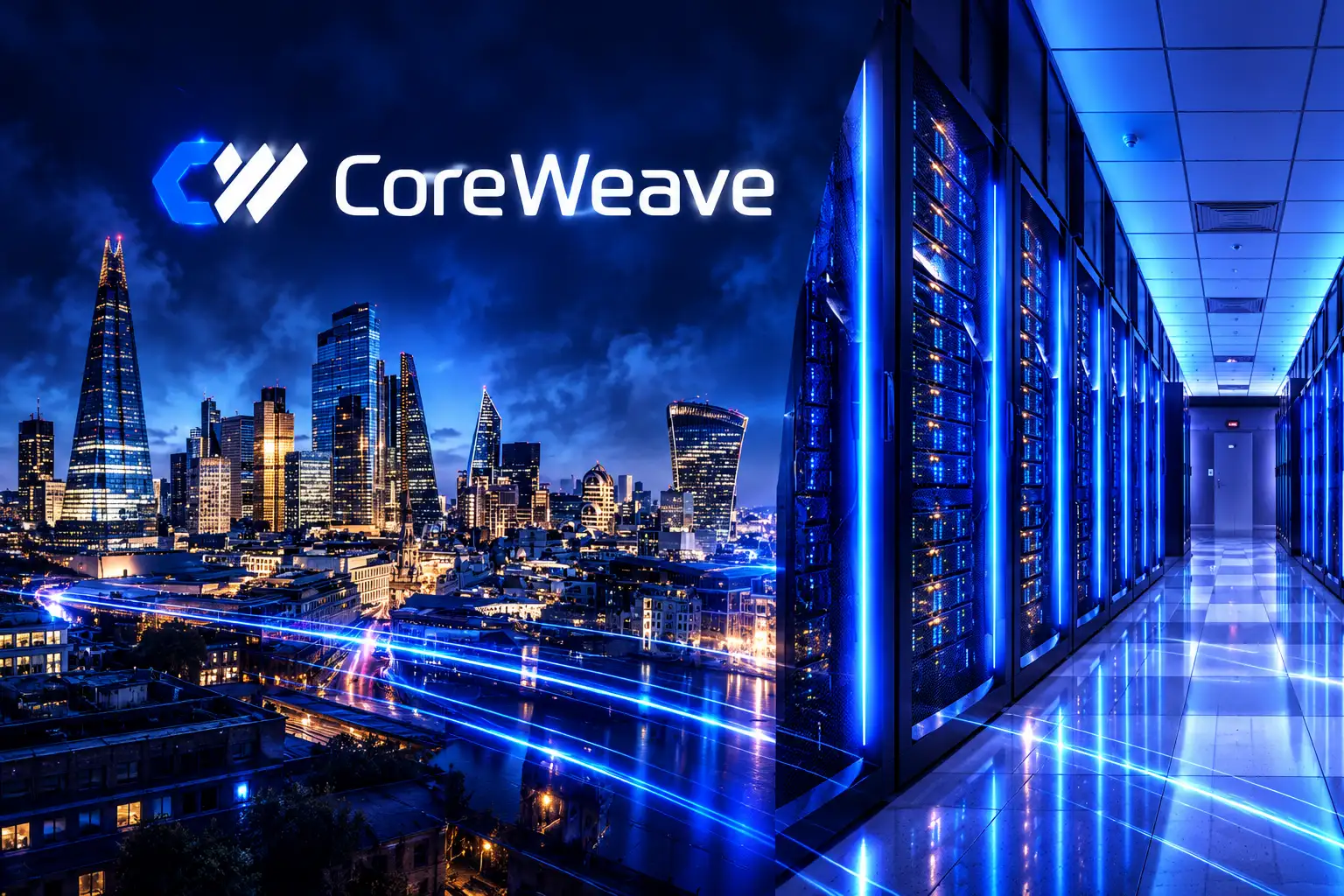
Why CoreWeave Leases UK Data Centre Space
Richardson said the UK choice was speed. A new build, he said, generally takes two to two and a half, or three years. Subleasing inside an existing facility is, on his reading of the UK market, the fastest way to satisfy customer demand.
The main reason that we took the approach we took in the UK is speed. When you look at the AI market, speed is one of the greatest currencies, if not the greatest currency. We needed to bring compute to satisfy the demand to our customers. And when you are trying to do that, you need to do that at the fastest velocity you can. And the fastest way to do that on analysing the market in the UK is to sub-lease space inside of an existing facility. Otherwise, generally speaking, it might take you two to two and a half, three years.
Ben Richardson, VP of strategy, CoreWeave, June 2026 podcast
That is a tenant strategy, not a land strategy. CoreWeave still has to install its own networking, cooling kit and GPU clusters. It does not wait for a greenfield shell, a new substation and a planning clock that he put at two to three years.
Seamus Dunne, managing director at Digital Realty in the UK and Ireland, called the Crawley deployment one of the continent’s largest Nvidia H200 GPU placements. Ashley Muldoon, chief executive of Global Switch, said the Docklands hall was CoreWeave’s first data centre in London. Both men were describing a customer moving into their buildings.
Meta’s $21 Billion Contract Runs on Someone Else’s Floor
The reason the clock is that tight sits in the order book, not in a UK press line. In April 2026 CoreWeave said it had struck an additional $21 billion deal to supply Meta with AI cloud capacity through December 2032, taking the Meta relationship to $35 billion. As of March 31, 2026, the company reported a contracted backlog of $99.4 billion, with Nvidia, Microsoft, Meta and OpenAI among the names on those contracts.
THE DEMAND THAT WILL NOT WAIT FOR A BUILD
- Meta add-on: $21 billion of extra cloud capacity through December 2032, taking the relationship to $35 billion.
- Backlog: $99.4 billion of contracted revenue as of March 31, 2026.
- UK cheque: £1 billion in May 2024, then a further £1.5 billion on September 16, 2025.
- Hardware path: H200 in the first English halls, Grace Blackwell Ultra and GB300 planned for later UK rooms.
A customer that has signed through 2032 does not want the first useful rack in 2028. Leasing an already-connected hall in Crawley or Docklands is how a neocloud turns a paper backlog into billed hours. The UK sites are a small slice of that book, and they are the slice that had to exist before a Scottish campus could be poured.
Lanarkshire Turns a Tenant Into a Construction Client
On September 16, 2025, during a US state visit, CoreWeave announced the next £1.5 billion phase and said that brought the total UK investment to £2.5 billion. The company said it would partner with Nvidia and DataVita in Scotland to deploy NVIDIA Grace Blackwell Ultra GPUs on renewable power with closed-loop cooling. It also said it planned GB300 and RTX PRO Blackwell Server Edition GPUs at other UK facilities.
Michael Intrator, co-founder, chairman and chief executive, said the UK spend would establish one of the world’s largest concentrations of state-of-the-art sustainable compute. Keir Starmer, then prime minister, called the cheque a vote of confidence in Britain’s AI plans. Jensen Huang, Nvidia’s founder and chief executive, said the United Kingdom sat in a Goldilocks position of talent, research and industry.
DataVita already ran DV1, an 8,000 sq m hall designed for up to 40 MW, and a 1,000 sq m DV2 hall of 1 MW. Danny Quinn, DataVita’s managing director, said the collaboration strengthened Scotland’s role in the UK’s AI ambitions. The language from both companies still described a deployment into DataVita’s platform, not a CoreWeave-owned campus.
WHERE THE GPUS ACTUALLY SIT
| Site | Landlord | Status | Published hardware |
|---|---|---|---|
| Crawley | Digital Realty | Live October 2024 | Nvidia H200 |
| London Docklands | Global Switch | Live December 2024 | Nvidia H200 |
| DataVita DV1, Lanarkshire | DataVita | Expansion due by the end of 2026 | Grace Blackwell Ultra |
| DataVita DV3, Lanarkshire | DataVita | Due summer 2027 | Grace Blackwell Ultra |
The English pair were occupancy. Lanarkshire is where the lease model meets wet concrete. Work on the DV1 expansion began in December 2025. Construction of DV3 started in April 2026. Those dates sit inside the two to three years Richardson named as the cost of building, only the builder is DataVita and CoreWeave is the contracted tenant.
A £202 Million Guarantee Backs the Next 80 MW
On August 18, 2026, DataVita said it had raised a c.£300 million debt facility to expand DV1 and build DV3 at its Airdrie campus in the North Lanarkshire AI Growth Zone. Once expanded, DV1 will provide 40 MW and DV3 another 40 MW. CoreWeave has leased the capacity of both halls for 15-year terms, a combined 80 MW.
The UK’s National Wealth Fund said a £202 million National Wealth Fund guarantee unlocked the facility. The guarantee covers 80 percent of a £252.5 million tranche from ING, ABN AMRO and Santander. The Scottish National Investment Bank and Siemens Financial Services lent the rest without that cover. DataVita said the two jobs would support about 600 construction roles and about 100 permanent skilled jobs once they run.
THE MONEY UNDER THE SCOTTISH HALLS
- The facility: About £300 million of debt to expand DV1 and build DV3.
- The state cover: A £202 million National Wealth Fund guarantee on 80 percent of the £252.5 million bank tranche.
- The offtake: Every megawatt of both halls contracted to CoreWeave for 15 years.
- The jobs: About 600 during construction and about 100 permanent skilled roles once the halls operate.
That structure is the second-order consequence of Richardson’s speed talk. CoreWeave does not carry the construction loan. Banks lend against a signed tenant. The public balance sheet takes first-loss risk on most of the senior tranche. Scotland supplies the site and the power. The compute hours go to a Nasdaq-listed US cloud firm whose customers are Meta, Microsoft and the other labs on the $99.4 billion book.
There is plenty of talk about AI infrastructure just now. This project is being delivered: work is well advanced on site, every megawatt is contracted, and the first facility completes this year.
Danny Quinn, managing director, DataVita, August 2026
Kanishka Narayan, the UK AI minister, said the announcements would help keep Scotland at the front of AI development. DV1 is due by the end of 2026. DV3 is due in summer 2027. Those are build dates, not lease-up dates in an already humming hall.
Grid Queues Still Outlast a Sublease
Leasing an existing hall only works while that hall has spare, connected power. New megawatts still have to join the queue. A Department for Energy Security and Net Zero consultation in March 2026 said that by the end of June 2025 the transmission demand queue stood at 96 GW, with NESO identifying about 140 data centres at transmission representing about 50GW of data centre schemes.
On the generation side, NESO said the old first-come model left more than 700 GW waiting for grid access across generation and storage, around four times what Great Britain needs for clean power in 2030. The operator has since sorted projects into a ready-and-needed pipeline. Data centre demand was not magically cleared by that sort; it was one of the loads the government said was inflating the demand queue.
That is why stuffing a live Crawley or Docklands room is a different product from announcing an AI Growth Zone. The first uses power that already reaches the floor. The second needs wires, transformers and a connection date. European operators who cannot wait for gigawatt campuses have been taking the same shortcut CoreWeave took in England: brownfield rooms under 50 MW that already sit on the grid, rather than a new town of substations.
Nscale, the other Nvidia-backed name in the UK’s AI compute pitch, chose a different first move. In January 2025 it said it had bought a Loughton site equipped for 50 MW, with headroom to 90 MW, scheduled to go live in Q4 2026 and able to hold up to 45,000 GB200 GPUs. That is a purchase-and-build path. CoreWeave’s English path was a key to someone else’s door. The Scottish path is a long lease on halls DataVita is still finishing.
The Buildings the UK Announced Belong to Landlords
Whitehall can count CoreWeave’s £2.5 billion as AI infrastructure. The physical rooms in England belong to Digital Realty and Global Switch. The next 80 MW in Lanarkshire belongs to DataVita, financed by a bank club and a £202 million public guarantee, then rented to CoreWeave until the early 2040s if the 15-year terms run to term.
For CoreWeave the trade is clean. Customers who signed nine-figure and ten-figure capacity deals get H200 hours in the South East without waiting for a greenfield pour. Nvidia gets another geography for Hopper and then Blackwell. The landlords get a creditworthy AI tenant in halls that would otherwise sell at older colocation rates. The National Wealth Fund gets a domestic compute project it can put on a press page.
What the lease does not buy is a CoreWeave-owned megawatt, or a private shortcut around the 96 GW demand queue. When DV3 is due in summer 2027, Richardson’s two to three years will have elapsed from the September 2025 Scotland announcement, on a site another company is building. The speed he described was real for Crawley and Docklands. It was occupancy. The construction clock moved to the landlord’s calendar, with the public purse on the guarantee line.
Disclaimer: This article is news reporting on CoreWeave’s UK data centre leasing, partner sites and related contract figures. It is informational only and is not investment, legal or infrastructure-procurement advice. Readers should consult a qualified financial adviser, solicitor or energy-planning professional before acting on any company, contract or grid-connection information mentioned here. Figures, project dates and lease statuses reflect the company, government and National Wealth Fund materials cited, and they can change as builds, queues and contracts are revised.

UPI MDR Delay Hands Traders the Calendar After Paytm Falls

Google Messages Builds Nine In-Chat Games After Samsung’s Exit

Anthropic’s $100 Million Academy Trains the Firms That Bill Both Sides

Toyota’s Electric C-HR Leaves the Cheap Twin to Subaru

Markets Bet the Fed Skips October After Hawkish Minutes

The Orchard Bug Forced Zcash to Open an Empty Pool

The $5.99 Game That Won Steam’s 2026 Summer Sale

Don Lee Joins Hemsworth as Extraction 3 Starts Shooting

YouTube Shorts Retires Dislikes and Swaps Likes for Hearts

Atlantic City Turned WWE’s Return Into a Civic Night
-
 NEWS5 months ago
The Orchard Bug Forced Zcash to Open an Empty Pool
-
 GAMING5 months ago
The $5.99 Game That Won Steam’s 2026 Summer Sale
-
 ENTERTAINMENT7 months ago
Don Lee Joins Hemsworth as Extraction 3 Starts Shooting
-
 NEWS5 months ago
YouTube Shorts Retires Dislikes and Swaps Likes for Hearts
-
 NEWS5 months ago
Atlantic City Turned WWE’s Return Into a Civic Night
-

 NEWS5 months ago
NEURA Robotics Is Spending Its $1.4B on a Machine Stack
-
 BUSINESS6 months ago
Norway’s Export Bank Backs Nscale’s $790 Million Narvik Loan
-

 GAMING5 months ago
Game of Thrones Dragonfire Follows Boston’s Conquest Playbook