
FINANCE
EPF Ceiling Set for ₹25,000 Lift Leaves Winners and Cost Losers
Department of Expenditure cleared the EPF wage ceiling rise to ₹25,000, expanding coverage and EPS pensions while raising employer costs and cutting some.

India’s Department of Expenditure has approved a proposal to lift the Employees’ Provident Fund wage ceiling from ₹15,000 to ₹25,000 a month. The step now heads to the Union Cabinet, with implementation expected around April 2027 if cleared and notified.
The change would pull a fresh band of salaried workers into mandatory EPF and Employees’ Pension Scheme cover for the first time since 2014. Higher covered wages mean larger monthly contributions, bigger retirement corpora, and potentially higher EPS pensions. Employers, especially smaller ones with many staff near the old threshold, face higher payroll outgo. Some employees will see a short-term dip in take-home pay.
The arithmetic is straightforward once the ceiling moves. Every rupee of basic plus dearness allowance brought inside the new band attracts the statutory 12 percent from both sides, and the Centre’s 1.16 percent EPS share rises with it. That single threshold shift therefore reshapes monthly cash flow, long-run corpus growth and the fiscal line item already budgeted at ₹11,144 crore for 2026-27.
What the Current Ceiling Still Controls
Under present EPFO membership and contribution rules, only employees whose basic wages plus dearness allowance stay at or below ₹15,000 must join EPF and EPS in establishments with 20 or more staff. Those earning more can stay out, and employers have no legal duty to enroll them. Once inside, a member remains covered even if pay later rises above the cap, though contributions are often restricted to the ceiling unless both sides agree otherwise under para 26(6).
The employer’s 12 percent share splits roughly 8.33 percent into EPS (capped on the wage ceiling) and the rest into the EPF account. The employee puts in a matching 12 percent, all to EPF. The Centre adds 1.16 percent of the capped wage toward the pension fund. EPS currently carries a 2026-27 budget outlay of ₹11,144 crore.
- Mandatory cover stops at basic + DA of ₹15,000 today.
- New joiners above the ceiling need an option form for EPF and cannot join EPS.
- Contributions above the statutory ceiling are voluntary for both sides.
- Establishments under 20 workers stay outside the mandatory net unless they opt in.
Raising the line to ₹25,000 simply moves that mandatory band upward. Workers between the two figures lose the option to stay out. The same membership logic that has governed the scheme since the last revision continues; only the rupee threshold changes. Establishments that already sit under the 20-worker mark remain free of the mandate unless they choose to join, so the expansion is concentrated in the organised segment that already files with EPFO.
Para 26(6) arrangements already in force stay intact. Where both sides have agreed to contribute on wages above the old ceiling, those contracts simply operate against a higher statutory floor once the notification takes effect. No fresh option form is required for members already inside the fund.
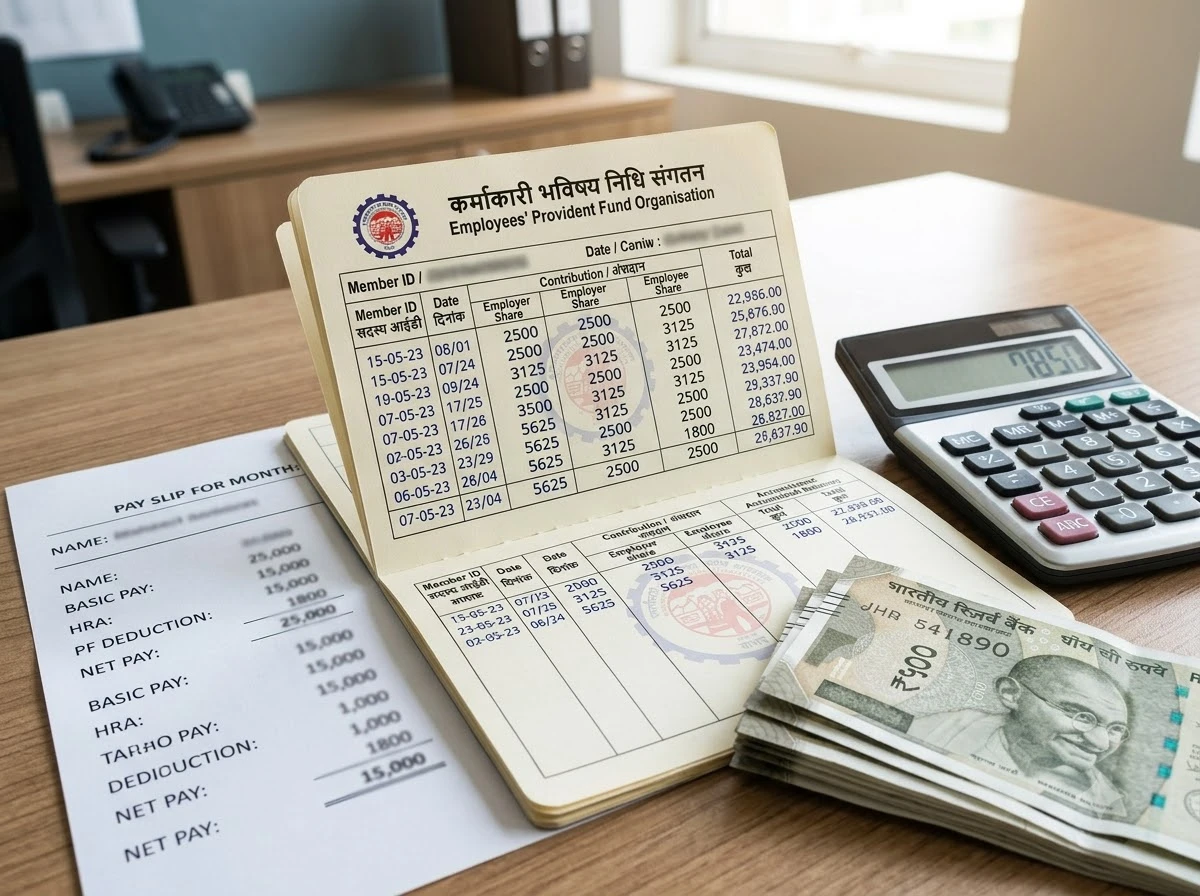
How Contributions and Pensions Would Move
Both sides would contribute 12 percent on a larger wage base for newly covered staff. On a ₹25,000 ceiling the statutory employer minimum jumps from ₹1,800 to ₹3,000 a month per eligible head. Employee deductions rise by the same amount, trimming net pay unless the employer restructures the CTC package.
| Item | At ₹15,000 ceiling | At ₹25,000 ceiling |
|---|---|---|
| Max employee EPF share (12%) | ₹1,800 | ₹3,000 |
| Max employer total (12%) | ₹1,800 | ₹3,000 |
| EPS diversion from employer (8.33%) | ₹1,250 | ₹2,083 |
| Illustrative 10-year max monthly EPS pension | ≈ ₹2,143 | ≈ ₹3,571 |
EPS pension uses a simple formula: (pensionable salary × pensionable service) ÷ 70. Pensionable salary is the average basic plus DA over the last 60 months, still subject to the ceiling in force. A higher ceiling therefore lifts the maximum pensionable salary by about 67 percent. For 35 years of service the long-run ceiling example moves from roughly ₹7,500 to ₹12,500 if the new limit applies throughout, according to the same arithmetic EPFO publishes for the current cap.
These figures assume the higher wage applies for the full service period. Actual pensions will vary with salary history, exit age, and any weightage for 20-plus years of service. Full official EPS contribution and pension details remain on the EPFO site.
- ₹25,000 proposed new statutory wage ceiling
- 12 years since the last revision in September 2014
- ₹11,144 crore EPS budget allocation for 2026-27
- April 2027 earliest widely expected start date after Cabinet and notice
The 67 percent rise in the maximum pensionable salary feeds straight through the division by 70. That is why the illustrative ten-year pension moves from roughly ₹2,143 to ₹3,571 and why the 35-year ceiling example climbs from ₹7,500 to ₹12,500. Members whose last sixty months already sit above the old cap gain the most once the new limit applies to that averaging window.
Workers Gain Corpus and Pension Headroom
Employees newly pulled into the net receive automatic EPF interest credits, portability via Universal Account Number, and EPS membership. Those already above ₹15,000 who were voluntary members can see larger matching contributions if employers align packages to the new floor. Over decades the extra monthly rupees compound. The recent EPFO interest rate credit of 8.25% shows how even modest rate credits multiply on a larger base.
Higher pensionable salary feeds directly into the EPS formula, so long-service workers can exit with a meaningfully larger monthly pension. Family pension and children pension rights also ride on the higher base. For many urban service, retail and manufacturing staff whose basic pay has drifted past ₹15,000 since 2014, the change simply restores mandatory social security that wage inflation had removed.
The trade-off appears on the payslip. A worker whose basic sits at ₹22,000 could see employee EPF rise by several hundred rupees a month. Tax-deductible contributions soften the hit for those in higher slabs, yet take-home still falls unless the employer raises gross pay to compensate.
Portability through the Universal Account Number means the larger corpus travels with the member across jobs. Interest at the declared rate, most recently 8.25 percent, accrues on the expanded balance without any fresh paperwork once the account is active. That continuity is the practical gain for staff who change employers often inside the organised sector.
Employers and the Centre Carry Fresh Costs
Every newly covered head raises the employer’s 12 percent outgo. Firms with dense clusters of staff between ₹15,000 and ₹25,000 feel it first. Small and mid-sized establishments already managing tight margins will recalculate annual payroll budgets, update software, and rewrite offer letters. Compliance filings and inspection exposure also widen.
The government itself contributes 1.16 percent of the capped wage into EPS. Expanding the base therefore lifts the Centre’s annual pension commitment beyond the current ₹11,144 crore line. That fiscal second-order effect is why the Department of Expenditure examined the file carefully and scaled an earlier ₹30,000 idea back to ₹25,000.
Larger companies that already contribute on actual higher salaries for retention will see less relative change. The uneven burden lands heaviest on firms that had kept many mid-wage staff outside the mandatory net.
| Cost bearer | What rises | Scale of change |
|---|---|---|
| Employer (statutory) | 12% on newly covered wages | ₹1,800 to ₹3,000 per head at the ceiling |
| Employee | Matching 12% deduction | Same rupee jump, lower take-home |
| Central government | 1.16% into EPS | Above the ₹11,144 crore 2026-27 outlay |
Offer letters written against the old ceiling will need fresh language on basic pay, contribution base and any CTC gross-up. Software that hard-codes the ₹15,000 limit must be patched before the first payroll cycle under the new rule. Those operational steps fall on every covered establishment, not only on the firms that feel the largest rupee impact.
The 12-Year Freeze and the 2014 Jump
The statutory ceiling has moved only a handful of times since the 1952 Act. It sat at ₹6,500 from 2001 until September 2014, when it jumped to ₹15,000. That earlier revision brought millions of additional workers into the system and forced a similar round of payroll recalibration.
- 1952-1957: early ceiling around ₹300
- 2001-August 2014: ₹6,500
- 1 September 2014: raised to ₹15,000
- August 2026: Department of Expenditure clears ₹25,000 proposal
- Target: Cabinet, notification, then possible April 2027 start
Wages in many organised urban roles rose far faster than the frozen ₹15,000 line. Minimum wages and dearness allowances in several states also climbed. The gap left a growing share of formal-sector workers free to opt out of mandatory EPF even while holding steady private jobs. The new ceiling closes part of that gap without matching the full rise in average pay.
Twelve years without a revision is the longest recent pause. The 2014 jump from ₹6,500 to ₹15,000 more than doubled the covered band in one step; the present proposal lifts it by two-thirds. Both moves followed the same pattern: a long freeze, then a single administrative correction once wage drift had pushed large numbers of staff above the old line.
Payroll Teams Brace for the Transition
Even after Cabinet approval, officials expect a transition window. Businesses need time to rewrite wage definitions, re-code contribution logic, train staff, and communicate the change. Payroll software vendors will push updates. HR teams will run cost simulations and decide whether to absorb the extra employer share, adjust basic-pay components, or raise overall CTC.
Employees will ask how the higher deduction affects net salary, Section 80C headroom, and long-term targets. Clear internal notes that separate the short-term cash impact from the compounding and pension gains will matter. Members should also keep nominations current; the EPF e-nomination steps members still need remain a practical checklist while the larger policy moves.
Crowd discussion among payroll consultants already flags the jump from roughly ₹1,800 to ₹3,000 statutory employer cost per newly covered head and the need to redesign mid-band packages before the go-live date. Workers focus on the pension upside yet note the immediate hit to disposable income. Both reactions are already visible even though nothing is notified yet.
- Rewrite wage definitions and contribution base rules
- Patch payroll software that still hard-codes ₹15,000
- Run cost simulations for the ₹15,000-₹25,000 staff band
- Decide whether to absorb, adjust basic, or raise CTC
- Issue staff notes that separate take-home impact from corpus and pension gains
Section 80C headroom will absorb part of the extra employee deduction for those already itemising. Staff who have not exhausted the limit may feel a smaller net hit than the raw 12 percent increase suggests. That tax interaction is one reason internal communications need to show both the gross deduction and the post-tax effect.
How the Ceiling Shapes Voluntary Cover Choices
Today a new joiner whose basic plus dearness allowance clears ₹15,000 can simply stay outside EPF and EPS. The employer has no duty to enroll that person. Once the ceiling becomes ₹25,000, the same joiner in the band between the two figures loses that choice and enters both schemes automatically in any establishment with 20 or more staff.
Existing voluntary members already contributing above the old ceiling stand in a different position. Their para 26(6) agreements remain valid. When the statutory floor rises, the minimum matching contribution rises with it, so the employer share that was once optional on the slice between ₹15,000 and ₹25,000 becomes compulsory. Packages built on voluntary top-ups therefore convert into statutory minimums for that slice.
Workers who had preferred higher take-home pay over retirement saving lose the opt-out route inside the new band. The policy trade-off is explicit: broader mandatory cover in exchange for less individual choice at the point of joining. Establishments under 20 workers continue to sit outside that trade-off unless they elect to join the fund.
What the 2014 Parallel Suggests for 2027
The September 2014 lift from ₹6,500 to ₹15,000 produced the same sequence now expected again: Cabinet clearance, formal notification, a gap before the effective date, then a wave of payroll recalibration. Millions of additional workers entered the system then. Employers rewrote offer letters and contribution logic in much the same way payroll teams are preparing to do now.
Two differences stand out from the facts already on record. The 2014 step more than doubled the ceiling; the present step raises it by two-thirds. The earlier move also arrived after a thirteen-year freeze at ₹6,500; the current freeze at ₹15,000 has lasted twelve years. The administrative pattern is therefore familiar even if the percentage jump is smaller.
Sources cited by Moneycontrol already point to April 1, 2027 as a realistic start, which would again leave several months between decision and go-live. That spacing matches the practical need for software patches, staff communication and CTC redesign that firms faced after the 2014 notification.
Cabinet Decision and the 2027 Window
The proposal sits with the Union Cabinet. Once approved, a formal notification will set the effective date and any transitional provisions. Sources cited by Moneycontrol point to April 1, 2027 as a realistic start, giving employers several months after the Cabinet decision. The final date could shift.
Until then the ₹15,000 ceiling and all existing EPFO membership and contribution rules stay in force. No automatic enrollment of the 15-25k band occurs, and EPS pensions continue to be calculated on the present limit. Workers and firms can only prepare.
If the higher ceiling lands on schedule, mid-wage private-sector staff will walk into 2027 with stronger automatic retirement saving and a higher pension ceiling. Employers will carry a larger monthly bill. The Centre will write a bigger EPS cheque. That split of gains and costs is already locked into the arithmetic the Department of Expenditure approved.
Nothing in the present rules changes before the notification appears. The Department of Expenditure clearance is a necessary step, not the final one. Cabinet approval, the formal gazette notice and the chosen effective date must all follow before a single extra rupee moves into EPF or EPS under the new ceiling.


Scott Pushes CLARITY Act Vote as Senate Calendar Slips Past Recess

EPF Ceiling Set for ₹25,000 Lift Leaves Winners and Cost Losers

Bybit Dual License Puts Regulated Payments Under One Roof

Bandcamp Boots Boy George Over AI Song, Not Just the Lyrics

Olix Triples to $3.3bn on Optical Bet Against Nvidia

Four Teens Died After Platforms Vowed Fixes and Suits Began

Google Health Now Writes Fitbit Data Into Apple Health

Pixel 11 Pre-Orders Open Eight Hours Before the Event

2026 Lexus RZ Gains Power and Range Yet Still Falls Short

Ankr Nodes Clear Path for XRPL Institutional Features

Fed Minutes Cite AI Demand as Inflation Risk, Put a 2026 Hike Back on the Map

Marker AI Writing Startup Lands $13M Seed Led by Index Ventures

Meta’s Muse Spark 1.1 Beats Rivals on Price, Trails on Coding

Finto Picks Munich Over Silicon Valley After YC, Raises $3.4M

CS2 Premier Season 5 Lands With Cache and a C4 Damage Rework

Backrooms Returns to Theaters as the Everything Must Go Edition

Trump Calls Iran ‘Islamic Republic of Japan’ as Ceasefire Ends

IO Interactive Regains Project Fantasy, Closes Istanbul Studio

Kord’s £6.4M Series A Bets Identity and Payments Run on One Stack

Taiwan Margin Debt Climbs 160% as Locals Borrow Into the TSMC Rally
-
 FINANCE2 months ago
Zcash Patched a Double-Spend Bug as ZEC Climbed 5%
-
 ENTERTAINMENT2 months ago
Steam Summer Sale 2026 Locks In June 25 to July 9 Dates
-

 FINANCE1 month ago
CLARITY Act Final Text Expected This Weekend as 60-Vote Hurdle Looms
-
 NEWS3 months ago
Meta Adds AI Replies to Threads, But Users Can’t Block It
-
 NEWS5 months ago
U.S. Navy Deploys Solar-Powered Lightfish Drone to Patrol Oceans
-
 ENTERTAINMENT3 months ago
‘Widow’s Bay’ Review: Apple TV’s Sleeper Horror-Comedy Earns Its Fog
-
 FINANCE2 months ago
CLARITY Act Floor Vote Likely Shifts to August, Lummis Says
-

 FINANCE1 month ago
Kalshi Loses Major NY Prediction Markets Ruling to Judge Torres