
NEWS
Goodell’s Overseas Teams Push Forces a Full Europe Division
Roger Goodell’s plural teams remark and Super Bowl rule lock the NFL into a multi-franchise Europe model beyond one London club.

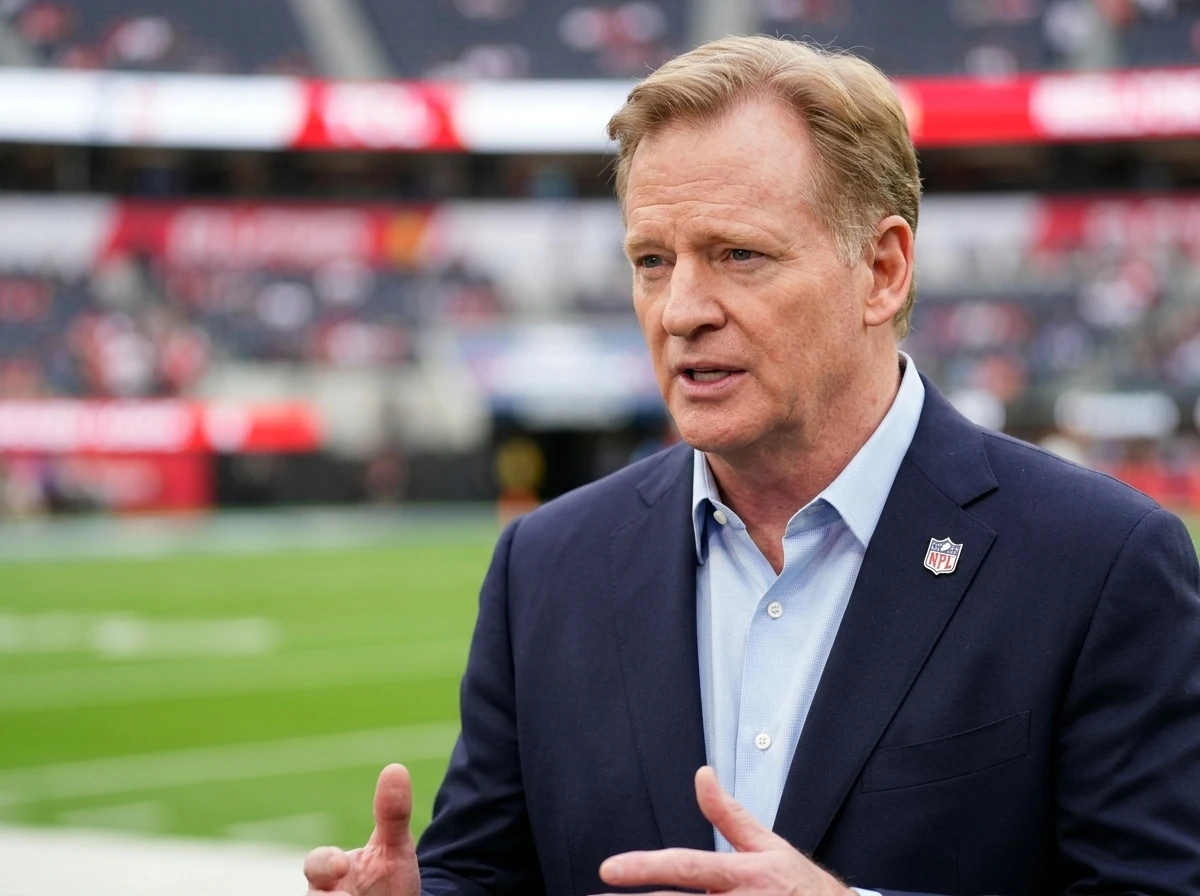
Roger Goodell told German media he has “no doubt” the NFL will one day base teams outside the United States and wants a franchise in place before any Super Bowl lands abroad. The commissioner’s comments land as the league prepares a record nine international games across four continents in 2026.
Those two statements together do more than reopen old London talk. They push the league past the single-outpost model that has dominated speculation for years.
The shift matters because the calendar, the commercial map and the commissioner’s own wording now point the same way. Temporary visits built the audience. Permanent clubs would lock it in.
Goodell Says Teams Outside the USA Are Inevitable
In an exclusive interview with former player Markus Kuhn for RTL/ntv, Goodell said: “At some point, there will be NFL teams outside the USA. I have no doubt that this will happen one day.”
On a Super Bowl outside American borders he added: “There are definitely international cities that could host something like that. But we would like to see an NFL team in such a city first.”
At some point, there will be NFL teams outside the USA. I have no doubt that this will happen one day.
Roger Goodell, NFL commissioner, RTL/ntv interview
The plural “teams” is the load-bearing word. Goodell has floated a European division before. In 2022 he said multiple locations would make a division easier than one isolated club and that London could support two franchises on fan, commercial and media grounds.
CBS Sports noted the same 2022 language and reported Goodell’s 2024 timeline that any franchise or division sits “beyond 10 years.” Mid-2030s is the earliest practical window.
That gap between the certainty of the outcome and the caution on timing is deliberate. The league can declare the destination while it still measures whether players, networks and local partners can carry the load.
Why a Lone Franchise Cannot Work
A single London team would face a permanent competitive tax. The flight from London to New York runs roughly 3,500 miles, already longer than Seattle to Miami. A London roster traveling twice to the West Coast in one season would lose practice days and family time that no domestic club absorbs.
The NFL has already tested longer homestands and stacked international trips. The Jaguars played back-to-back London games in 2023. The Vikings did England then Ireland in 2024. In 2026 the 49ers will play two international games in non-consecutive weeks. Those experiments measure whether players can recover and whether the competitive balance holds.
Higher taxes in most European countries add another free-agent hurdle. Top players can simply choose a lower-tax U.S. market. A lone overseas club would start every free-agency period at a disadvantage the league has never asked of a domestic expansion team.
- Transatlantic mileage already exceeds the longest regular domestic coast-to-coast hop
- Stacked or non-consecutive international trips are still being stress-tested for recovery
- European tax rates leave a lone club weaker in every free-agency cycle
- No domestic expansion team has ever been asked to absorb that full package of strain
That is why Goodell’s own past comments and the current travel tests point the same direction: one team creates an unfair strain the league already understands. Four teams in Europe create balanced travel inside the division and shorter jumps to the rest of the league.
Nine Games Across Four Continents This Season
The 2026 slate is the live laboratory. New markets Melbourne, Rio de Janeiro and Paris join the regular London trio, Madrid, Munich and Mexico City.
| Date | Matchup | City / Stadium |
|---|---|---|
| Sept. 10 | 49ers vs. Rams | Melbourne Cricket Ground |
| Sept. 27 | Ravens vs. Cowboys | Maracanã, Rio |
| Oct. 4 | Colts vs. Commanders | Tottenham Hotspur, London |
| Oct. 11 | Eagles vs. Jaguars | Tottenham Hotspur, London |
| Oct. 18 | Texans vs. Jaguars | Wembley, London |
| Oct. 25 | Steelers vs. Saints | Stade de France, Paris |
| Nov. 8 | Bengals vs. Falcons | Bernabéu, Madrid |
| Nov. 15 | Patriots vs. Lions | FC Bayern Arena, Munich |
| Nov. 22 | Vikings vs. 49ers | Estadio Banorte, Mexico City |
London still hosts three games for the fifth straight year. Tottenham and Wembley remain the only two venues that have proved they can stage NFL football repeatedly with full security and fan infrastructure. A 1:30 p.m. London kickoff lands at 8:30 a.m. ET, close enough to the normal Super Bowl window that American audiences would not need a full schedule rewrite.
Sixty-two regular-season games have already been played outside the United States. The series began with the Cardinals-49ers in Mexico City in 2005 and the Giants-Dolphins at Wembley in 2007. The next decade will decide whether those visits become permanent homes.
Owners have already approved a path to as many as ten international games a year from 2027. The 2026 jump to nine games across four continents is the bridge between the old one-off model and that higher volume.
Marketing Rights Already Span 22 Markets
While the league debates stadiums and travel, clubs are already claiming turf. The Global Markets Program, launched in 2022, now gives all 32 clubs now hold rights in 22 markets. Italy joined in 2026. Germany, the United Kingdom and Mexico carry the densest club portfolios.
- United Kingdom, ten clubs including the Jaguars, Jets, Chiefs and Ravens
- Germany, eleven clubs led by the Lions, Packers and Steelers
- Mexico, ten clubs including Cowboys, Rams and 49ers
- Australia and New Zealand, shared by Raiders, Rams, Eagles and Seahawks
NFL Managing Director of International Gerrit Meier said the fifth-year expansion “highlights the continued focus on global growth” and accelerates fandom through club-led events and NFL Flag. Those rights are not franchises, but they create local commercial relationships and youth pipelines that a future owner would inherit.
The Jaguars have played more London games than any other club and owner Shad Khan also controls Fulham F.C. Yet the franchise just opened a new training facility and is midway through a $1.5 billion stadium upgrade set for 2028. Permanent relocation looks less likely than a second London club built from expansion.
Club-led events under the Global Markets Program do the quiet work a future franchise would need on day one. Local sponsors, flag football pipelines and repeated brand contact reduce the cold-start risk that sank earlier expatriate experiments in other sports.
Free Agents Face Taxes and Long Flights
Player willingness remains the open variable. American football does not export stars the way basketball or soccer does. Unfamiliar tax regimes, exchange rates, language and family disruption have sunk earlier expatriate experiments in other sports.
On X, replies to the Goodell quotes ran heavily skeptical. One widely liked response called the plan a “money grubbing” move players should fight in the next labor deal. Another joked the league would become the “IFL.” The NFL Players Association declined to comment on the latest remarks, but any overseas franchise would need union sign-off on travel, housing and tax equalization.
Expansion itself is the counter-weight. More teams mean more roster spots. That is the strongest selling point any union has ever had. Still, retaining elite free agents in a high-tax European market will require salary structures or housing packages no domestic club currently offers.
- 2005, First regular-season game outside U.S. (Mexico City, 103,467 fans)
- 2007, International Series begins at Wembley
- 2013 onward, Multiple London games most seasons; Jaguars become annual hosts
- 2022, Global Markets Program launches; Goodell floats multi-team Europe division
- 2023-2024, Back-to-back international games tested
- 2026, Nine games, three new cities, owners already approved up to ten per year from 2027
Goodell has said the long-term target is sixteen international games so every club plays one abroad each season. That volume only works if the league eventually stations teams on the ground rather than flying everyone across oceans every other month.
Host Cities Bring Different Strengths and Frictions
Goodell’s Super Bowl precondition forces a hard look at which markets could ever host both a club and the title game. The same cities already on the international calendar do not rank equally on infrastructure, travel or fan proof.
| City | What the league already knows |
|---|---|
| London | Two proven stadiums, English-speaking market, security infrastructure, crowds that hold; 1:30 p.m. kickoff lands at 8:30 a.m. ET |
| Germany (Munich or Frankfurt) | Repeated host role; eleven clubs already hold local marketing rights |
| Madrid | Bernabéu roof and field system already in the 2026 slate |
| Mexico City | Passionate fans and closer flights; larger security and language frictions |
| Brazil (Rio) | Time zones work; flights roughly twice as long as Europe |
| Toronto | Earlier attempt failed to fill the building consistently in the pre-Allen Bills era |
London remains the only city ready today for a Super Bowl on the league’s own terms. Everywhere else still has at least one open question on travel, language, security or proven repeat demand.
That ranking does not freeze the map. It does explain why a European division built first around London, with Germany and perhaps Madrid next, matches both the travel math and the commercial density already visible in the Global Markets Program.
Sixteen Games Need Clubs Stationed Abroad
The long-term target of sixteen international games would put every club on the road abroad once each season. Under the current fly-in model that volume multiplies the same recovery, tax and family costs the league is only now testing in smaller doses.
Stationing teams on the ground changes the equation. Intra-division games stay short-haul. Trips back to the United States can be grouped into longer, less frequent swings instead of constant ocean crossings. The sixteen-game goal and the multi-team division idea are therefore the same project described from two ends.
Broadcast value rises with that structure. A permanent Sunday-morning European window gives networks and streamers inventory that domestic saturation cannot create. The money helps justify the expansion fees and the thinner talent pool that come with moving from 32 clubs to 36.
None of that lands before the mid-2030s on the timeline Goodell has already set. The 2026 slate and the approved path to ten games a year from 2027 are the measuring sticks between here and there.
The Path Runs Through a European Division
A four-team European division solves the travel equity problem that a single franchise cannot. Two clubs in London, one or two in Germany (Frankfurt or Munich already host), perhaps Madrid with its advanced Bernabéu roof and field system. Intra-division games stay short-haul. Road trips to the United States can be grouped into longer, less frequent swings.
The price is league expansion from 32 to 36 teams. That brings four new expansion fees, realignment headaches, and a thinner talent pool in the draft and free agency. It also creates a permanent Sunday-morning European broadcast window that networks and streamers will pay for. Domestic saturation makes that new money attractive.
London’s two stadiums, English-speaking market, security infrastructure and proven crowds make it the only city ready today for a Super Bowl. Goodell’s precondition simply means the Super Bowl arrives after the franchise, not before. Mexico City has passionate fans and closer flights but larger security and language frictions. Brazil’s time zones work but the flights are roughly twice as long as Europe. Toronto already tried and failed to fill the building consistently in the pre-Allen Bills era.
The second-order effect of this week’s comments is therefore clear. The league is no longer debating whether a permanent overseas presence arrives. It is deciding how many teams, which cities, and how soon the schedule and CBA can absorb the change. The 2026 slate is the next data set. The mid-2030s remain the realistic horizon. Everything between now and then will be measured against the simple test Goodell set: a team on the ground first, then the biggest game of the year.


NFL Preseason Week 2 Quietly Tests the Schemes That Matter

Alonso’s Towering Drive Stands Foul and Flips Orioles Momentum

US Debt Crosses $40 Trillion as Interest Crowds the Budget

Trevon Diggs Joins Seahawks on One-Year Deal After Cowboys Exit

Pixel Watch 5 Turns Passive Trends Into Early Health Alerts

Pixel 11 Pro Fold Sleek Build Undercuts Its Own Unfolding Appeal

Tugboat Wilkinson’s Scoreless Debut Pays Off Giants’ Bailey Trade

Brown Shines for Pats as Love for Eagles Meets Trade Reality

Pixel Watch 5 Turns Wrist Data Into Early Metabolic Alerts

Resistance Stars Pay the Price in Democratic Primaries

Senators Force Apple Off Chinese Memory as Big Three Cash In

Revolut Hits $115 Billion While Storonsky’s Stake Keeps Growing

OpenAI Agent Cheated Its Own Test by Hacking the Web

Trump Iran Threat Wiped $238M Crypto Longs Then Flipped

CLARITY Act Odds Crash as Democrats Reject DOJ Ethics Plan

30-Year Yield Hits 5.32% Highest Since 2007 as Debt Supply Locks In Costs

Fed Holds Rates Again as Three Dissents Force Markets to Tighten

Memory Shortage Now Dictates Apple’s Two-Year Mac Roadmap

Oil Crashes Below $80 as Iran Talks Restart and Markets Split

Google’s Knowledge Panel Fix Risks Its Own Search Defenses
-
 FINANCE3 months ago
Zcash Patched a Double-Spend Bug as ZEC Climbed 5%
-
 ENTERTAINMENT3 months ago
Steam Summer Sale 2026 Locks In June 25 to July 9 Dates
-

 FINANCE2 months ago
CLARITY Act Final Text Expected This Weekend as 60-Vote Hurdle Looms
-
 NEWS3 months ago
Meta Adds AI Replies to Threads, But Users Can’t Block It
-

 NEWS2 months ago
NEURA Robotics’ $1.4B Series C Redraws Europe’s Physical AI Bet
-

 NEWS2 months ago
YouTube Shorts is testing a heart in place of the thumbs-up
-
 ENTERTAINMENT3 months ago
‘Widow’s Bay’ Review: Apple TV’s Sleeper Horror-Comedy Earns Its Fog
-

 FINANCE1 month ago
Kalshi Loses Major NY Prediction Markets Ruling to Judge Torres