
NEWS
InfiniteRoots Buys Bosque Foods for Mycelium Scale

InfiniteRoots’ Bosque Foods acquisition gives the Hamburg foodtech company a second route into industrial mycelium production: Bosque’s solid-state fermentation and whole-cut know-how. The purchase matters because the next contest in fungi-based foods is less about lab novelty and more about repeatable texture, process data, intellectual property and regulatory files.
That makes this a small deal with a large signal. Fungi-based protein startups spent years proving that mycelium, the threadlike growth network of fungi, could become food. The harder phase now starts on factory floors, in approval dossiers and in the dull but decisive work of making the same product every day.
The Purchase Turns Two Fermentation Routes Into One Platform
The Hamburg startup agency’s acquisition note says the Hamburg-based buyer has acquired Berlin’s Bosque Foods, combining two companies working on meat alternatives made from fungal mycelium. No purchase price was disclosed in the public material reviewed for this article.
The fit is technical. The buyer has spent years building a scalable fermentation platform. Bosque arrives with a product emphasis on whole-cut formats, the steak, fillet and strip problem that has long separated convincing meat alternatives from minced patties and nuggets.
| Company | Base | Core Strength | Why It Matters |
|---|---|---|---|
| Infinite Roots | Hamburg, Germany | Liquid fermentation and platform scale, described on Infinite Roots’ process page as selecting edible mushroom species and growing mycelium in nutrient liquid | Gives the combined group a production base and a broader industrial plan |
| Bosque Foods | Berlin, Germany | Solid-state fermentation, whole-cut product development and clean-label positioning, according to Bosque Foods’ product site | Adds texture work and solid-substrate process knowledge |
In plainer terms, this is a bet on process data. A mycelium company can have a persuasive tasting plate and still fail if the growth conditions, yield, texture and safety file cannot travel from bench scale to industrial runs.
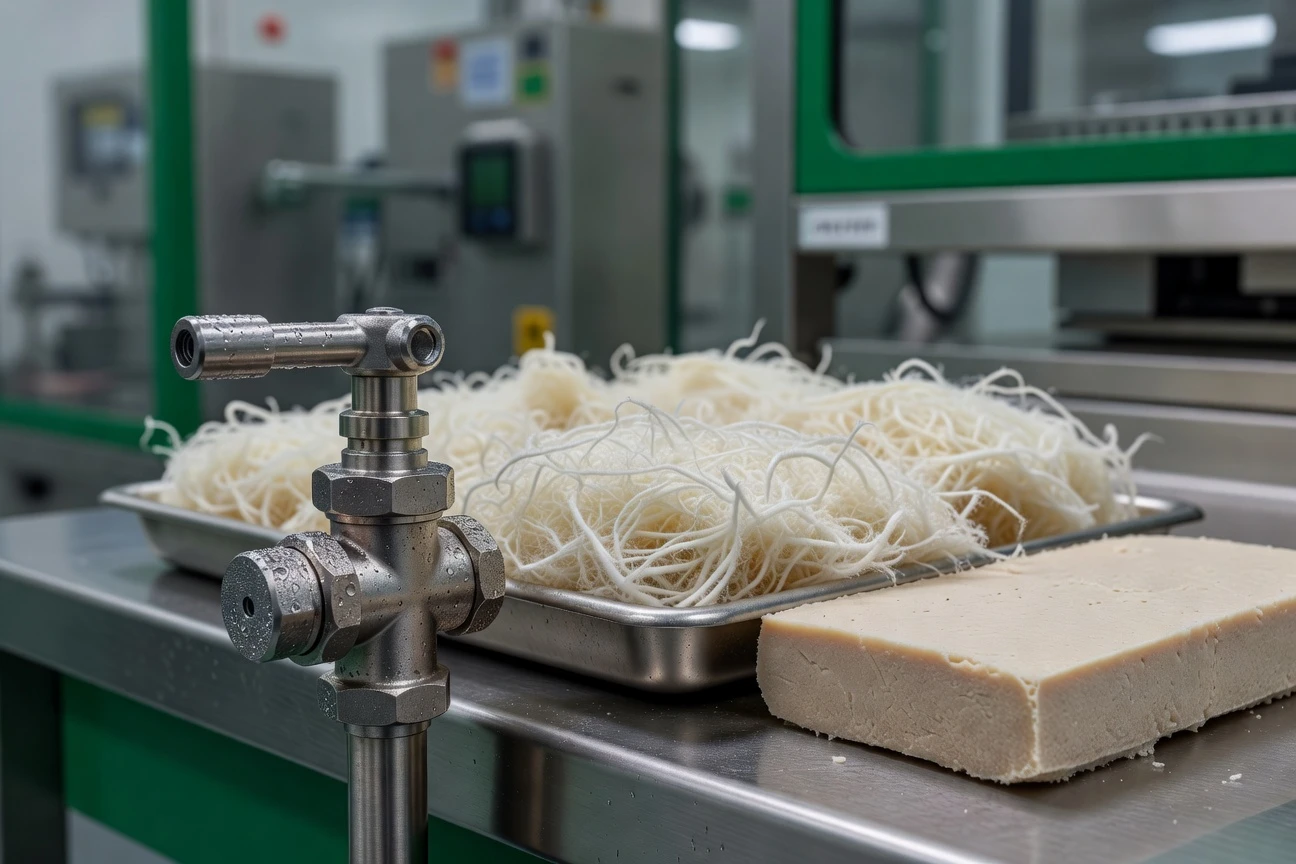
Whole Cuts Give the Deal Its Product Logic
Whole cuts are the hardest shelf test. Consumers forgive a burger patty for being engineered. A fillet has fewer hiding places. It has to pull apart, brown, hold moisture and carry flavor without looking like a reassembled paste.
Bosque’s own site makes that product ambition explicit, describing whole-muscle chunks, strips, cuts and filets. Its process also points to solid-state fermentation, a method where fungi grow on moist solid materials rather than only in a stirred liquid tank. That distinction matters because texture can emerge from the way the organism grows, not only from what a food scientist adds later.
- Whole-cut texture can help mycelium move beyond balls, patties and minced formats.
- Solid feedstocks can use low-value agri-food side streams, if the economics and safety work.
- A wider product range gives foodservice buyers more menu options than a single patty line.
The buyer already signalled this commercial path last spring, when it launched mushroom-based products for German foodservice under the MushRoots brand. That launch used ingredients with a clearer market route while the deeper mycoprotein work kept moving through regulation.
The timing also fits a broader European reset in foodtech funding. As Thunder Tiger Europe Media noted in its coverage of Europe’s foodtech reset, investors have been rotating from broad consumer narratives toward companies that can show technical defensibility and a path to scale.
EU Approval Still Sets the Pace
For all the industrial talk, the European Union (EU, the bloc’s single market and regulatory system) remains the gatekeeper. The European Food Safety Authority (EFSA, the agency that assesses food safety risks) says novel food covers products not consumed to a significant degree in the EU before May 15, 1997, including foods produced by new technologies or from new sources.
That is why the approval file can become as important as the recipe. EFSA says applicants must provide data on composition, nutrition, toxicology, allergenicity, production process, proposed uses and use levels. Once a dossier is valid, EFSA normally has nine months for risk assessment, although requests for more information can stop the clock, and the Commission process follows after that.
A useful snapshot of the regulatory and market box around this deal:
- More than 200 novel foods are approved for sale in the EU, according to EFSA’s novel food overview.
- Nine months is EFSA’s standard assessment window for a valid novel food risk review before any pauses for extra data.
- Seven months is the Commission-side period EFSA describes after the scientific assessment before member-state decision making.
That sequence helps explain why buying process knowledge can be faster than waiting for a single product to clear every hurdle. A company with better characterization data, better batch records and clearer production controls has a better chance of answering regulators without rebuilding the science each time.
Process Data Has Become the Fundraising Currency
The deal also lands in a colder funding market. The Good Food Institute’s latest fermentation report says companies operating primarily in fermentation raised $357 million in private funding in 2025, down from $632 million the prior year. The same report counted 163 specialized fermentation companies and described a sector still pushing through technical, cost and regulatory hurdles.
That backdrop changes what an acquisition means. In a cheap-money market, a startup could raise another round to duplicate capabilities internally. In the current market, buying a distressed or constrained peer’s data, team experience and intellectual property (IP, legal protection for inventions and process know-how) can be the shorter route.
The next phase of mycelium will not be determined solely by isolated breakthroughs, but by companies that can integrate biology, process data, IP and industrial implementation. By bringing together complementary mycelium technologies, datasets and process expertise, we can scale up faster, develop across a wider range of product formats and translate technical progress more efficiently into industrially relevant applications.
That was the way Dr. Mazen Rizk, founder and chief executive of Infinite Roots, described the transaction in the acquisition announcement. It is a founder’s line, but it matches the market evidence.
The European Patent Office’s Infinite Roots case study on IP shows how far this logic already runs through the company. The study says later-stage investors treated patent protection, freedom to operate and a developed IP strategy as core diligence points, not paperwork after the fact.
Reproducibility Is the Hard Manufacturing Test
The acquisition will be judged on whether the combined platform can turn biology into repeatable manufacturing. Mycelium behaves like a living system because it is one. Growth medium, temperature, moisture, strain selection and harvesting conditions can all affect output.
That is where solid-state and liquid approaches may help each other. Liquid fermentation can suit controlled scale and data-rich bioreactors. Solid-state work can support fibrous structure and whole-cut formats. Combining both does not guarantee a cheap product, but it gives the company more knobs to tune.
The list of risks is still long:
- Batch-to-batch consistency has to hold when production moves beyond pilot runs.
- Feedstock sourcing has to be cheap, clean and predictable across seasons.
- Texture has to survive cooking, freezing, transport and restaurant prep.
- Regulatory files have to describe the process in enough detail without giving away the moat.
This is why industrial reproducibility has become a better phrase than disruption for mycelium food. The companies that win will likely sound boring for a while. They will talk about yield curves, moisture profiles, contamination control and documentation before they talk about replacing steak.
Adjacent European foodtech categories are learning the same lesson. Cocoa-free chocolate, for example, has moved from climate pitch to scale pitch, as seen in Thunder Tiger Europe Media’s report on Foreverland’s funding for cocoa-free chocolate. The products differ, but the investor question is the same: can the process leave the pilot line?
Germany Gets Its Industrial Mycelium Case
Germany now has a compact test case for the next phase of alternative protein. The assets sit in two cities with strong foodtech and biotech talent pools. The buyer has strategic backers from retail, consumer goods and public innovation finance. The acquired company brings a product problem that consumers can understand in one bite.
None of that removes the bottleneck. EU authorization, manufacturing economics and consumer acceptance still have to meet at the same point. A product that regulators accept but diners ignore is a science project. A product diners like but factories cannot make cheaply is a restaurant special.
The acquisition gives the combined group a more complete toolkit. It does not give it a shortcut around the hard parts of industrial food.
If the added Bosque technology helps turn mycelium into consistent whole-cut products at scale, the deal will look early and disciplined. If it becomes another archive of promising lab work, the sector’s next lesson will be just as clear: fungi can grow quickly, but food companies rarely do.


Replit Opens Its London Office Inside an AI Crowd

Straight Circle Trailer Lands Without a U.S. Date

Anemo Labs Bets £700,000 on an AI Sense of Smell

Nintendo Prices the Zelda 40th Switch 2 at $519

Copilot Capital Buys the Autopilot Already Running 90 GW

Ground A Raises €9.1 Million for a Pallet Laser

Gibney’s Musk Film Opens in Venice Without Its Subject

Torvalds Blames AI for a Full-Fat Linux 7.3-rc2

Dexter Returns Sharper, Older, and Stuck Between Killers

Meta’s Muse Agent Can Spend Before the Privacy Lock

Walter’s TWG Insists No Fraud as Insurer Probes Force Cleanup

30-Year Yield Hits 5.32% Highest Since 2007 as Debt Supply Locks In Costs

PCE Stays at 3.7% as Gas and Tariffs Outrun Coming Revisions

Evernorth S-4 Clears Path for Active XRP Treasury on Nasdaq

Astute’s $1.2M bet makes B2B creator deals feed AI discovery

Strategy Parks $1.59B Cash While Bitcoin Stack Stays Flat

Instinct Hits $2.5 Billion as AI Agent Access Sparks Trust Fights

CLARITY Act Cloture Opens a Door Ethics Still Blocks

Oracle’s 2.8 GW Bloom Deal Exposes the AI Power Bypass

Space Mirror Demo Revives 1993 Russian Night-Light Test
-
 FINANCE3 months ago
Zcash Patched a Double-Spend Bug as ZEC Climbed 5%
-
 ENTERTAINMENT3 months ago
Steam Summer Sale 2026 Locks In June 25 to July 9 Dates
-

 FINANCE2 months ago
CLARITY Act Final Text Expected This Weekend as 60-Vote Hurdle Looms
-
 NEWS4 months ago
Meta Adds AI Replies to Threads, But Users Can’t Block It
-
 ENTERTAINMENT5 months ago
Extraction 3 Is Officially Coming to Netflix in 2027
-

 NEWS3 months ago
YouTube Shorts is testing a heart in place of the thumbs-up
-

 NEWS1 month ago
Senators Force Apple Off Chinese Memory as Big Three Cash In
-

 NEWS3 months ago
NEURA Robotics’ $1.4B Series C Redraws Europe’s Physical AI Bet