
NEWS
Invisix Raises €20 Million to Measure Chips Fabs Cannot See
Invisix raised €20 million after ASML spun out process metrology, betting that 3D AI chips now lose yield because optical tools cannot see inside them.

Invisix closed an oversubscribed €20 million seed round on June 1, 2026, to measure 3D chips without cutting the wafer. Hitachi Ventures, Transition Ventures, imec.xpand, Doosan Investment Co. and an unnamed tier-1 chipmaker put up the money.
The Dutch company is not selling a prettier microscope. It is selling a way to check buried layers at production speed, which is now where yield slips on the chips that train and run AI models.
Metrology Now Caps Yield on 3D Chips
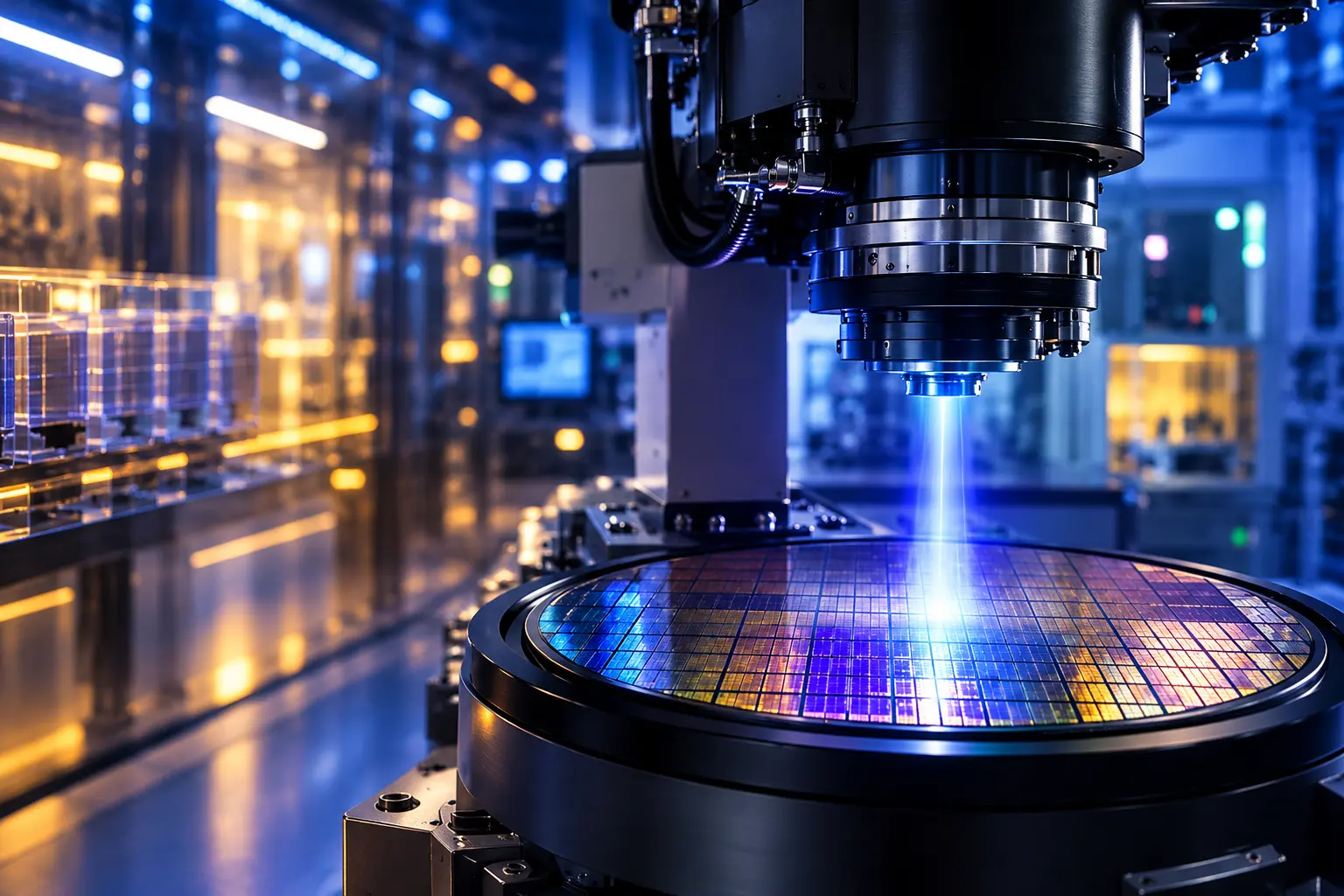
A modern logic or memory die is stacked like a tiny tower. Each floor has to print before the next one goes down, and a misspent cavity etch or a tilted channel hole can scrap the wafer. Optical scatterometry still runs most of those checks, and it is going blind on the parts that sit under other material.
Gate-all-around transistors put several silicon nanosheets on top of one another. Inner spacers, sheet-to-sheet thickness and the timed etches that open those cavities do not show up in a top-down image. Memory is worse in a different way: 3D NAND now runs 200, 300 and 400-plus layers, with channel holes only tens of nanometres wide punching through tens of microns of film.
When light cannot reach the bottom of those holes, fabs fall back on cutting samples for electron microscopes. That destroys the wafer and can only be done on a sliver of lots, so process engineers fly partly blind while they ramp a node. Wolfgang Seibold, partner and chief investment officer at Hitachi Ventures, put the commercial point without dressing it up.
As semiconductor architectures grow more three-dimensional, metrology increasingly limits semiconductor yield and ramp speed, with each new node generation intensifying the challenge.
Wolfgang Seibold, Partner and Chief Investment Officer, Hitachi Ventures
That is the second-order effect behind a hardware seed of this size. The tool is a means. The purchase order, if it ever comes, is for faster ramps and fewer wafers sawn open for a look.
Why ASML Licensed the Physics Instead of Selling the Tool
Invisix was founded in 2025 in Eindhoven on technology licensed from ASML. The physics sat inside the lithography group from 2015. Christina Porter, co-founder and chief executive, is a University of Colorado Boulder physics PhD who pitched high-harmonic-generation metrology to ASML that year and then spent seven years as a project leader and pathfinding architect on the soft x-ray programme. Sietse van der Post, co-founder and chief technology officer, spent twelve years in ASML Research, ten of them as sensing architect and main architect on the same effort.
ASML already sells overlay and scanner-control metrology, the measurements that feed back into the exposure tool. Process control on device internals sits further down the line. In April 2026, before the seed was public, the spin-out was described as a bet ASML would not productise itself: the lithography company keeps the loops that make scanners print better, and a wider yield tool was judged out of that map, yet promising enough to license rather than kill.
Porter has said she founded the company after reading The Innovator’s Dilemma, convinced the method would move faster as a startup. Van der Post, an inventor on 31 published patents, has said an independent shop was the right place to turn the research into a tool that survives a fab. ASML did not walk away from the underlying light source. It still files an ASML patent on high harmonic generation for metrology, which fits a split: scanner-adjacent work stays in Veldhoven, and the process-control box left with two alumni.
THE SXR PATH OUT OF ASML
- 2015: Porter pitches high-harmonic-generation metrology to ASML and moves to the Netherlands.
- 2015 to 2025: Soft x-ray work continues inside ASML Research, with van der Post as main architect.
- April 27, 2023: Porter and colleagues, including Intel researchers, present soft x-ray profilometry and overlay on gate-all-around devices.
- October 3, 2023: Pierre Agostini, Ferenc Krausz and Anne L’Huillier receive the Nobel Prize in Physics for attosecond light methods built on the same harmonic physics.
- 2025: Invisix is founded in Eindhoven on a licensed ASML package.
- April 23, 2026: The company is framed as a process-control spin-out ASML would not sell beside its scanners.
- June 1, 2026: The oversubscribed €20 million seed closes.
Roald Dogge, chief operating officer, spent ten years at NTS, a Dutch contract manufacturer, including a stretch as COO, after eleven years at Volvo. Hens van Ooijen, chief financial officer, spent thirteen years in finance at FEI and Thermo Fisher Scientific and eight years around high-tech startups. The operating bench looks like a company that expects to build machines, not a lab that expects to write papers.
A Nobel Light Trick Now Aimed at Buried Nanosheets
High harmonic generation fires a short-pulsed laser into a noble gas. The atoms throw off soft x-rays at many wavelengths, a broadband burst rather than a single laser colour. Reconstruction software and machine learning then turn the diffracted light into a 3D model of the structure. The company ties that source to work recognised in the 2023 Nobel Prize in Physics, awarded to Agostini, Krausz and L’Huillier of Lund University for attosecond pulses. Photonics coverage of the round also noted a long collaboration with L’Huillier’s group.
Shorter wavelength is the same lever lithography already pulled. Visible light averages several nanosheets into one blob. Soft x-rays scatter from features closer to the size of the device, so the inverse problem has more independent information and less confusion from material optical constants. Invisix says the system can more than four times as many parameters as optical CD scatterometry, and that it can read individual nanosheets instead of a stack average.
WHAT THE EINDHOVEN BENCH IS BUILT TO MEASURE
- Logic profiles: Individual nanosheets, lateral timed etches and 3D conformal films on gate-all-around and complementary FET flows.
- DRAM etches: Depth profiles on the hardest steps in 4F2 memory, a denser cell than today’s 6F2 designs.
- Product overlay: After-develop and after-etch measurements on the device unit cell, without extra marks and the offsets those marks create.
- NAND holes: Channel geometry through stacks the company cites at 200, 300 and 400-plus layers, claiming aspect ratios above 100:1 and tilt below 0.05 degrees, without slicing the wafer.
- Unpatterned films: Characterisation of complementary FET mandrels before the pattern is even there.
Those are product claims from the company’s own site, not independent fab data. The 2023 conference paper was more cautious. It called soft x-ray scatterometry at short wavelength a promising route for 3D profile and overlay, and said gate-all-around timed etches still lacked an established high-volume metrology solution. That gap is what the seed is paying to close.
Hitachi, Doosan and a Chipmaker Wrote the Check
Hardware seeds this large are unusual because the first tool is still a prototype. Porter has called the ASML years a de-risking that seed-stage kit rarely gets, and she has said customers get a shorter path to a machine on the floor. The cap table is built to test that claim with people who already sell into, or buy from, chip plants.
WHO PUT MONEY INTO THE SPIN-OUT
| Investor | Type | What is public |
|---|---|---|
| Hitachi Ventures | Corporate VC of Hitachi, more than $1 billion under management | Seibold argued metrology now limits yield and ramp speed |
| Transition Ventures | London early-stage firm | Partner Clara Ricard said the tool targets a bottleneck in chips used for AI training and inference |
| imec.xpand | Deep-tech fund tied to imec | imec is already named as a research partner on the technology |
| Doosan Investment Co. | Corporate investor | Named in the round; no further thesis released |
| Unnamed tier-1 chipmaker | Strategic | A customer sitting on the cap table, identity not disclosed |
A chipmaker writing a seed cheque is a stronger signal than another software fund. In this industry, process tools get paid when a fab believes they will sit on the line. The company has not named that manufacturer, and it should stay unnamed until someone on the record does.
Clara Ricard, a partner at Transition Ventures, said Invisix is chasing a bottleneck in making the advanced chips used for AI training and inference, and that the physics is already de-risked relative to a typical seed. Porter would not give a date for the first shippable system. The money is earmarked to grow the team, finish that system, and keep customer demos running from a new Eindhoven cleanroom that now holds a 300 mm wafer-capable testbench.
Optical Tools Still Run the Fab Floor
Porter has said nobody yet has a soft x-ray metrology tool on the market, and she named KLA, Nova and Onto as the optical incumbents. That sentence is easy to over-read. X-ray metrology is already in plants. KLA sells optical and X-ray critical-dimension tools, including the Axion T2000 for high-aspect-ratio 3D NAND and DRAM shapes, and SpectraShape optical systems aimed at nanosheets, DRAM and stacked NAND. Applied Materials and others sell high-landing-energy e-beam review. Automated TEM still supplies the atomic-scale reference, on a destroyed sample.
The live gap is narrower than “bring X-rays to the fab.” Hard X-ray CD scatterometry is a memory-hole tool. Soft x-ray broadband scatterometry, if it works at throughput, is a bid to reconstruct gate-all-around nanosheets and to read overlay on the product cell rather than on a nearby mark. Those are different jobs, and they fail in different ways. Optical models lose spectral resolution in deep holes and cannot separate sheet-to-sheet error. TEM is accurate and slow. Invisix has to beat both on a 300 mm line, not in a paper.
The public conversation around the round barely treated that distinction. Chip-industry voices filed it as another Brainport spin-out. Elsewhere, traders tried to map a Dutch soft x-ray startup onto domestic industrial X-ray names, which only underlines that X-ray inspection is already a category. The sharper test is whether a harmonic-generation scatterometer can hold recipe stability, throughput and matching to TEM once a foundry starts paying by the wafer pass.
The Eindhoven Cleanroom Is the Product for Now
Porter’s line on the round was blunt, and it is still the company’s slogan.
Semiconductor manufacturers can’t build what they can’t see. As chips become more 3D, the industry needs a new generation of metrology tools that can look inside these incredibly complex miniature skyscrapers without destroying them.
Christina Porter, Co-founder and CEO, Invisix
The company says the method has been shown with Intel and imec, including on next-generation gate-all-around transistors, and that demos continue in Eindhoven. At the round it had 17 full-time staff and planned to grow in the second half of 2026. It has advertised for device experts who can sit with Samsung, TSMC, Intel, Micron or SK Hynix process teams and defend models in the room. Porter said staff already come from nine countries, and that the company stayed in Eindhoven because the team and the supply chain were already there.
WHAT WE KNOW
- The round: An oversubscribed €20 million seed closed on June 1, 2026, with the five backers named above.
- The package: A decade of soft x-ray work inside ASML, licensed into a 2025 Eindhoven company, with 100+ pending and issued patents and 1.5K publication citations listed on the site.
- The bench: A 300 mm-capable test platform in a new Eindhoven cleanroom, used for customer demos while the first shippable tool is built.
WHAT IS UNCONFIRMED
- Ship date: Porter declined to say when the first production system leaves Eindhoven.
- The chipmaker: The tier-1 manufacturer on the cap table has not been named on the record.
- Fab results: Independent high-volume matching data against optical CD and TEM have not been published with the round.
Through mid-September 2026 there has been no follow-on product announcement, which is normal for a tool still in demonstration. The next fact that matters is not another quote about skyscrapers. It is a serial-numbered system on a foundry floor, running the etches optical tools still average away.

UPI MDR Delay Hands Traders the Calendar After Paytm Falls

Google Messages Builds Nine In-Chat Games After Samsung’s Exit

Anthropic’s $100 Million Academy Trains the Firms That Bill Both Sides

Toyota’s Electric C-HR Leaves the Cheap Twin to Subaru

Markets Bet the Fed Skips October After Hawkish Minutes

The Orchard Bug Forced Zcash to Open an Empty Pool

The $5.99 Game That Won Steam’s 2026 Summer Sale

Don Lee Joins Hemsworth as Extraction 3 Starts Shooting

YouTube Shorts Retires Dislikes and Swaps Likes for Hearts

Atlantic City Turned WWE’s Return Into a Civic Night
-
 NEWS5 months ago
The Orchard Bug Forced Zcash to Open an Empty Pool
-
 GAMING5 months ago
The $5.99 Game That Won Steam’s 2026 Summer Sale
-
 ENTERTAINMENT7 months ago
Don Lee Joins Hemsworth as Extraction 3 Starts Shooting
-
 NEWS5 months ago
YouTube Shorts Retires Dislikes and Swaps Likes for Hearts
-
 NEWS5 months ago
Atlantic City Turned WWE’s Return Into a Civic Night
-

 NEWS5 months ago
NEURA Robotics Is Spending Its $1.4B on a Machine Stack
-

 AUTO6 months ago
Kawasaki Bets the New Z1100 Against Its Own Supercharger
-
 BUSINESS5 months ago
Norway’s Export Bank Backs Nscale’s $790 Million Narvik Loan