
NEWS
Paris Hilton Built a Pink Android App With Three Gemini Prompts
Google names Paris Hilton Android’s first Icon in Residence. She built a pink app with three prompts and hosted a campus challenge for teen students.

Google has named Paris Hilton as Android’s first-ever “Icon in Residence,” and she celebrated the role by building a pink productivity app called Iconic Ideas using only three text prompts in Gemini Canvas. The partnership, announced on Google’s blog on Tuesday, puts Hilton at the front of a wider campaign to reframe app creation as a conversation with AI. Google used the same campus visit to put a cohort of young women from the YMCA and Altadena Girls through the same prompt-to-app workflow.
Paris Hilton Becomes Android’s First Icon in Residence
Google’s announcement on The Keyword names Hilton as the first person to hold the title. Paris Hilton’s first-person Icon in Residence essay lays out the framing in her own words and sets the tone for the wider campaign.
Hilton is a long-time Android user, by her own account, and a self-described “undercover nerd” who has spent her career turning ideas into businesses at speed. She frames the new role as a deliberate break with the assumption that app building belongs only to engineers and developers. “The future should be built by artists, entrepreneurs, dreamers, creators and people who see the world differently,” she wrote in the post. Hilton has been public about her ADHD diagnosis, and the framing of the partnership leans on it.
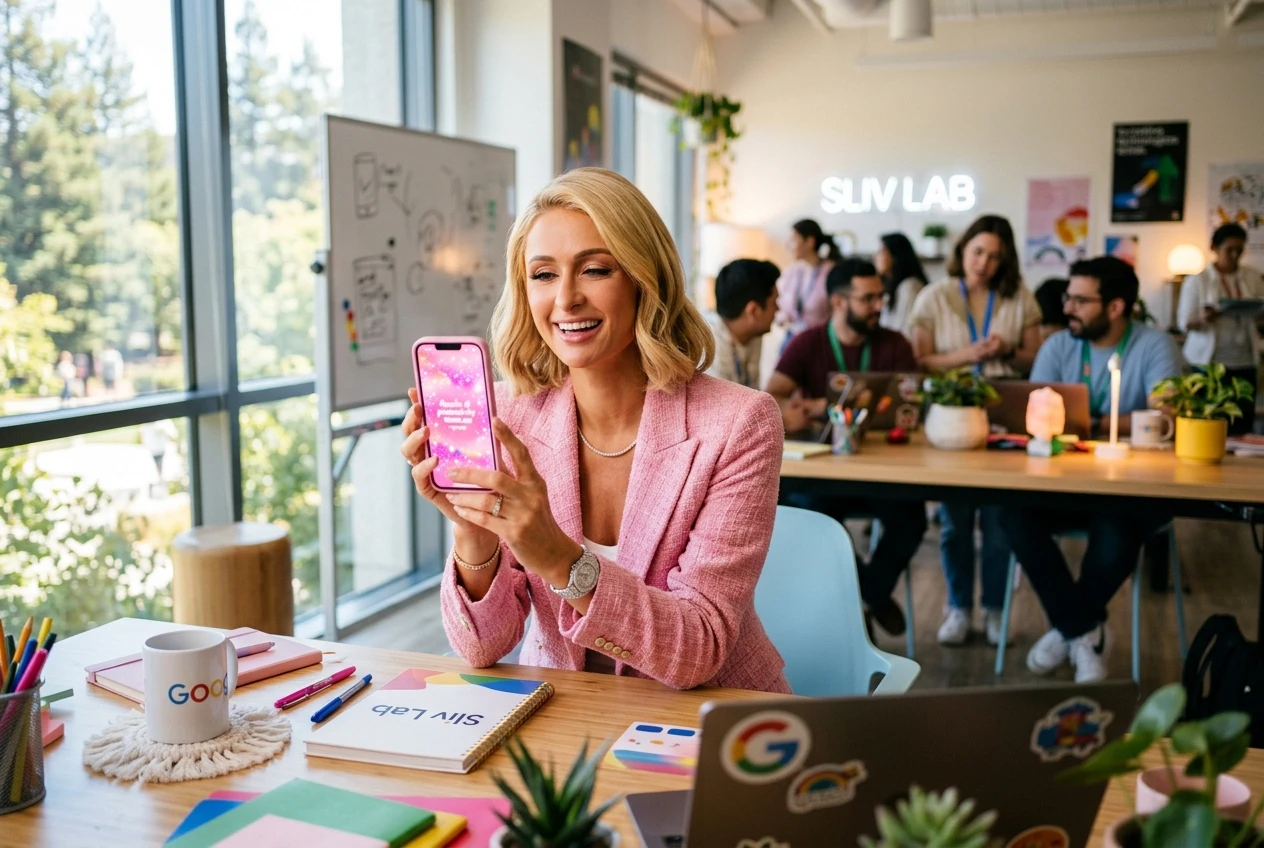
Google’s Android team built a custom workspace on its campus called the “Sliv Lab” for the visit, where Hilton worked alongside creative technologists and stress-tested Gemini on Android. 9to5google reports the partnership is Hilton’s second high-profile Android deal, following a previous collaboration with Motorola on the pink Razr foldable.
Three Prompts and a Pink Productivity App
The app Hilton built is called Iconic Ideas, a productivity tool designed to match the way her ADHD brain generates a constant stream of business ideas, creative concepts and to-do items. Google asked her to describe what she wanted in plain language. The Iconic Ideas template and try-it-yourself page is now live for anyone to launch, fork or rebuild from scratch.
After just three prompts in Canvas, Hilton says, the app was already taking shape. She did not write code. The interface is, in her words, pink and sparkly, “obviously,” a design choice Google preserved in the public template. The landing page also reveals a small gamification hook: users earn “sparkle points” for crossing items off their lists, in the same pink-and-sparkly visual language.
I didn’t have to write code. I described a vision, and Gemini bridged the gap between the idea in my head and an app I could actually use. And yes, it’s completely pink and sparkly, obviously.
Paris Hilton, writing in a first-person essay published Tuesday on Google’s blog, on building Iconic Ideas inside Gemini Canvas. Google credits Hilton with the prompts; the Sliv Lab team provided the build environment.
What Young Women Built in a Single Afternoon
Hilton was not the only one building. Google and Hilton invited young women from the YMCA and Altadena Girls to Google’s campus for an Android Innovation Challenge, where the participants used Gemini Canvas, Circle to Search, Nano Banana and Gemini Omni to build real apps. Google says the work the cohort produced in just an afternoon was “awe-inspiring.” The challenge lineup included a social networking app that prioritizes user well-being and a virtual hairstyle try-on tool built on Nano Banana.
The challenge winner built an app that helps girls walk home safely from school, share their location with their parents, and report hazards along the route. Google did not name the participant, but the app went further than Hilton’s Iconic Ideas in one specific way: it solved a real-world safety problem with location and reporting features that a productivity app does not. It also showed that the same prompt-to-app workflow scales to a young woman with no coding background.
Three apps the students built:
- A school-safety app that shares a participant’s location with parents and reports route hazards along the way.
- A social network that puts user well-being ahead of engagement metrics.
- A virtual try-on tool that previews different hairstyles using Nano Banana.
Why Google Put a Cohort of Young Women on Stage
Hilton is the headline. The rest of the campaign, including the Android Innovation Challenge and the Google AI Studio launch, makes the pitch that app building no longer requires an engineering background. The participants are the proof, and they reach an audience the celebrity tie-up does not. The I/O 2026 announcement of native Android vibe coding inside Google AI Studio turns the same pitch into a product any user can try.
The launch coincides with a wider push. At Google I/O 2026, the company introduced native Android vibe coding inside Google AI Studio, a separate but parallel product that lets anyone build a working Android app from a prompt. Hilton’s Iconic Ideas is a marketing showcase for a category Google is now actively shipping. The same week Google tells the public a celebrity can build an app, the public can build one too, in the same tool, on the same campus.
A single celebrity-built app is a press release. The cohort of young women that left Google’s campus with working apps reaches an audience the celebrity tie-up does not: parents, teachers, YMCA coordinators, and the young women themselves. Hilton’s pink productivity app lands in front of cameras and entertainment outlets. The student challenge lands in front of every parent, teacher and YMCA coordinator who hears about it. The two halves of the campaign target different buyers of the same message.
Google is paying Hilton to be the user-facing face of a campaign that reframes app creation as a creative act. Hilton is the visible user. The rest of the campaign is the argument that everyone else can be one too, and the same tools Hilton used in the Sliv Lab are now available to anyone with a Google account.
By the numbers:
- 1 Icon in Residence appointed to date: Paris Hilton.
- 3 prompts Hilton used in Gemini Canvas to build Iconic Ideas.
- 1 afternoon for the YMCA and Altadena Girls cohort to ship working apps.
- 1 student winner: the school-safety walking-home app.
From Razr to Gemini, Hilton’s Second Android Act
This is not Hilton’s first Android deal. 9to5google frames it as her second big partnership inside the ecosystem, after an extended run with Motorola on the Razr foldable. The earlier tie-up sold a phone: the bright pink Razr, marketed to Hilton’s audience as a fashion object. The new tie-up sells a different product: a tool, a workflow, and a category of consumer that the industry has not yet named.
The split between the two deals is visible on Google’s own landing page. Razr partnerships move hardware. Hilton’s new role moves software literacy. The android.com/paris page even surfaces the Razr fold as “Paris’s favorite phone,” a quiet piece of product placement that bridges the two partnerships and underlines that Hilton is now bridging both.
How to Try Iconic Ideas and Build Your Own
Readers can try the app Google and Hilton built without writing code or installing developer tools. The template is live now, alongside the rest of the campaign materials.
- Open android.com/paris in a phone or laptop browser.
- Tap the “Try Iconic Ideas” prompt on the landing page to launch Hilton’s template inside Gemini Canvas.
- Describe the app you want in plain language, the way Hilton did, using as few as three prompts.
- Use the in-Canvas preview to refine the look and feel before publishing or remixing the result.
For readers who want to go further than Iconic Ideas, Google AI Studio now supports native Android vibe coding with the same prompt-to-app flow, including an in-browser emulator and one-click publishing to Google Play’s internal test track. The tools Hilton used in the Sliv Lab are the same ones the I/O 2026 announcement made available to any user with a Google account, and the “Sliv Lab” Hilton namechecks is, in effect, now open to everyone.
Frequently Asked Questions
What app did Paris Hilton build with Google?
Paris Hilton built Iconic Ideas, a pink-themed productivity app that runs on Google’s Gemini Canvas. The app is designed to catch the rapid-fire ideas her ADHD brain produces, and Google says Hilton shipped a working version after typing only three text prompts.
What is vibe coding?
Vibe coding is the practice of describing an app in plain language and letting a generative AI model assemble the working result. Hilton’s Iconic Ideas is Google’s first mainstream celebrity demonstration of the technique. Google I/O 2026 made the same workflow available to any user inside Google AI Studio.
How can I try Iconic Ideas myself?
Visit android.com/paris, where Hilton’s template is hosted. You can launch the app as built, fork the design, or write your own prompts to spin up a different productivity tool. No coding background is required.
What was the Android Innovation Challenge?
A one-afternoon campus event Google and Hilton hosted for young women from the YMCA and Altadena Girls. The participants used Gemini Canvas, Circle to Search, Nano Banana and Gemini Omni to build working apps, with the winning entry focused on girls walking home safely from school.
Has Paris Hilton worked with Google before?
This is her first partnership directly with Google. 9to5google, however, frames it as her second high-profile Android deal after a previous partnership with Motorola on the pink Razr foldable.


Galaxy Ring’s FDA Sleep Apnea Clearance Faces a Familiar Wait

kausable’s €12 Million Seed Joins a Quiet Bet Against AI Scaling

Bitcoin ETFs Shed $225 Million as Treasury’s Biggest Buyers Retreat

telli Raises $15 Million Seed to Rival Billion-Dollar AI Giants

PageMind Raises €1.2 Million to Crack AI Shopping Search

Hackers Hijack Robinhood CEO’s X to Push Fake Memecoin

Apple’s Trade Secrets Suit Against OpenAI Is Europe’s Problem Too

Adobe’s Patch Leaves WhatsApp’s Own Security Gap Untouched

Reddit and Publishers Weigh Blocking Google Over AI Traffic Losses

CuspAI’s $2.6 Billion Bet Echoes AI Drug Discovery’s Playbook

CLARITY Act Final Text Expected This Weekend as 60-Vote Hurdle Looms

Fed Minutes Cite AI Demand as Inflation Risk, Put a 2026 Hike Back on the Map

Kalshi Loses Major NY Prediction Markets Ruling to Judge Torres

Marker AI Writing Startup Lands $13M Seed Led by Index Ventures

Dota 2 Esports World Cup 2026: Spirit Defends $2M Title In Paris

Meta’s Muse Spark 1.1 Beats Rivals on Price, Trails on Coding

CS2 Premier Season 5 Lands With Cache and a C4 Damage Rework

Trump Calls Iran ‘Islamic Republic of Japan’ as Ceasefire Ends

ARC Intelligence Closes €4M Seed Round in Roughly a Week

Finto Picks Munich Over Silicon Valley After YC, Raises $3.4M
-
 FINANCE2 months ago
Zcash Patched a Double-Spend Bug as ZEC Climbed 5%
-
 ENTERTAINMENT2 months ago
Steam Summer Sale 2026 Locks In June 25 to July 9 Dates
-
 NEWS2 months ago
Meta Adds AI Replies to Threads, But Users Can’t Block It
-
 FINANCE3 weeks ago
CLARITY Act Final Text Expected This Weekend as 60-Vote Hurdle Looms
-
 ENTERTAINMENT2 months ago
‘Widow’s Bay’ Review: Apple TV’s Sleeper Horror-Comedy Earns Its Fog
-
 NEWS7 months ago
FolderFresh Review: This Free Tool Automates Windows File Organizing
-
 NEWS4 months ago
U.S. Navy Deploys Solar-Powered Lightfish Drone to Patrol Oceans
-
 FINANCE2 weeks ago
Fed Minutes Cite AI Demand as Inflation Risk, Put a 2026 Hike Back on the Map