
FINANCE
Robinhood Lets AI Agents Trade Your Stocks and Swipe Your Card

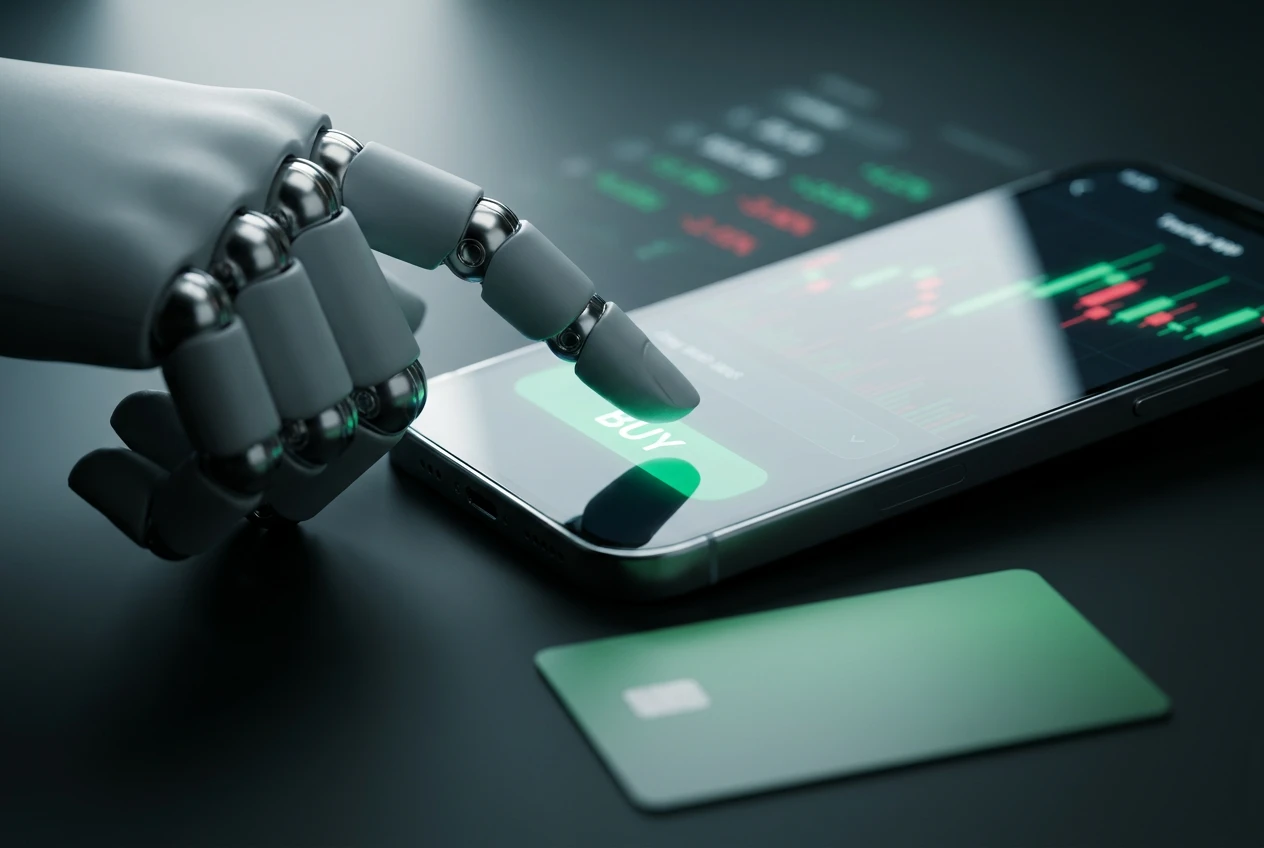
Robinhood flipped a switch on May 27 that lets an artificial intelligence agent buy and sell stocks from your account and swipe a credit card on your behalf. The brokerage calls the two products agentic trading and an agentic credit card, and both hand routine money decisions to bots built by outfits like OpenAI and Anthropic. The pitch is convenience plus a 3% cash back sweetener. The catch buried in the fine print is that you, not Robinhood, absorb the losses if the bot gets it wrong.
That trade-off is the part most of the launch-day coverage skipped past. The bigger shift sits underneath the app: a payments race where Visa and Mastercard are already wiring the same machine-spending plumbing, and Robinhood just became the first major US broker to point it straight at a retail brokerage account.
Robinhood Hands the Order Ticket to a Bot
Here is the mechanic that matters. When you switch on agentic trading, Robinhood opens a dedicated account that sits apart from your main portfolio. The agent can only touch the cash and positions you move into that account, so a bot cannot drain your retirement holdings to chase a meme stock. You fund the sandbox, and the sandbox is all the software sees.
Inside that account, the agent places real orders without asking you to confirm each one. You describe a strategy in plain language, rebalance when one sector gets too heavy, buy a stock if it dips to a set price, and the software executes. For now the system trades equities only while it sits in beta. Robinhood says options, crypto, futures and the prediction-market event contracts the company has been pushing will follow once the beta widens.
To keep a human near the controls, Robinhood bolts on a set of guardrails:
- A push notification fires the moment the agent executes a trade
- A real-time activity feed tracks every order and your running profit and loss
- You can preview orders before they go live
- One tap disconnects the agent and freezes the account instantly
The design intent is clear enough. Robinhood wants the bot to feel like a junior trader you can fire at any second, not a black box running unsupervised. Whether casual users actually watch those notifications is a different question, and it is the one that decides how this plays out. The full terms sit in Robinhood’s agentic finance announcement.
The MCP Plug That Lets Any Agent In
None of this would scale without a common connector, and that connector is the reason the launch is more than a gimmick. Robinhood built what it calls AI-native MCP servers. MCP, short for Model Context Protocol, is an open standard that lets AI assistants reach out to external tools and data through a single shared interface.
The practical upshot is that you do not need a Robinhood-branded bot. Any agent that speaks the protocol can connect, and the company specifically lists Claude, ChatGPT, Codex and the coding assistant Cursor as working out of the box. Plug the agent into the server, point it at your funded account, and it can read market data and fire orders.
That openness is a deliberate bet. By leaning on a protocol that the wider AI industry is rallying around, rather than a closed in-house assistant, Robinhood positions itself as the brokerage rail that whatever agent wins the consumer race eventually plugs into. You can read the technical shape of that standard in the open Model Context Protocol specification. It is a smart play, and it is also the exact spot where the security questions start.
Why Visa and Mastercard Are in the Same Race
Robinhood did not invent agentic finance, and it is not running alone. The card networks have spent the past year building the payment plumbing that lets software, not people, complete a checkout. Visa rolled out Intelligent Commerce, a framework that issues scoped tokenized credentials to agents and verifies machine-initiated payments. Mastercard answered with Agent Pay, pairing agentic tokens with agent-aware identity and checkout.
The scale they are pointing at is the tell. Visa said its program had already produced hundreds of controlled, real-world agent-initiated transactions and predicted that millions of consumers would buy through AI agents by the 2026 holiday season. That forecast sits in Visa’s announcement on secure AI transactions. Mastercard, meanwhile, has stretched its agentic rails into Hong Kong as part of a push toward an international network for machine commerce.
| Player | What the agent can do | Where it stands |
|---|---|---|
| Robinhood agentic finance | Trade equities and shop with a virtual card | Beta, US, launched May 27 |
| Visa Intelligent Commerce | Complete tokenized checkouts for agents | Targeting mass use by holiday 2026 |
| Mastercard Agent Pay | Authorize agent purchases via agentic tokens | Expanding internationally, now in Hong Kong |
Seen against that backdrop, Robinhood’s move reads less like a one-off feature and more like a land grab. The same wave is pulling in startups too, with venture money flowing into companies building the agent layer for shopping, a trend visible in deals like the funding behind the broader agentic commerce wave. The difference is that Robinhood attached the agent to something far more sensitive than a sneaker cart. It attached it to a brokerage account.
The Virtual Card That Shops While You Sleep
The spending side works on the same separation principle. Connect an agent to Robinhood’s banking layer and it gets access to a dedicated virtual version of the Robinhood Gold Card, with Platinum support promised later. Your real card number and the rest of your account stay hidden from the bot.
From there the agent can scan the web for the lowest price, check whether an item is in stock, and buy it under rules you set. Robinhood floats the obvious use cases: catch a sneaker price drop, reorder pet food on Amazon, book a flight or grab a hard-to-get restaurant reservation. Every purchase earns the standard cash-back rate.
The controls mirror the trading side, with a few numbers worth pinning down:
- 3% cash back on every purchase the agent makes
- One disposable virtual card is all the bot ever sees, deletable with a single tap
- Per-transaction approval can be required, so nothing clears until you say yes
Set a monthly cap, demand a manual sign-off above a dollar threshold, and the agent stays on a short leash. The terms are spelled out on the agentic credit card support page. Left wide open with no cap, though, it is a credit line that shops on autopilot, and that is precisely where the convenience starts to bite back.
Who Pays When the Agent Gets It Wrong
This is the section the marketing glides over. Robinhood is unusually blunt about the downside in its own disclosures, and the language is not comforting. Agents can misread instructions or simply make mistakes. Strategies can crater in the wrong market. And if an automated trade goes bad, the company is clear that it is your money on the line.
Robinhood assumes no responsibility for losses an agent generates. There is a second layer too: once your data passes to a third-party AI provider, it leaves Robinhood’s security environment, so the broker is not vouching for how OpenAI, Anthropic or any other vendor handles what your agent sees and does.
That sits awkwardly next to the company’s framing of the whole project.
Our mission has always been to democratize finance for all, and now, that mission extends to AI agents.
The line came from Robinhood chief executive Vlad Tenev at the launch. Democratizing access is one thing; democratizing the chance to lose your stake to a bot you only half-supervised is the part that regulators and consumer advocates will chew on. The guardrails are real, but they are opt-in, and the default human instinct with automation is to stop watching.
So the next few months become a live test. If agent-driven accounts trade through a calm market without a headline blowup, expect rivals to copy the model fast and the card networks to push agentic checkout into the mainstream by year end. If an early user wakes up to a drained sandbox and a credit card that bought the wrong thing at the wrong price, the same openness that makes this clever becomes the thing the lawyers and lawmakers go after first.
Frequently Asked Questions
Can an AI agent trade stocks on Robinhood now?
Yes. As of May 27, 2026, Robinhood lets you connect a compatible AI agent to a dedicated trading account that handles equities during the beta. Options, crypto, futures and event contracts are planned for later phases.
Does Robinhood cover losses if my AI agent makes a bad trade?
No. Robinhood states it assumes no responsibility for losses an agent generates, and warns that agents can misinterpret instructions or perform poorly in certain markets. The capital you place in the agentic account is fully at risk.
How much cash back does the agentic credit card earn?
Purchases made by the agent earn 3% cash back, the same rate as the standard card. The feature is open to Robinhood Gold Card customers at launch, with Platinum Card support coming later.
Which AI agents work with Robinhood?
Any agent that supports the Model Context Protocol can connect through Robinhood’s MCP servers. The company specifically names Claude, ChatGPT, Codex and Cursor as supported out of the box.
Can I limit how much my agent spends or trades?
Yes. The agent only accesses funds in the dedicated account or a single virtual card, and you can set spending caps, require manual approval for each transaction, and disconnect the agent with one tap.
Disclaimer: This article is for informational purposes only and does not constitute investment, financial or legal advice. Letting an AI agent trade securities or spend on a credit line carries significant risk, including the possible total loss of invested capital. Consult a qualified financial professional before enabling automated trading or spending features. All figures are accurate as of publication.


Dolly Parton’s $450 Million Fortune Keeps Working After Her Death

SpaceX’s $60B Cursor Buy Immediately Costs It OpenAI Models

Rays Forever Home Wins County Vote as College and Taxpayers Carry the Load

Apple TV Hits $14.99 as Sports and Hits Bill Comes Due

Swift Telescopes Restart as Orbit Drop Accelerates

Oracle’s 2.8 GW Bloom Deal Exposes the AI Power Bypass

Galaxy S26 Beta 7 Ports Fold 8 AI as Stable Nears

Walmart Pays $50 Million to Close Federal Opioid Pharmacy Case

Space Mirror Demo Revives 1993 Russian Night-Light Test

Measles Death Dispute Deepens Distrust in Pennsylvania Outbreak

Trump Iran Threat Wiped $238M Crypto Longs Then Flipped

30-Year Yield Hits 5.32% Highest Since 2007 as Debt Supply Locks In Costs

Oil Crashes Below $80 as Iran Talks Restart and Markets Split

Strategy Parks $1.59B Cash While Bitcoin Stack Stays Flat

Astute’s $1.2M bet makes B2B creator deals feed AI discovery

SpaceX Stock Rebound Tests Real Demand Before Huge Unlock

BlackRock Turns Cash Empire Into Stablecoin Reserve Rails

The 20% Savings Ideal Meets a 2.7% Reality Check

Amber’s €7M locks Mittelstand knowledge inside Europe

Walter’s TWG Insists No Fraud as Insurer Probes Force Cleanup
-
 FINANCE3 months ago
Zcash Patched a Double-Spend Bug as ZEC Climbed 5%
-
 ENTERTAINMENT3 months ago
Steam Summer Sale 2026 Locks In June 25 to July 9 Dates
-

 FINANCE2 months ago
CLARITY Act Final Text Expected This Weekend as 60-Vote Hurdle Looms
-
 NEWS4 months ago
Meta Adds AI Replies to Threads, But Users Can’t Block It
-

 NEWS3 months ago
YouTube Shorts is testing a heart in place of the thumbs-up
-

 NEWS1 month ago
Senators Force Apple Off Chinese Memory as Big Three Cash In
-

 NEWS3 months ago
NEURA Robotics’ $1.4B Series C Redraws Europe’s Physical AI Bet
-
 ENTERTAINMENT5 months ago
Extraction 3 Is Officially Coming to Netflix in 2027