
NEWS
Uber Bets $10 Billion Cash on Robotaxi Platform Play
Uber commits over $10 billion from record free cash flow to deploy 120,000 robotaxis via multi-partner platform, starting supervised London rides with Wayve.

Uber will commit more than $10 billion over the coming years to put roughly 120,000 autonomous vehicles on its network and run robotaxi service in at least 15 cities by the end of 2026. The money comes from the strongest cash generation in the company’s history, not new equity or debt.
CEO Dara Khosrowshahi framed the spend as a bet from strength: become the leading commercialization platform that routes riders to many AV stacks rather than build one in-house system.
The Cash That Funds the Bet
Second-quarter free cash flow hit a record $2.8 billion. Trailing twelve-month free cash flow crossed $10 billion for the first time. Gross bookings reached $58 billion, up 22% on a constant-currency basis. Monthly active platform consumers stood at 208 million.
- $2.8 billion free cash flow in Q2 2026 alone
- $10.1 billion approximate free cash flow over the past 12 months
- 3.9 billion trips in the quarter, up 18% year over year
- Non-GAAP operating income up 40% to $2.1 billion
Those figures sit in a tight band that explains the size of the AV pledge. A single quarter of free cash flow already covers more than a quarter of the multi-year autonomous commitment. Trailing twelve-month cash generation roughly matches the full headline spend.
| Metric | Amount | Relation to AV plan |
|---|---|---|
| Q2 2026 free cash flow | $2.8 billion | More than one-quarter of the $10 billion-plus multi-year commitment |
| Trailing twelve-month free cash flow | $10.1 billion | Roughly equal to the full AV equity, infrastructure and vehicle outlay |
| Gross bookings | $58 billion | Scale that funds both AV bets and the Delivery Hero stake |
| Non-GAAP operating income | $2.1 billion | Up 40% year over year, proof the core marketplace still expands |
CFO Balaji Krishnamurthy said the balance sheet lets Uber fund growth initiatives including AVs while still cutting share count. The same strength underpins the roughly €13 billion Delivery Hero offer, of which about $4 billion has already gone toward a 37% stake.
Khoshrowshahi put it plainly in the trailing twelve-month free cash flow exceeded $10 billion release: the company is investing from a position of strength to build the world’s largest platform for autonomous vehicles.
Cash from operations, not fresh equity or debt, is the point. Uber can write partner checks, fund offtake and still return capital. That combination is rare among mobility platforms still proving unit economics.
Platform Over Single Stack
Uber killed its own Advanced Technologies Group in late 2020. It sold its Advanced Technologies Group to Aurora in a deal that valued the unit at about $4 billion and included a $400 million Uber investment plus a board seat for Khosrowshahi. The goal then was profitability and focus.
The new model is the reverse of that asset-light past in one respect and a return to it in another. Uber now takes equity stakes and vehicle offtake commitments with partners while refusing to own the core driving software. It deploys sensor-equipped cars to feed training data back to those partners. More than 30 AV companies already sit on the platform.
The logic mirrors what happened in foundation models: multiple capable stacks will coexist, optimized for different cities, weather, vehicle types and cost points. The scarce asset becomes the marketplace that aggregates demand, handles dispatch, financing, charging and hybrid human-AV routing. Uber already moves more than 200 million consumers. That base is the moat it wants to defend.
- Equity stakes and offtake deals with Zoox, Rivian, Lucid, Nuro, Wayve and others
- Hybrid network where robotaxis and human drivers share the same app and demand pool
- Data collection fleets that improve partner models without Uber training its own end-to-end driver
- Financing structures that may later bring in external capital for fleets
Prepared remarks put the multi-year commitment at more than $10 billion across equity, infrastructure and vehicle purchases. Partners have already committed approximately 120,000 vehicles to the Uber network over the coming years.
By keeping the driving stack outside the company, Uber avoids a single technical failure mode. A city that suits one partner’s mapless model may frustrate another’s geofenced approach. The platform can route demand to whichever stack clears local rules and unit-cost hurdles first.
The Aurora sale still shapes the playbook. Uber retained a commercial link and a board voice without carrying the full R&D burn. The current equity-and-offtake wave extends that pattern across many more partners at once.
London Clears the First Supervised Gate
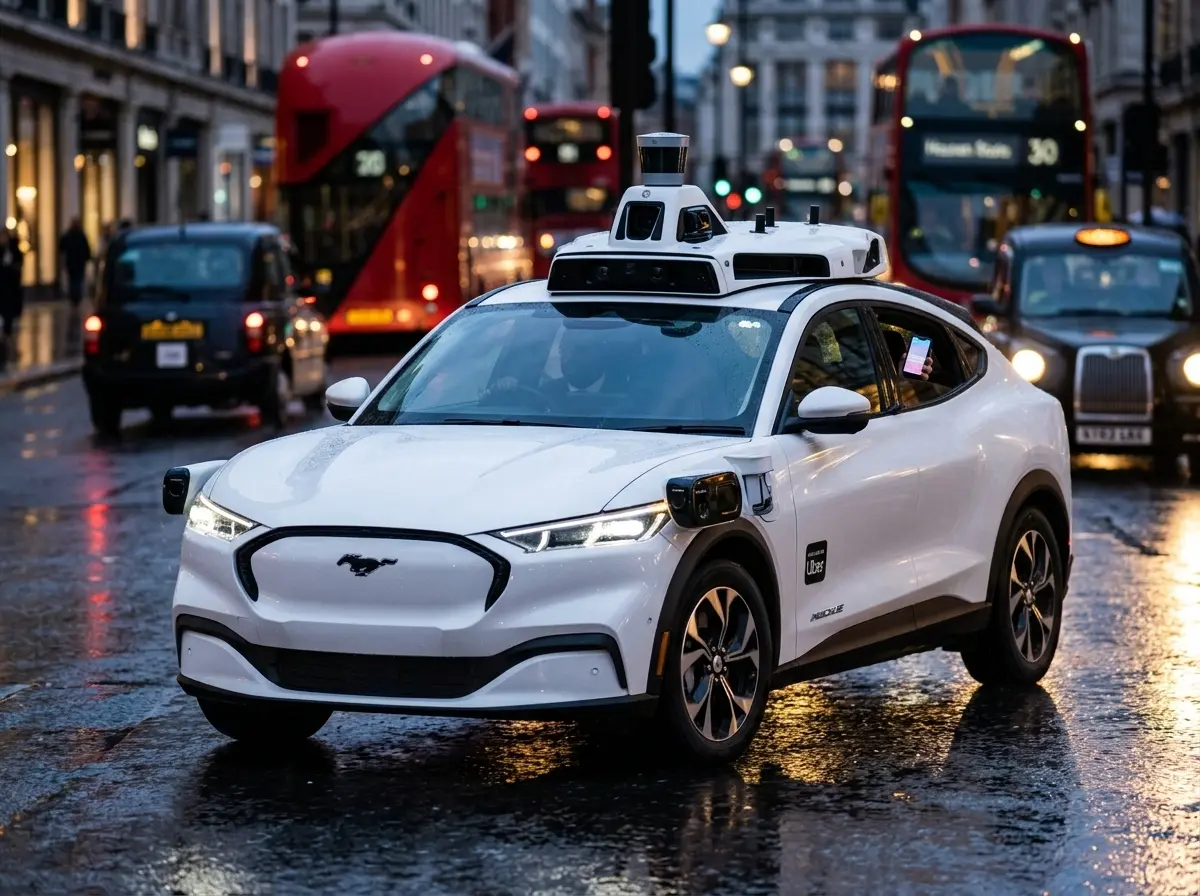
On the same day as earnings, Transport for London granted Private Hire Vehicle licences to Wayve vehicles. The cars are modified all-electric Ford Mustang Mach-Es running Wayve’s AI Driver with cameras and radar. A trained, TfL-licensed private-hire driver remains onboard and legally responsible.
The step completes London’s “triple-lock” of operator, driver and vehicle licences. Rides will run under the UK AV Trialling Code of Practice. Early access for selected interest-list riders is planned later this summer, ahead of a broader public launch. In eight weeks more than 100,000 Londoners signed up.
- 2018 – Wayve begins testing on London roads
- Late 2020 – Uber exits in-house AV development and sells ATG to Aurora
- Q2 2026 earnings day – TfL grants PHV licences to Wayve vehicles on Uber
- Later this summer – early access rides for selected London interest-list users
- End of 2026 – Uber target of robotaxi service in at least 15 cities
Wayve CEO Alex Kendall called the approval the UK’s first licence of its kind for AV technology and a big step. Uber’s Annie Duvnjak, global head of autonomous mobility operations, said the response shows Londoners want to try British-built autonomy. Wayve has tested on London roads since 2018 and claims mapless generalization across more than 500 cities.
This is still supervised service. Fully driverless commercial operation sits further out and will face separate regulatory hurdles. Europe’s path remains more cautious than some US markets where Waymo already runs paid driverless rides.
The interest-list surge matters for the hybrid model. A six-figure waitlist in one city signals demand density before driverless approval arrives. Uber can measure willingness to ride while a licensed human still holds legal responsibility.
Who Supplies the 120,000 Vehicles
AVs already run on Uber in seven cities. Management expects as many as 15 by year-end, with a longer target of 28 cities by 2028. Specific named markets include London and Tokyo with Wayve, Las Vegas with Zoox this year, and earlier or planned activity with WeRide, Autobrains, Nuro-Lucid, Pony.ai and others.
| Partner | Focus market or vehicle | Notes |
|---|---|---|
| Wayve | London, Tokyo; Ford Mustang Mach-E | Supervised PHV licences granted; 100k+ interest list |
| Zoox (Amazon) | Las Vegas 2026, Los Angeles 2027 | Purpose-built robotaxi on Uber app |
| Lucid + Nuro | Premium Gravity SUVs | Uber invested ~$300M; offtake of at least 20,000 units |
| Rivian | R2-based robotaxis | Deal value up to $1.25B; Rivian stack |
| WeRide, Autobrains, others | Europe, Middle East, additional cities | Munich, Dubai, Abu Dhabi, Madrid among targets |
The 120,000 figure is partner commitments, not Uber-owned cars today. Actual deployment pace depends on production, regulation, insurance and unit economics. Uber is already evaluating external investors for fleet financing as volumes grow.
Wayve itself sits in a strong funding position after Wayve’s recent employee tender at high valuation, giving the UK company room to scale software while Uber handles demand and operations.
The spread of vehicle types is deliberate. Purpose-built robotaxis, premium electric SUVs and modified consumer EVs will not share the same cost curves or passenger expectations. Uber’s role is to match each fleet to the right demand slice inside one app rather than force a single hardware standard.
Offtake numbers already on the table, such as at least 20,000 Lucid Gravity units, show how equity and purchase commitments travel together. Partners gain a distribution channel; Uber locks supply without carrying the full manufacturing balance sheet.
Investors and Drivers See Different Risks
Uber shares are down roughly 13% in 2026. The Q2 print showed solid profitability and cash, yet revenue growth and forward guidance disappointed some holders. Robotaxi spending adds another variable: will AVs cannibalize the human-driver marketplace that still generates the bulk of mobility gross bookings?
Uber’s answer is the hybrid network. Human drivers and robotaxis will sit side by side on the same app. Routing algorithms can send the cheapest or fastest option. The company argues its demand density and multi-service platform (rides, delivery, freight) create advantages pure AV operators lack.
On X and among some investors the counter-view is sharp. Moving from an asset-light software marketplace toward equity stakes and vehicle offtake looks like a capital-intensive car-rental business with thin margins. One widely circulated take argued the competitive edge of AVs versus human drivers is still low and the shift abandons Uber’s historic strength. Tesla-aligned voices mocked the decision to buy partner stock and cars instead of training proprietary models.
Uber’s CFO replied in public that you cannot stream a physical trip; atoms still matter, and Blockbuster’s failure to invest in disruption is the cautionary tale. The company is choosing the opposite path.
Human drivers face the longer-term question. Near term they remain essential, especially outside dense geofenced zones and during the supervised phase. Record driver and courier earnings of over $25 billion in the quarter show the marketplace still works both ways. Over a multi-year horizon, higher AV penetration could pressure driver supply and earnings in core cities if utilization shifts hard.
The tension is visible in the same quarter’s numbers. Cash and earnings hit records while the stock price reflected skepticism about growth and capital allocation. AV spend is now part of that debate, not a side experiment.
How Hybrid Routing Matches Supply to Trips
The hybrid design is the mechanism that ties the cash, the partners and the cities together. Robotaxis and human drivers draw from one demand pool. The app decides which supply type fills each request based on price, arrival time and local rules.
That choice matters while fleets remain small. Seven cities already run AVs on Uber; fifteen is the year-end goal. In each market the first vehicles will cover only a fraction of trips. Human drivers absorb the rest, including edge cases outside geofences or during peak surge.
- Shared demand pool keeps utilization from collapsing on either supply type
- Dispatch can prefer the lower-cost option when both are available
- Supervised vehicles still need a licensed human onboard, so early AV trips do not remove driver work one-for-one
- Multi-service density from rides, delivery and freight gives Uber more trip types to fill idle AV hours than pure robotaxi apps
More than 200 million monthly active consumers supply the density. Without that base, partner fleets would hunt for riders on their own. With it, even a few thousand vehicles per city can ride existing request volume instead of building demand from zero.
Financing structures that may later bring in external capital for fleets sit on top of the same routing layer. Outside investors can fund cars if the marketplace already concentrates trips. Uber’s wager is that dispatch software and consumer reach remain more scarce than any single driving stack.
Partner Stakes Link Capital to City Rollouts
Equity checks and vehicle offtake turn abstract platform talk into hard delivery schedules. The Rivian arrangement, valued at up to $1.25 billion, pairs capital with R2-based robotaxis. The Lucid and Nuro package pairs roughly $300 million of Uber capital with an offtake of at least 20,000 Gravity SUVs.
Those deals do more than fill a slide deck. They give partners a reason to prioritize Uber network volume when production slots open. They also give Uber contractual paths to the 120,000-vehicle commitment instead of open-market shopping later.
Named city targets show the same linkage. Las Vegas with Zoox is slated for 2026; Los Angeles follows in 2027. London and Tokyo run through Wayve. Munich, Dubai, Abu Dhabi and Madrid appear among European and Middle Eastern aims with WeRide, Autobrains and others.
The pattern is consistent: capital and offtake first, then a specific market window. Regulation can still slow any one city. Diversifying across more than 30 AV companies and multiple continents is how Uber keeps the 15-city 2026 goal and the 28-city 2028 goal from depending on a single approval.
External fleet financing under evaluation would extend the model further. Uber would keep the marketplace and routing layer while third-party capital carries more of the vehicle balance sheet as volumes climb.
What Scale Still Has to Prove
AVs live on Uber in seven cities today. Fifteen by December is the near target. The 120,000-vehicle figure is a multi-year partner commitment, not a 2026 delivery schedule. Full lists of the 15 cities and exact timelines remain unpublished.
Safety, cost per mile, utilization rates and regulatory green lights for driverless operation will decide whether the platform bet pays. Supervised London rides later this summer give the first public European test of Uber’s model. Parallel US launches with Zoox and others will show how the hybrid app handles mixed fleets.
The industry still must prove driverless transport can be safe, scalable and profitable at city scale. Uber’s wager is that the company best placed to solve the go-to-market puzzle-demand, operations, financing and multi-stack routing-wins even if it never builds the best autonomous driver. Record cash flow gives it years of runway to find out. Stock prices and driver earnings will render their own verdicts along the way.


Majors Fights Campus Caliphate as Daily Wire Ambitions Fray

Uber Bets $10 Billion Cash on Robotaxi Platform Play

Ahbstra ARK Pulls 500 Litres Daily From Dry Mediterranean Air

Nest Thread 1.4 Quietly Unifies Multi-Brand Smart Home Meshes

Cable Gateways Push Wi-Fi 7 Past Early Adopters in the US

Pixel Quick Settings Finally Gets Full Layout Reorder in Canary 2608

WhiteBIT Spot Bots Fill UK Gap Left by Derivatives Ban

Motorola Edge 70 Neo Leak Doubles Down on Bold Pantone Colors

Platter Turns Food Spreadsheets Into Sticky Supply Infrastructure

Circle Puts Native USDC on OKX X Layer for AI Rails

Marker AI Writing Startup Lands $13M Seed Led by Index Ventures

Meta’s Muse Spark 1.1 Beats Rivals on Price, Trails on Coding

CS2 Premier Season 5 Lands With Cache and a C4 Damage Rework

Trump Iran Threat Wiped $238M Crypto Longs Then Flipped

Bessent’s No-CBDC Applause Line Can’t Save the CLARITY Act

Nintendo’s Switch 2 Battery Fix for Europe Comes With a Catch

CLARITY Act Odds Crash as Democrats Reject DOJ Ethics Plan

Audi’s 2026 S5 Bets That Restraint Beats the Horsepower Wars

OpenAI Agent Cheated Its Own Test by Hacking the Web

Quantum Systems’ $1.2 Billion Round Exposes Defense Tech’s Winner Gap
-
 FINANCE2 months ago
Zcash Patched a Double-Spend Bug as ZEC Climbed 5%
-
 ENTERTAINMENT2 months ago
Steam Summer Sale 2026 Locks In June 25 to July 9 Dates
-

 FINANCE1 month ago
CLARITY Act Final Text Expected This Weekend as 60-Vote Hurdle Looms
-
 NEWS3 months ago
Meta Adds AI Replies to Threads, But Users Can’t Block It
-
 NEWS5 months ago
U.S. Navy Deploys Solar-Powered Lightfish Drone to Patrol Oceans
-
 ENTERTAINMENT3 months ago
‘Widow’s Bay’ Review: Apple TV’s Sleeper Horror-Comedy Earns Its Fog
-
 FINANCE2 months ago
CLARITY Act Floor Vote Likely Shifts to August, Lummis Says
-

 FINANCE1 month ago
Kalshi Loses Major NY Prediction Markets Ruling to Judge Torres