
GAMING
Valve’s Steam Machine Lands at $1,049 With No Subsidy
Valve is selling the Steam Machine at cost from $1,049 after memory prices killed its original target, and it still refuses a console-style subsidy.

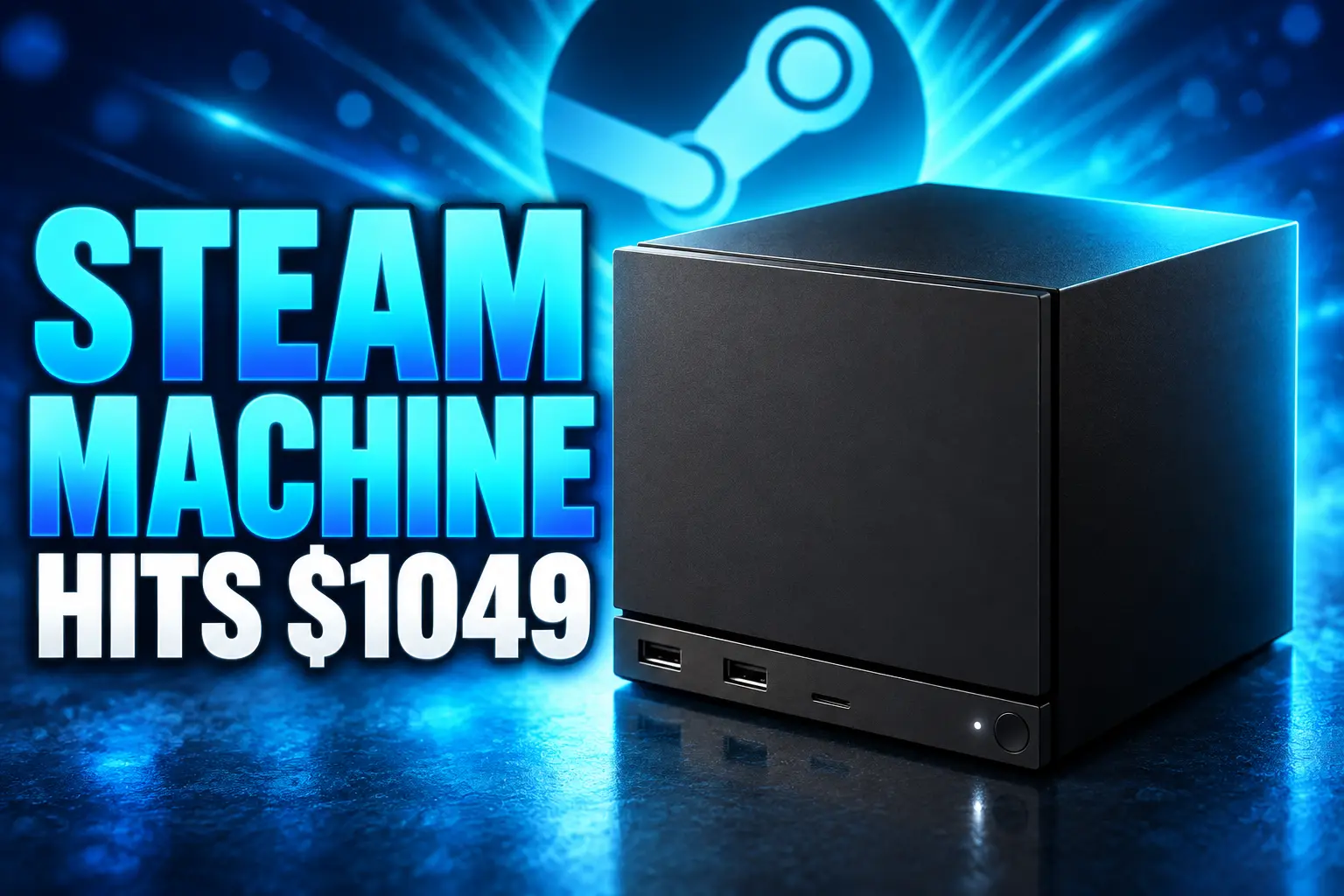
Valve is selling the Steam Machine at $1,049 for the 512GB model, with no console-style loss on each box. The 2TB version is $1,349, and adding a Steam Controller puts those bundles at $1,128 and $1,428.
That is the “current PC market” window Valve described in November 2025, after a memory crunch made a sub-$1,000 living room PC impossible to hold. The 6-inch cube is an honest PC. It is also a four-figure couch box.
Valve Priced a Living-Room PC Like a PC
On June 22, 2026, Valve posted four SKUs and a reservation lottery instead of a midnight cart rush. Software engineer Pierre-Loup Griffais had already said, months earlier, that the machine should sit near what it costs to build a PC with the same performance, “ideally” as a good deal at that level, and that Valve was not going to eat a big loss to grow a category.
Linus Sebastian had asked Valve staff about a $500 console-style sticker. He said the room went quiet. The earlier Steam Machine price debate treated $700 to $800 as the scary outcome. The launch card came in higher than that chatter, and Valve did not hide why.
STEAM MACHINE LAUNCH PRICES
| Configuration | US price | What else is in the box |
|---|---|---|
| 512GB | $1,049 | Base cube, SteamOS 3 |
| 512GB + Steam Controller | $1,128 | Controller adds $79 |
| 2TB | $1,349 | Red fabric and solid walnut faceplates |
| 2TB + Steam Controller | $1,428 | Controller plus both extra faceplates |
The hardware page lists a semi-custom AMD Zen 4 chip with 6 cores and 12 threads, a semi-custom RDNA3 GPU with 28 compute units, 16GB of DDR5, 8GB of GDDR6, Wi-Fi 6E, Bluetooth 5.3, and a built-in Steam Controller radio. Valve says the box has over six times the horsepower of Steam Deck and can do 4K with FSR 4.1. Griffais had put that GPU class above about 70% of gaming PCs in Valve’s hardware survey when the machine was being specced.
The cube is about 6 inches on a side, roughly 160mm, with DisplayPort 1.4, HDMI 2.0, one USB-C port, four USB-A ports, gigabit ethernet, a microSD slot, and a power supply inside the chassis. No wall wart. An LED strip on the case can show download progress when the TV is off.
The Current PC Market Now Starts at Four Figures
Valve started locking Steam Machine parts in 2023 on the old PC rule that silicon gets cheaper. In the June 22 post it said that rule broke, most visibly on RAM and storage, and that the original goal for the price was no longer viable. The figures it published were the cost of components it had actually secured over the prior six months.
In February 2026 the company had already said it had to revisit both ship dates and pricing because memory and storage were getting scarce and dear. There were stretches, it later wrote, when some parts could not be bought at any price. That, more than demand, is why launch volume is tight enough for a randomized queue.
The same squeeze hit Valve’s handheld. The Steam Deck’s own memory-driven hike put a higher sticker on Deck OLED when it came back in stock in May. A living-room PC with 16GB of DDR5, 8GB of GDDR6, and a 512GB or 2TB NVMe drive was never going to dodge that bill if the company refused to sell below cost.
Griffais’s November pitch still holds in one narrow way. A quiet 6-inch PC with HDMI-CEC, four Bluetooth antennas, and a controller that can wake the whole stack is hard to clone from a parts list. The “good deal at that performance” line is harder to hear at $1,049 when the comparison shopper is holding a TV remote, not a PCPartPicker tab.
What $1,049 Buys Against a PS5 Pro
Sony’s US list on the disc PS5 is $649.99, the digital model is $599.99, and the PS5 Pro is $899.99 after the April 2026 increase. Microsoft raised Xbox hardware on August 1, 2026, by $100 on 512GB models and $150 on 1TB models. The Series X disc unit is $799.99, the all-digital Series X is $749.99, the Series S 512GB is $499.99, and the Series S 1TB is $599.99.
LIVING ROOM STICKERS AFTER THE MEMORY SPIKE
| Box | US price | Gap vs Steam Machine 512GB |
|---|---|---|
| Steam Machine 512GB | $1,049 | – |
| PS5 Pro | $899.99 | $149.01 cheaper |
| Xbox Series X (disc) | $799.99 | $249.01 cheaper |
| PS5 (disc) | $649.99 | $399.01 cheaper |
| Xbox Series S 512GB | $499.99 | $549.01 cheaper |
Team Xbox said console storage and memory prices had risen more than 2.5x and that it expects another doubling by the fall of 2027. It also said consoles are typically sold for less than they cost to make, which is why the component spike hits that business harder than phones or PCs. Sony and Microsoft still take a cut of games and subscriptions on locked hardware. Valve still takes a cut on Steam. It still would not print a $500 Steam Machine.
The 512GB cube costs $399.01 more than a disc PS5 and $149.01 more than a PS5 Pro. For that extra money you get your Steam library on the TV, a tiny chassis, and no monthly online pass to play the games you already own. You also get 8GB of GDDR6 and a 28-CU RDNA3 part that leans on FSR for 4K, which is a midrange PC in 2026, not a halo console.
The Subsidy That Would Walk Out the Door
Michael Douse, Larian’s publishing director, wrote in November 2025 that skipping a loss on the box was “peculiar in this case,” because Steam is “essentially a money printing machine.” He figured Valve would lose “far more” than a roughly $200 gap by keeping people off the store. That $200 was the spread people were sketching when they still thought the fight was $500 versus $700.
The leak is the reason the $200 never made sense as a console play. A PlayStation that sells below cost still has to buy games from PlayStation. A Steam Machine that sells below cost is a small AMD PC. Put Windows on it, use it as a workstation, ignore Steam, and the subsidy walks out the door. Valve said the quiet part in its own FAQ.
We think of Steam Machine as an extension of PC gaming, not as a console. The traditional console model is to sell hardware at a loss and make up the revenue with subscription services or by selling games that are locked-in to the hardware. We think this can make sense for a single business in the short term but that open ecosystems are better for customers over the long term.
Valve, Steam Hardware blog, June 22, 2026
Griffais listed the bits that are nasty to DIY at this size: HDMI-CEC so the TV and the cube come up together, the noise floor, four antennas aimed at four Bluetooth controllers plus Valve’s own radio, and a one-button wake from the pad. Lawrence Yang, a Valve designer, put it more bluntly. He used to build PCs in college and is “too old and tired to do that now.” Convenience is the product. Convenience does not have a console loss-leader baked in.
A cheaper sticker would have been popular. It would also have been a fire sale on a general-purpose computer. Valve chose not to run that sale, then watched RAM vendors quote monthly take-it-or-leave-it prices while AI data centers soaked up wafers. The open-PC stance and the memory spike stacked. The stacked result is $1,049.
Partners Already Sold Living-Room Steam Boxes in 2015
This is Valve’s second pass at a Steam Machine, and the first one already priced like a PC. In 2015 the company did not ship a first-party cube. Alienware, iBuyPower, Syber, Zotac, Falcon Northwest, and others put SteamOS in small cases. Alienware’s cheapest unit started around $450. Falcon Northwest’s Tiki ran as high as $4,999. SteamOS was thin, Linux game performance lagged Windows, and the Steam Controller of that era did not save the pitch. Partners drifted back to Windows. The living-room SKUs faded.
FROM ANNOUNCEMENT TO THE $1,049 CARD
- November 12, 2025: Valve unveils a first-party Steam Machine, a new Steam Controller, and Steam Frame, with early 2026 as the ship window and no price.
- February 2026: Valve says memory and storage shortages force it to revisit pricing and dates, still aiming at the first half of the year.
- May 4, 2026: The new Steam Controller goes on sale and demand overruns the first plan, which is why later hardware uses a reservation queue.
- June 22, 2026: Valve posts the $1,049 starting price and opens signups through June 25 at 10 a.m. Pacific.
- June 29, 2026: Purchase emails start; the first units follow. On July 28 Valve says it is still working the randomized list and expects every reservation holder to get a buy email by the end of 2026.
The 2015 lesson was not only “Linux wasn’t ready.” It was that a living-room PC priced like a PC competes with a screwdriver and a console, and loses a lot of those fights. SteamOS is in a different place now because of Steam Deck. The pricing logic did not change. Valve still will not lock the store to the chassis, so it still will not copy Sony’s hardware math.
The Reservation Queue Runs Through December
Signups needed a Steam account in good standing and a purchase made before April 27, 2026, with one slot per household. Valve randomized each SKU list by region (North America, United Kingdom and the European Union, and Australia) after June 25. Land in the reservation queue and a unit is held in your name until a purchase email lands; you then have 72 hours to pay or the slot moves. Land on the waitlist and you sit behind this production run, unless cancellations pull you forward.
By late July, Valve was sending those emails daily. Some product-and-region lists had already exhausted the reservation queue and started pulling from the waitlist. The hardware page still tells new visitors to join the waitlist. South Korea is not getting the machine in this run. Japan, Taiwan, and Hong Kong go through Komodo.
IF THE CUBE IS OUT OF REACH
- SteamOS 3.8 on your parts: Valve says the same code as Steam Machine can run on a living-room PC you already own, with AMD GPUs supported now and more vendors promised later.
- Stay in the waitlist: New signups go to the back of the line; Valve’s July note still pointed reservation holders at a purchase email by the end of 2026.
- Buy a locked console: A disc PS5 at $649.99 or a Series X at $799.99 undercuts the cube and still takes a loss on the metal, which is the deal Valve refused.
That SteamOS door is the tell. The $1,049 cube is a finished, quiet, CEC-aware reference design for people who will not build. The volume play is the OS, which is why a mini PC at the same money, or an old AMD box with SteamOS on it, keeps showing up as the rational answer in the same threads that hate the sticker. Scalpers listing reservation slots well above retail prove a smaller group will pay anyway. They do not prove the living room switched from PlayStation to Valve.
Valve got the strategy it announced in November. It did not subsidize the Steam Machine, it priced the box like the current PC market, and that market, after AI data centers chewed through memory, charged four figures for a 6-inch living room PC. The reservation queue runs through the end of 2026. SteamOS does not wait in that line.
Frequently Asked Questions
How much does the Steam Machine cost outside the US?
Valve’s 512GB model is 1,509 CAD, 1,039 EUR, 879 GBP, 1,609 AUD, and 4,389 PLN, with the 2TB model at 1,919 CAD, 1,359 EUR, 1,149 GBP, 2,109 AUD, and 5,739 PLN. Those figures include VAT where it applies. Controller bundles add the same accessory premium in each currency.
Does Valve subsidize the Steam Machine like Sony or Microsoft?
No. Valve set the sticker from component costs and said it is not eating a loss to buy market share. Xbox, by contrast, still describes consoles as hardware typically sold below cost, even after the August 1, 2026 price rise driven by memory that Microsoft said had jumped more than 2.5x.
What ports and extras does the Steam Machine include?
The cube has HDMI 2.0, DisplayPort 1.4, gigabit ethernet, one USB-C port, four USB-A ports, a high-speed microSD slot, 2×2 Wi-Fi 6E, Bluetooth 5.3 with a dedicated antenna, and a power supply built into the case. The 2TB SKUs also include magnetic red-fabric and solid-walnut faceplates. A status LED strip can be recolored, animated, or switched off.
Can you install SteamOS without buying a Steam Machine?
Yes. Valve pointed people who miss the cube at SteamOS 3.8 on their own living-room PC, using the same code the Machine ships. Right now that path supports AMD GPUs, with wider graphics support described as in progress, so an Nvidia box is not the drop-in clone yet.
Where is the Steam Machine actually shipping?
Reservation lists cover North America, the United Kingdom and the European Union, and Australia. Komodo is the official distributor for Japan, Taiwan, and Hong Kong. Valve said the Steam Machine will not ship in South Korea in this run.

UPI MDR Delay Hands Traders the Calendar After Paytm Falls

Google Messages Builds Nine In-Chat Games After Samsung’s Exit

Anthropic’s $100 Million Academy Trains the Firms That Bill Both Sides

Toyota’s Electric C-HR Leaves the Cheap Twin to Subaru

Markets Bet the Fed Skips October After Hawkish Minutes

The Orchard Bug Forced Zcash to Open an Empty Pool

The $5.99 Game That Won Steam’s 2026 Summer Sale

Don Lee Joins Hemsworth as Extraction 3 Starts Shooting

YouTube Shorts Retires Dislikes and Swaps Likes for Hearts

NEURA Robotics Is Spending Its $1.4B on a Machine Stack
-
 NEWS4 months ago
The Orchard Bug Forced Zcash to Open an Empty Pool
-
 GAMING4 months ago
The $5.99 Game That Won Steam’s 2026 Summer Sale
-
 ENTERTAINMENT6 months ago
Don Lee Joins Hemsworth as Extraction 3 Starts Shooting
-
 NEWS4 months ago
YouTube Shorts Retires Dislikes and Swaps Likes for Hearts
-
 NEWS4 months ago
NEURA Robotics Is Spending Its $1.4B on a Machine Stack
-

 AUTO6 months ago
Kawasaki Bets the New Z1100 Against Its Own Supercharger
-

 BUSINESS5 months ago
Norway’s Export Bank Backs Nscale’s $790 Million Narvik Loan
-

 GAMING4 months ago
Game of Thrones Dragonfire Follows Boston’s Conquest Playbook