
NEWS
VTT Spinout Granarium Lands €1M to Scale Renewable Supercapacitors
Helsinki-based Granarium Technologies has raised over €1M to scale renewable supercapacitors from waste wood and nanocellulose for grid stability.

Granarium Technologies, a Helsinki-based deeptech startup spun out of Finland’s VTT research centre, has raised over €1 million in pre-seed funding to commercialise renewable supercapacitors made from nanocellulose and waste wood. The round, announced on 9 June 2026, was led by BSV Ventures and joined by Beamline, with participation from FiBAN (Finnish Business Angels Network), EstBAN and LatBAN. VTT has transferred the underlying technology and patents to the new company.
VTT originated the bio-based supercapacitor platform after years of materials research on nanocellulose and biocarbon. Granarium’s devices are designed as a fast-response layer that complements batteries rather than competing with them on duration, and the company plans to launch its first industrial pilots within six months of the funding.
The €1M Pre-Seed and What It Funds
Granarium Technologies has closed a pre-seed round of over €1 million, with BSV Ventures as the lead investor and Beamline co-leading, according to the company’s 9 June funding announcement. FiBAN, the Finnish Business Angels Network, and the Estonian and Latvian networks EstBAN and LatBAN added regional capital. VTT’s transfer of IP and patents to Granarium is the structural anchor of the round, the research centre is effectively the founding technology partner.
The capital is earmarked for the operational work that turns a research-centre spinout into a revenue-stage business. Granarium’s plan is to stand up a small industrial production line, secure pilot customers and value-chain partners, and start pilots aimed at continuous-operation industrial sites. The early product targets process industries with continuously running production operations. The company frames the early production line as a base for what it calls “rapid scale-up through industrial partnerships and international market expansion.”
- Over €1 million in pre-seed funding led by BSV Ventures, with Beamline joining
- Up to 50 units per year targeted at initial commercial production scale
- Six months from funding to first industrial pilots
- TRL5 validated technology with granted patents transferred from VTT
How a Nanocellulose Platform Reaches the Grid
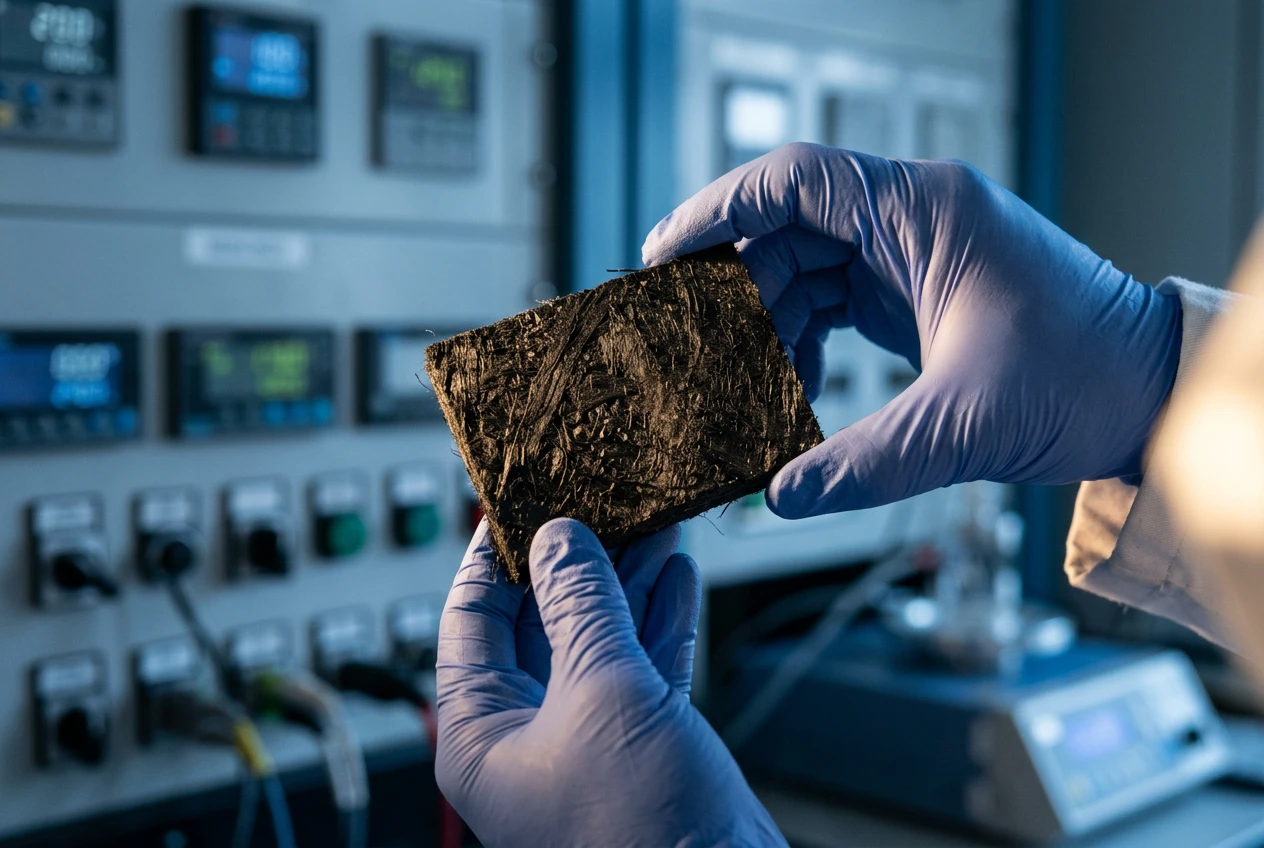
Granarium’s renewable supercapacitor is built on a nanocellulose-based material platform that binds biocarbon structures for power storage. The feedstock is waste wood and agro-residues, the same by-products that Finnish forest industries generate in volume.
The technology upcycles those waste streams into supercapacitors that the company describes as 100% renewable and able to store electricity. Nanocellulose, derived from wood pulp, acts as a binder for biocarbon structures that hold charge, replacing the activated carbon used in conventional cells. The result is a device that charges and discharges in milliseconds, a time scale where lithium-ion batteries struggle to respond.
Granarium positions its system as a fast-response layer within energy systems. It addresses short-duration needs such as grid balancing, frequency response and industrial power quality, and helps operators manage peak loads and distributed power generation. CTO Otto-Ville Kaukoniemi said the devices are “far more environmentally sustainable” than lithium-based storage and “lower in cost to produce compared to battery gigafactory investments.” The platform originated at VTT, a Finnish state research centre with more than 80 years of technology-transfer experience, with granted patents and validated technology at TRL5, per the VTT technology transfer release. In the longer term, the company says, the design freedom of the device could enable new concepts such as replacing the passive elements of EVs to extend battery life.
Why the European Grid Needs a New Layer
Grid volatility is rising across Europe as wind and solar scale up, and EU grid codes and resilience frameworks are tightening. Industrial operators with continuous production face more power quality issues as renewables take a larger share of generation, a strain that runs alongside Europe’s broader push to tie power, chips and cloud policy together.
The structural demand is the backdrop for the funding. UBS forecasts global energy storage demand to grow by approximately 40% year over year in 2026, driven by data-centre power demand and renewable integration, according to a UBS analysis of the battery storage surge. Batteries work well for duration, but the market for short, high-frequency balancing remains underserved, and that gap is where fast-response supercapacitors sit.
EU policy is closing in on grid reliability. New resilience frameworks and grid codes are forcing operators to manage peak loads and frequency events on shorter timescales than batteries were designed for. CEO Paula Viinamäki said the company’s approach “supports Europe’s strategic goals of reducing dependency on critical raw materials and building local, resilient energy infrastructure,” and that “deployment is as simple as installing a battery.”
The bet is on a category of grid hardware rather than a single chemistry. Supercapacitors store energy electrostatically on the surface of their electrodes rather than through chemical reactions, the same physics that makes them fast also makes them well suited to grid services that batteries handle less cleanly.
Granarium is the first startup to commercialise the renewable-biomass variant of that physics at industrial scale.
The Investors Behind the Round
BSV Ventures led the round, with Beamline joining and FiBAN, EstBAN and LatBAN adding angel capital from Finland, Estonia and Latvia. Jana Budkovskaja, partner at BSV Ventures, anchored the deal for the lead investor. VTT’s transfer of IP to the new company is a deliberate technology-transfer play, not a one-off licensing deal.
Atte Virtanen, vice president of advanced bio-based materials at VTT, framed the move in commercial terms. He called Granarium a demonstration of “how successful technology transfer can turn advanced bio-based materials into real industrial solutions for secure and resilient energy storage.” VTT is a Finnish state research centre with more than 80 years of experience in technology transfer, per the centre’s materials. Granarium inherits both the patents and the technology-transfer mandate from that relationship.
A key structural shift is that storage is no longer just ‘backup power’ – it is becoming core grid infrastructure. Granarium is the perfect addition to our portfolio because the company is solving a massive global challenge in a safe and scalable way. We were also impressed with the company’s technology and experience, as well as the capacity to use local raw materials to make the production process sustainable and inexpensive.
Jana Budkovskaja, partner at BSV Ventures, made the remarks in the 9 June funding announcement. Granarium is the first renewable-biomass supercapacitor startup to come out of VTT’s technology transfer programme, per the centre’s release.
Squaring Up to Skeleton Technologies
The most established European supercapacitor player is Skeleton Technologies, an Estonian manufacturer of graphene-based supercapacitor cells. Skeleton is investing €220 million in a fully automated factory in Germany built with Siemens, a project billed as the world’s largest supercapacitor factory. Granarium is pitching a different materials story into the same hardware category, with no overlap on the underlying chemistry.
Where Skeleton’s cells run on graphene, Granarium’s run on nanocellulose and biocarbon derived from waste wood. The pitch is the same physics, a high-surface-area electrode, but with a different feedstock and a different cost structure, per the Skeleton Technologies company profile.
| Attribute | Skeleton Technologies | Granarium Technologies |
|---|---|---|
| Electrode material | Graphene | Nanocellulose and biocarbon from waste wood |
| Headquarters | Estonia (Tallinn) | Finland (Helsinki) |
| Latest scale-up commitment | €220M Siemens factory in Germany | Pre-seed round led by BSV Ventures |
| Initial production scale | Fully automated factory planned | Up to 50 units per year |
Granarium says its approach enables up to 80% lower production capital expenditure in safe, scalable and locally producible systems, compared with the complex chemical processing used in conventional supercapacitor manufacturing. Kaukoniemi framed the cost advantage as relative to “battery gigafactory investments” rather than to supercapacitor peers, in the company’s funding announcement. The early production line, at up to 50 units per year, sits far below Skeleton’s planned German capacity but at a price point aimed at industrial customers with continuous production needs.
The contest is at the materials and cost layer, not at the end application. Both target grid stabilisation, industrial power quality and fast-response storage; the difference is what each cell is made of. Skeleton’s graphene bet is the incumbent moat, Granarium’s biomass bet is the challenger pitch.
Six Months to Pilots and International Expansion
The first pilots launch within six months of the funding. Initial commercial production begins at a small industrial scale, with capacity to deliver up to 50 units per year. The pilot focus is process industries with continuously running production, paper mills, data centres, pharmaceutical plants, where any power dip costs output. The company also plans to expand into Germany and other international markets that have high grid volatility and strong industrial power quality needs.
Finland’s forest industry side streams are the feedstock. Granarium says the technology removes complex logistics chains and enables simple production using locally sourced materials.
Viinamäki is a former Nokia and Microsoft director who joined VTT as a commercialisation lead. She co-founded the Finnish SaaS startup Duuers before moving into renewables. The company has secured pilot customers and key value-chain partners and is now preparing to launch the first pilots within six months of funding.
Frequently Asked Questions
What does Granarium Technologies do?
Granarium Technologies is a Helsinki-based deeptech startup that commercialises renewable supercapacitors made from nanocellulose and biocarbon derived from waste wood. The company was spun out of VTT in 2026, with VTT transferring the underlying patents and IP to the new business.
How is a supercapacitor different from a battery?
Supercapacitors store energy electrostatically on the surface of their electrodes rather than through chemical reactions, which lets them charge and discharge in milliseconds. Granarium’s release frames its devices as a fast-response layer that complements batteries on grid services such as frequency response, grid balancing and peak-load management.
Who led Granarium’s pre-seed round?
BSV Ventures led the pre-seed round, with Beamline joining as a co-investor. FiBAN (Finnish Business Angels Network), EstBAN and LatBAN also participated, alongside VTT’s transfer of IP to the new company.
When will Granarium launch its first pilots?
Granarium says the first pilots will launch within six months of the funding. The pilot focus is process industries and continuously running production operations, with initial commercial production targeting up to 50 units per year.
How does Granarium’s capex compare to conventional supercapacitors?
Granarium says its nanocellulose and biocarbon platform can lower production capital expenditure by up to 80% compared with standard methods. The company frames its cost advantage as relative to both battery gigafactory investments and the complex chemical processing used in conventional supercapacitor manufacturing.


Replit Opens Its London Office Inside an AI Crowd

Straight Circle Trailer Lands Without a U.S. Date

Anemo Labs Bets £700,000 on an AI Sense of Smell

Nintendo Prices the Zelda 40th Switch 2 at $519

Copilot Capital Buys the Autopilot Already Running 90 GW

Ground A Raises €9.1 Million for a Pallet Laser

Gibney’s Musk Film Opens in Venice Without Its Subject

Torvalds Blames AI for a Full-Fat Linux 7.3-rc2

Dexter Returns Sharper, Older, and Stuck Between Killers

Meta’s Muse Agent Can Spend Before the Privacy Lock

Walter’s TWG Insists No Fraud as Insurer Probes Force Cleanup

30-Year Yield Hits 5.32% Highest Since 2007 as Debt Supply Locks In Costs

PCE Stays at 3.7% as Gas and Tariffs Outrun Coming Revisions

Evernorth S-4 Clears Path for Active XRP Treasury on Nasdaq

Astute’s $1.2M bet makes B2B creator deals feed AI discovery

Strategy Parks $1.59B Cash While Bitcoin Stack Stays Flat

Instinct Hits $2.5 Billion as AI Agent Access Sparks Trust Fights

Oracle’s 2.8 GW Bloom Deal Exposes the AI Power Bypass

CLARITY Act Cloture Opens a Door Ethics Still Blocks

Space Mirror Demo Revives 1993 Russian Night-Light Test
-
 FINANCE3 months ago
Zcash Patched a Double-Spend Bug as ZEC Climbed 5%
-
 ENTERTAINMENT3 months ago
Steam Summer Sale 2026 Locks In June 25 to July 9 Dates
-

 FINANCE2 months ago
CLARITY Act Final Text Expected This Weekend as 60-Vote Hurdle Looms
-
 NEWS4 months ago
Meta Adds AI Replies to Threads, But Users Can’t Block It
-
 ENTERTAINMENT5 months ago
Extraction 3 Is Officially Coming to Netflix in 2027
-

 NEWS3 months ago
YouTube Shorts is testing a heart in place of the thumbs-up
-

 NEWS1 month ago
Senators Force Apple Off Chinese Memory as Big Three Cash In
-

 NEWS3 months ago
NEURA Robotics’ $1.4B Series C Redraws Europe’s Physical AI Bet