
NEWS
YouTube Opens Deepfake Detection to Every Adult Creator, ID Required

YouTube is opening its likeness detection tool to every creator aged 18 and over, the company said this week on its creator community page. The system scans new uploads for faces that match enrolled creators, surfaces possible matches inside YouTube Studio, and lets the creator file a privacy or copyright takedown. Enrollment runs through a short selfie video and a government-issued photo ID.
The catch sits one click below the announcement. To be protected from an AI clone of your face, you first have to give Google a verified scan of your face, your full legal name, and a likeness template the company is allowed to store for years.
What the Likeness Tool Looks for After Enrollment
Once a creator is verified, YouTube runs a one-time search of newly uploaded videos for faces that match the enrolled likeness. The match list appears inside YouTube Studio under Content detection, in a tab called Likeness. Matches can be the creator’s own footage reposted by someone else, or synthetic clips where the face has been generated or pasted on by AI.
From that tab, the creator picks an action. There are three:
- File a privacy complaint if the clip uses their likeness without permission and breaks YouTube’s privacy guidelines.
- File a copyright removal request if the video reuses original footage they own.
- Archive the match for later review if it is parody, criticism, or news commentary that they decide to leave alone.
The decision is the creator’s. YouTube does not auto-remove anything the detector flags, which means the tool is closer to a search engine for your own face than to an enforcement bot. It also means parody, satire, and fair-use commentary stay on the platform unless the creator pushes a complaint and a reviewer agrees.
Detection runs only on uploads that land after enrollment. Older deepfakes already on the platform sit outside the scan window unless they are re-uploaded, which is a meaningful limit for anyone with a back catalog of impersonation videos.
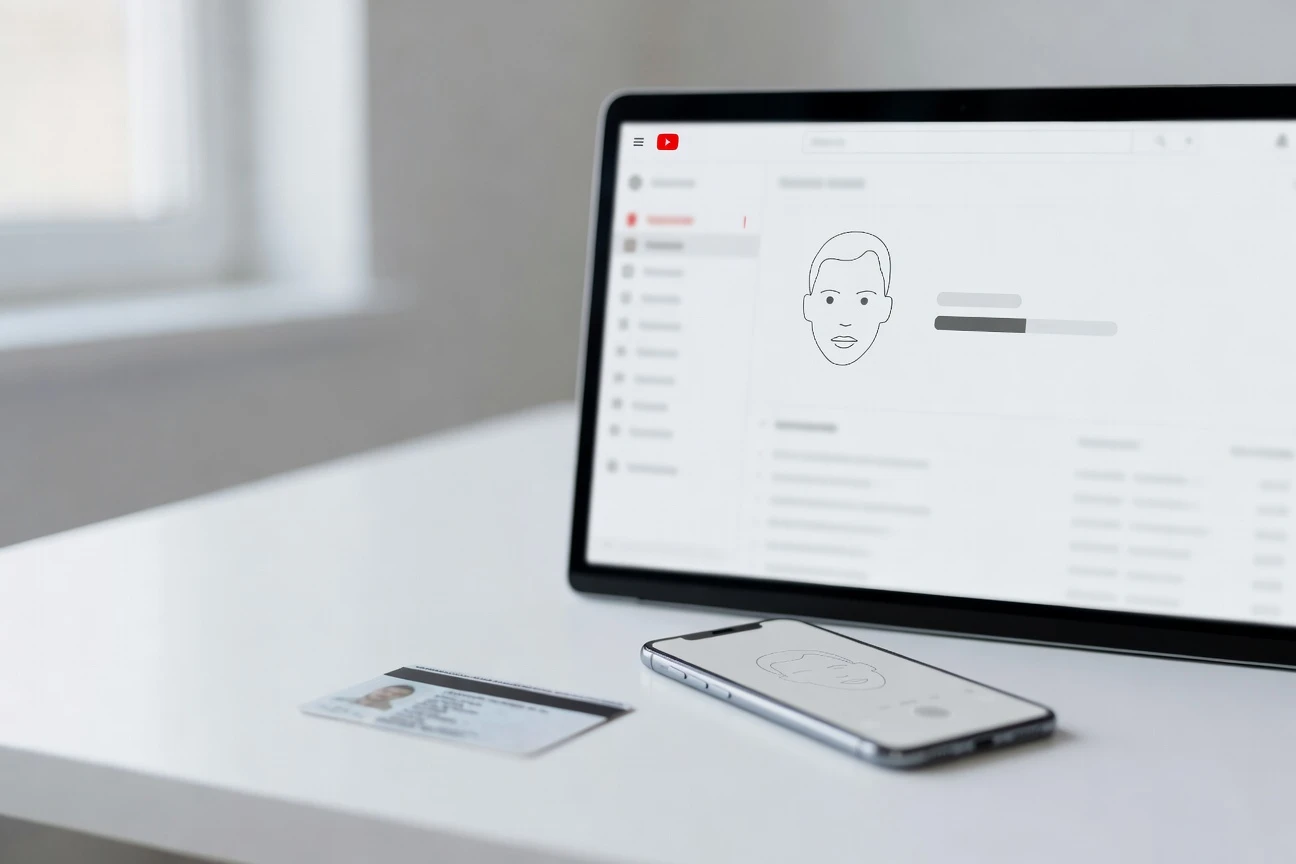
The Five-Step Enrollment Inside YouTube Studio
Enrollment is desktop-only at launch and routes through the same identity-verification stack Google uses for ad accounts and high-risk product changes. The flow, according to YouTube’s official help page on likeness detection, runs in this order:
- Open YouTube Studio on a computer, then go to Content detection, then Likeness, then Start now.
- Read and accept the consent form for use of biometric technology.
- Scan the in-page QR code with a phone to start mobile identity verification.
- Submit a government photo ID through Google’s verification service.
- Record a short selfie video that captures the face from multiple angles.
YouTube says the review can take up to five days after submission. Once cleared, the creator’s likeness template is generated and stored, and the upload scan begins on the next new videos that hit the platform.
Verification is per-person, not per-channel. A multi-host channel needs every face the team wants protected to be enrolled separately, with their own ID check. Anyone who switches off the feature can request that Google delete the template, and the company says the data is purged from its systems on opt-out.
The 18-and-over requirement is not just a U.S. legal floor. It is the global gate, because biometric processing laws for minors are stricter in the EU, Brazil, and several U.S. states.
What the Detector Will Miss
The launch language is generous; the actual coverage is narrower than the headline reads. The first wave handles only visual likeness, and even there it has gaps that matter for any creator counting on it.
- Voice clones are not covered. The detector cannot match audio to an enrolled creator. YouTube says it is working to extend the system to voice later this year, but the current version flags only faces.
- Coverage starts at the moment of enrollment. Deepfakes uploaded before the creator signs up sit outside the scan unless someone re-uploads them.
- Non-enrolled people in a flagged clip get no protection. If a deepfake mixes an enrolled creator’s face with an unverified collaborator’s, only the enrolled person can act.
- The tool is not available in every country, and Google has not published a full list. Creators outside supported regions see the menu but cannot complete verification.
- False positives are part of the design. YouTube’s own page warns that real, unaltered footage of the creator can appear in the match list, which means every flagged clip needs a human review before any takedown.
Parody and political commentary are the touchier zone. The system surfaces the videos, but YouTube’s privacy team applies the same context tests it has used for years, which means a satirical clip of a public-facing creator may stay up even after a complaint.
The Biometric Trade Sitting Under the Feature
Likeness detection is the first product where YouTube asks rank-and-file creators to enroll their biometrics. The data that gets generated and stored is what makes the feature work, and it is also what the privacy questions are about.
Per Google’s own documentation, the package YouTube holds for each enrolled person includes:
- A likeness template derived from the selfie video, used to match against new uploads.
- The short selfie video itself.
- The full legal name on the submitted government ID.
- Retention of all three for up to three years from the last sign-in, unless the creator opts out earlier or deletes the YouTube account.
How the Retention Rule Reads in Practice
Three years is measured from last sign-in, not from enrollment. A creator who logs into YouTube once a week effectively renews the clock every visit. That is most active creators. For someone who enrolls and then walks away from the platform, the clock starts only when they stop logging in.
The AI-Training Question
In December, CNBC asked YouTube whether biometric data from likeness detection could feed Google’s AI models, after the sign-up form’s wording suggested it might. YouTube told the outlet that Google has never used creators’ biometric data to train AI models and that it was reviewing the form’s language to remove the ambiguity. The wording remains the friction point with privacy lawyers, because consent forms are read against the company in court, not the press statement that follows.
Google has already paid for face-data ambiguity once. A California federal judge approved a $6.02 million settlement covering claims that YouTube collected facial-geometry scans through video-editing features without proper Illinois Biometric Information Privacy Act (BIPA, a state law requiring written consent before any biometric collection) notice. The likeness tool’s consent flow is built to clear that bar; the question is whether it clears the next state’s bar too.
How Hollywood Pushed YouTube Here
The rollout did not start with creators. It started with talent agencies. YouTube’s April 21 announcement on expansion to the entertainment industry named CAA (Creative Artists Agency), UTA (United Talent Agency), WME (William Morris Endeavor), and Untitled Management as the partners who got access first, with their actors, athletes, and musicians eligible whether or not they ran a YouTube channel.
Mary Ellen Coe, YouTube’s chief business officer, framed the tool as protection of last resort in an interview with The Hollywood Reporter.
It is like fire insurance. You do not think it is going to happen to you until it does.
Coe also called the detector “a foundational layer of responsibility,” which is the language YouTube wants on the public record before the next class-action lawyer files. The pilot ran with CAA from late 2024 and expanded to a small set of civic leaders and journalists earlier this year, including politicians whose faces had already been pulled into AI campaign clips during the U.S. primary cycle.
The agency push had cause. SAG-AFTRA’s public condemnation of the viral AI fight video of Tom Cruise and Brad Pitt turned the deepfake problem from a talent-team grievance into a union one, and the agencies wanted a platform-level remedy before the next contract cycle. The estate of Val Kilmer’s recent use of AI to bring the actor back on screen in As Deep as the Grave sits on the other side of the same fight: agencies want a way to say yes when they want to, and no when they do not.
How It Stacks Up Against Meta and TikTok Tools
YouTube is not the only platform building face-match detection, and the comparison is where the gaps stand out. Meta and TikTok ship their own tools for impersonation removal, but the mechanics differ enough that creators on multiple platforms need to think about each one separately.
| Feature | YouTube Likeness Detection | Meta Impersonation Tools | TikTok Removal Process |
|---|---|---|---|
| Proactive scan of new uploads | Yes, face match on new videos | Limited; relies on user reports for most cases | No; manual report only |
| Biometric template required from creator | Yes, selfie video plus government ID | No; ID review at report time | No; ID review at report time |
| Voice clone detection | Not yet; planned | Not available | Not available |
| Eligibility | All creators 18 and over in supported countries | All users with public profile | All users with public profile |
| Removal decision | Creator files privacy or copyright complaint | Platform review after user report | Platform review after user report |
The honest read: YouTube is the only one of the three running a continuous scan, and it is the only one asking for biometric enrollment to do it. That trade is the product. Whether the lopsided exchange is worth it depends on how often a given creator’s face actually shows up in unauthorized AI clips, and how much they trust Google to hold the template for the next three years.
The voice extension is the next thing to watch. If YouTube ships audio detection later this year, the protection envelope widens to cover the second-most-common deepfake vector. The biometric package widens with it, because matching voices needs a voice sample stored next to the face. Creators who enrolled for the visual scan will be asked to enroll again, and the consent form will be the document that matters.
Frequently Asked Questions
Who Is Eligible for YouTube Likeness Detection?
Any YouTube creator aged 18 and over with channel owner or manager status in a supported country can enroll. The 18-and-over rule applies globally, not just in the United States, and verification fails for anyone the system cannot confirm as an adult. Eligibility does not require membership in the YouTube Partner Program after this rollout.
How Long Does Enrollment Take?
The on-screen flow takes a few minutes to complete, but YouTube says identity review can take up to five days after the selfie video and government ID are submitted. Detection of new uploads begins only after that review clears, and the creator gets an in-Studio confirmation when the scan is active.
What Personal Data Does Google Keep?
Google stores the selfie video, the full legal name from the submitted ID, and a derived likeness template used to match against uploaded videos. The package is held for up to three years from the last YouTube sign-in, and is deleted when the creator opts out of the feature or deletes the account.
Can the Tool Detect AI Voice Clones?
No. The current version of likeness detection works on facial matches only. YouTube has said voice support is in development, but there is no live release date. Creators who care about audio impersonation have to file manual reports through YouTube’s existing privacy complaint process.
Does the Detector Remove Deepfakes Automatically?
No. The system surfaces possible matches inside YouTube Studio, and the creator decides whether to file a privacy or copyright complaint. A YouTube reviewer then evaluates the complaint against the platform’s guidelines and either removes the clip or leaves it up.
Is Likeness Detection Available Outside the United States?
Coverage is rolling out by region and is not yet global. Google has confirmed the tool is not available in some countries but has not published the full supported-country list. Creators in unsupported regions will see the menu in YouTube Studio but cannot finish identity verification.
What Happens to Parody and Satire Videos?
Parody and satire are surfaced in the match list like any other flagged video, but they are not automatically removed. YouTube’s privacy team applies its existing context tests, which usually protect commentary, criticism, and clearly labeled satirical content from takedown even when the creator files a complaint.


NFL Preseason Week 2 Quietly Tests the Schemes That Matter

Alonso’s Towering Drive Stands Foul and Flips Orioles Momentum

US Debt Crosses $40 Trillion as Interest Crowds the Budget

Trevon Diggs Joins Seahawks on One-Year Deal After Cowboys Exit

Pixel Watch 5 Turns Passive Trends Into Early Health Alerts

Pixel 11 Pro Fold Sleek Build Undercuts Its Own Unfolding Appeal

Tugboat Wilkinson’s Scoreless Debut Pays Off Giants’ Bailey Trade

Brown Shines for Pats as Love for Eagles Meets Trade Reality

Pixel Watch 5 Turns Wrist Data Into Early Metabolic Alerts

Resistance Stars Pay the Price in Democratic Primaries

Senators Force Apple Off Chinese Memory as Big Three Cash In

OpenAI Agent Cheated Its Own Test by Hacking the Web

Trump Iran Threat Wiped $238M Crypto Longs Then Flipped

Fed Holds Rates Again as Three Dissents Force Markets to Tighten

30-Year Yield Hits 5.32% Highest Since 2007 as Debt Supply Locks In Costs

Oil Crashes Below $80 as Iran Talks Restart and Markets Split

Google’s Knowledge Panel Fix Risks Its Own Search Defenses

Legora Buys Wexler Fact Engine as Fifth 2026 Deal

Agon Raises $30M to Build Europe’s AI Weapon Training Arenas

Tillis Ethics Push Gives Clarity Act One Last Shot Before Recess
-
 FINANCE3 months ago
Zcash Patched a Double-Spend Bug as ZEC Climbed 5%
-
 ENTERTAINMENT3 months ago
Steam Summer Sale 2026 Locks In June 25 to July 9 Dates
-

 FINANCE2 months ago
CLARITY Act Final Text Expected This Weekend as 60-Vote Hurdle Looms
-
 NEWS3 months ago
Meta Adds AI Replies to Threads, But Users Can’t Block It
-

 NEWS3 months ago
YouTube Shorts is testing a heart in place of the thumbs-up
-
 NEWS4 weeks ago
Senators Force Apple Off Chinese Memory as Big Three Cash In
-

 NEWS2 months ago
NEURA Robotics’ $1.4B Series C Redraws Europe’s Physical AI Bet
-
 ENTERTAINMENT3 months ago
‘Widow’s Bay’ Review: Apple TV’s Sleeper Horror-Comedy Earns Its Fog