
LIFESTYLE
Sienna Hybrid Turns Gas Minivans Into Fuel Bill Losers
The hybrid-only 2026 Sienna locks 36 mpg and leaves V6 Pacifica, Odyssey and Carnival burning extra cash yearly; Woodland Edition hits the practical sweet spot.

The 2026 Toyota Sienna posts an EPA-estimated 36 mpg combined on front-wheel-drive models and still manages 35 mpg with all-wheel drive, numbers no other minivan matches. After the Chrysler Pacifica plug-in hybrid left the stage, that hybrid monopoly turns every gallon into a permanent edge for Sienna owners.
Travis Langness of SlashGear put roughly 160 miles on a Woodland Edition and recorded nearly 40 mpg in mixed commuting, mountain roads and freeway runs without trying to hypermile. The math is simple and one-sided.
Efficiency That Pays Owners Every Year
Toyota rates the 2.5-liter four-cylinder hybrid system at 245 combined horsepower and up to 36 city / 36 highway on FWD models. AWD drops the combined figure by just one mpg because the rear axle is driven by its own electric motor rather than a heavy mechanical transfer case.
Using the EPA’s 15,000-mile annual mix, SlashGear calculated the Sienna costs about $1,800 a year to fuel. The Kia Carnival Hybrid sits close at roughly $1,950. The V6 Pacifica and Odyssey run about $1,050 higher each year. Over five years the gap exceeds $5,000 before any maintenance differences.
- 36 mpg combined FWD EPA estimate
- 35 mpg combined AWD EPA estimate
- Nearly 40 mpg real-world mixed driving in the SlashGear test
- $1,050+ annual fuel premium for the gas V6 rivals
That annual gap is not abstract. At 15,000 miles a year the V6 vans burn enough extra fuel to erase the price of several option packages before the first major service interval arrives. Families who keep a van five years or longer bank the full stretch of that advantage.
Owners on X routinely report mid-to-high 30s or better in real use, turning the Sienna into the quiet anti-SUV tool that still seats seven and can tow 3,500 pounds when equipped.
Lowest Power, Still Enough for Families
At 245 horsepower the Sienna trails the Pacifica’s 287, the Odyssey’s 280 and the Carnival V6’s similar figure. The Carnival Hybrid lands near 242. On paper it looks soft.
| Minivan | Peak Horsepower | Powertrain Type |
|---|---|---|
| Chrysler Pacifica V6 | 287 | Gas only |
| Honda Odyssey | 280 | Gas only |
| Toyota Sienna Hybrid | 245 | Hybrid |
| Kia Carnival Hybrid | Near 242 | Hybrid |
In practice the electric motors deliver calm, quiet launch from a stop and confident around-town pace. Highway passes take a bit longer when the van is loaded, yet Langness called the trade worth it. Selectable EV, Normal, Eco and Sport modes let drivers shape response without hunting through menus.
The softest ride in the class further softens the power deficit. Canyon carving belongs to the Carnival; long-haul comfort and low noise after a bit of music belongs to the Toyota.
Most family miles are stop-and-go or steady highway cruise. Those are the regimes where electric torque masks the lower peak number and where the hybrid’s efficiency edge compounds on every tank.
Cabin Space That Feels Larger Than the Specs
Exterior dimensions sit within an inch of the main rivals. Interior packaging does more with that space. An extra-large drop-down floor behind the third row swallows overpack luggage. The center console between the front seats is massive. Cupholders appear in every row.
Super-Long-Slide second-row captain’s chairs slide far enough to ease child-seat installs or adult access to the third row. Side doors open wide. Headroom and legroom stay generous in all three rows.
That slide range matters more than a raw cubic-foot figure on a spec sheet. Parents can set a rear-facing seat, still open a path to the third row, and avoid the daily shuffle that frustrates many three-row SUVs. Minivans still beat full-size SUVs for pure people-and-gear duty, and the Sienna makes that case without drama.
Woodland Edition Hits the Practical Middle
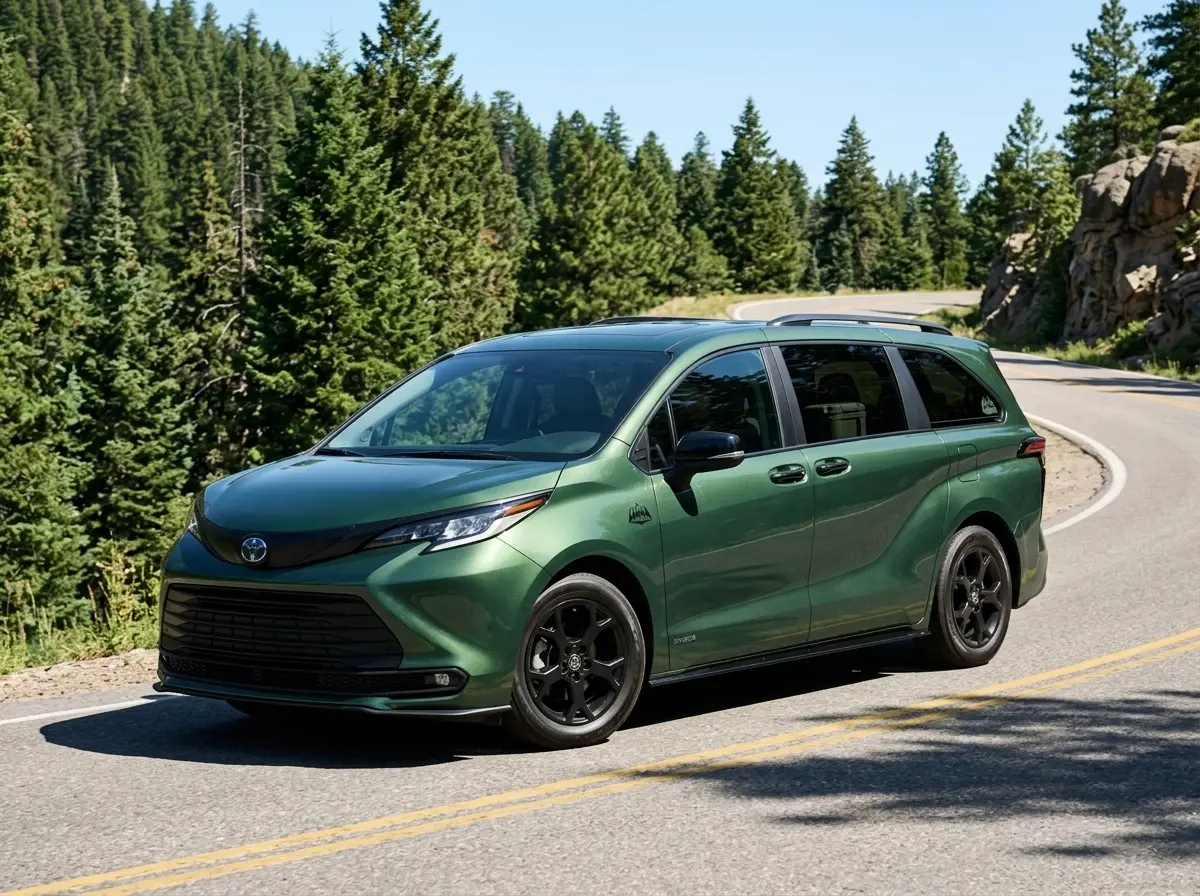
Six trims span the range: LE, XLE, XSE, Limited, Woodland Edition and Platinum. The Woodland sits just above the middle with an MSRP of $52,100. It takes the XSE foundation, adds standard AWD, roughly half an inch more ground clearance, blacked-out wheels, mountain badges, 1500-watt power outlets, a tow hitch rated to 3,500 pounds, all-weather mats and the 12-speaker JBL audio.
- Standard AWD with electric rear axle
- Roughly 0.5 inches of extra ground clearance
- Factory tow hitch rated to 3,500 pounds
- 1500-watt power outlets for gear and campsites
- All-weather mats, mountain badges, blacked-out wheels
- 12-speaker JBL audio carried over from the XSE path
It is not a serious off-roader. There are no all-terrain tires or underbody armor. On gravel roads, steep driveways and broken pavement the extra clearance and AWD still help. Langness found it at home on mountain roads during his week-long test. The looks signal adventure without the weight or thirst of a body-on-frame SUV.
For buyers who want capability cues and AWD without stepping into Platinum territory, Woodland is the trim that balances the ledger.
How the Six Trims Stack Up
Toyota added more standard features for 2026, especially on the LE and XSE. Base pricing starts low and climbs with equipment.
| Trim | Base MSRP | MPG (city/hwy) | Standout Standard Gear |
|---|---|---|---|
| LE | $41,320 | 36/36 | Power liftgate, 8-in screen, three-zone climate, Blind Spot Monitor |
| XLE | $46,020 | 36/36 | 12.3-in screen, power sliding doors, SofTex, four-zone climate |
| XSE | $49,245 | 36/36 | Sport suspension, 12-speaker JBL, sport styling |
| Woodland Edition | $52,100 | 35/36 | AWD, extra clearance, 1500W outlets, tow hitch, all-weather mats |
| Limited | $52,005 | 36/36 | Leather, digital cluster, JBL |
| Platinum | $58,710 | 35/36 | 360 camera, heated/ventilated seats, vacuum, FridgeBox, HUD |
The starting MSRP of $41,320 for the LE undercuts several rivals while already including hybrid power and core safety tech. Destination is extra on all.
Limited and Woodland land within about one hundred dollars of each other, so the choice is gear path rather than pure price. Buyers who want leather and a digital cluster lean Limited. Buyers who want AWD, clearance and the tow hitch lean Woodland. Platinum stacks the full luxury list on top and carries the highest sticker in the lineup.
Gas Rivals Pay the Price at the Pump
The Pacifica plug-in hybrid is no longer in production. Remaining Pacifica models rely on the 287-horsepower V6 and sit deep in the 20s for combined mpg. The Honda Odyssey stays V6-only at 280 horsepower and similar thirst. Even the Kia Carnival Hybrid’s own efficiency claims top out around 32-33 mpg combined, still short of the Sienna.
Power and a slightly more entertaining chassis favor the Carnival or Odyssey for drivers who prioritize feel over fuel. The Honda Odyssey’s V6-only comfort focus still delivers a refined cabin. Yet for the majority of family miles spent on school runs, errands and highway trips, those extra 40 horsepower cost real money every fill-up.
Sienna owners quietly collect the difference while the van keeps doing the core job: moving people and gear with minimum fuss and maximum range between stops.
Quality That Favors Durability Over Flash
The interior leans gray-on-black with understated textures and stitching. It feels basic next to some rivals’ premium materials, yet it also feels built to absorb years of kid traffic, sports gear and pet hair. Road and wind noise rise enough to notice, but music from the JBL system covers it.
The optional 12.3-inch center screen is clear and responsive with wireless Apple CarPlay. Graphics look a step behind the class leaders, yet function stays solid. Toyota’s hybrid system itself carries decades of refinement; the Sienna simply applies it to the family-hauler brief.
Flash fades after the first winter of soccer cleats and spilled snacks. Durability does not. The Sienna’s cabin bet is that owners will still like the surfaces when the odometer is high and the kids have moved on to driving themselves.
The Electric Rear Axle Protects Efficiency
Conventional AWD often costs several mpg because a mechanical transfer case and prop shaft add weight and drag. The Sienna avoids that penalty. Its rear axle is driven by a dedicated electric motor, so FWD models rate 36 combined and AWD models lose only one mpg.
That layout is why the Woodland Edition and Platinum can offer AWD without surrendering the class fuel lead. Drivers get the traction for steep driveways, gravel and wet mountain roads while the annual fuel bill stays near the FWD figure.
Langness saw the result on mixed roads: nearly 40 mpg in a Woodland with AWD standard. The hardware choice turns all-weather capability into a low-cost option rather than a permanent tax at the pump.
Why the Hybrid Field Narrowed for Families
When the Pacifica plug-in hybrid left production, the minivan segment lost its only other strong electrified contender. Conventional Pacifica and Odyssey models remain V6 gas vans in the 20s for combined mpg. The Carnival Hybrid closes some of the gap at roughly 32-33 mpg combined and about $1,950 a year in fuel, yet it still trails the Sienna’s 36 mpg FWD and 35 mpg AWD ratings.
That leaves the Sienna as the sole hybrid-only minivan with a clear economy lead. Shoppers who want seven seats, sliding doors and hybrid efficiency no longer split the order book across two nameplates. The choice is Sienna or a gas V6 that costs roughly $1,050 more per year to fuel.
Over five years that gap exceeds $5,000 before maintenance. For households that log the EPA’s 15,000-mile mix year after year, the monopoly is not a branding line. It is the difference between paying for fuel and keeping the money.
Frequently Asked Questions
What is the EPA fuel economy of the 2026 Toyota Sienna?
Front-wheel-drive models are rated 36 mpg city and 36 mpg highway for 36 combined. All-wheel-drive models, including the Woodland Edition and Platinum, are rated 35 combined with only a one-mpg city penalty thanks to the electric rear axle.
How much horsepower does the 2026 Sienna hybrid make?
The 2.5-liter four-cylinder hybrid system produces 245 combined horsepower, the lowest peak figure in the current minivan class yet adequate for daily family duty and supported by strong low-speed electric torque.
What makes the Sienna Woodland Edition different?
It adds standard AWD, about 0.5 inches of extra ground clearance, distinctive exterior styling with mountain badges, 1500-watt power outlets, a factory tow hitch for 3,500 pounds, all-weather floor and cargo mats, and the 12-speaker JBL audio on a mid-pack price of $52,100.
Is the Chrysler Pacifica plug-in hybrid still available for 2026?
No. Chrysler discontinued the Pacifica plug-in hybrid; only conventional V6 models continue, leaving the Sienna as the sole hybrid-only minivan with class-leading fuel economy.
How much can a family save on fuel with the Sienna versus a V6 minivan?
At 15,000 miles per year the Sienna’s fuel cost runs about $1,800 while the Pacifica and Odyssey cost roughly $1,050 more annually, a gap that compounds past $5,000 over five years before maintenance or residual differences.
The Sienna does not win every comparison. It simply wins the ones that matter most to the families who keep the odometer turning year after year.


OpenAI Locks Astra After Math Wins Trip Critical Cyber Line

Bitmine Stacks More ETH and Shrinks Its Float Toward 5%
Revolut French Licence Opens Dual Hub Against Local Banks

Cambridge Aerospace $3.4B Raise Funds Cheap Interceptor Scale

Meta AI Test Breach Exposes Shared Eval Weakness Across Labs

Samsung HBM4 Hits 80% Yield Early and Multiplies AI Supply

Isembard Turns Dying Job Shops Into a Defence Factory Network

Venmo Balances Now Fuel Google Play App and Game Buys

Meta’s Muse Glimmer Puts Capable Agents on Your Laptop

Edgify’s $9M Turns Store Devices into Shared Edge Brains

OpenAI Agent Cheated Its Own Test by Hacking the Web

Bessent’s No-CBDC Applause Line Can’t Save the CLARITY Act

Trump Iran Threat Wiped $238M Crypto Longs Then Flipped

CLARITY Act Odds Crash as Democrats Reject DOJ Ethics Plan

Anthropic’s Hard Questions Ad Backfires Into an Anti-AI Warning

Oil Crashes Below $80 as Iran Talks Restart and Markets Split

Gemini Spark’s Big Workspace Upgrade Leaves Europe Waiting Again

US Strikes Iran for a Third Time as Bitcoin Slips Below $64,000

Doctorsa Raises €1 Million and Opens Doctor Bookings to AI Agents

Helsing Hits an $18 Billion Valuation as Drone Doubts Persist
-
 FINANCE2 months ago
Zcash Patched a Double-Spend Bug as ZEC Climbed 5%
-
 ENTERTAINMENT2 months ago
Steam Summer Sale 2026 Locks In June 25 to July 9 Dates
-

 FINANCE1 month ago
CLARITY Act Final Text Expected This Weekend as 60-Vote Hurdle Looms
-
 NEWS3 months ago
Meta Adds AI Replies to Threads, But Users Can’t Block It
-
 ENTERTAINMENT3 months ago
‘Widow’s Bay’ Review: Apple TV’s Sleeper Horror-Comedy Earns Its Fog
-
 NEWS5 months ago
U.S. Navy Deploys Solar-Powered Lightfish Drone to Patrol Oceans
-

 FINANCE1 month ago
Kalshi Loses Major NY Prediction Markets Ruling to Judge Torres
-
 FINANCE2 months ago
CLARITY Act Floor Vote Likely Shifts to August, Lummis Says