
ENTERTAINMENT
Why Lynch’s Inland Empire Remains a Terrifying Digital Masterpiece

Eighteen years after its release, David Lynch’s INLAND EMPIRE remains cinema’s most terrifying labyrinth. This sprawling digital nightmare defies logic while cementing itself as the surrealist master’s ultimate, uncompromising vision of a Hollywood dream turned violent. It stands today not just as a film but as a endurance test for the subconscious.
The Revolutionary Shift to Digital Filmmaking
When INLAND EMPIRE premiered in 2006, it shocked audiences not only with its narrative opacity but with its visual texture. Lynch abandoned traditional celluloid film for the Sony PD-150, a standard-definition digital camcorder.
This decision created a murky, pixelated aesthetic that feels uncomfortably intimate.
The low-resolution footage mimics the quality of home movies or deep-web nightmares. It removes the glossy barrier between the audience and the horror on screen.
Why the Digital Format Matters:
- Immediacy: The lightweight camera allowed Lynch to shoot scenes rapidly without massive lighting setups.
- Texture: The grain and noise in low-light scenes add a layer of grime that 35mm film cannot replicate.
- Freedom: It allowed for 40-minute takes, letting actors exist in the moment without cutting for film reloads.
Critics initially dismissed the look as “ugly,” but time has proven it a stroke of genius.
The harsh digital video captures the grotesque reality beneath Hollywood’s veneer. It makes the surrealism feel documented rather than staged.
laura dern inland empire close up screaming face
“I love the digital video. It’s lightweight, and you can see what you have right there. You don’t have to wait for the rushes.”
David Lynch (Archived Interview)
This medium was essential for the story Lynch wanted to tell. A pristine image would have sanitized the nightmare.
Unraveling the Cursed Narrative of Nikki Grace
At the center of this three-hour odyssey is Laura Dern in a performance of seismic proportions. She plays Nikki Grace, an actress attempting a comeback in a film titled On High Noon in Blue Tomorrows.
Things unravel quickly when she learns the script is based on a cursed Polish folktale.
The boundaries between Nikki and her character, Sue Blue, disintegrate immediately. Lynch utilizes this confusion to explore the fracturing of identity.
Narrative Layers in INLAND EMPIRE:
| Layer | Description |
|---|---|
| Reality | Nikki Grace is a wealthy actress living in a Hollywood mansion. |
| The Film | Nikki plays “Sue Blue” in a melodrama about adultery. |
| The Curse | The original Polish production where the lead actors were murdered. |
| The Sitcom | A bizarre stage set featuring humanoid rabbits engaging in non-sequiturs. |
Dern navigates these shifts with a terrifying vulnerability. One moment she is a confident star, and the next she is a battered woman in Pomona.
Her performance anchors the chaos. Without her emotional clarity, the film would collapse under its own weight.
She screams, contorts, and morphs before our eyes. It is arguably the greatest performance ever given in a Lynch film.
The Rabbits and the Architecture of Fear
Lynch creates dread through sound and disjointed imagery rather than traditional plot mechanics. The most infamous element involves a family of rabbits.
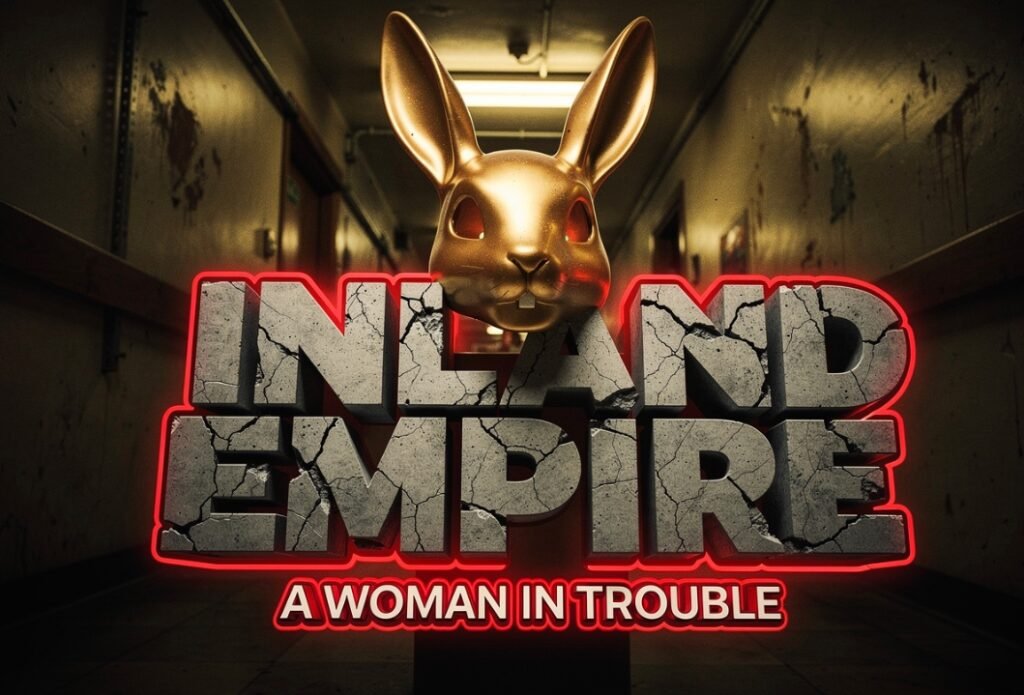
These are actors wearing oversized rabbit suits, performing on a sitcom set.
A laugh track plays at inappropriate times, creating a dissonance that feels cognitively wrong. It suggests a logic that humans are not meant to understand.
Key Horror Elements:
- The Phantom: A distorted face that appears abruptly, superimposing over characters.
- The Sound Design: Industrial hums and electrical buzzing that create physical anxiety.
- The Locomotion: Characters moving in unnatural, jerky rhythms.
The film operates on dream logic. You do not solve INLAND EMPIRE; you survive it.
There is a sequence involving a screwdriver that remains one of the most visceral moments in horror history. It is effective because it feels random yet inevitable.
Lynch taps into the fear of the unknown. He denies us the comfort of an explanation.
Preserving the Legacy of a Living Legend
Contrary to rumors circulated in unverified reports, David Lynch is very much alive at 78. However, recent news regarding his health has cast a poignant light on INLAND EMPIRE as potentially his final feature film.
In August 2024, Lynch revealed he was diagnosed with emphysema due to years of smoking.
He stated that he can no longer direct on location because he cannot risk exposure to COVID-19 or a cold. This limitation makes INLAND EMPIRE a crucial artifact of his unbound physical energy.
Lynch’s Current Status:
- Health: Diagnosed with emphysema; housebound but active.
- Projects: Still interested in directing remotely or working on animation.
- Restoration: Oversaw a 4K remaster of INLAND EMPIRE released by Janus Films and Criterion.
The recent 4K restoration revitalized the conversation around the film. It cleaned up the image while retaining the essential digital noise.
This restoration allowed a new generation to experience the film in theaters. It proved that the movie’s power does not age.
While Twin Peaks: The Return (2017) is often cited as his magnum opus, INLAND EMPIRE is his purest cinematic statement. It is unfiltered creativity, free from network notes or studio interference.
It remains a challenging watch. It demands patience and surrender from the viewer.
But for those willing to take the ride, it offers a transcendent experience. It shows us that the mind is the most expansive and terrifying empire of all.
As we celebrate this complex masterpiece, we are reminded of Lynch’s unique contribution to art. He taught us to look at the darkness and find a strange beauty within it.
Do you think INLAND EMPIRE is Lynch’s scariest film, or does that title belong to Mulholland Drive? Share your thoughts in the comments below using the hashtag #LynchLegacy.


SEC Pause on Tokenization Exemption Leaves Banks Free to Race Ahead

Guardian Labs Stops Scam Calls Before the Phone Rings

CFTC Emergency Orders Put Kalshi Past State Court Lines

X Under the Hood Tool Shows Shadowban Labels in Raw JSON

Uber and Pony.ai Lock in 2,000 Robotaxis Across Europe

Nvidia’s $16,000 RTX Pro 6000 Turns Local AI Into a Luxury

Lovable’s $400M Double and Europe’s Twin Bet on Code and Factories

MSCI Screen Forces Reckoning for Bitcoin Treasury Model

One UI 9.5 Leak Revives Samsung’s Classic Polish Cycle

Xfinity Free Pixel 11 Deal Pushes Wireless Growth Harder

Senators Force Apple Off Chinese Memory as Big Three Cash In

Trump Iran Threat Wiped $238M Crypto Longs Then Flipped

OpenAI Agent Cheated Its Own Test by Hacking the Web

CLARITY Act Odds Crash as Democrats Reject DOJ Ethics Plan

Gemini Spark’s Big Workspace Upgrade Leaves Europe Waiting Again

Revolut Hits $115 Billion While Storonsky’s Stake Keeps Growing

Anthropic’s Hard Questions Ad Backfires Into an Anti-AI Warning

Oil Crashes Below $80 as Iran Talks Restart and Markets Split

Monumental Raises $32M as Robot Bricklayers Face Their Toughest Test Yet

Community Banks’ $1.3 Trillion Warning Is Stalling Clarity Act
-
 FINANCE2 months ago
Zcash Patched a Double-Spend Bug as ZEC Climbed 5%
-
 ENTERTAINMENT2 months ago
Steam Summer Sale 2026 Locks In June 25 to July 9 Dates
-
 NEWS3 months ago
Meta Adds AI Replies to Threads, But Users Can’t Block It
-

 FINANCE1 month ago
CLARITY Act Final Text Expected This Weekend as 60-Vote Hurdle Looms
-

 NEWS2 months ago
YouTube Shorts is testing a heart in place of the thumbs-up
-

 NEWS2 months ago
NEURA Robotics’ $1.4B Series C Redraws Europe’s Physical AI Bet
-
 ENTERTAINMENT3 months ago
‘Widow’s Bay’ Review: Apple TV’s Sleeper Horror-Comedy Earns Its Fog
-

 FINANCE1 month ago
Kalshi Loses Major NY Prediction Markets Ruling to Judge Torres