
FINANCE
How One Couple Cut Their Mortgage to Under $900 With a $209,000 Self-Build
Maddy and Drew Olson built a 1,400-square-foot home in Washington for $209,000, keeping their monthly mortgage under $900. Here is how the math worked.

Maddy and Drew Olson capped the cost of their first home at $209,000 and locked in a monthly mortgage under $900. They got there the hard way, buying a lot for $156,000 in January 2025, framing and finishing most of the house themselves, and moving in about nine months later. The result is a 1,400-square-foot home in Washington with three bedrooms and two and a half bathrooms.
That monthly figure sits in a different zip code from what most American buyers face. The average monthly mortgage payment across all outstanding U.S. home loans reached $2,005 in the fourth quarter of 2025, and the median for new buyers entering the market in April 2026 was $2,152. Industry analysis puts the 2025 national average at $2,329 a month for principal and interest alone. The Olsons got their number by trading time, labor, and family support for a smaller loan, a path that is rare but no longer theoretical.
A $209,000 Build and a Mortgage Under $900
Maddy and Drew Olson started married life in a rental home in 2019. Their landlord offered to sell them the rental for $249,000, a price Maddy later called “so expensive” given what they had saved. With a baby on the way and no clear path to ownership, they decided to build.
They bought a lot for $156,000 in January 2025. The Olsons set their build budget at $209,000 and secured a construction loan for the rest. Drew worked for his parents’ concrete business, which gave him room to spend slow days on the house site. Maddy picked up the rest of the slack with help from her mother and mother-in-law, who covered childcare for their daughter Campbell. Nine months after breaking ground, the family moved in with a monthly mortgage payment under $900.
- $209,000: build budget the Olsons set and hit
- Under $900: monthly mortgage payment after the build
- About 9 months: time from breaking ground to move-in
Inside the Olson Strategy
The Olsons did not reinvent homebuilding. They bought a small lot near a cousin’s home and based the design on a builder’s existing floor plan with minor tweaks. The lot was tighter than they had hoped, but the size ended up disciplining the project. Maddy Olson, the content creator behind Over Ice Soda, told Business Insider it was easier to keep costs down because there was simply less room to overspend.
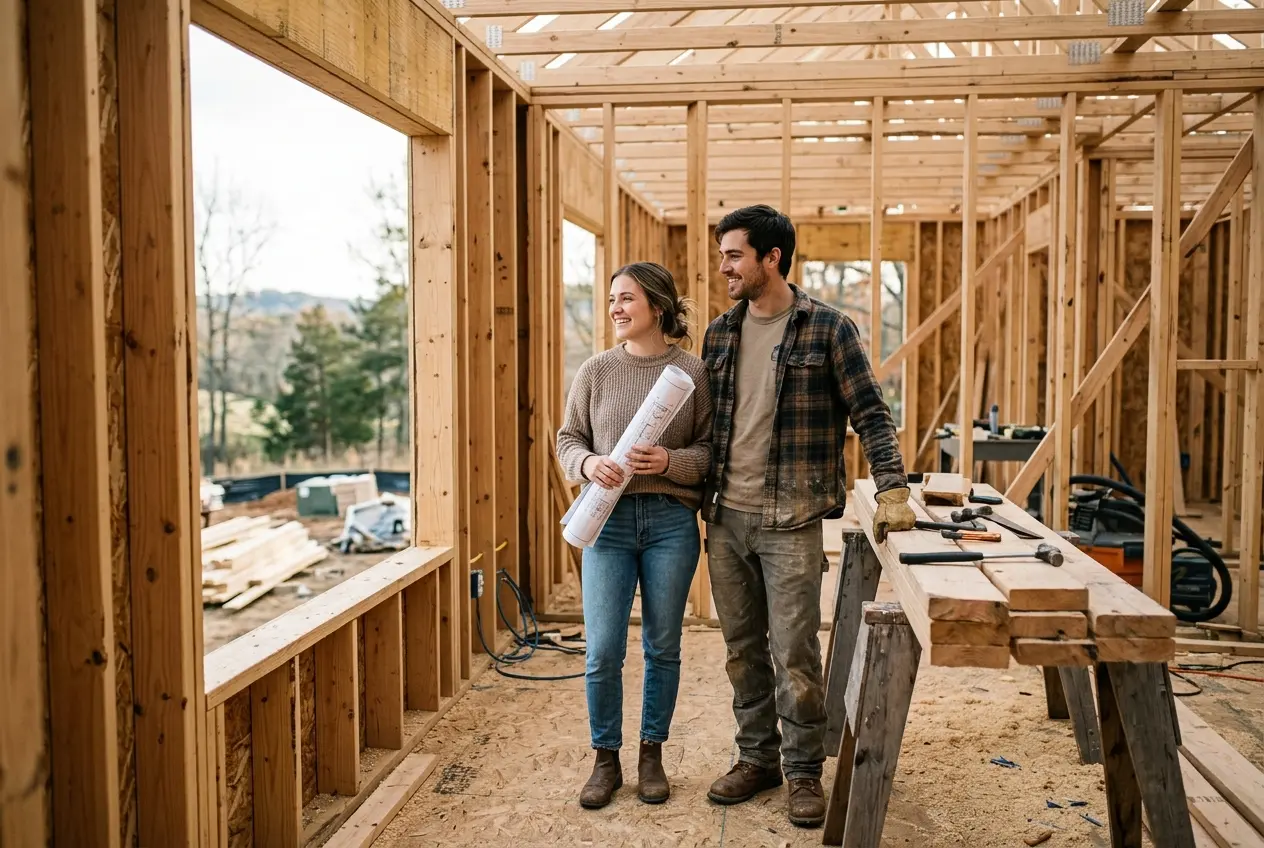
Drew did the framing, siding, and most of the finishes. He had general construction knowledge from working for his parents and a family deep in the trade. Maddy had never tiled before, but she taught herself to set the two bathroom floors during the build.
The couple hired professionals only for tasks that required a license or specialty tools: HVAC and drywall. Everything else, including painting, trim, cabinet installation, and tile, fell to the Olsons and the family members who came to help. That labor-for-cash swap is the single biggest cost lever on a self-build. Industry data from the National Association of Home Builders puts onsite labor at 20% to 25% of a typical new home’s total cost, with general overhead at roughly 6%.
| Buyer profile | Monthly payment | Source |
|---|---|---|
| The Olsons, self-built home | Under $900 | Under30CEO |
| New purchase applicants, April 2026 | $2,152 | Mortgage Bankers Association |
| All outstanding U.S. loans, Q4 2025 | $2,005 | FHFA National Mortgage Database |
| Existing mortgage holders, late 2025 | $1,600 | Federal Reserve SHED |
| 2025 national average (industry) | $2,329 | Industry analysis |
The Market They Were Buying Into
The Olsons made their build decision against a backdrop most first-time buyers would recognize. The average price of new homes sold in the United States reached $420,300 in August 2025, up roughly 31% from around $320,000 in early 2020. With Freddie Mac’s 30-year fixed-rate mortgage averaging 6.68% in August 2025, the typical buyer was stretching to cover both the price and the rate. By April 2026, the Mortgage Bankers Association reported a median payment of $2,152 among new purchase applicants, up from $2,131 in March. That is the environment a $209,000 build was designed to escape.
Geography shapes how unusual the result is. Connecticut carried the highest state average monthly payment at $4,635, with California at $3,672 and Massachusetts at $3,241. Even in West Virginia, where published state averages sit at $1,543, the Olsons’ sub-$900 number would still stand out.
How Owner-Builders Actually Finance It
Self-built homes are usually funded through a construction-to-permanent loan that converts to a mortgage when the build wraps. Bankrate describes the structure as a one-time close loan, also called a single-close loan. The lender pays the builder in stages, called draws, as work is completed and inspected. When construction finishes, the loan rolls into a traditional 15- or 30-year mortgage.
The qualification bar is higher than for a standard purchase mortgage. Most lenders want a 20% down payment, a credit score of at least 680, and a debt-to-income ratio of 45% or below. They also want detailed budgets, draw schedules, blueprints, and proof that permits are in place. Some lenders require licensed contractors for major phases like electrical and plumbing. Owners who can show construction skills, insurance, and a realistic calendar may have more flexibility on the lender list.
The numbers can shift quickly if the project runs long. Construction-to-permanent loans typically carry higher rates than standard mortgages during the build, and many require interest-only payments until the home is done. In one Bankrate example, a $320,000 loan at a 7% rate over 30 years produces a monthly principal and interest payment of about $2,129, before taxes and insurance.
- Pre-qualify with a construction lender and confirm the loan matches the project budget.
- Lock in permits, blueprints, and either a builder contract or a documented owner-builder plan before the first draw.
- Set a contingency reserve; cost overruns are common on owner-led projects.
- Track every expense so each draw request matches actual spend.
The Hidden Costs Most Buyers Underestimate
The Olson build was not free, even with most of the labor coming from inside the family. Drew kept his day job at his parents’ concrete business, which gave him the freedom to put in work on slow days. Maddy continued her brand and content work around the project, with her mother and mother-in-law covering most of the childcare for their daughter, who was born during the planning phase.
Sweat equity is real, and it is also work. The couple lived in a rental for most of the build and stayed with Drew’s parents for the final stretch. Drew had not framed or sided a house before, though his family runs in the trade. Mistakes on an active job site can be expensive if work has to be redone to meet code. Weather, inspections, and supply delays each push the calendar.
On any slow days when there wasn’t work, he’d be here working at the house.
Maddy Olson told Business Insider that is how the schedule held, with her mother and mother-in-law covering most of the childcare for their daughter. That kind of multi-generational support is not in the loan paperwork. The math also depends on local rules; some jurisdictions require licensed trades for electrical or plumbing, which removes two of the biggest savings buckets from the owner’s hands. Going much longer than the Olsons’ nine months usually means more rental overlap and higher interest-only payments during construction.
There is the trade the headline figure does not capture. Drew and Maddy spent the better part of a year on framing, tiling, painting, and finishing a house with a baby next door. The sub-$900 monthly payment is the price of that year, paid up front. Most first-time buyers cannot easily replicate the skills, family support, and time the project required.
What the Olson Path Signals Next
One couple’s build does not move the national housing market. Their result lands in a moment when the gap between renting and owning is at a historic high, when mortgage rates have stayed above 6% for years, and when builders report labor shortages that push prices higher. The arithmetic of a $209,000 build is a side door out of that market.
That door is open to a narrow group of buyers. It takes people with construction skills, family labor to lean on, time to spend on the site, and tolerance for nine months of partial construction noise. Lender products aimed at owner-built construction are expanding, and modular and small-footprint plans are easier to find than five years ago. Local rules still vary widely, and training programs for owner-builders remain thin. The Olsons show what is possible when those pieces line up; for households watching monthly costs climb past $2,000, the lesson may be the order of operations: define a payment you can carry, then build the house, the loan, and the budget around that number.
Read the original account of how Maddy and Drew Olson built their $209,000 home, the national average monthly mortgage payment across outstanding U.S. loans, and the construction cost breakdown by category from the National Association of Home Builders.
Frequently Asked Questions
How did Maddy and Drew Olson keep their mortgage under $900?
The Olsons set a build budget of $209,000 on top of a $156,000 lot purchase in January 2025 and handled most of the construction labor themselves. They hired professionals only for HVAC and drywall. The result was a 1,400-square-foot home in Washington finished in about nine months.
How much did their home cost to build?
The build itself was capped at $209,000. Adding the $156,000 lot, the total project landed around $365,000. The final monthly mortgage payment came in under $900, against a national average of $2,329 for 2025.
Can any buyer replicate a sub-$900 mortgage on a self-built home?
Not easily. Most construction-to-permanent lenders require a 20% down payment, a credit score of 680 or above, and detailed budgets and permits. The Olsons also brought construction knowledge through Drew’s family and free labor through relatives who helped with childcare.
How does a construction-to-permanent loan work?
The loan finances the build and then converts into a traditional 15- or 30-year mortgage once the home is finished. Lenders pay the builder in stages, called draws, and inspect work before each release. Owners typically make interest-only payments during the build phase.
What are the biggest risks of building your own home?
Cost overruns are common. Construction-to-permanent loans usually carry higher rates during the build, and if expenses exceed the loan amount the owner covers the gap. Mistakes can be expensive if work has to be redone to meet code, and active construction sites carry real safety risks.
How long does a self-built home typically take?
The Olsons finished in about nine months. Bankrate notes that construction phases on these loans typically last about one year, though timelines vary with permitting, scheduling, and the size of the project.
Disclaimer: This article is for informational purposes only. Mortgage rates, loan terms, and self-build requirements vary by lender and location. Consult a qualified mortgage professional before making financial decisions. Figures are accurate as of publication.


Boldr’s $5M Bet Puts HVAC Contractors at Grid Center

NEON Bets Big on Lily James Cliffhanger for February 2027

Gemini Locks Apex Pipes for Crypto Event Contracts

Sony Email Restates Old License Rules Amid Disc Backlash

TidalSense Breaks Spirometry’s Grip With a 75-Second COPD Test

Asus Zenbook Duo 2026 Makes Dual Screens a Daily Driver

SoftBank’s €172M Robot Bet Tops Europe’s €684M Funding Week

NEURA Gives Cleaning Robots a New Brain With ADLATUS Deal

Lotus Emira V6 Manual Delivers Pure Thrills Before Hybrid Shift

Pimax Dream Air Cracks the Bulk Barrier for High-End PCVR

Senators Force Apple Off Chinese Memory as Big Three Cash In

OpenAI Agent Cheated Its Own Test by Hacking the Web

Trump Iran Threat Wiped $238M Crypto Longs Then Flipped

Fed Holds Rates Again as Three Dissents Force Markets to Tighten

30-Year Yield Hits 5.32% Highest Since 2007 as Debt Supply Locks In Costs

Oil Crashes Below $80 as Iran Talks Restart and Markets Split

Google’s Knowledge Panel Fix Risks Its Own Search Defenses

Legora Buys Wexler Fact Engine as Fifth 2026 Deal

Capital Clusters and the Dual Tracks of European Tech Finance

Agon Raises $30M to Build Europe’s AI Weapon Training Arenas
-
 FINANCE3 months ago
Zcash Patched a Double-Spend Bug as ZEC Climbed 5%
-
 ENTERTAINMENT3 months ago
Steam Summer Sale 2026 Locks In June 25 to July 9 Dates
-

 FINANCE2 months ago
CLARITY Act Final Text Expected This Weekend as 60-Vote Hurdle Looms
-
 NEWS3 months ago
Meta Adds AI Replies to Threads, But Users Can’t Block It
-

 NEWS3 months ago
YouTube Shorts is testing a heart in place of the thumbs-up
-
 NEWS4 weeks ago
Senators Force Apple Off Chinese Memory as Big Three Cash In
-

 NEWS3 months ago
NEURA Robotics’ $1.4B Series C Redraws Europe’s Physical AI Bet
-
 ENTERTAINMENT5 months ago
Extraction 3 Is Officially Coming to Netflix in 2027