
NEWS
Xbox Disc Licenses Turn Physical Games Into Portable Rights
Microsoft’s disc-to-digital plan binds licenses to the plastic disc itself so rights move with resale.

Microsoft is preparing digital licenses for Xbox One and Series discs that stay tied to the physical media and move when the disc changes hands, while also opening a wider Xbox 360 library to PC and next-gen devices starting in 2027. The plans appear in an internal document reviewed by The Verge and align with testing of a feature sometimes called Disc2Digital or Positron.
The move arrives as both major console makers edge toward fewer or no disc drives. It gives physical owners a path to keep playing across Xbox hardware, PCs and handhelds without buying the game again.
Together the two efforts form a single continuity bet. One turns plastic already on shelves into a portable entitlement. The other pulls a large backward catalog onto the same multi-device surface. Both lean on developer opt-in and account-level checks rather than a clean break from physical media.
What the Leaked Document Spells Out
The Verge reported on August 3 that a document sent to developers outlines two linked efforts. One expands Xbox 360 titles to PC, Project Helix and handhelds. The other details how players turn a physical disc into a digital entitlement.
Xbox 360 support rolls out gradually across next-gen devices between 2027 and 2028. Developers choose whether a title joins Game Pass and set its price. Original Xbox games already have a path to PC, with full launch set for October 2026 after a smaller July start.
- 360 rollout window: gradual, 2027-2028 on Helix, Xbox PCs and handhelds
- Developer controls: opt-in for backward compatibility, Game Pass inclusion and pricing
- Original Xbox PC: full launch October 2026
- Disc2Digital status: internal testing advanced; public beta delayed from July target, general availability once floated for August
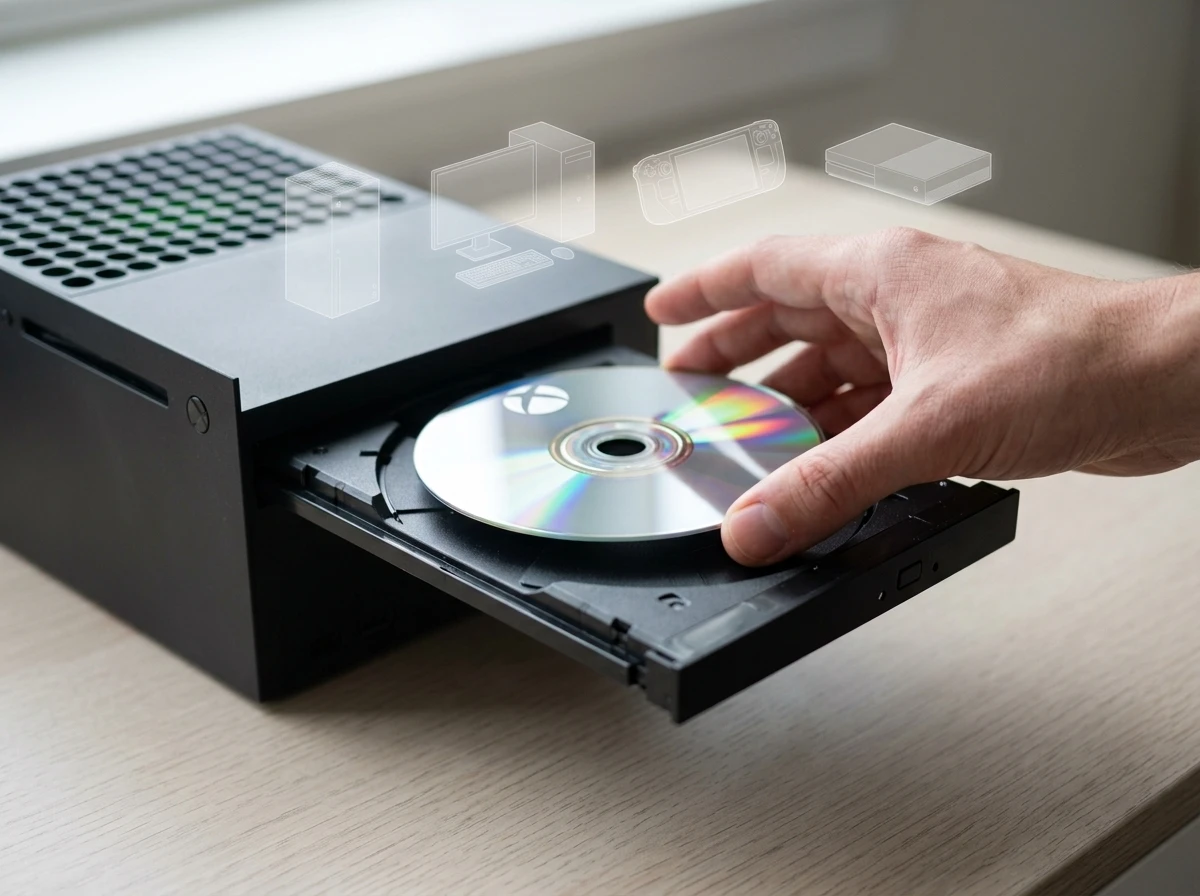
The same document confirms the disc-to-digital mechanic first detailed by The Verge in July. Insert an Xbox One or Series disc into a console with a drive, install and play, and the account receives a digital license bound to that disc.
Linking the two programs in one briefing is deliberate. Studios weighing 360 participation can see the same multi-device end state that Disc2Digital already promises for newer physical copies. The staggered dates also give Microsoft room to finish entitlement work before Helix hardware reaches a wider audience.
How the License Stays Glued to the Disc
The license is not a free digital twin that lives forever on one account. It travels with the plastic. Lend or sell the disc and the digital rights follow the new owner. The previous holder loses the digital version.
That single rule keeps the secondary market alive. Discs remain playable after digitization. Multi-disc sets and some bundled titles are covered. Certain older Xbox One pressings may lack the needed features, Microsoft has warned internal testers.
| Aspect | Detail |
|---|---|
| Supported discs | Xbox One and Xbox Series X only |
| Excluded | Xbox 360 and original Xbox discs |
| How it activates | Insert disc, install and play on drive-equipped Xbox One or Series X |
| License binding | Tied to the specific disc and the player’s account |
| Transfer rule | License moves to new owner if disc changes hands |
| Devices after digitization | Xbox consoles, PCs, handhelds; cloud if Game Pass eligible; Play Anywhere titles cross over |
| Disc after conversion | Still works; entitlement lost only on loan or sale |
Crowd reaction on X quickly zeroed in on the one-active-owner limit. Posts noted the design blocks duplication while still letting used discs carry value. Some players said they still want a built-in drive for Blu-rays and movies; others treated the transfer rule as proof physical media keeps leverage even in a digital-first era.
Activation stays simple on purpose. The console already knows how to read the disc, install the game and check the account. Binding the license at that moment avoids a separate redemption step and keeps the plastic as the proof of ownership. Once the entitlement exists, the same account can reach the title on any supported device without inserting the disc again, until the disc itself changes hands.
Exclusion of Xbox 360 and original Xbox discs keeps the program inside hardware that already shares a generation with Series consoles. Those older libraries instead move through the separate PC and Helix expansion path, where developers opt in title by title rather than through a disc scan.
The Broader 360 Library Heads to PC and Helix
Microsoft already sells a handful of Xbox 360 titles on PC through the Xbox Store, including Fallout 3, Fallout: New Vegas, Gears of War 3, Fable III, Dragon Age: Origins and The Elder Scrolls IV: Oblivion. The new effort aims much wider and runs in step with the digitization push.
Titles will run on Project Helix, Xbox-branded PCs and handhelds. The gradual 2027-2028 window gives studios time to decide participation. That control matters after Microsoft’s summer reset of studios and headcount.
- July 2026: Initial original Xbox games appear on PC
- October 2026: Full original Xbox PC launch planned
- 2027-2028: Gradual Xbox 360 expansion across next-gen devices
- Ongoing: Disc2Digital testing and possible public release
The library expansion feeds the same multi-device goal as Game Pass catalog expansions this year. Once a 360 title is digital and opted in, it can sit alongside newer Play Anywhere games that already move between console and PC.
Pricing control sits with the developer for each opted-in 360 title. A studio can chase Game Pass subscribers, hold a premium store price, or stay out entirely. That flexibility is the counterpart to the forced transfer rule on Disc2Digital: one program protects secondary-market value for owners, the other protects commercial choice for rights holders.
Project Helix Meets Sony’s Hard Stop on Discs
Xbox has confirmed Project Helix as its next first-party console. It is designed to play both Xbox console games and PC games, powered by a custom AMD SoC. Officials plan to ship Project Helix alpha hardware to developers in 2027. Whether every SKU ships with a disc drive remains unconfirmed; reports have pointed both ways.
If Helix arrives disc-free or with limited drive options, Disc2Digital becomes the bridge for owners who want their physical collection on the new hardware. Sony has taken a clearer line. On its official blog the company said it will discontinue physical disc production starting January 2028 for new PlayStation games. Existing and pre-2028 titles keep their discs. New releases after that date go digital-only through the store and retailers.
As consumer preferences and the broader entertainment industry continue to shift away from physical discs to digital, physical game disc production for all new games releasing on PlayStation consoles will be discontinued starting January 2028.
Sid Shuman, senior director of content communications at Sony Interactive Entertainment, wrote those lines in the July announcement. Microsoft has not issued a matching hard end date. Its document instead treats digitization of existing discs as preparation for a future with fewer drives.
The calendar overlap is hard to miss. Helix alpha kits are due to developers in 2027. Sony’s disc cutoff lands in January 2028. Microsoft’s 360 wave spans that same 2027-2028 band. Owners who digitize early keep options open no matter which Helix SKUs finally ship with a drive.
| Company | Physical media stance | Key date |
|---|---|---|
| Microsoft | Digitize existing One and Series discs; no hard end date announced | Disc2Digital testing now; Helix alpha 2027 |
| Sony | End new disc production; older titles keep plastic | January 2028 cutoff for new games |
Why the Two Programs Share One Roadmap
Disc2Digital and the 360 expansion solve different inventory problems with the same destination. One covers discs players already bought for Xbox One and Series. The other covers a catalog that never had a native path onto modern Xbox PCs, Helix and handhelds at scale.
Both depend on account entitlements rather than permanent offline unlocks. Both feed Play Anywhere style movement and, where eligible, cloud streaming. Both arrive while Microsoft is still shipping drive-equipped hardware that can perform the initial disc read.
- Disc2Digital converts owned One and Series plastic into a movable license
- 360 expansion brings opted-in older titles onto Helix, PC and handhelds
- Original Xbox PC work lands earlier, in 2026, as a separate on-ramp
- Game Pass and store pricing stay under developer control for the 360 wave
Running them on overlapping calendars reduces the chance that a Helix launch leaves large owned libraries stranded. It also gives the company a single story about portability when it talks about controllers, cloud and multi-device play in the same breath.
Who Gains When Licenses Travel With the Plastic
Physical owners keep a tradable asset. Sell the disc and the buyer receives both the plastic and the digital rights. That differs from pure digital purchases that usually stay locked to one account. Used-game retailers and peer-to-peer sellers retain inventory that still confers multi-device access.
Collectors who already own large One and Series libraries gain a low-friction path onto Helix and PC without double-dipping. Cloud and Play Anywhere titles become streamable or installable once the entitlement exists. Handhelds benefit from the same pool.
Developers and publishers control pricing and Game Pass decisions for the 360 wave, so they can protect margins or chase subscribers. Microsoft strengthens the case that an Xbox library is portable across form factors, a point that also surfaces in talk of a new Xbox controller with Wi-Fi support aimed at cloud and multi-device play.
The risks sit on the other side of the ledger. Timelines have already slipped once for the public beta. Some One discs may never qualify. Players who prefer offline permanence without any account tether still face Microsoft’s entitlement checks, a friction that appeared during a recent outage. Pure digital buyers gain nothing new from the disc program. And if Helix ultimately drops the drive entirely, the window to digitize shrinks to whatever current hardware remains in living rooms.
- Physical owners and resellers: retain transferable value and multi-device rights
- Collectors moving to Helix or PC: avoid rebuying the same titles
- Developers: retain opt-in control over 360 pricing and Game Pass
- Microsoft: smoother path to disc-optional hardware while keeping library continuity
- Players locked into pure digital or missing compatible discs: limited upside
What Still Hinges on Timing and Hardware
Several open questions sit inside the dates already on the table. The public beta missed its July target. General availability was once floated for August. Every slip narrows the stretch of time when drive-equipped Xbox One and Series consoles are still common enough for mass digitization.
Helix SKU decisions matter just as much. If some configurations ship without a drive, owners who never ran Disc2Digital on older hardware will need another path or a friend with a drive. The document does not promise a forever window.
Developer opt-in for the 360 wave adds a second variable. A wide catalog on Helix and PC is the goal, yet each studio still chooses participation, Game Pass inclusion and price after a summer of studio and headcount resets. The 2027-2028 ramp exists partly so those choices can land without a single forced drop day.
For players the practical sequence is straightforward. Digitize eligible One and Series discs while a drive is still in the house. Watch the original Xbox PC dates in 2026. Treat the later 360 wave as an expanding store and Game Pass shelf rather than an automatic unlock of every disc on the shelf.
The second-order effect is the license that follows the disc. Microsoft is not simply scanning boxes into the cloud. It is rewriting physical ownership as a moving passport that works on the next console, a Windows PC and a handheld, just as Sony sets a hard end date for new plastic. Whether the August general-availability window holds or slips again, the shape of the bridge is now public.


Bandcamp Boots Boy George Over AI Song, Not Just the Lyrics

Olix Triples to $3.3bn on Optical Bet Against Nvidia

Four Teens Died After Platforms Vowed Fixes and Suits Began

Google Health Now Writes Fitbit Data Into Apple Health

Pixel 11 Pre-Orders Open Eight Hours Before the Event

Aflabox Seed Funds Field Mycotoxin Tests That Beat Lab Delays

2026 Lexus RZ Gains Power and Range Yet Still Falls Short

Ankr Nodes Clear Path for XRPL Institutional Features

Xbox Disc Licenses Turn Physical Games Into Portable Rights

BlackRock Turns Cash Empire Into Stablecoin Reserve Rails

Kalshi Loses Major NY Prediction Markets Ruling to Judge Torres

Fed Minutes Cite AI Demand as Inflation Risk, Put a 2026 Hike Back on the Map

Marker AI Writing Startup Lands $13M Seed Led by Index Ventures

Dota 2 Esports World Cup 2026: Spirit Defends $2M Title In Paris

Meta’s Muse Spark 1.1 Beats Rivals on Price, Trails on Coding

Finto Picks Munich Over Silicon Valley After YC, Raises $3.4M

ARC Intelligence Closes €4M Seed Round in Roughly a Week

CS2 Premier Season 5 Lands With Cache and a C4 Damage Rework

Backrooms Returns to Theaters as the Everything Must Go Edition

Magnificent Seven Shed $2 Trillion in June as the Rally Broadens
-
 FINANCE2 months ago
Zcash Patched a Double-Spend Bug as ZEC Climbed 5%
-
 ENTERTAINMENT2 months ago
Steam Summer Sale 2026 Locks In June 25 to July 9 Dates
-

 FINANCE1 month ago
CLARITY Act Final Text Expected This Weekend as 60-Vote Hurdle Looms
-
 NEWS3 months ago
Meta Adds AI Replies to Threads, But Users Can’t Block It
-
 ENTERTAINMENT3 months ago
‘Widow’s Bay’ Review: Apple TV’s Sleeper Horror-Comedy Earns Its Fog
-
 NEWS5 months ago
U.S. Navy Deploys Solar-Powered Lightfish Drone to Patrol Oceans
-
 FINANCE4 weeks ago
Kalshi Loses Major NY Prediction Markets Ruling to Judge Torres
-
 NEWS8 months ago
FolderFresh Review: This Free Tool Automates Windows File Organizing