
NEWS
Olix Triples to $3.3bn on Optical Bet Against Nvidia
UK startup Olix secures $312m Series B at $3.3bn, tripling value on optical specialist chips that skip scarce HBM and target 2027 delivery.

UK chip startup Olix has raised $312 million in a Series B round that values the company at $3.3 billion, more than tripling its mark from February. The two-year-old London firm, founded by 25-year-old James Dacombe, plans to put its first specialised optical AI inference systems in customers’ hands in the second half of 2027.
Fundomo led the round. Arm, Hudson River Trading, Netflix co-founder Reed Hastings and the UK government’s Sovereign AI fund all joined, while existing backers increased their stakes. The money funds manufacturing commitments, the wider silicon platform and the path to first racks.
A $312 Million Round That Tripled the Valuation
Olix closed the Series B on 3 August 2026, exactly two years after founding. In February it had raised $220 million at just over $1 billion. The new capital takes total raised past $530 million in six months.
- $312m Series B led by Fundomo
- $3.3bn post-money valuation
- H2 2027 target for first customer deliveries of DX-1
- 140+ staff across London, Bristol, Austin, Toronto and San Francisco
Existing investors Hummingbird Ventures, Crane, Plural, Creandum, Phoenix Court and Transition all upped their commitments. The company will use the funds to finish design and testing, lock supply chain capacity and expand the custom silicon platform behind its X-1 systems.
Who Put Money In and Who Joined the Board
The investor list mixes pure-play venture, strategic silicon, quant trading and sovereign capital. Arm’s participation carries particular weight: the British chip designer sits at the centre of many AI system-on-chip efforts and now has a direct stake in a pure inference specialist.
| Participant | Role | Notes |
|---|---|---|
| Fundomo | Lead | New York VC |
| Arm | Strategic | Chip IP giant |
| Hudson River Trading | Investor | Quant firm, deep tech focus |
| Reed Hastings | Angel | Netflix co-founder |
| UK Sovereign AI fund | Existing + increase | Fifth equity investee |
| Hummingbird, Crane, Plural, Creandum, Phoenix Court, Transition | Existing | All increased |
Alongside the money, Olix named two heavyweight additions. Matt Briers joined as CFO after nine years in the same role at Wise, where he took the fintech through its 2021 London direct listing. Professor Nick McKeown, Stanford emeritus and co-inventor of software-defined networking, OpenFlow and P4, joined the board. McKeown previously co-founded Nicira and Barefoot Networks and led Intel’s networking business after the Barefoot acquisition. He won the 2025 Marconi Prize.
Iain Dunning, head of AI at Hudson River Trading, posted that the firm was “proud to partner with firms solving the deepest technical problems,” signalling that sophisticated quant capital sees real engineering substance rather than pure narrative.
How the Token Factory Architecture Works
Olix rejects the general-purpose GPU model for inference. Its core claim is that a data centre is a factory whose product is the token, and that producing one token requires hundreds of operations with different hardware needs. Today every stage runs on the same generalist chip. Olix wants specialised chips for each stage, connected by a novel optical fabric.
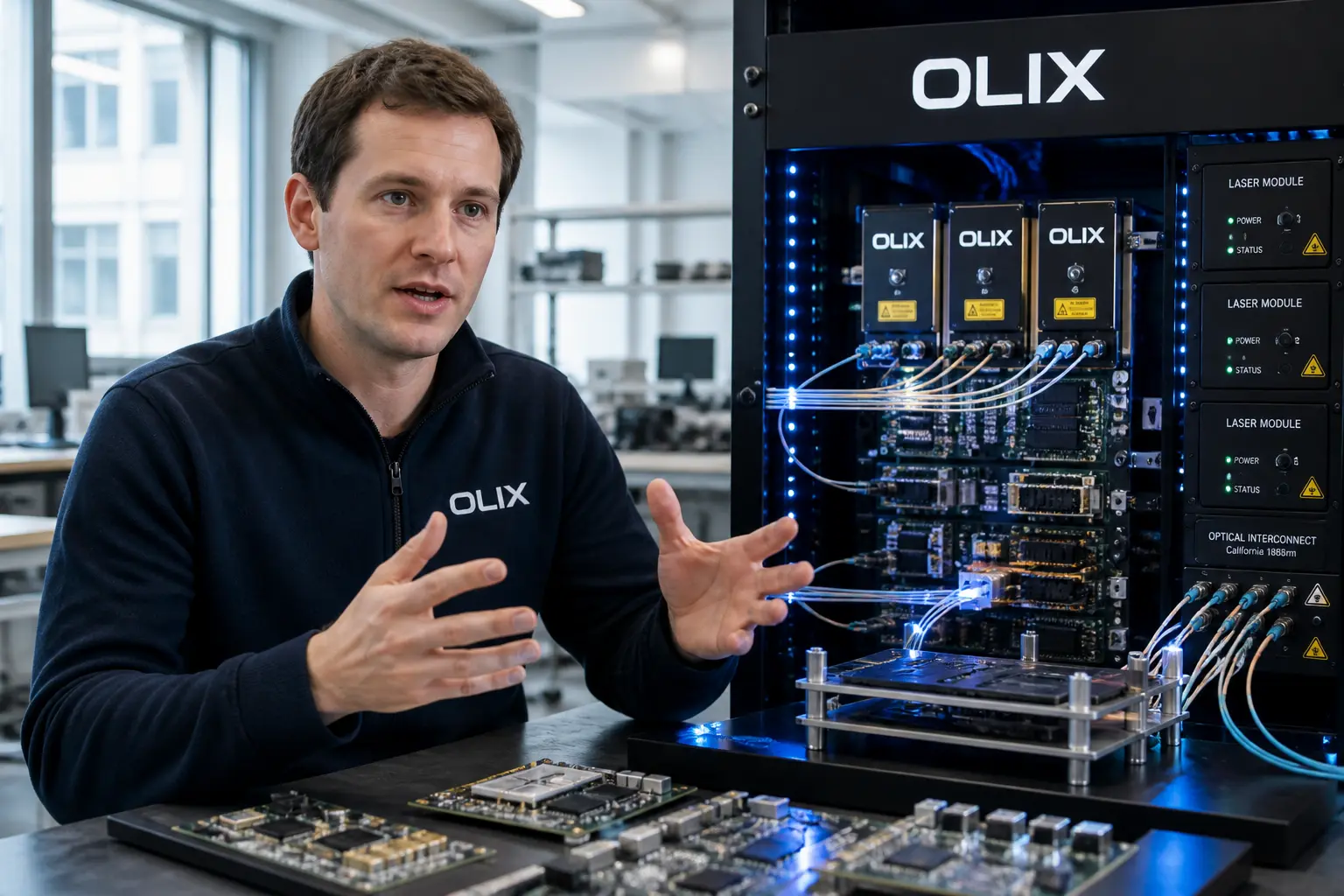
On the OLIX token factory platform overview, the company describes the X-1 system as fully unrolling models across many chips so each focuses on one part of the workload. A deterministic compiler schedules work across racks. The interconnect is deliberately “slow and wide”: light moves data directly between chips at ultra-low latency and energy cost instead of copper. Rack-scale co-design covers lasers, networking and silicon together.
- Specialised chips per inference stage rather than one generalist
- Novel slow-and-wide optical interconnect replacing copper links
- Models held in fast on-chip SRAM, not external HBM
- No advanced packaging required for the first DX-1 part
- Flexible compute fabric that does not hard-code any single model architecture
- Multi-rack scale-up domain aimed at 10-trillion-parameter models and beyond
The first product, DX-1, is a decode accelerator for the stage where a model generates output. Olix claims that for 100-billion-parameter models it can deliver over 10,000 tokens per second per user while beating general-purpose chips on tokens per watt even at large batch sizes. Those numbers remain internal until silicon ships.
The Shortage Olix Claims to Sidestep
The most timely piece of the pitch is what the chips leave out. DX-1 uses no high-bandwidth memory and no advanced packaging. Those are precisely the components in shortest supply across the AI industry. By holding models in on-chip SRAM and relying on optical links, Olix argues it can scale volumes even while HBM and packaging lines stay constrained.
Dacombe has been blunt about the shift. He told the Financial Times the days of Nvidia handling every AI chip workload are over: “we are moving into a world of specialists.”
Olix believes the industry’s approach to building AI inference hardware is reaching its efficiency limits. A datacenter is a factory whose product is the token.
That language appears in the official Series B announcement details. Crowd reaction on X has been quieter than the valuation might suggest, yet the sharpest takes note that capital is already rotating toward architectures that treat memory bandwidth and interconnect as the real bottlenecks rather than raw FLOPS. The HBM “memory wall” is no longer a fringe complaint; optical interconnect capacity expansions and co-packaged optics roadmaps are industry mainstream topics in 2026.
James Dacombe Runs Two Capital-Intensive Hardware Firms
Dacombe is 25 and still CEO of CoMind, the brain-monitoring and treatment startup he founded as a teenager after dropping out of sixth-form college in Harrogate two days into A-levels. CoMind has raised roughly $100 million. He incorporated Olix in March 2024 and became a director the same day. The dual mandate is unusual for two hardware companies that both demand deep physical systems work.
His holding company is called Bletchley Industries, a deliberate nod to wartime British code-breaking. Sovereign AI’s head of ventures, Joséphine Kant, said after her first meeting she left “convinced he’d be one of the most important founders of his generation.” The UK government fund counts Olix among its earliest equity bets and treats the company as proof that ambitious AI hardware can still be built from Britain.
AI Minister Kanishka Narayan put the sovereign case plainly in the UK Sovereign AI fund investment statement: “The future of AI will be built on chips that power models. Countries that build chips will build leverage.” The fund’s public materials note that a 5 percent share of a market expected to reach one trillion dollars in the early 2030s would mean fifty billion dollars in UK revenue and tens of thousands of high-skilled jobs.
First Racks Target Late 2027
- March 2024, Olix incorporated in London; Dacombe becomes director.
- February 2026, $220 million raise at just over $1 billion valuation.
- 3 August 2026, $312 million Series B at $3.3 billion; McKeown and Briers join.
- Later 2026, Design and testing of DX-1 to complete.
- H2 2027, First customer access to DX-1 systems sold as complete server racks with software and networking.
Olix is still pre-silicon. Performance claims have not been validated on real customer workloads. Peers such as Etched and SambaNova carry higher valuations and more mature products. Public markets remain skittish about debt-funded AI infrastructure build-outs. The company must still hire aggressively across silicon, photonics, compilers and systems engineering while locking long-lead manufacturing capacity.
Yet the combination of optical interconnect, specialist decode silicon, SRAM-only memory and an explicit avoidance of the two scarcest components gives the bet a clear technical edge case that general-purpose GPU roadmaps do not address. Arm’s presence, McKeown’s networking pedigree and a former public-company CFO all reduce the pure “young founder” risk premium that often attaches to pre-product hardware unicorns.
If DX-1 lands on schedule and hits even a fraction of the claimed tokens-per-watt advantage, the $3.3 billion price will look cheap. If the optical stack or the compiler misses, the same number will look like the peak of another AI hardware cycle. For now the capital is committed, the board is set and the production line is being built in London, Bristol and beyond.
Frequently Asked Questions
Who founded Olix and what else does he run?
James Dacombe, now 25, founded Olix in 2024. He remains CEO of CoMind, a neurotechnology company he started at 17 that has raised about $100 million for brain monitoring and treatment devices. He dropped out of sixth form in Harrogate after two days of A-levels and has been building hardware companies since his teens.
What is the previous funding history of Olix?
Olix raised $220 million in February 2026 at a valuation just over $1 billion. The August 2026 Series B of $312 million at $3.3 billion brings total capital raised above $530 million inside six months. Existing investors from the earlier round all increased their commitments.
How does Olix’s chip approach differ from Nvidia GPUs?
Olix designs specialised chips for individual stages of the AI inference process and connects them with a slow-and-wide optical interconnect instead of copper. The first DX-1 part holds models in on-chip SRAM and requires neither high-bandwidth memory nor advanced packaging, the two components currently in shortest supply for GPU-centric systems.
When will Olix ship its first products?
The company is in final design and testing and expects to deliver its first DX-1 systems to customers in the second half of 2027. Systems will ship as complete server racks that include the chips, software and networking equipment rather than bare silicon.
What role does the UK government play in Olix?
The UK Sovereign AI venture fund is an existing investor that increased its commitment in the Series B. Olix is the fifth company to receive equity investment from the fund. Government materials frame the stake as part of a broader push for British sovereign capability in AI hardware and cite a potential $50 billion UK revenue opportunity if the country captures 5 percent of a trillion-dollar chips market.


Bandcamp Boots Boy George Over AI Song, Not Just the Lyrics

Olix Triples to $3.3bn on Optical Bet Against Nvidia

Four Teens Died After Platforms Vowed Fixes and Suits Began

Google Health Now Writes Fitbit Data Into Apple Health

Pixel 11 Pre-Orders Open Eight Hours Before the Event

Aflabox Seed Funds Field Mycotoxin Tests That Beat Lab Delays

2026 Lexus RZ Gains Power and Range Yet Still Falls Short

Ankr Nodes Clear Path for XRPL Institutional Features

Xbox Disc Licenses Turn Physical Games Into Portable Rights

BlackRock Turns Cash Empire Into Stablecoin Reserve Rails

Kalshi Loses Major NY Prediction Markets Ruling to Judge Torres

Fed Minutes Cite AI Demand as Inflation Risk, Put a 2026 Hike Back on the Map

Marker AI Writing Startup Lands $13M Seed Led by Index Ventures

Dota 2 Esports World Cup 2026: Spirit Defends $2M Title In Paris

Meta’s Muse Spark 1.1 Beats Rivals on Price, Trails on Coding

Finto Picks Munich Over Silicon Valley After YC, Raises $3.4M

ARC Intelligence Closes €4M Seed Round in Roughly a Week

CS2 Premier Season 5 Lands With Cache and a C4 Damage Rework

Backrooms Returns to Theaters as the Everything Must Go Edition

Magnificent Seven Shed $2 Trillion in June as the Rally Broadens
-
 FINANCE2 months ago
Zcash Patched a Double-Spend Bug as ZEC Climbed 5%
-
 ENTERTAINMENT2 months ago
Steam Summer Sale 2026 Locks In June 25 to July 9 Dates
-

 FINANCE1 month ago
CLARITY Act Final Text Expected This Weekend as 60-Vote Hurdle Looms
-
 NEWS3 months ago
Meta Adds AI Replies to Threads, But Users Can’t Block It
-
 ENTERTAINMENT3 months ago
‘Widow’s Bay’ Review: Apple TV’s Sleeper Horror-Comedy Earns Its Fog
-
 NEWS5 months ago
U.S. Navy Deploys Solar-Powered Lightfish Drone to Patrol Oceans
-
 FINANCE4 weeks ago
Kalshi Loses Major NY Prediction Markets Ruling to Judge Torres
-
 NEWS8 months ago
FolderFresh Review: This Free Tool Automates Windows File Organizing