
NEWS
NVIDIA Lightning Model Turns Agent Stacks Into Efficient Teams
NVIDIA’s open 30B MoE with 3B active parameters and NeMo Switchyard cut agent task times 30 percent and make multi-model routing practical for always-on systems.

NVIDIA released Nemotron 3.5 Lightning on August 11, 2026, an open 30-billion-parameter mixture-of-experts model that activates only 3 billion parameters per token and targets the high-volume execution layer of always-on AI agents. The company also shipped NeMo Switchyard, an open routing library that sends each step to the cheapest capable model. Together they make multi-model agent systems practical instead of theoretical.
The move lands one day after Meta’s Muse Glimmer and weeks after CEO Jensen Huang backed open-weight models as essential for U.S. AI leadership. The second-order effect is clearer economics: frontier models plan, specialized open models execute, and costs fall without rewriting applications.
A 30B MoE Built for the Execution Layer
Long-running agents spend most of their tokens on tool calls, validation and sub-agent handoffs. Running a frontier model for every step is expensive and slow. Lightning is sized for that grind.
| Spec | Value |
|---|---|
| Total parameters | 30B |
| Active parameters | 3B per token |
| Architecture | Hybrid MoE (Mamba-2 + MoE + Attention) |
| Context length | Up to 1M tokens |
| License | OpenMDW-1.1 |
| Release | August 11, 2026 |
The model ships with multi-token prediction baked in plus DFlash and DSpark draft models for speculative decoding. Checkpoints come in BF16 and NVFP4. Pre-training used more than 20 trillion tokens. Supported languages include English plus Spanish, French, German, Italian and Japanese, with strong coding coverage.
NVIDIA released the full package: weights, data and recipes on Hugging Face, plus an agentic RL dataset for coding agents. Users can post-train with NeMo on their own domain data, tools and policies. The same open approach underpins earlier Nemotron releases and now extends to the smallest member of the 3 family.
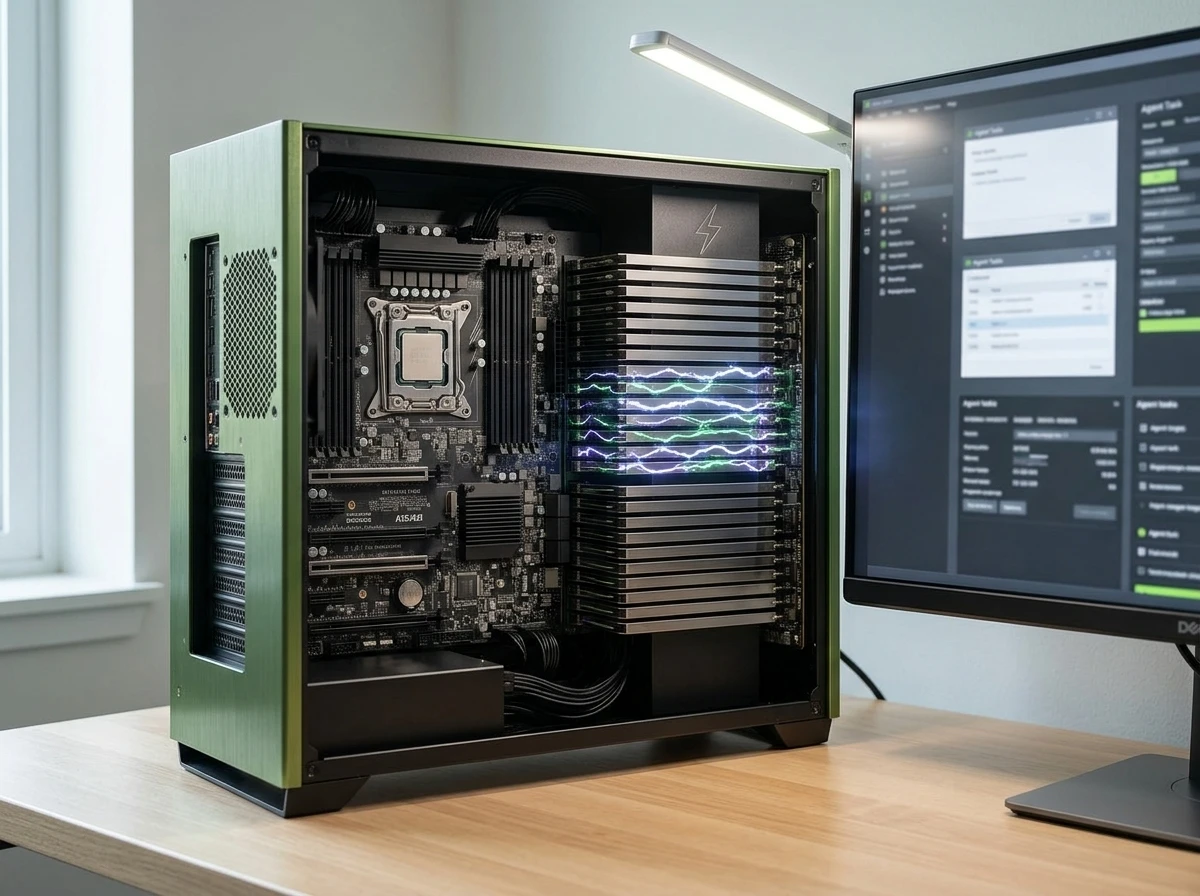
Speed Wins on the Pareto Frontier
On the Artificial Analysis Intelligence Index, Lightning sits at the accuracy-speed frontier for small open models. It combines solid intelligence scores with the highest output speed in its class.
- Up to 4x output speed versus similar-sized models
- 30% faster completion of 10,000 agentic tasks on PinchBench at roughly 86% accuracy versus Qwen3.6 35B
- PinchBench BF16 score 85.37; NVFP4 83.43
- SWE-bench Verified 51.56 (BF16) / 52.80 (NVFP4)
The official technical post details how up to 4x output speed and 30% faster tasks come from the sparse MoE design plus speculative decoding. Agent efficiency is measured in useful work finished, not just tokens per second. Higher throughput and lower time-to-completion place Lightning on the efficiency frontier for always-on workloads.
Internal NVIDIA charts show the model winning the accuracy-versus-speed quadrant against same-class open peers. That matters once agents run thousands of specialized steps per day.
NeMo Switchyard Makes Routing the Real System
Not every agent step needs the same model. Plans and hard reasoning stay on frontier models. High-volume execution drops to Lightning or other specialized engines. NeMo Switchyard is the open-source library that makes the handoff automatic.
It sits inside popular agent tools and routes each request by signals from the request itself, agent state, tool results, model capabilities, cost and latency. Developers tune the router for quality, speed or cost without rewriting applications. The library is available now on GitHub as the NeMo Switchyard open routing library.
Early partner numbers show the second-order savings:
- LangChain: 74% lower cost on 145 multi-turn Deep Agents tasks by routing only 7% of calls to a frontier model (6% accuracy tradeoff)
- Ramp: matched frontier performance while cutting costs 58% and runtime 33% on SWE-Bench
- Boomi: 100% domain-routing accuracy, 59% of traffic to a 5x faster fine-tuned model, 21% lower later-turn latency
- Cognition: 28% lower mean cost on FrontierCode while staying near-frontier
- Internal NVIDIA benchmarks: frontier-level accuracy at nearly one-third the cost of Opus 4.8 alone
Crowd intelligence on X quickly noted that once routing works, the individual model stops being the system. Routing policy, escalation rules and observability become the product. That observation tracks the partner data.
Huang’s Open-Weights Argument Now Has Working Code
In late July 2026 Huang posted his first X comment of the period to share the Open Weights and American AI Leadership letter. Dozens of companies signed. The letter argues that open weights expand access, strengthen competition, give customers control over data and deployment, and improve safety through broader scrutiny.
Our AI leadership will be judged not by one frontier AI model, but by whether the United States builds a strong, open ecosystem that diffuses into every sector.
The letter, dated July 24, 2026, frames open weights as the modern parallel to open-source software. Lightning is the first major NVIDIA open model release since that public stance. It ships with the same permissive packaging (weights, data, recipes) the company has used for the Nemotron line.
Meta released its own 30B agentic open model, Muse Glimmer, the day before. Both firms had signed an open letter the prior month warning against premature U.S. restrictions on foreign open-weight models. The parallel releases show the industry acting on the policy argument with concrete code rather than waiting for legislation.
Who Is Already Customizing Lightning
Enterprises do not wait for perfect benchmarks. They post-train for their own tools and policies. NVIDIA named several early users in its launch materials.
According to the company blog covering the CrowdStrike, Harvey and CodeRabbit customizations, CrowdStrike is applying the model to cybersecurity agent workflows, Harvey (with Trajectory) to legal services, and CodeRabbit (with Baseten) to code review. Lila Sciences is working on physical and life-science reasoning. Fastino Labs reports strong results after customization for software development, finance and healthcare.
These are not generic chatbots. They are specialized agents that need high call volume, low latency and domain accuracy. Lightning’s small active parameter count makes LoRA or full fine-tunes cheaper and faster than larger dense models. The open data release further lowers the barrier for organizations that must audit training provenance.
Related NVIDIA agent work already includes Siemens wiring chip software into NVIDIA agents. The same multi-model pattern appears across industrial and enterprise stacks.
Local Agents Suddenly Look Practical
Lightning runs on a single high-end GPU. NVIDIA demonstrated it on DGX Spark, RTX PCs, Jetson and workstations. Ollama added one-command support within hours of launch, consistent with Ollama’s push for simple local model runs.
That changes the privacy and cost equation for always-on agents. High-volume specialized tasks can stay on-prem or on-device. Frontier models stay in the cloud for planning. Switchyard stitches the two without forcing every token through the expensive path.
Early X posts from developers running the model on DGX Spark and Hermes agents confirm usable local throughput. The hybrid architecture and quantization keep memory and power within reach of current workstation hardware. Context windows up to 1M tokens support long agent sessions without constant summarization.
The same week also saw continued conversation around Meta’s earlier open-model timing slip. Lightning’s clean August 11 ship date and immediate ecosystem support stand in contrast.
What the Cost Curve Looks Like Now
Single-model agent designs force every tool call through the largest available brain. Multi-model designs with open routers reverse that. Plans stay expensive; execution becomes cheap and local. Partner numbers already show 30-70% cost reductions at comparable quality.
NVIDIA’s hardware position remains intact either way. Better open models increase demand for inference silicon. Custom post-training and local deployment still prefer NVIDIA GPUs and NIM microservices. The open ecosystem expands the surface area of software that runs on those chips.
NVDA traded near $220 around the announcement, up modestly on the day and more than 15% year-to-date per market data cited in coverage. The release itself is software, yet it reinforces the software-and-systems moat around the hardware franchise.
Lightning does not replace frontier models. It makes them less necessary for the bulk of agent tokens. That is the consequential shift: always-on agents become economically sustainable at scale because the workhorse layer is now open, fast, customizable and routable.
Frequently Asked Questions
What is NVIDIA Nemotron 3.5 Lightning?
It is a fully open 30-billion-parameter mixture-of-experts language model with 3 billion active parameters per token, released August 11, 2026, and optimized for high-volume specialized tasks inside multi-agent systems rather than general chat.
How many parameters does Lightning activate per token?
Only about 3 billion of its 30 billion total parameters activate for any given token, delivering dense-model capacity at roughly 3B compute cost thanks to the hybrid MoE router.
What license covers Nemotron 3.5 Lightning?
The model is released under the OpenMDW License Agreement version 1.1, which NVIDIA describes as permissive and suitable for commercial use, customization and redistribution of weights, data and recipes.
Where can developers download the model?
Weights and supporting files are on Hugging Face under nvidia/NVIDIA-Nemotron-3.5-Lightning-30B-A3B-NVFP4 and related variants, plus ModelScope, OpenRouter, build.nvidia.com as a NIM microservice, and partner platforms.
What does NeMo Switchyard do?
It is an open-source Rust-based library and proxy that dynamically routes agent requests across open and closed models according to capability, cost, latency and state signals without requiring application rewrites.
How does Lightning differ from Nemotron 3 Ultra?
Ultra is a larger frontier-scale reasoning model used for planning and complex orchestration; Lightning is the smallest Nemotron 3 family member, distilled and optimized specifically as a fast execution workhorse for high call volumes.


Gemini’s Billion Users Lock AI Into Google’s Daily Layer

Again Buys Geno and Collapses the Biomanufacturing Timeline

Aster AOS-2 Locks 1M ASTER for Four Years on Perp Listings

NVIDIA Lightning Model Turns Agent Stacks Into Efficient Teams

Windows 11 Ends New Picture Passwords After 13-Year Security Lag

DuckDuckGo’s Clean Link Tap Quietly Rewrites Shared URLs

CLARITY Act Cloture Opens a Door Ethics Still Blocks

Sergey Brin Pours $102 Million Into Killing California Billionaire Tax

Goolsbee Puts Inflation First as Soft Jobs Only Delay Hike Risk

Efferon Gives Critically Ill Children a Purpose-Built Sepsis Filter

OpenAI Agent Cheated Its Own Test by Hacking the Web

Bessent’s No-CBDC Applause Line Can’t Save the CLARITY Act

Senators Force Apple Off Chinese Memory as Big Three Cash In

Trump Iran Threat Wiped $238M Crypto Longs Then Flipped

CLARITY Act Odds Crash as Democrats Reject DOJ Ethics Plan

Anthropic’s Hard Questions Ad Backfires Into an Anti-AI Warning

Gemini Spark’s Big Workspace Upgrade Leaves Europe Waiting Again

Oil Crashes Below $80 as Iran Talks Restart and Markets Split

Doctorsa Raises €1 Million and Opens Doctor Bookings to AI Agents

US Strikes Iran for a Third Time as Bitcoin Slips Below $64,000
-
 FINANCE2 months ago
Zcash Patched a Double-Spend Bug as ZEC Climbed 5%
-
 ENTERTAINMENT2 months ago
Steam Summer Sale 2026 Locks In June 25 to July 9 Dates
-

 FINANCE1 month ago
CLARITY Act Final Text Expected This Weekend as 60-Vote Hurdle Looms
-
 NEWS3 months ago
Meta Adds AI Replies to Threads, But Users Can’t Block It
-
 ENTERTAINMENT3 months ago
‘Widow’s Bay’ Review: Apple TV’s Sleeper Horror-Comedy Earns Its Fog
-
 NEWS5 months ago
U.S. Navy Deploys Solar-Powered Lightfish Drone to Patrol Oceans
-

 FINANCE1 month ago
Kalshi Loses Major NY Prediction Markets Ruling to Judge Torres
-

 NEWS2 months ago
YouTube Shorts is testing a heart in place of the thumbs-up