
NEWS
Again Buys Geno and Collapses the Biomanufacturing Timeline
Danish startup Again buys 28-year Geno pioneer, merging CO2 scale-up with deep AI pathway data to speed industrial chemicals from discovery to plant.

Danish technology company Again has acquired San Diego industrial biotechnology firm Genomatica, known as Geno, in a deal that folds two decades of AI-guided molecule design and commercial plants into a multi-feedstock scale-up platform. Financial terms were not disclosed.
The move gives the Copenhagen-based buyer Geno’s full computational biotechnology stack, patent portfolio and experimental data while Geno’s existing partners keep support through the transition.
Again Just Bought a 28-Year Process Pioneer
Again, founded around 2020, converts waste CO₂ and hydrogen into chemicals such as acetate using ancient bacteria and modular reactors. It already runs or is building sites in Copenhagen, Texas City and Norway. Geno dates to 1998, when Christophe Schilling and Bernhard Palsson launched it to replace fossil feedstocks with plant-based routes for high-volume chemicals.
Geno commercialized bio-based 1,4-butanediol (BDO) in 2008 and later licensed the process into large plants. Its technology now underpins the world’s largest Geno Bio-BDO facility in Iowa, operated by the Qore joint venture of Cargill and HELM, plus a Hyosung project that has drawn a $1 billion commitment for integrated bio-spandex. A 2025 Sojitz partnership targets plant-based nylon-6.
Max Kufner, Again’s co-founder and CEO, framed the logic clearly.
AI is revolutionizing biology, but algorithms are only as good as their ability to translate into real-world, commercial-scale execution. Geno pioneered AI and computational biotechnology for molecule discovery and design. By integrating that with our scale-up platform and novel feedstock technologies, we are building the world’s leading biomanufacturing platform, unlocking novel products and supply-chains that industries critically need.
Kufner’s remarks appear in the official acquisition announcement details. Schilling stepped down as Geno CEO at the end of 2024 and continues in a founder capacity.
The Data and Plants That Came With the Check
At the center of the deal sits Geno’s AI and computational platform plus the data that trained it: experimental results, structural analysis, scale-up records and development outcomes. Again will feed that material into its own modelling engines to sharpen predictions and cut the cycle from pathway idea to industrial plant.
- Geno total funding: roughly $388 million across 13 rounds, most recently a large Series C in 2021 led by Novo Holdings.
- Again capital raised: about $56 million, including a $43 million Series A in 2024 backed by investors such as GV and Atlantic Labs.
- Combined footprint: Geno’s commercial licenses and plants plus Again’s TXS-1 Texas facility (partnered with Dow and HELM), CPH-1 in Denmark and NOR-1 in the PyroCO2 project.
- Carbon claim on Geno BDO: up to 90 percent lower CO₂ than coal-based routes.
Again already positions itself as feedstock-flexible, moving beyond sugar or biomass to single-carbon waste streams. Geno’s historic strength has been renewable plant feedstocks and the process engineering that turns them into drop-in chemicals for plastics, fibers, solvents and personal care. The combination spans discovery through full-scale production.
Geno’s Commercial Footprint Meets Again’s Modular Reactors
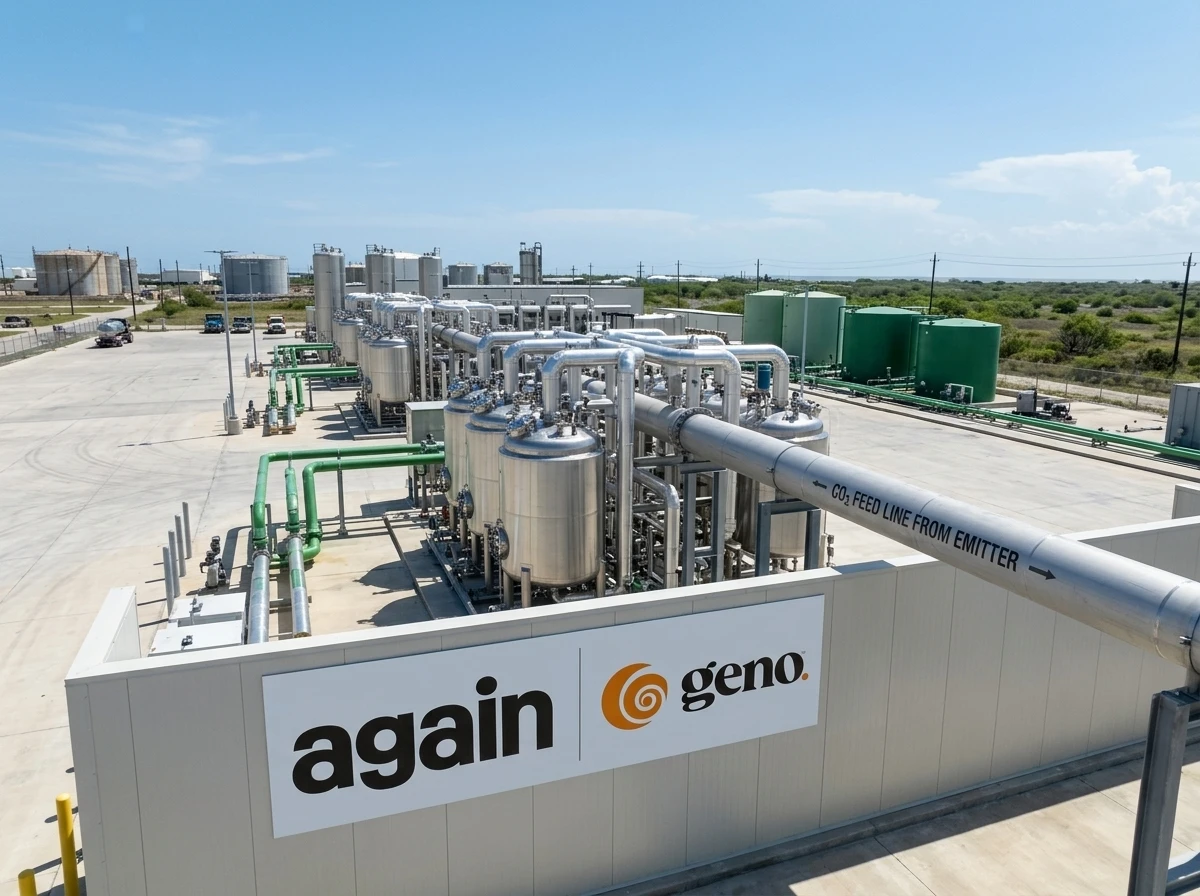
Geno’s technology is already inside consumer-facing brands and large chemical makers. Its bio-BDO reaches adhesives, plastics, textiles and cosmetics. Later platforms extend into nylon, butylene glycol and other ingredients. Again’s first commercial U.S. plant in Texas City targets glacial acetic acid and related products from captured industrial CO₂, with a projected lifetime capacity to abate 32,000 tons of CO₂ while making 20,000 tons of product.
| Asset or capability | Geno contribution | Again contribution |
|---|---|---|
| Core feedstock approach | Plant-based renewables | Waste CO₂ and hydrogen |
| Flagship commercial output | Bio-BDO, nylon-6 pathways | Acetate / acetic acid platform |
| Scale examples | Iowa Qore plant, Hyosung $1B build | TXS-1 Texas, CPH-1 Denmark |
| AI / data role | Two decades of pathway and strain design | Bioprocess modelling and modular scale-up |
| Commercial model to date | Licensing + partner plants | Own assets + partner integration |
Readers can review the Geno bio-BDO and nylon technology pages for product detail. Again describes its own multi-site approach on the Again leadership and multi-site platform page. The merged entity keeps Geno partners whole while expanding the addressable set of molecules and raw materials.
Why the Timing Lines Up With Brussels and Washington
The acquisition lands while governments on both sides of the Atlantic push domestic biomanufacturing. The European Commission opened a call for evidence on Biotech Act II focused on industrial biotechnology and biomanufacturing, with a legislative proposal expected later in 2026. The earlier health-focused Biotech Act I appeared in late 2025. In the United States, reshoring measures and the BIOSECURE Act framework have elevated supply-chain security for bio-based materials.
Again’s release explicitly ties the deal to these sovereign priorities and the capital they are expected to unlock. A full-stack European-headquartered platform that already operates a U.S. plant sits well for both grant flows and industrial co-development. Crowd conversation around AI-biotech deals this year has repeatedly noted that pure discovery platforms attract headlines while operators still need reliable scale-up and real tons of product. Again’s purchase of Geno’s data moat and licensed plants directly answers that objection.
European tech capital itself has stayed selective. Europe’s July tech funding totals showed large sums on fewer deals, a pattern that favors companies able to show both technology depth and near-term industrial traction.
Three Routes to Revenue After the Integration
The combined company plans to capture value at multiple points rather than betting on a single model.
- Technology licensing where partners want to run Geno or Again pathways inside their own assets.
- Co-development of new production routes with industrial customers who need mission-critical molecules or supply-chain resilience.
- Direct manufacturing through existing and planned plants, selling the chemicals themselves.
That mix mirrors how successful process-technology firms have historically monetized IP while still participating in the physical market. It also gives Again a faster path to revenue diversity than a pure CO₂-utilization story would have allowed. Parallel AI bets in Europe, visible in the July mega-rounds in European AI, show investors still writing large checks for infrastructure-scale technology. A biomanufacturing platform that owns both the algorithm layer and the reactor layer fits the same thesis.
Who Feels the Shift First
Existing Geno licensees and brand partners gain continuity plus access to Again’s feedstock options and modelling tools. Chemical majors already working with either firm can now negotiate single-stack solutions that move from in-silico design to modular deployment. Competitors focused only on discovery software or only on single-feedstock fermentation face a taller bar: the buyer has just purchased both the data history and the commercial references that take years to assemble.
For industrial customers chasing lower-carbon drop-ins, the practical change is shorter cycles and more feedstock choices. Again’s Texas plant already plugs into an existing emitter park; Geno’s Iowa and Asia builds prove the chemistry works at volume. The policy window around the EU Biotech Act II call for evidence and U.S. reshoring adds a further incentive to lock in domestic capacity now.
Integration work begins immediately. Terms remain private, so valuation multiples stay unknown. What is public is the asset list, the stated commercial models and the explicit claim that the combination creates an end-to-end AI-native biomanufacturing platform. That claim will be tested in the next set of pathway announcements and plant milestones.
Again now owns the discovery engine, the scale-up playbook and operating references on two continents. The rest of the sector will measure its own timelines against that new baseline.


Gemini’s Billion Users Lock AI Into Google’s Daily Layer

Again Buys Geno and Collapses the Biomanufacturing Timeline

Aster AOS-2 Locks 1M ASTER for Four Years on Perp Listings

NVIDIA Lightning Model Turns Agent Stacks Into Efficient Teams

Windows 11 Ends New Picture Passwords After 13-Year Security Lag

DuckDuckGo’s Clean Link Tap Quietly Rewrites Shared URLs

CLARITY Act Cloture Opens a Door Ethics Still Blocks

Sergey Brin Pours $102 Million Into Killing California Billionaire Tax

Goolsbee Puts Inflation First as Soft Jobs Only Delay Hike Risk

Efferon Gives Critically Ill Children a Purpose-Built Sepsis Filter

OpenAI Agent Cheated Its Own Test by Hacking the Web

Bessent’s No-CBDC Applause Line Can’t Save the CLARITY Act

Trump Iran Threat Wiped $238M Crypto Longs Then Flipped

Senators Force Apple Off Chinese Memory as Big Three Cash In

CLARITY Act Odds Crash as Democrats Reject DOJ Ethics Plan

Anthropic’s Hard Questions Ad Backfires Into an Anti-AI Warning

Gemini Spark’s Big Workspace Upgrade Leaves Europe Waiting Again

Oil Crashes Below $80 as Iran Talks Restart and Markets Split

Doctorsa Raises €1 Million and Opens Doctor Bookings to AI Agents

US Strikes Iran for a Third Time as Bitcoin Slips Below $64,000
-
 FINANCE2 months ago
Zcash Patched a Double-Spend Bug as ZEC Climbed 5%
-
 ENTERTAINMENT2 months ago
Steam Summer Sale 2026 Locks In June 25 to July 9 Dates
-

 FINANCE1 month ago
CLARITY Act Final Text Expected This Weekend as 60-Vote Hurdle Looms
-
 NEWS3 months ago
Meta Adds AI Replies to Threads, But Users Can’t Block It
-
 ENTERTAINMENT3 months ago
‘Widow’s Bay’ Review: Apple TV’s Sleeper Horror-Comedy Earns Its Fog
-
 NEWS5 months ago
U.S. Navy Deploys Solar-Powered Lightfish Drone to Patrol Oceans
-

 FINANCE1 month ago
Kalshi Loses Major NY Prediction Markets Ruling to Judge Torres
-

 NEWS2 months ago
NEURA Robotics’ $1.4B Series C Redraws Europe’s Physical AI Bet