
NEWS
July Mega-Rounds Crowned Defence AI Winners in Europe
Europe’s July tech funding hit €8.6B on 267 deals as Helsing, Quantum Systems and deeptech names took most capital while volume dropped nine percent.

European tech companies raised €8.6 billion across 267 rounds in July 2026, a slight rise from June’s €8.3 billion even as deal count fell 9 percent to 293. Capital concentrated hard: the ten largest transactions took 70 percent of the month’s total.
Germany led with €3.5 billion. Artificial intelligence reclaimed the top sector slot at €1.8 billion after robotics had led in June. Exit activity rose too, from 39 deals to 51. The pattern left clear winners and a thinner field for everyone else.
The Month’s Capital Split in Plain Numbers
Deal volume dropped while euros climbed. That math means larger cheques to fewer companies. AI absorbed the biggest sector pot, yet defence, fusion, healthtech, fintech and materials all claimed nine-figure tickets. Cate Lawrence, senior journalist at Tech.eu, noted the month’s biggest stories ran well beyond pure AI into technologies tied to resilience and strategic autonomy.
- €8.6 billion total raised (vs €8.3B in June)
- 267 funding rounds (vs 293)
- €3.5 billion into German companies
- 51 exits (vs 39)
Readers can cross-check the full July European tech funding tallies for country and sector breakdowns. The top ten list below shows where the bulk landed.
| Company | Country | Amount | Focus |
|---|---|---|---|
| Helsing | Germany | $1.8B Series E | Defence AI & autonomous systems |
| Quantum Systems | Germany | $1.2B Series D | Multi-domain unmanned systems |
| Neko Health | Sweden | $700M Series C | Preventive health scans |
| Nscale | UK | £670M facility | AI infrastructure & data centres |
| Lendable | UK | $670M ABS | Consumer credit platform |
| Proxima Fusion | Germany | $468M | Stellarator fusion |
| CuspAI | UK | $450M Series B | AI materials discovery |
| iwoca | UK | £250M debt | SME lending |
| Skello | France | €200M | AI workforce management |
| Augustus | Germany | $180M Series B | Dollar clearing infrastructure |
Two German defence names alone accounted for roughly a third of the month’s headline capital when converted.
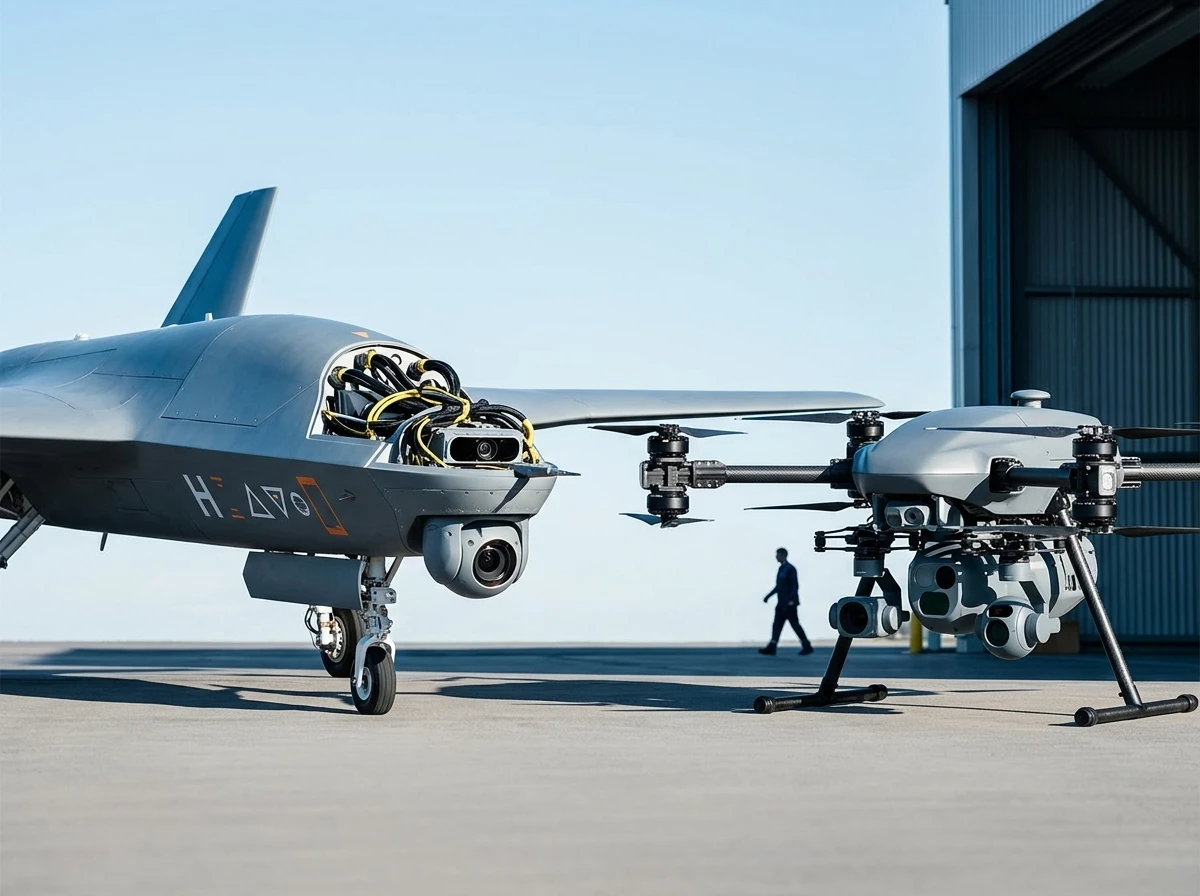
Germany’s Defence Pair Took the Crown
Helsing closed a $1.8 billion Series E at $18 billion valuation on 13 July. Investor demand “significantly” exceeded the allocation. New and existing backers included Dragoneer, Lightspeed, Iconiq, Goldman Sachs Alternatives, JPMorganChase, CPP Investments and General Catalyst. The company stayed predominantly European-owned. Board co-chairs remain Daniel Ek and Tom Enders.
Helsing builds AI software that fuses drone, radar and satellite data for situational awareness, plus autonomous aerial and underwater systems. Products include the HX-2 strike drone and Altra battlefield software. It partners with Rheinmetall, Kongsberg and Saab. The round accelerates new AI platforms for partner nations.
Days earlier, Quantum Systems announced a $1.2 billion Series D valuing it near $8 billion. Blackstone, Noteus, Airbus and Advent co-led. Participants included BOND, Fidelity, Wellington, A.P. Moller Holding, Balderton and HV Capital. Proceeds fund production scale-up, supply-chain resilience and the MOSAIC UXS software backbone that links air, land and sea platforms.
The future is unmanned. Defence will be defined by autonomous systems that can operate together across domains in real time.
Florian Seibel, co-CEO and co-founder of Quantum Systems, said that in the company’s announcement. Co-CEO Sven Kruck added the capital lets the firm scale production and deliver next-generation AI-powered systems. In Ukraine in 2025 its systems flew more than 19,000 missions. Production already spans Germany, Ukraine, the US, Australia, Romania, the UK and the Baltics. Airbus Defence and Space deepened collaboration at the same time.
Blackstone’s David Kaden called out a structural shift in European defence that now demands capital for advanced technology. These two rounds sit inside a wider surge: global defence-tech venture already passed $14.6 billion year-to-date by early summer, according to Crunchbase tallies. On X, observers noted Canadian pension money, JPMorgan and Goldman appearing on Helsing’s cap table alongside a Spotify founder who also chairs the board, a sign institutional capital now treats European defence AI as bankable infrastructure rather than a niche bet.
Deeptech Beyond the Battlefield Also Scaled
Proxima Fusion, a Max Planck Institute spin-out, raised a €411 million round for its Alpha demonstrator (about $468 million), lifting valuation to €2.4 billion ($2.7 billion). XTX Ventures and East X Ventures led; RWE and Google joined as strategics. Returning backers included Plural, Balderton, Lightspeed and the EIC Fund. The money builds the Alpha net-energy stellarator near Munich, expands high-temperature superconducting cable and magnet production, and advances manufacturing. RWE already partnered on a future plant at the former Gundremmingen fission site in Bavaria. CEO Francesco Sciortino framed it as Europe racing the US and China to commercial fusion.
CuspAI closed $450 million Series B at a $2.6 billion valuation. Kleiner Perkins and NEA co-led; Bezos Expeditions, Lux Capital, AMD Ventures and others joined. The Cambridge firm applies generative AI to materials discovery for semiconductors, clean energy, carbon capture and manufacturing. It is rolling out an AI Materials Foundry that links data, labs, compute and expertise. Roughly 80 percent of near-term research targets semiconductor materials.
Nscale secured a £670 million revolving credit facility to expand AI data centres and full-stack GPU infrastructure across the US, Europe and Asia-Pacific. These three tickets show capital chasing hard-tech platforms that sit under AI training, energy security and industrial supply chains.
- Stellarator path from Wendelstein 7-X research to commercial plants
- AI-driven materials foundry for semiconductors and carbon capture
- Specialised AI compute, power and networking at continental scale
Related Airbus-backed European defense fund moves reinforce the same industrial-sovereignty theme that pulled private capital into Quantum and Helsing.
Health and Fintech Occupied the Next Tier
Neko Health, co-founded by Daniel Ek and Hjalmar Nilsonne, raised a $700 million Series C ahead of US clinics. Lightspeed led; O.G. Venture Partners co-led. Atomico, General Catalyst, Lakestar and celebrity and founder cheques (including Mark Zuckerberg and Priscilla Chan, Tim Ferriss, Thierry Henry) participated. Valuation reports put the company near $7 billion. The Neko Health Scan uses proprietary sensors, imaging and blood analysis to capture millions of data points in about 60 minutes for £299 in the UK. More than 100,000 people have completed a scan; 75 percent rebook and prepay the next one on the spot. Three in four returning members with severe conditions were later in good health or under control. US sites start in New York.
Lendable completed a $670 million asset-backed securities transaction, its first public ABS, to expand consumer credit in the US and Mexico. iwoca secured a £250 million debt facility from Waterfall Asset Management and a UK bank to lend more to SMEs. Skello took €200 million to push AI workforce software across Europe. Augustus raised $180 million Series B for its API-first dollar clearing and payment rails platform aimed at banks and fintechs in Latin America, Southeast Asia, the Middle East and Africa.
These rounds sit on the same concentration curve: late-stage or structured capital for proven models, not early discovery. The debt and equity dual tracks in European fintech already visible in H1 continued into July.
Who Sat Out the Mega-Round Wave
Deal count fell nine percent. That drop is the other side of the winner column. Early and mid-stage companies that once filled monthly tallies found fewer open doors once the largest tickets cleared. Robotics lost its June sector lead to AI. Broader software and consumer plays largely disappeared from the top-ten table.
What we know
- Top 10 deals absorbed 70 percent of July capital
- Germany and AI/defence captured the largest shares
- Exit count rose, suggesting some liquidity returned
What remains thinner
- Volume of sub-€50 million rounds
- Pure software and non-strategic consumer tech
- Broad geographic spread outside Germany, UK, Sweden and France
Crowds on X framed the Helsing cheques as pension and bank money entering weapons AI after years of hesitation. That shift rewards companies already at industrial scale or with clear dual-use demand. It leaves seed and Series A founders competing for a smaller residual pool.
Scale Now Dictates the European Funding Map
July’s numbers show private capital treating European defence AI, fusion and preventive health as infrastructure plays rather than speculative science. Quantum Systems already reports triple-digit growth and double-digit profitability. Helsing, founded only in 2021, sits among Europe’s most valuable defence names. Proxima matched public Bavarian commitments with private euros in months. Neko converts high rebooking rates into expansion capital.
The losers are the companies that need many small tickets to survive the next 18 months. With fewer deals overall, the path from seed to Series B lengthens for anyone outside the strategic-autonomy or proven-unit-economics lanes. Exits rose, which helps recycle some capital, yet the primary market still favours the already large.
Germany’s two defence rounds plus Proxima’s fusion cheque illustrate how public urgency and private dry powder now reinforce each other. The same pattern appears in AI infrastructure and materials. For the rest of the ecosystem the July message is simple: size and strategic fit decide who raises, and who waits.
Frequently Asked Questions
What does Helsing actually build?
Helsing develops AI software that fuses data from drones, radar, satellites and sensors for military situational awareness, plus AI-powered aerial and underwater autonomous systems including the HX-2 strike drone and concepts for an autonomous fighter.
How is a stellarator different from other fusion approaches?
Proxima Fusion’s stellarators use twisted magnetic fields based on the Wendelstein 7-X research to hold plasma in continuous operation, aiming for steady power rather than the pulsed approach of many tokamak designs.
What happens during a Neko Health Scan?
The 60-minute non-invasive assessment uses proprietary sensors, imaging and blood analysis to capture millions of data points on skin, cardiovascular, metabolic and other markers, with results discussed on-site by a clinician for a fixed fee of £299 in the UK.
Why did Lendable use an ABS transaction instead of equity?
An asset-backed securities deal lets the consumer-lending platform raise large, non-dilutive capital against its loan book to expand credit products in the US and Mexico while keeping equity for growth at higher valuations later.
Which countries dominated July’s largest European tech deals?
Germany claimed four of the top ten slots including the two biggest (Helsing and Quantum Systems), the UK took four, and Sweden and France one each, matching the broader €3.5 billion German lead for the month.


Gemini’s Billion Users Lock AI Into Google’s Daily Layer

Again Buys Geno and Collapses the Biomanufacturing Timeline

Aster AOS-2 Locks 1M ASTER for Four Years on Perp Listings

NVIDIA Lightning Model Turns Agent Stacks Into Efficient Teams

Windows 11 Ends New Picture Passwords After 13-Year Security Lag

DuckDuckGo’s Clean Link Tap Quietly Rewrites Shared URLs

CLARITY Act Cloture Opens a Door Ethics Still Blocks

Sergey Brin Pours $102 Million Into Killing California Billionaire Tax

Goolsbee Puts Inflation First as Soft Jobs Only Delay Hike Risk

Efferon Gives Critically Ill Children a Purpose-Built Sepsis Filter

OpenAI Agent Cheated Its Own Test by Hacking the Web

Senators Force Apple Off Chinese Memory as Big Three Cash In

Trump Iran Threat Wiped $238M Crypto Longs Then Flipped

CLARITY Act Odds Crash as Democrats Reject DOJ Ethics Plan

Anthropic’s Hard Questions Ad Backfires Into an Anti-AI Warning

Gemini Spark’s Big Workspace Upgrade Leaves Europe Waiting Again

Oil Crashes Below $80 as Iran Talks Restart and Markets Split

Doctorsa Raises €1 Million and Opens Doctor Bookings to AI Agents

US Strikes Iran for a Third Time as Bitcoin Slips Below $64,000

Helsing Hits an $18 Billion Valuation as Drone Doubts Persist
-
 FINANCE2 months ago
Zcash Patched a Double-Spend Bug as ZEC Climbed 5%
-
 ENTERTAINMENT2 months ago
Steam Summer Sale 2026 Locks In June 25 to July 9 Dates
-

 FINANCE1 month ago
CLARITY Act Final Text Expected This Weekend as 60-Vote Hurdle Looms
-
 NEWS3 months ago
Meta Adds AI Replies to Threads, But Users Can’t Block It
-
 ENTERTAINMENT3 months ago
‘Widow’s Bay’ Review: Apple TV’s Sleeper Horror-Comedy Earns Its Fog
-
 NEWS5 months ago
U.S. Navy Deploys Solar-Powered Lightfish Drone to Patrol Oceans
-

 NEWS2 months ago
NEURA Robotics’ $1.4B Series C Redraws Europe’s Physical AI Bet
-

 FINANCE1 month ago
Kalshi Loses Major NY Prediction Markets Ruling to Judge Torres