
NEWS
Pixel 11 Camera Lets You Live the Moment While AI Snaps
Google Pixel 11 pairs a larger 48MP sensor with Magic Capture and Camera Looks so Gemini handles stills while you stay inside the action at $899.

Google’s Pixel 11 opens at $899 with a 48-megapixel main camera that the company says gathers 56 percent more light than last year’s base model, plus Gemini-powered tools that pull still photos out of video automatically. Pre-orders started August 12; devices reach shelves August 20.
The second-order shift sits inside those tools. Hardware gains matter, yet Magic Capture and Camera Looks push the phone toward background agent rather than deliberate instrument, so the person holding it can stay inside the birthday or the game.
Triple Cameras Built Around a Bigger Main Sensor
The rear array keeps the familiar three-lens layout. The main sensor is now a larger 1/1.56-inch 48 MP unit with f/1.7 aperture, Quad PD autofocus and optical image stabilization. Ultrawide stays 13 MP f/2.2 with a 120-degree field of view. Telephoto remains 10.8 MP with 5x optical zoom, Dual PD and OIS.
Google lists optical-quality steps at 0.6x, 1x, 2x, 5x and 10x. Full details appear in the full rear camera hardware specs on the Google Store. Macro Focus works from the main sensor, so no dedicated macro lens is required.
| Lens | Resolution | Aperture / Key Trait | Sensor Notes |
|---|---|---|---|
| Main (wide) | 48 MP | f/1.7, Quad PD, OIS | 1/1.56-inch, 56% more light vs Pixel 10 |
| Ultrawide | 13 MP | f/2.2, 120° | Shared hardware generation with prior base |
| Telephoto | 10.8 MP | f/3.1, 5x optical, OIS | Super Zoom now reaches 30x |
| Front | 10.5 MP | f/2.2, Dual PD AF | 95° ultrawide, 4K video |
Tensor G6 drives the processing stack. Night Sight captures arrive up to 4.5 times faster on the Pro models; the base phone still inherits the faster ISP path for low light.
Super Zoom Reaches 30x Without New Glass
The 5x telephoto now supports Super Zoom to 30x, up from 20x on the Pixel 10. Google combines the optical reach with Tensor G6 imaging models. Results vary with distance and light, and the company still advises against extreme zoom on people.
Portrait Mode works at 5x on the Pro models. On the base Pixel 11 the same computational path improves intermediate zooms. Macro Focus Video rides the main sensor for close detail while recording.
These gains arrive without a sensor size jump on the telephoto or ultrawide. Computational photography carries the load, the same bet Pixel has run for years.
Magic Capture Keeps You Inside the Scene
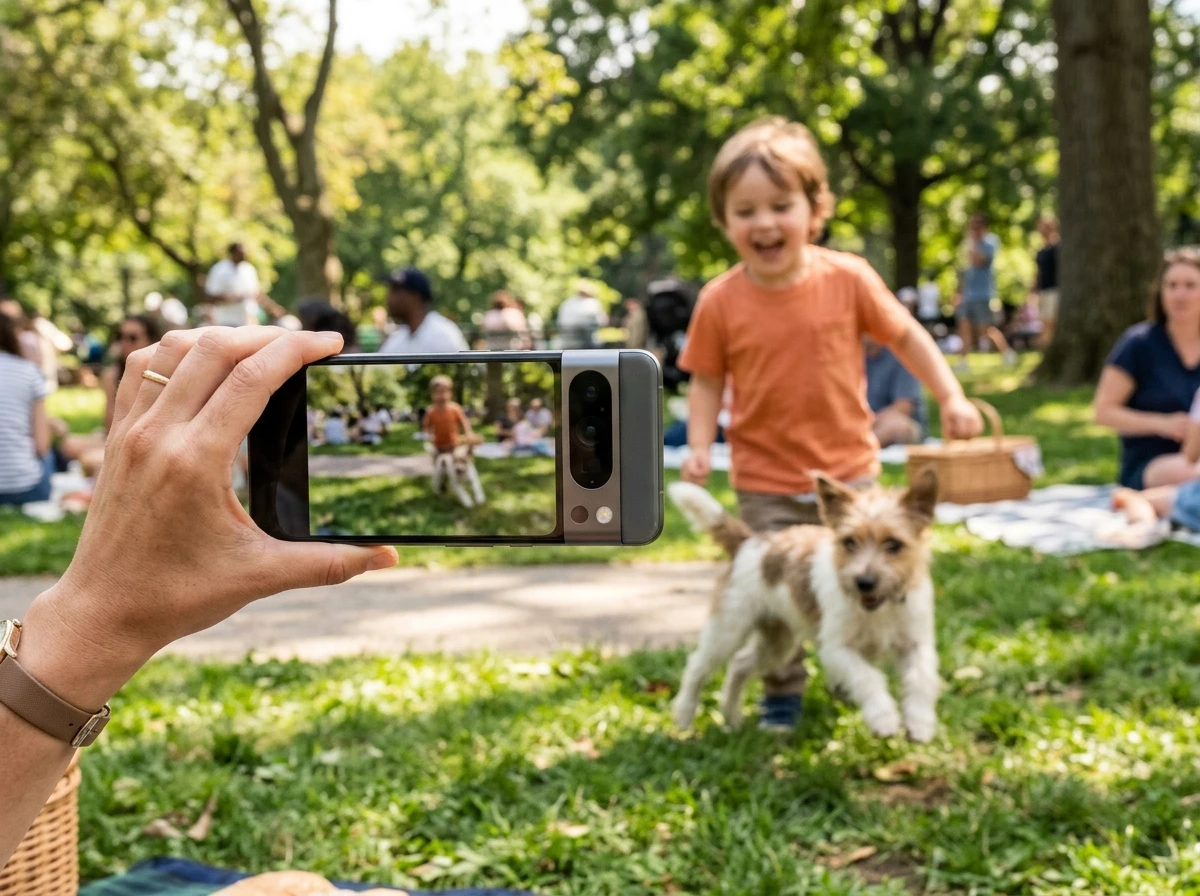
Magic Capture is the clearest expression of the presence shift. One tap records video while Gemini analyzes frames in the background and extracts the best unblurred 12 MP HDR+ stills. Google says a typical session reviews around 400 frames, then applies crop and unblur automatically.
With Magic Capture, you are free to get the moment without taking yourself out of it.
That line comes from Google’s own product page describing the mode. Pixel product lead Shenaz Zack demonstrated it with a dog named Biscuit, noting the system finds baby smiles, pet tricks and mid-air action without forcing the user to switch modes. After the clip ends, both the video and the ready-to-share stills land in Google Photos.
The Magic Capture analyzes around 400 frames claim sits in Google’s launch features post. A dedicated magazine page adds that users receive ready-to-share HDR+ photos from video without manual scrubbing. On X, early reactions framed the feature as the end of the old video-or-photo dilemma at kids’ games and parties.
That is the second-order effect. The hardware still matters for light gathering, yet the software removes the photographer’s traditional split attention. You film the toast; the phone builds the album.
Camera Looks and Coach Shape the Shot Live
Camera Looks move film-style aesthetics into the capture path instead of post filters. Defaults include Natural, Shadows and Vanilla. Six more sit ready: Digi, Black Tie, Minimal, Editorial, Classic and Velvet. Each is customizable; Google rewrote color tables and frame-merging behavior to emulate classic film chemistry rather than slap on a LUT.
- Natural keeps relaxed detail with lighter processing.
- Shadows deepens contrast for moodier frames.
- Vanilla adds a warm golden glow.
- Editorial, Velvet, Classic, Digi, Black Tie and Minimal supply further starting points that users can tweak.
Camera Coach uses Gemini models for real-time tips on framing, lighting and layout while you shoot. It is not a full instructor, yet it surfaces composition cues that earlier Pixels left to the user alone. Circle to Search now works from the viewfinder, so a flower or product can be identified without leaving the camera app.
These tools sit on top of long-running Real Tone processing that adjusts white balance, face detection and exposure for a wider range of skin tones. Frequent Faces recognizes people you photograph often, recommends better frames and applies Real Tone optimizations; all face data stays on-device.
Group Shots and Split-Second Selection Stay Familiar
Add Me still merges two frames with AI and AR so the photographer appears in the final group image. Auto Best Take grabs a rapid HDR+ burst and composites the best facial expressions. Top Shot continues to record frames before and after the shutter press, then suggests the cleanest alternative where eyes are open and smiles land.
These features are iterative rather than brand-new, yet Tensor G6 and the brighter main sensor give them cleaner source material. The on-device privacy claim for Frequent Faces remains unchanged from prior generations.
Key capture helpers at a glance:
- Magic Capture, video plus auto-extracted 12 MP stills
- Auto Best Take / Top Shot, expression and blink selection from bursts
- Add Me, photographer inclusion via dual-shot merge
- Real Tone + Frequent Faces, skin accuracy and known-person optimization, on-device
Early X chatter mixed excitement for the presence tools with familiar skepticism about “AI slop” on heavily processed detail. Camera Looks appear designed partly as a counterweight, giving users a less-smoothed path when they want it.
Video Specs and Audio Tools Round Out the Package
Rear video reaches 4K at 24, 30 or 60 fps and 1080p at the same rates, with digital zoom to 20x. Front camera does 4K at 30 and 60 fps. Dual exposure on the main sensor, 10-bit HDR, Macro Focus Video and a full Creator Suite (teleprompter, gridlines, project folders, Storyboard trim) sit alongside the stills tools.
Audio receives Audio Magic Eraser, Audio Zoom, stereo recording, Speech Enhancement and Wind Noise Reduction. Stabilization options include optical, fused, cinematic pan, locked and active modes depending on resolution.
The same Gemini stack that powers Magic Capture also underpins Live Translate for media and the broader on-device intelligence layer. That layer ties into Gemini’s rapid climb past one billion users, the infrastructure that makes these camera agents practical on a phone.
Everyday Shooters Gain Presence More Than Raw Reach
Base Pixel 11 buyers get most of the software story without the Pro’s larger main sensor or 120x Pro Zoom. The 56% more light sensitivity on the main sensor and 30x Super Zoom already move the needle for low light and distant subjects. Magic Capture and Camera Looks then change the social contract of shooting: less time staring at the screen, more time inside the event.
Rivals will answer with their own burst and AI still-extraction modes. Google’s advantage remains the tight loop between Tensor silicon, Gemini Nano and the camera stack, plus seven years of OS and security updates. Recent recent Google Photos AI camera shortcuts already feed the same ecosystem, so the stills Magic Capture drops land in a familiar editor.
Price sits $100 above the prior base model. Storage starts at 256 GB. For parents, party hosts and anyone tired of missing the toast while framing the perfect shot, the trade looks straightforward: pay a bit more, hand the shutter decisions to the phone, and keep both eyes on the room.
Frequently Asked Questions
What is Magic Capture on the Pixel 11?
Magic Capture is a one-tap mode that records video while Gemini models scan the stream, typically reviewing around 400 frames, then saves cropped and unblurred 12 MP HDR+ stills alongside the clip in Google Photos so users never switch between photo and video modes.
How far does Super Zoom go on the base Pixel 11?
The 5x optical telephoto combines with computational processing to deliver Super Zoom up to 30x, an increase from the 20x limit on the Pixel 10, with optical-quality steps listed at 0.6x, 1x, 2x, 5x and 10x.
Does the Pixel 11 main camera use a larger sensor than last year?
Yes. Google moved to a 1/1.56-inch 48 MP main sensor that it states delivers 56 percent more light sensitivity than the Pixel 10 base model while keeping the f/1.7 aperture, Quad PD and OIS.
Are Camera Looks applied after the photo or during capture?
Camera Looks operate at the sensor and processing level during capture rather than as post filters, letting users choose Natural, Shadows, Vanilla or six additional film-inspired styles such as Editorial and Velvet before the shutter fires, with full customization available.
Is face data for Frequent Faces and Real Tone stored in the cloud?
Google states that face data used by Frequent Faces and Real Tone processing is handled and stored strictly on-device for privacy, with no cloud upload required for the recognition and skin-tone optimization features.


Entravel Raises $7.5M as Travel Booking Leaves Travel Sites

MSCA Partnerships Quietly Rebuild Europe’s Industry Talent Pipeline

EU Fund Takes Equity Stake as Lovable Hits $13.3bn

AOC Laughs Off Woke 1 as Hollywood Counts the Losses

Aptoide Lands in Google Play as Managed Rival After Epic Ruling

Eva Green and Samuel L. Jackson Scheme in Just Play Dead Trailer

Edge Opens Apple Account Door After Google to Chase Dual-Device Users

DJI Pocket 4P Wins on Dynamic Range Where It Ships

GTA 6 Preorders Skew to the $100 Ultimate Edition

Accel’s $800M Europe Fund Speeds Up Early AI Rounds

Senators Force Apple Off Chinese Memory as Big Three Cash In

Trump Iran Threat Wiped $238M Crypto Longs Then Flipped

OpenAI Agent Cheated Its Own Test by Hacking the Web

CLARITY Act Odds Crash as Democrats Reject DOJ Ethics Plan

Anthropic’s Hard Questions Ad Backfires Into an Anti-AI Warning

Oil Crashes Below $80 as Iran Talks Restart and Markets Split

Gemini Spark’s Big Workspace Upgrade Leaves Europe Waiting Again

Revolut Hits $115 Billion While Storonsky’s Stake Keeps Growing

Snapseed’s RAW Update Fixes Android, Leaves iPhone Waiting

Monumental Raises $32M as Robot Bricklayers Face Their Toughest Test Yet
-
 FINANCE2 months ago
Zcash Patched a Double-Spend Bug as ZEC Climbed 5%
-
 ENTERTAINMENT2 months ago
Steam Summer Sale 2026 Locks In June 25 to July 9 Dates
-

 FINANCE1 month ago
CLARITY Act Final Text Expected This Weekend as 60-Vote Hurdle Looms
-
 NEWS3 months ago
Meta Adds AI Replies to Threads, But Users Can’t Block It
-
 ENTERTAINMENT3 months ago
‘Widow’s Bay’ Review: Apple TV’s Sleeper Horror-Comedy Earns Its Fog
-

 NEWS2 months ago
NEURA Robotics’ $1.4B Series C Redraws Europe’s Physical AI Bet
-

 FINANCE1 month ago
Kalshi Loses Major NY Prediction Markets Ruling to Judge Torres
-

 NEWS2 months ago
YouTube Shorts is testing a heart in place of the thumbs-up