
NEWS
Pixel 11 Share Tick Up Masks Memory Cost Shock
SAG sees Pixel shipments flat at 2.5 million for 2026 yet share edging to 1.1% as AI memory inflation lifts prices and trims RAM on mid tiers.

Google’s Pixel smartphone shipments will hold near 2.5 million units in 2026 after the Pixel 11 launch, enough to lift global market share from 1.0% to 1.1% while the broader industry contracts, according to research firm SAG.
The gain arrives with $100 US price increases on most models, base storage starting at 256GB, and RAM cut to 12GB on the 256GB Pro and Pro XL tiers. The second-order effect is clearer than the share tick: AI data-center demand for memory has rewritten flagship economics, and Google’s software-first approach lets it stay flat where pure volume players shrink.
What the Pixel 11 Lineup Costs
Made by Google on August 12, 2026 brought the Pixel 11, Pixel 11 Pro, Pixel 11 Pro XL and Pixel 11 Pro Fold. All run the Tensor G6, Android 17 and seven years of updates.
US starting prices sit $100 above the prior generation on the models SAG flagged. The base Pixel 11 opens at $899 with 256GB and 12GB RAM. The Pro starts at $1,099 and the Pro XL at $1,299, both with 256GB/12GB as the entry configuration; 16GB RAM arrives only with 512GB and 1TB storage. The Fold starts near $1,899.
| Model | 2026 Start Price | Prior Start | Entry Storage / RAM |
|---|---|---|---|
| Pixel 11 | $899 | $799 | 256GB / 12GB |
| Pixel 11 Pro | $1,099 | $999 | 256GB / 12GB |
| Pixel 11 Pro XL | $1,299 | $1,199 | 256GB / 12GB |
| Pixel 11 Pro Fold | ~$1,899 | ~$1,799 | 256GB tier |
Google dropped the 128GB Pro option entirely. Higher base storage softens the sticker shock while the RAM trim on mid-storage Pros protects margins against soaring DRAM and NAND costs. Full official Pixel hardware tech specs list the Tensor G6, updated cameras and IP68 across the family.
The configuration ladder now does more margin work than the prior generation. Buyers who want the full 16GB RAM package must step into 512GB or 1TB. That split keeps the headline Pro prices from absorbing the full memory spike while still giving Google a premium SKU path.
Across the four models the $100 lift is uniform enough to read as a line-wide reset rather than a one-off Pro tax. The Fold’s roughly $1,899 open keeps it in the same premium band as before, only higher by the same step.
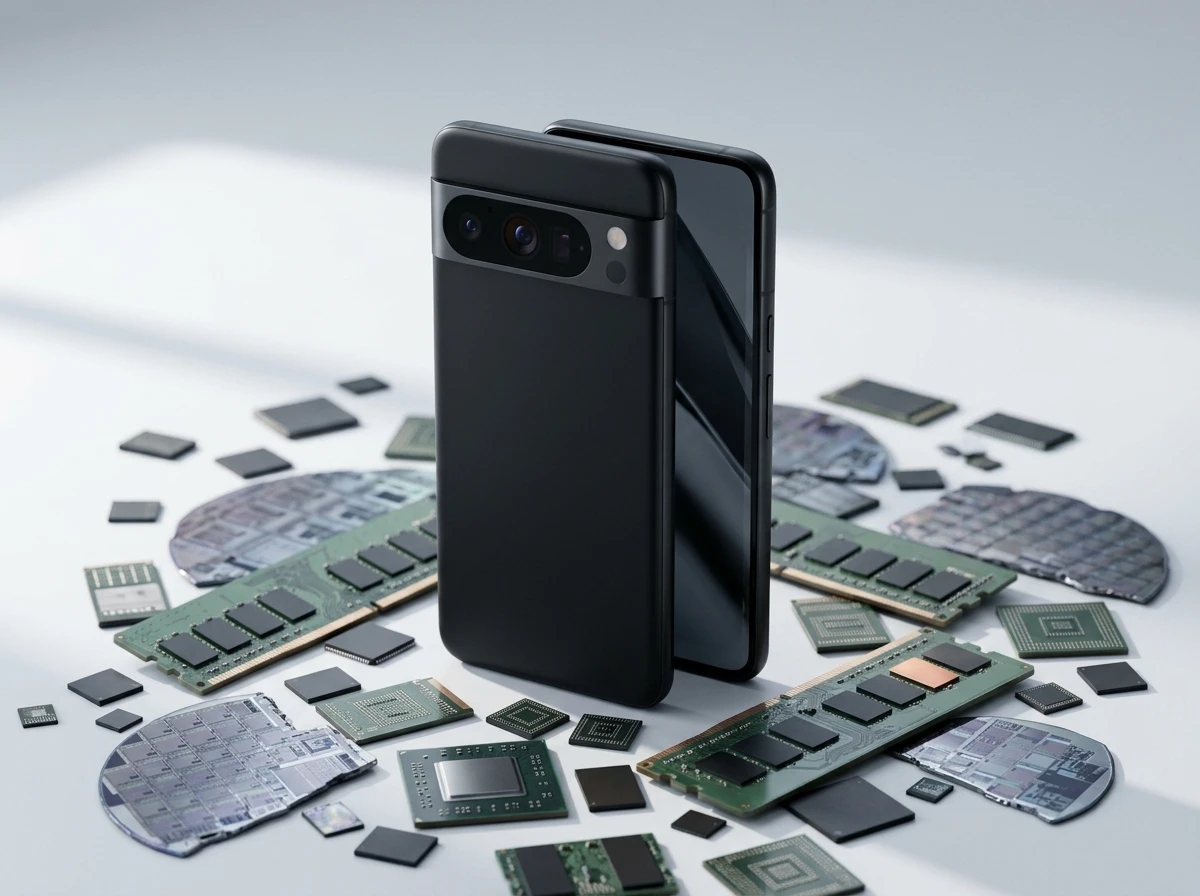
Memory Inflation Hits Every Flagship Bill
The price and configuration moves track an industry-wide memory crunch. AI servers and high-bandwidth memory have pulled capacity away from consumer DRAM and NAND. Reports earlier in the cycle put DRAM price jumps near 47% for 2026 in some forecasts, with spikes of 70-80% or higher on certain products.
Samsung executives publicly flagged that the shortages would affect everyone in 2026, not only their own devices. That same pressure shows up in Samsung’s own Galaxy S26 price warnings and in the memory chipmakers’ record profits from the hikes.
- Supply shift: HBM and enterprise demand crowd out phone DRAM and NAND.
- BOM share: Memory and storage have risen from under 10% of some phone costs toward 20% or more.
- OEM response: Higher retail prices, eliminated low storage SKUs, and tiered RAM that reserves higher capacity for premium storage options.
- Winner class: Suppliers such as Micron, SK Hynix and Samsung’s memory business gain pricing power.
On X, market watchers immediately read the $100 Pixel bumps as confirmation that component inflation had reached consumer devices and would force Apple and others to follow on upcoming Pro models to protect hardware margins.
When memory climbs from a single-digit slice of the bill of materials toward one-fifth of cost, every flagship maker faces the same fork: raise prices, cut configurations, or both. Google chose both. The vanished 128GB Pro tier and the 12GB cap on 256GB Pros are the configuration half of that answer.
| Pressure Point | Reported Scale | Phone-Side Effect |
|---|---|---|
| DRAM price jump (some 2026 forecasts) | Near 47% | Higher retail opens, tighter RAM tiers |
| Spikes on certain memory products | 70-80% or higher | Low storage SKUs dropped |
| Memory and storage share of phone cost | From under 10% toward 20%+ | ASP defense becomes mandatory |
Why Software Keeps Pixel Shipments Flat
Hardware changes stay modest. Cameras receive sensor and zoom tweaks, batteries move by small percentages, and displays keep similar sizes and rates. The Tensor G6 targets faster local AI at lower power and swaps in a MediaTek 5G modem aimed at long-running connectivity complaints.
the Pixel 11 generation focuses far more on smart software and AI tricks than flashy hardware upgrades
Linda Sui, founder and principal of SAG, made that assessment as the firm published its forecast. Paired with Android 17, the phones emphasize on-device privacy features, deeper Gemini integration, Magic Capture, expanded Live Translate and Circle to Search through the camera viewfinder.
In a market where traditional hardware has plateaued, SAG argues the software pivot is rational. Counterpoint Research earlier raised its 2026 Tensor/Pixel growth outlook sharply on the same AI differentiation thesis, though its absolute shipment view sat higher than SAG’s flat 2.5 million call. The latest SAG numbers, tied directly to the Pixel 11 launch, treat holding volume as the win while Chinese volume brands absorb steeper drops.
A SAG forecast post on Pixel share summarized the stance as remaining near 1% global share with limited hardware upgrades and rising prices.
Seven years of updates stretch the useful life of each unit and support the higher open prices. Buyers who plan to keep a phone through multiple Android releases get a longer software runway in return for the $100 step-up. That trade favors a software-led brand more than a pure specs race.
Who Gains When Volume Stays Flat
Google remains roughly the No. 10 global vendor by shipments. Flat volume in a double-digit industry decline still produces the 0.1-point share rise. IDC and other trackers have projected full-year 2026 worldwide declines in the mid-to-high single digits or worse in some scenarios, with worldwide smartphone shipment forecasts showing pressure concentrated outside the premium tier.
Winners and losers stack up clearly:
- Google holds unit volume and high-margin Pro mix via trade-ins, carrier plans and software lock-in.
- Memory suppliers extract higher prices and capacity preference for AI customers.
- Premium-tier buyers who take 512GB/1TB keep full 16GB RAM and the newest AI features.
- Entry Pro buyers on 256GB receive less RAM than last year’s equivalent configuration.
- Low- and mid-tier Android OEMs, especially several Chinese brands, face steeper shipment declines as cheaper memory becomes scarce.
The Fold contributes a practical edge. The Pixel 11 Pro Fold ships in August with the rest of the family rather than the delayed October window of the prior model. The longer sales runway lifts year-over-year foldable units even while Google’s share of the global foldable segment stays under 1%.
Holding units steady while the industry contracts is a relative win. The 0.1-point global share move from 1.0% to 1.1% is small in absolute terms, yet it is the arithmetic result of flat Pixel volume against a shrinking total market. Premium mix and software lock-in matter more to Google’s model than raw rank.
The Market Backdrop That Makes Flat Look Strong
Q1 and Q2 2026 already showed multi-percent global declines. Samsung and Apple gained share through better premium positioning; Xiaomi, OPPO group and others lost ground. Google’s US shipments in earlier 2026 quarters sat near 800,000 in one reported quarter, still a single-digit share of the US market but enough to hold the brand’s established niche.
SAG’s full-year view treats the Pixel 11 cycle as continuation rather than breakout. Aggressive trade-in credits, monthly payments and carrier promotions are expected to keep demand steady despite the higher list prices. The company is not chasing Samsung- or Apple-scale volume. It is defending a high-ASP software platform inside a shrinking pie.
US run-rates near 800,000 in a reported quarter show the brand’s core market still absorbs new hardware at a steady pace. That base, plus carrier financing and trade-in support, is what lets SAG call 2.5 million units for the full year even after the price reset.
- Q1 and Q2 2026: Multi-percent global shipment declines set the tone for the year.
- Earlier 2026 quarters: Google US shipments near 800,000 in one reported quarter held the niche.
- August 12, 2026: Pixel 11 family launch, including the Fold with the rest of the line.
- Full-year 2026: SAG projects about 2.5 million Pixel units and a move from 1.0% to 1.1% global share.
Tensor G6 and the AI-First Trade-Off
Google positions the G6 as the enabler for on-device AI that does not require constant cloud round-trips. Claims include up to 25% better performance versus the prior Tensor and efficiency gains that free power for always-available assistants and camera tools. The MediaTek modem targets the connectivity reliability complaints that have followed Tensor phones for years.
Camera hardware moves are incremental: updated main sensors on Pros, longer Super Res zoom reach, faster Instant Night Sight, and new software modes such as Magic Capture and Camera Looks. It is not a clean-sheet redesign. The bet is that the software layer plus seven-year support and Gemini features will matter more to the target buyer than raw benchmark wins against Snapdragon or A-series chips.
That calculation only works if memory costs stabilize or if Google continues to manage the bill of materials through tiering. A Samsung warning on 2026 memory shortages made plain that even the largest memory producer expects industry-wide price effects. Phone makers that cannot pass costs or differentiate will lose units.
On-device AI features such as deeper Gemini integration, Magic Capture, expanded Live Translate and Circle to Search depend on local memory headroom. Tiering RAM by storage tier is how Google keeps those features funded on the higher SKUs without pushing every open price higher by a larger step.
How the Fold Gains a Longer Sales Window
Prior Pixel foldable timing left the device with a short runway into the holiday period. Shipping the Pixel 11 Pro Fold in August with the rest of the family removes that lag. The same Tensor G6, Android 17 stack and seven-year update promise apply across the slate, so the Fold no longer looks like a late add-on.
Google’s share of the global foldable segment stays under 1%, so the volume effect is modest in absolute units. Year-over-year foldable growth still improves because more selling months are available after the August open. At a start near $1,899, the Fold also sits in the high-ASP band that Google is defending elsewhere in the line.
Aligning Fold availability with the main launch simplifies carrier and retail planning. One family window, one software story, and one set of trade-in and monthly payment offers reduce friction that a staggered October drop created in the prior cycle.
Why Flat Volume Still Lifts Share
Share math favors anyone who holds units while the total market shrinks. SAG’s path from 1.0% to 1.1% global share on about 2.5 million units is that pattern in miniature. IDC and other trackers describe full-year 2026 declines in the mid-to-high single digits or worse in some scenarios, with pressure heaviest outside premium tiers.
Google does not need Samsung- or Apple-scale volume for the strategy to work. It needs steady demand in its niche, enough Pro mix to protect ASP, and software differentiation that justifies the $100 lifts. Trade-ins, carrier plans and seven-year updates are the demand tools; Tensor G6 on-device AI and Gemini features are the product tools.
- Industry: Mid-to-high single-digit or worse shipment declines in some 2026 views.
- Pixel: Flat near 2.5 million units after the Pixel 11 launch.
- Share: 1.0% to 1.1% global, still roughly No. 10 by shipments.
- Mechanism: Premium positioning and software lock-in while volume brands absorb steeper drops.
Chinese volume brands and other low- and mid-tier Android OEMs face the sharper side of the same memory crunch. When cheaper DRAM and NAND grow scarce, their price-sensitive catalogs lose ground faster than a high-ASP software platform that can pass costs and still hold its buyer base.
Google’s Small Footprint Strategy Holds
Holding the No. 10 global spot with 1.1% share is not a volume story. It is a proof that a software- and AI-centric brand can keep shipments steady, protect ASP, and nibble share while the market digests a memory supply shock caused by the same AI boom that powers the phones’ features.
The $100 hikes and the 12GB RAM step-down on mid-storage Pros are the visible cost of that boom. The flat 2.5 million forecast is the result. For Google the combination is acceptable. For memory suppliers it is profitable. For the rest of the industry it is the new baseline.


Entravel Raises $7.5M as Travel Booking Leaves Travel Sites

MSCA Partnerships Quietly Rebuild Europe’s Industry Talent Pipeline

EU Fund Takes Equity Stake as Lovable Hits $13.3bn

AOC Laughs Off Woke 1 as Hollywood Counts the Losses

Aptoide Lands in Google Play as Managed Rival After Epic Ruling

Eva Green and Samuel L. Jackson Scheme in Just Play Dead Trailer

Edge Opens Apple Account Door After Google to Chase Dual-Device Users

DJI Pocket 4P Wins on Dynamic Range Where It Ships

GTA 6 Preorders Skew to the $100 Ultimate Edition

Accel’s $800M Europe Fund Speeds Up Early AI Rounds

Senators Force Apple Off Chinese Memory as Big Three Cash In

Trump Iran Threat Wiped $238M Crypto Longs Then Flipped

OpenAI Agent Cheated Its Own Test by Hacking the Web

CLARITY Act Odds Crash as Democrats Reject DOJ Ethics Plan

Anthropic’s Hard Questions Ad Backfires Into an Anti-AI Warning

Oil Crashes Below $80 as Iran Talks Restart and Markets Split

Gemini Spark’s Big Workspace Upgrade Leaves Europe Waiting Again

Revolut Hits $115 Billion While Storonsky’s Stake Keeps Growing

Snapseed’s RAW Update Fixes Android, Leaves iPhone Waiting

Monumental Raises $32M as Robot Bricklayers Face Their Toughest Test Yet
-
 FINANCE2 months ago
Zcash Patched a Double-Spend Bug as ZEC Climbed 5%
-
 ENTERTAINMENT2 months ago
Steam Summer Sale 2026 Locks In June 25 to July 9 Dates
-

 FINANCE1 month ago
CLARITY Act Final Text Expected This Weekend as 60-Vote Hurdle Looms
-
 NEWS3 months ago
Meta Adds AI Replies to Threads, But Users Can’t Block It
-
 ENTERTAINMENT3 months ago
‘Widow’s Bay’ Review: Apple TV’s Sleeper Horror-Comedy Earns Its Fog
-

 NEWS2 months ago
NEURA Robotics’ $1.4B Series C Redraws Europe’s Physical AI Bet
-

 FINANCE1 month ago
Kalshi Loses Major NY Prediction Markets Ruling to Judge Torres
-

 NEWS2 months ago
YouTube Shorts is testing a heart in place of the thumbs-up