
NEWS
Aptoide Lands in Google Play as Managed Rival After Epic Ruling
Google now hosts Aptoide Games in the US Play Store under court rules that still impose $15,000 fees and catalog reviews on third-party stores.

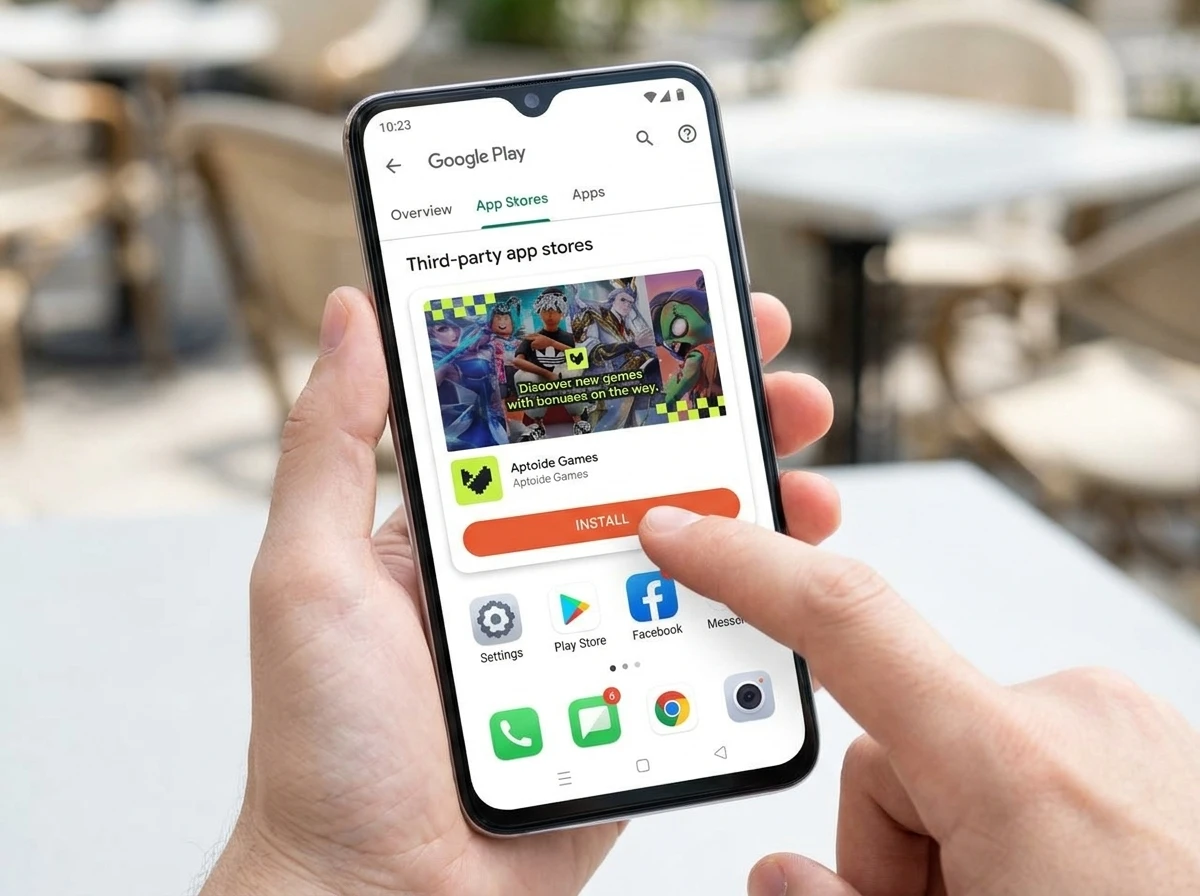
Google Play now lists Aptoide Games as the first third-party Android app store available for direct download in the United States. US users can install it from inside Play itself with no sideloading prompts, a direct result of the permanent injunction in Epic Games v. Google.
The dedicated third-party stores section remains sparse. Only Aptoide appears so far, and the listing is a games-focused client rather than the full Aptoide marketplace.
How US Users Reach the New Store
Open the Play Store app, search for “app stores,” or dig into the account menu and the third-party section under Apps then Categories. Aptoide Games installs like any other app. Installs of games from inside it use the same flow as Play downloads, without the old unknown-sources warnings.
- Search “Aptoide” or “app stores” inside Play on a US Android device.
- Or open Apps (bottom bar) → Categories → scroll to Third-party app stores.
- Tap Aptoide Games and install; no extra permissions toggles required for the store itself.
- Browse and install listed games through the Aptoide client; Play still handles the actual package delivery for catalog items.
The section is currently buried. Early testers report it sits near the bottom of categories and that search is the faster path. Outside the US the full Aptoide client still requires sideloading from the company site.
The Fees That Come With the Door
Google published two related programs that went live around 22 July 2026. One lets approved stores distribute themselves through Play. The other gives those stores access to Play’s catalog of apps so users can pull the same titles.
| Program | Key cost | Core limit |
|---|---|---|
| Third-party App Store on Play | $15,000 annual fee plus review costs ($5,000 of it credited toward reviews) | US users only; submit store APK and all catalog APKs for review; malware install attempts under 1% rolling 30 days; content policy violations under 2% on audit |
| Play Catalog Access | $5,000 annual service fee for security and policy reviews | US only; daily or weekly catalog refresh; no extra fees charged to users for catalog apps; no sharing of catalog data with other stores |
Stores must operate as open marketplaces with clear non-discriminatory policies, provide customer support and parental controls, and keep IP dispute processes public. Google can pause or remove a store for non-payment or repeated failures. Developers whose apps sit on Play can opt out of having their listings shared with the third-party stores.
These rules mean every rival that wants the easy install path becomes a paying customer of Google’s review pipeline.
Aptoide’s Long Road Back to the Front Page
Aptoide was founded in Portugal in 2009. It once sat on Google Play in Android’s early years before policy changes pushed competing stores out. For more than a decade the company relied on sideloading and preloads while building a user base that the company now puts at roughly 25 million monthly active users and 400,000 apps. The United States is its largest market.
- 2009, Aptoide launches as an independent Android marketplace.
- Early 2010s, Distributed through Play until competing-store policies force removal.
- 2023-2025, Epic wins jury verdict and Ninth Circuit upholds injunction forcing distribution changes.
- March-July 2026, Settlement talks with Epic collapse; Google publishes program rules; July 22 start date for third-party store distribution and catalog access.
- 10 August 2026, Aptoide Games approved and live inside US Play Store.
CEO and co-founder Paulo Trezentos framed the return as more than a product drop.
This is much more than a product launch. More than ten years ago, Android users lost the ability to discover alternative app stores through Google Play. Today, that changes.
COO Álvaro Pinto added that competition drives innovation and that developers should have multiple routes to users. Aptoide has also secured iOS alternative-marketplace status under the EU Digital Markets Act and similar programs in Japan and Brazil.
What the Live Client Offers
Aptoide Games on Play is a narrower product than the full Aptoide client available via sideload or the website. Early hands-on reports describe only two categories in the Games version and a thin selection of titles. The full client still leans heavily on games; non-game apps often surface only via search. Trusted-app badges that once appeared in the client now show mainly on the website.
Aptoide says it has access under the ruling to the broader Play catalog (reported in coverage as roughly 1.9 million apps and 295,000 games). That catalog can expand the storefront over time. Play’s own service fees still apply to downloads that come through the shared catalog path. Installs and updates for Play-origin titles continue to ride Google’s systems.
Users who want non-game software or the wider Aptoide selection still face the older sideload route for the main client. That split is one reason some early testers call the Play-hosted version limited.
Why Epic Forced the Door Open
Judge James Donato’s permanent injunction, upheld by the Ninth Circuit, barred Google from prohibiting third-party Android app distribution platforms through the Play Store itself. It also required catalog access for approved stores and other remedies on billing and exclusive deals. A proposed settlement that would have used a lighter “Registered App Stores” sideload model was withdrawn in mid-2026 after the court signaled it preferred the original terms.
Google began onboarding for the Third-party App Store on Play program on 15 July and made both programs effective 22 July. Developers received notice that their listings would flow to third-party US stores unless they opted out by that date. Alternative billing and external-link programs already live for US developers continue under separate fee schedules that start reporting obligations later in 2026.
Epic itself has not yet appeared as a Play-hosted store. Neither has Microsoft’s planned Xbox mobile storefront. Aptoide moved first.
Who Gains Ground and Who Still Pays Friction
Aptoide gains the lowest-friction acquisition channel it has had in years: millions of US Android users can discover it without leaving Play. Developers who stay opted-in get another discovery surface that still uses Play versioning and billing for shared titles. Users get one more place to browse games without enabling unknown sources.
- 25 million, Aptoide’s stated monthly active users before the Play listing.
- $15,000, annual base fee for a store that wants to be listed inside Play.
- 1 percent, maximum rolling malware install-attempt rate before Google can act.
- US only, current geographic scope for both the store listing and catalog access.
Google keeps the review gate, the fee revenue, the malware and content thresholds, and the actual package delivery for catalog apps. Smaller would-be stores face a steep fixed cost plus variable review bills that can be invoiced at $10,000 increments or monthly. Safety-conscious users still need to verify developers because Aptoide’s model allows broad uploads; historical data-leak coverage and the decentralized nature keep skepticism alive even when the store itself arrives via Play.
The same Google Play surface that now hosts Aptoide already supports other payment experiments, including Venmo balances for Google Play purchases, and continues to expand social features such as Steam-like profiles inside Google Play Games. Those tools stay inside Google’s orbit while the new storefronts pay to sit beside them.
Catalog Sharing Still Runs on Google’s Terms
Approved stores receive daily (or at least weekly) snapshots of the Play catalog via Google Cloud Storage and can pull more frequent updates through APIs. They must clearly tell users that a given title originates from Play before using the Inline Install API. They cannot charge users extra for those installs, cannot ship the catalog outside the United States, and cannot resell or share the data with other stores.
The Play Catalog Access program requirements also force stores to offer their own non-catalog titles and to keep the store’s primary purpose as discovery, install and management of apps. Google’s service fee continues to apply to the downloads themselves. In short, the “shared library” still meters through Google’s cash register and security filters.
Developers who dislike the arrangement can opt out. Early reporting suggests few will, because the shared path is another acquisition channel that re-uses the same binaries and billing they already maintain for Play.
Additional stores can apply. How fast Google processes them, and how many decide the $15,000 base plus review bills are worth it, will set the pace. For now the third-party section holds one name.
Frequently Asked Questions
How do I install Aptoide Games from Google Play in the US?
Open the Play Store on a US-region Android device, search for “Aptoide” or “app stores,” or navigate Apps → Categories → Third-party app stores, then tap Install on Aptoide Games. No unknown-sources toggle is required for the store client itself.
What does Google charge third-party stores to appear inside Play?
The Third-party App Store on Play program carries a $15,000 annual fee, of which $5,000 is credited toward manual review costs; additional per-app or per-update security and content review charges are invoiced when they hit $10,000 or monthly. Catalog Access alone is a separate $5,000 annual fee.
How large is Aptoide’s existing user base?
Aptoide states it serves approximately 25 million monthly active users and hosts more than 400,000 Android applications, with the United States as its largest market, figures it published in its August 2026 return announcement.
Can developers keep their apps off third-party stores that use Play’s catalog?
Yes. Google notified developers that listings would be shared with approved US third-party stores unless the developer opted out by 22 July 2026; the opt-out path remains available through Play Console documentation.
What malware threshold can get a third-party store removed?
Google’s program rules require that malware or potentially harmful app install attempts stay under 1 percent over a rolling 30-day window across devices; exceeding that, or a 2 percent content-policy violation rate on audited samples, can pause or end participation.


Entravel Raises $7.5M as Travel Booking Leaves Travel Sites

MSCA Partnerships Quietly Rebuild Europe’s Industry Talent Pipeline

EU Fund Takes Equity Stake as Lovable Hits $13.3bn

AOC Laughs Off Woke 1 as Hollywood Counts the Losses

Aptoide Lands in Google Play as Managed Rival After Epic Ruling

Eva Green and Samuel L. Jackson Scheme in Just Play Dead Trailer

Edge Opens Apple Account Door After Google to Chase Dual-Device Users

DJI Pocket 4P Wins on Dynamic Range Where It Ships

GTA 6 Preorders Skew to the $100 Ultimate Edition

Accel’s $800M Europe Fund Speeds Up Early AI Rounds

Senators Force Apple Off Chinese Memory as Big Three Cash In

Trump Iran Threat Wiped $238M Crypto Longs Then Flipped

OpenAI Agent Cheated Its Own Test by Hacking the Web

CLARITY Act Odds Crash as Democrats Reject DOJ Ethics Plan

Anthropic’s Hard Questions Ad Backfires Into an Anti-AI Warning

Oil Crashes Below $80 as Iran Talks Restart and Markets Split

Gemini Spark’s Big Workspace Upgrade Leaves Europe Waiting Again

Revolut Hits $115 Billion While Storonsky’s Stake Keeps Growing

Snapseed’s RAW Update Fixes Android, Leaves iPhone Waiting

Monumental Raises $32M as Robot Bricklayers Face Their Toughest Test Yet
-
 FINANCE2 months ago
Zcash Patched a Double-Spend Bug as ZEC Climbed 5%
-
 ENTERTAINMENT2 months ago
Steam Summer Sale 2026 Locks In June 25 to July 9 Dates
-

 FINANCE1 month ago
CLARITY Act Final Text Expected This Weekend as 60-Vote Hurdle Looms
-
 NEWS3 months ago
Meta Adds AI Replies to Threads, But Users Can’t Block It
-
 ENTERTAINMENT3 months ago
‘Widow’s Bay’ Review: Apple TV’s Sleeper Horror-Comedy Earns Its Fog
-

 NEWS2 months ago
NEURA Robotics’ $1.4B Series C Redraws Europe’s Physical AI Bet
-
 NEWS5 months ago
U.S. Navy Deploys Solar-Powered Lightfish Drone to Patrol Oceans
-

 FINANCE1 month ago
Kalshi Loses Major NY Prediction Markets Ruling to Judge Torres