
NEWS
Uber and Pony.ai Lock in 2,000 Robotaxis Across Europe
Uber expands its Pony.ai partnership to more than 2,000 robotaxis in five European cities plus the Middle East.

Uber and Pony.ai will deploy more than 2,000 robotaxis across Europe under an expanded partnership announced August 13, 2026. The push starts from the live Zagreb service and adds four more cities plus Middle East plans, pairing Chinese Level 4 tech with Uber’s app and local fleet operators.
Cities and exact timelines stay phased. The deal still marks the clearest commercial scale move yet for robotaxis on the continent.
Three Pieces Make the Joint Model Work
The expanded agreement spells out a joint-deployment structure built for markets where one company cannot own every layer. Pony.ai supplies the L4 autonomous driving technology, rider experience and operational know-how proven in China. Uber supplies booking, payment, customer service and its hybrid network of human drivers. Local fleet partners handle day-to-day operations, vehicle ownership and market-specific funding.
- Technology layer: Pony.ai Gen-7 Virtual Driver stack on vehicle-agnostic hardware.
- Platform layer: Uber app integration for demand, matching and payments.
- Operations layer: Local partners own or fund fleets and run cleaning, charging, maintenance and regulatory liaison.
Vehicle funding can sit with different partners by market. The structure lets each player stick to its strength while the service appears seamless to riders on the Uber app. Sarfraz Maredia, Uber’s Global Head of Autonomous Mobility & Delivery, called it the move “from individual launches to repeatable commercial scale.”
In the official release the companies said they plans to collaborate on more than 2,000 Pony.ai Robotaxis across Europe, building directly on the Zagreb template.
Repeatability is the point of the split. Pony.ai does not need a full local sales force in every city. Uber does not need to certify a driving stack. Local operators do not need to invent autonomy software. Each layer can scale on its own clock as long as the interfaces stay stable.
That design also keeps capital flexible. A partner strong in one market can fund vehicles there without carrying the same obligation elsewhere. The rider still sees one app, one fare flow and one support channel.
Zagreb Gave Them the First Commercial Beachhead
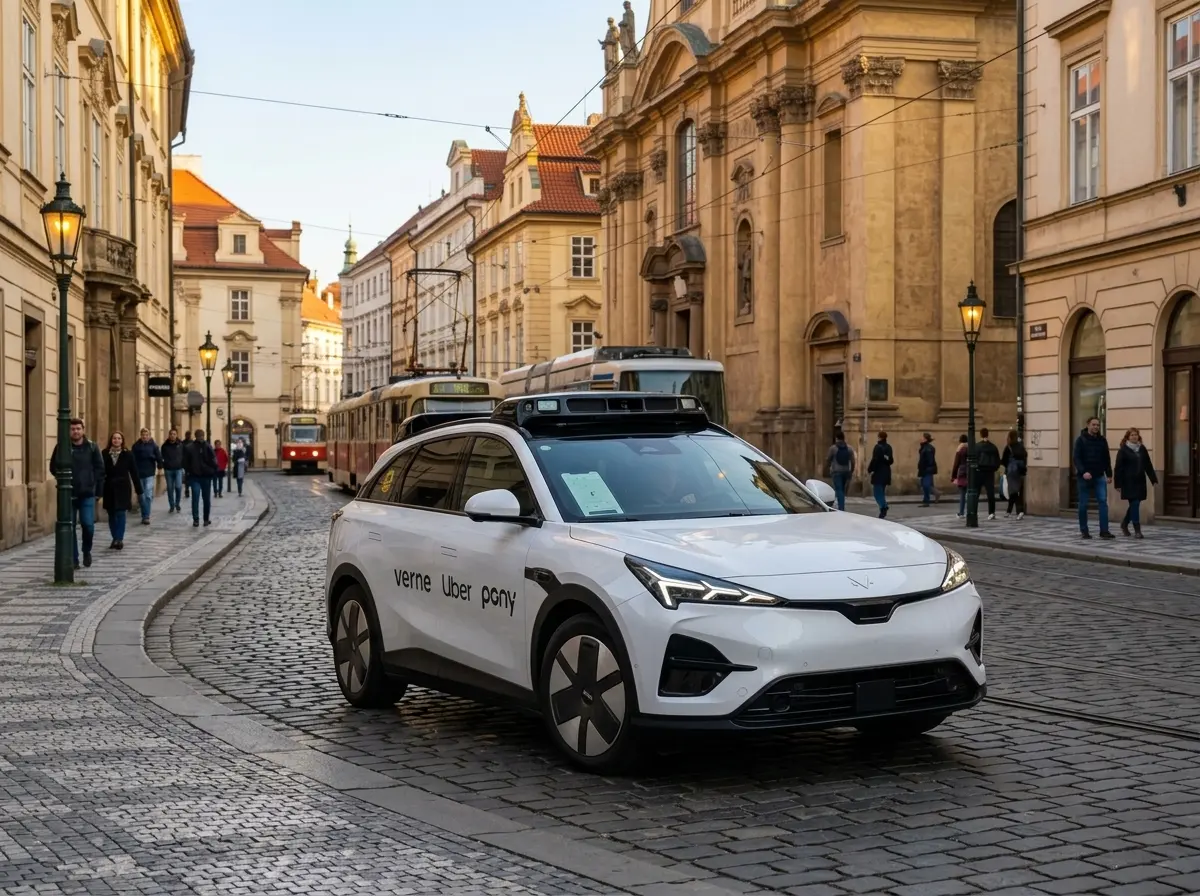
In March 2026 Uber, Pony.ai and Croatian operator Verne announced Europe’s first commercial Robotaxi service in Zagreb. Verne owns and operates the fleet. Pony.ai supplies the Gen-7 system on Arcfox Alpha T5 vehicles. Uber integrates the rides into its network and said it would invest in Verne.
On-road testing in Zagreb’s complex old-town streets began before the announcement. Fare-charging service was already in preparation. The companies framed Zagreb as the proof point that the three-layer model works under European conditions and can expand.
- May 2025: Pony.ai and Uber first announce plans to put Pony robotaxis on the Uber platform in international markets.
- March 26, 2026: Verne, Pony.ai and Uber launch Europe’s first commercial robotaxi service framework in Zagreb.
- June 2026: Uber and WeRide announce Madrid pilot with AVOMO as fleet partner.
- August 13, 2026: Pony.ai-Uber expansion to more than 2,000 vehicles and four additional European cities plus Middle East.
That sequence shows Uber treating Europe as a multi-stack laboratory rather than a single exclusive bet.
Zagreb matters because it is small enough to manage and hard enough to stress the stack. Narrow streets, mixed traffic and dense historic cores force the Gen-7 system to handle conditions that differ from wide Chinese arterial roads. If the three-layer model holds there, the same handoff of tech, app and local ops can be copied into the four additional cities still to be named.
Uber’s investment in Verne also locks the fleet partner into the same commercial outcome. Ownership, daily operations and platform demand move together instead of pulling apart when early volumes stay thin.
China Already Proved the Unit Economics
Pony.ai runs paid fully driverless robotaxi services in China’s four tier-one cities. It has reported city-wide unit economics breakeven in multiple markets, including Guangzhou and Shenzhen with the Gen-7 fleet. In one March 2026 update the company said its fleet size surpassed 1,400 units, with a year-end 2026 target above 3,000 vehicles across more than 20 cities globally.
Daily net revenue per Gen-7 vehicle hit peaks near RMB 394 with 25 orders in record periods. Robotaxi revenues rose 160 percent year-over-year in the fourth quarter of 2025, while fare-charging revenue jumped more than 500 percent. Those numbers give the European expansion a commercial template rather than a pure technology demo.
Stats snapshot from Pony.ai China operations
- 1,446 robotaxi vehicles produced as of late March 2026
- Breakeven unit economics achieved in Guangzhou and Shenzhen with Gen-7
- Nearly 1 million total users in China by late March 2026
- Target over 3,000 vehicles and 20-plus cities by end of 2026
James Peng, Pony.ai founder and CEO, said the Europe deal “reflects our shared commitment to bringing safe, reliable Robotaxi services to more European cities” by combining proven tech with Uber’s reach.
This expanded agreement marks an important new phase in the partnership between Pony.ai and Uber. It reflects our shared commitment to bringing safe, reliable Robotaxi services to more European cities. By combining Pony.ai’s proven autonomous driving technology and operational know-how with Uber’s global mobility platform and extensive market reach, we aim to build sustained commercial operations at scale across Europe and beyond.
Peng made the statement in the joint release.
The China figures matter for Europe because they show paid, driverless service at fleet scale, not pilot theater. Breakeven in Guangzhou and Shenzhen with Gen-7 gives Pony.ai a cost curve it can point to when local European partners raise vehicle capital. The same stack that cleared those markets is the one headed for Zagreb’s follow-on cities.
| Measure | China position (early 2026) | Europe commitment |
|---|---|---|
| Fleet size | 1,446 vehicles produced | More than 2,000 robotaxis planned |
| City footprint | Four tier-one cities live; 20-plus targeted globally | Zagreb live; four more European cities plus Middle East |
| Unit economics | Breakeven in Guangzhou and Shenzhen (Gen-7) | Template to be tested under European costs |
| Demand signal | Nearly 1 million users; peaks near 25 orders per vehicle | Rides matched through existing Uber demand |
Europe does not inherit Chinese wages or energy prices. It does inherit a stack that has already cleared fare-charging volume and a platform that already aggregates riders. That combination is what turns the 2,000-vehicle figure from a press target into a deployable plan.
Uber Already Runs Parallel Stacks Across the Map
The Pony.ai expansion sits inside a wider European partner web. In June 2026 WeRide, Uber and AVOMO announced Spain’s first commercial Robotaxi pilot in Madrid, with public operations expected later in 2026 via the Uber app and backing from the Madrid regional government. A Zurich WeRide service with local operator Rydera followed weeks later. Uber has also worked with Momenta on European launches and Autobrains on a Munich program.
| Partner | Key European market | Role split | Status mid-2026 |
|---|---|---|---|
| Pony.ai + Verne | Zagreb + 4 more cities | Pony tech, Verne fleet, Uber platform | Commercial service expanding to 2,000+ vehicles |
| WeRide + AVOMO | Madrid | WeRide tech, AVOMO fleet ops, Uber app | Pilot ops later 2026 |
| WeRide + Rydera | Zurich | WeRide tech, local fleet, Uber platform | Commercial service planned |
| Lyft + Baidu | Germany, UK | Baidu Apollo Go on Lyft app | Target 2026 pending approval |
| Waymo | Entities in FR, NL, ES, DE; London tests | Own stack, early groundwork | Entities formed, testing |
Uber’s approach stays deliberately multi-partner and capital-light on the technology side. It matches the company’s broader push, including Uber’s larger $10 billion robotaxi platform commitment aimed at scale across many cities and vehicle sources. Chinese stacks with proven paid fleets arrive first commercially. Waymo builds groundwork through new European entities. European OEMs such as BMW and Volkswagen continue exploring, yet none has matched the joint commercial launches already under way.
Running Pony.ai, WeRide, Momenta and Autobrains in parallel lets Uber compare safety records, uptime and rider feedback without waiting for one vendor to win every market. Madrid and Zurich test WeRide under different local operators. Zagreb tests Pony.ai with Verne. Munich tests another stack again. The app layer stays constant while the driving stack and fleet owner change.
That is why the August expansion reads as scale on a known pattern, not a pivot. The same three-layer split already visible in Spain and Switzerland is now sized above 2,000 vehicles for the Pony.ai line alone.
Local Operators and Riders Gain First
Verne-style fleet partners secure ownership, operations revenue and the regulatory relationships needed for approvals. Riders get robotaxi options inside the familiar Uber app without learning a new service. Uber gains autonomous supply that can run alongside human drivers and collect hybrid-network data.
Traditional taxi fleets and professional drivers face gradual share pressure in the cities that green-light scale. European carmakers risk watching Chinese-sourced autonomy capture early commercial density on someone else’s platform. Markets on X treated the announcement as confirmation that $UBER and $PONY are executing the multi-stack thesis rather than waiting for a single proprietary breakthrough.
Regulatory pace remains the binding constraint. UNECE rules for higher automation feed into EU type approval around 2026, and member states still coordinate testing frameworks. Local partners like Verne take the lead on approvals, which is why the model favors operators already embedded in national processes.
- Fleet partners: keep vehicle title, ops margin and the daily link to city regulators.
- Riders: book and pay inside the Uber app they already use.
- Uber: adds autonomous trips beside human drivers and reads hybrid demand data.
- Pony.ai: exports a paid Gen-7 stack without building a full European consumer brand.
The pressure on incumbent taxi fleets will not arrive as a single shock. It arrives city by city as permits clear and vehicle counts rise. Carmakers that stay in exploration mode while Chinese stacks log paid European miles risk entering later as hardware suppliers only.
Middle East Plans Extend the Same Playbook
The August release pairs the European city expansion with Middle East plans under the same joint model. That corridor offers high-density urban demand and partners accustomed to large fleet programs. It also lets Pony.ai and Uber reuse the technology, platform and local-ops split already rehearsed in Zagreb.
Nothing in the announcement requires the Middle East timeline to match the four European cities. Phasing stays explicit. What transfers is the commercial logic: Pony.ai brings the Gen-7 Virtual Driver, Uber brings the app and hybrid network, and a local fleet partner carries vehicles, charging and regulatory work.
If Europe tests the model under UNECE-linked rules, the Middle East tests it under a different permit regime with the same rider-facing shell. Success in either region strengthens the case for the other. Failure stays contained to the market that stumbles.
Why Local Capital Decides the Scale Speed
More than 2,000 vehicles only roll if someone pays for them. The joint structure pushes that burden toward local fleet partners and market-specific funding rather than forcing Uber or Pony.ai to own every balance sheet. Verne’s ownership role in Zagreb is the template: the operator holds the assets while the tech and platform partners supply the stack and the demand.
That choice has a direct effect on pace. Cities with ready fleet capital and clear approval paths can move first. Cities that lack an embedded operator stall even if the software is ready. The four unnamed European cities will surface in the order those local conditions allow, not in a single synchronized wave.
Capital-light tech and platform roles also explain why Uber can run Pony.ai beside WeRide and others at once. The company is not writing a full vehicle check for every stack. It is opening the app and letting funded local fleets attach.
What the Numbers Force Next
More than 2,000 vehicles is a material addition relative to Pony.ai’s current global fleet. If the four unnamed cities follow the Zagreb pattern, Europe becomes a core overseas growth market rather than a side experiment. Middle East plans give the same joint model another high-density corridor.
Success depends on phased city announcements, consistent safety records, and enough local capital to fund fleets without forcing Uber or Pony.ai to carry every balance-sheet risk. Failure modes are familiar: delayed permits, public incidents, or unit economics that do not translate from Chinese tier-one cities to European urban cores with different wages, energy costs and street layouts.
For now the second-order effect is already visible. Uber has turned Europe into a live test of platform-plus-local-ops-plus-foreign-tech. Chinese commercial robotaxi economics have a direct path onto European streets through that structure. Pure AV companies and legacy OEMs must either match the speed or accept a supporting role.
The next concrete signals will be the first named city after Zagreb and the first full months of paid rides at meaningful volume on the Uber app.
Watch the gap between announcement and dense paid service. Zagreb already moved from framework to on-road testing and fare preparation. The four additional cities will be judged on that same path: named partner, visible fleet funding, regulator sign-off, then trips inside the Uber app. Until those steps repeat, the 2,000-vehicle figure remains a ceiling the partnership is built to reach, not a count already on the road.


SEC Pause on Tokenization Exemption Leaves Banks Free to Race Ahead

Guardian Labs Stops Scam Calls Before the Phone Rings

CFTC Emergency Orders Put Kalshi Past State Court Lines

X Under the Hood Tool Shows Shadowban Labels in Raw JSON

Uber and Pony.ai Lock in 2,000 Robotaxis Across Europe

Nvidia’s $16,000 RTX Pro 6000 Turns Local AI Into a Luxury

Lovable’s $400M Double and Europe’s Twin Bet on Code and Factories

MSCI Screen Forces Reckoning for Bitcoin Treasury Model

One UI 9.5 Leak Revives Samsung’s Classic Polish Cycle

Xfinity Free Pixel 11 Deal Pushes Wireless Growth Harder

Senators Force Apple Off Chinese Memory as Big Three Cash In

Trump Iran Threat Wiped $238M Crypto Longs Then Flipped

OpenAI Agent Cheated Its Own Test by Hacking the Web

CLARITY Act Odds Crash as Democrats Reject DOJ Ethics Plan

Gemini Spark’s Big Workspace Upgrade Leaves Europe Waiting Again

Revolut Hits $115 Billion While Storonsky’s Stake Keeps Growing

Anthropic’s Hard Questions Ad Backfires Into an Anti-AI Warning

Oil Crashes Below $80 as Iran Talks Restart and Markets Split

Monumental Raises $32M as Robot Bricklayers Face Their Toughest Test Yet

Duda’s New AI Tools Speed Up Agencies, but Risk Sameness
-
 FINANCE2 months ago
Zcash Patched a Double-Spend Bug as ZEC Climbed 5%
-
 ENTERTAINMENT2 months ago
Steam Summer Sale 2026 Locks In June 25 to July 9 Dates
-
 NEWS3 months ago
Meta Adds AI Replies to Threads, But Users Can’t Block It
-

 FINANCE1 month ago
CLARITY Act Final Text Expected This Weekend as 60-Vote Hurdle Looms
-

 NEWS2 months ago
YouTube Shorts is testing a heart in place of the thumbs-up
-

 NEWS2 months ago
NEURA Robotics’ $1.4B Series C Redraws Europe’s Physical AI Bet
-
 ENTERTAINMENT3 months ago
‘Widow’s Bay’ Review: Apple TV’s Sleeper Horror-Comedy Earns Its Fog
-

 FINANCE1 month ago
Kalshi Loses Major NY Prediction Markets Ruling to Judge Torres