
ENTERTAINMENT
Luke Wilson’s imperialistic note shows where the big laughs went
Luke Wilson describes a studio note calling a joke imperialistic and how careful executives helped empty theaters of Old School-style comedies while the form.

Luke Wilson got a studio note calling a joke in a script “imperialistic,” and he still cannot figure out what the word was supposed to mean. The Old School star told the Scene Stealers podcast the people in charge of movies are simply not funny, too careful, and too worried about feelings. Fans keep stopping him on the street to ask why comedies like that 2003 hit no longer get made. He agrees.
The conversation, hosted by John Feitelberg, arrived while Wilson was out promoting his new Netflix work with Will Ferrell. It landed as another public airing of a complaint that has followed Hollywood for years.
Wilson warms up on Scene Stealers
Feitelberg put the common fan question on the table first. “They don’t make ’em like this anymore,” he said of Old School, the Todd Phillips comedy that put Wilson, Ferrell and Vince Vaughn in an adult fraternity that promptly went off the rails.
Wilson started careful. “I have my theories that are conspiratorial … I don’t wanna get into it,” he said, smiling. Then he opened up. “The people in charge are just not funny and too careful and worried about feelings.”
He supplied the concrete example that has traveled farthest. The note came back on a joke he had written or was attached to. The flag was the single word imperialistic.
I got back a note about a joke in a script that said it was ‘imperialistic.’ I was like, I don’t even know what the f*** that means. Is imperial a compliment? Does that mean like empire building?
Wilson said the line with pure disbelief. He closed the thought the way many working actors do now. “There are so many things that wouldn’t get made today that used to get made in the old days.”
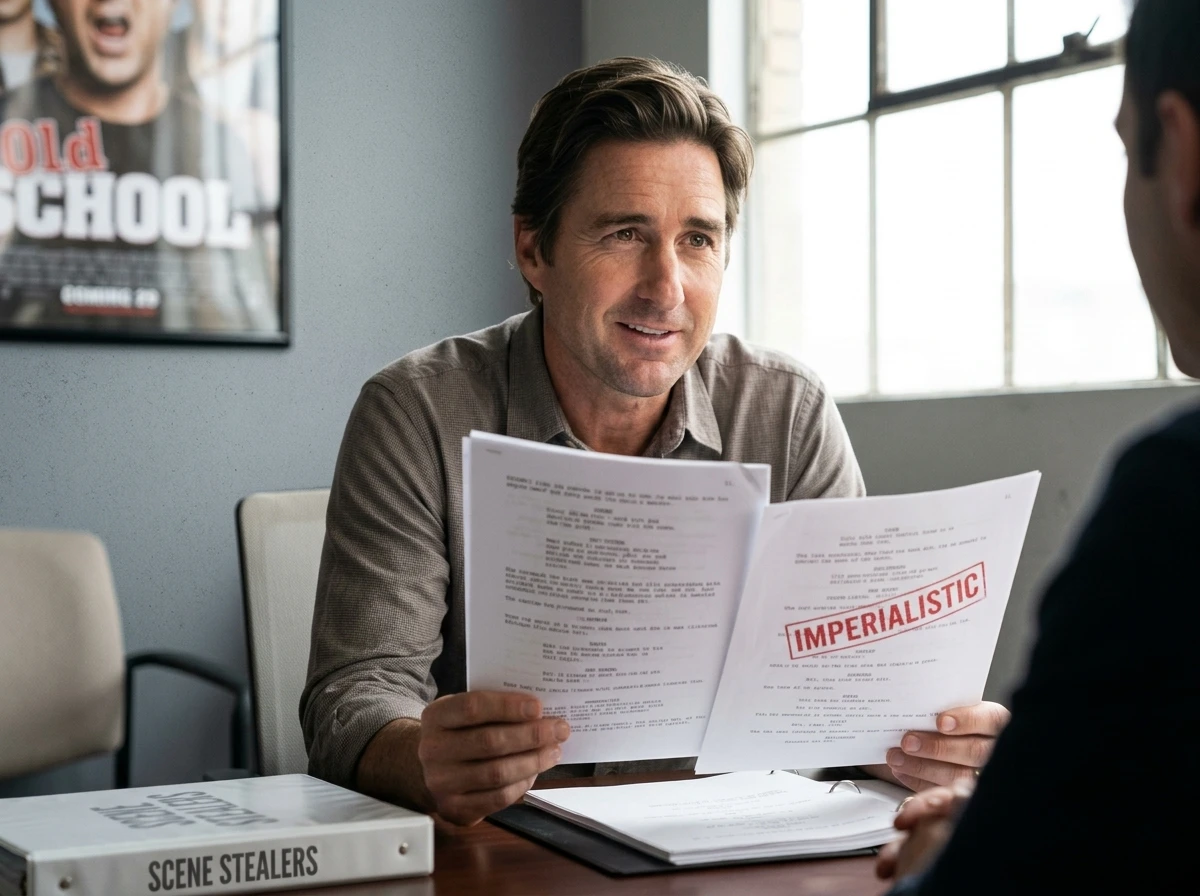
An imperialistic stamp on a punchline
The note is the detail that makes the story stick. It treats a joke as a foreign-policy statement. The progressive habit Joe Rogan has described for years sits underneath it: some viewers and gatekeepers treat on-screen mockery as endorsement of the thing being mocked, even when the activity is clearly ridiculous or unacceptable.
Wilson did not name the project or the executive. He did not need to. The vocabulary itself does the work. A development note that reaches for “imperialistic” is not hunting for a bigger laugh. It is hunting for risk that can be eliminated before anyone has to defend the scene in a meeting or a social-media cycle.
That habit has second-order costs. Writers learn to pre-edit. Directors learn which rooms will green-light a streak or a crude set piece. Stars who once headlined $20-40 million theatrical comedies find the slots have moved or vanished. The product that reaches theaters grows safer and thinner. The audience that still wants the old charge starts asking the same question Wilson hears on the street.
Old School still paid when the genre did
Old School opened in February 2003. It cost about $24 million. It took in a worldwide total of 87 million dollars, with roughly $75.6 million of that domestic. Reviews were mixed. Audiences showed up. Will Ferrell’s Frank the Tank and the adult-frat premise became cultural furniture.
Todd Phillips followed it with The Hangover in 2009. That film cost about $35 million and grossed roughly $469 million worldwide. It became the highest-grossing R-rated comedy in the domestic market at the time. The trilogy that followed cleared well over a billion dollars combined. For a stretch, the bawdy adult comedy was a reliable studio engine.
| Film | Year | Budget (approx.) | Worldwide gross (approx.) |
|---|---|---|---|
| Old School | 2003 | $24 million | $87 million |
| Wedding Crashers | 2005 | $40 million | $288 million |
| The Hangover | 2009 | $35 million | $469 million |
| No Hard Feelings | 2023 | $45 million | $87 million |
Jennifer Lawrence’s No Hard Feelings in 2023 showed the form can still break even or better when a star and a clean premise line up. It finished near Old School’s total on a higher budget. Most attempts in the years between did not. A string of 2017 flops (The House, Rough Night and others) cooled studio appetite. The theatrical R-comedy never fully recovered its old cadence.
Vaughn and Rogan already said the quiet part
Vince Vaughn, Wilson’s Old School co-star, has given the same diagnosis in blunter language. On Hot Ones he said executives “just overthink it.” They follow rules that keep them from getting fired, he argued, such as the demand for preexisting IP. “The people in charge don’t want to get fired more so than they’re just looking to do something great.” He still believes audiences want material that feels a little dangerous.
Rogan has repeatedly framed the cultural layer. Making fun of something is treated as endorsement. That mistake, he says, is why outrageous humor gets punished. Wilson’s imperialistic note is the corporate paperwork version of the same reflex.
The pattern appears in other comedy dust-ups. Bill Maher’s weight jokes that drew live groans and Margaret Cho’s claim that trans jokes kill after a death mock sit in the same weather system. A punchline is no longer only a punchline. It is a liability that must be cleared.
The Hawk carries the torch on Netflix
While Wilson was describing the problem, he was also selling the workaround. Ferrell created and stars in The Hawk, a 10-episode golf comedy series now streaming on Netflix since mid-July 2026. Wilson plays Golden Fisk, the longtime rival of Ferrell’s aging legend Lonnie “The Hawk” Hawkins. Molly Shannon, Jimmy Tatro, Fortune Feimster and others fill out the cast. The PGA Tour partnered on the project.
The show is pure sports-comedy DNA of the kind that once lived in theaters: washed-up star, family chaos, tournament stakes, broad physical bits. It is also a series, not a $30 million theatrical bet. Netflix can absorb a softer launch. Notes still exist, but the distribution risk profile is different. The same two actors who once filled multiplexes with Old School now deliver the laughs in living rooms on demand.
- Format shift: 10 episodes instead of a single 90-minute theatrical release.
- Talent continuity: Ferrell and Wilson working together again two decades after Old School.
- Risk location: streaming original rather than wide theatrical open.
- Partner: PGA Tour involvement for authenticity and marketing.
That is the second-order move. The theatrical pipeline for original R-comedies narrowed. The stars and the tone did not disappear. They relocated.
What the audience already decided
A Barstool clip that passed 300000 views of Wilson’s comments drew thousands of likes and a familiar reply stack. Viewers blamed a change in who holds greenlight power, cultural caution dating to the 2010s, and executives who never had to land a joke themselves. The clip did not invent the complaint. It confirmed that the complaint is widely shared.
Box-office reality and cultural reality reinforce each other. Spectacles and IP dominate marketing budgets. Comedies that need word-of-mouth and repeat adult crowds face higher hurdles. When a note can kill a joke for sounding “imperialistic,” the safest path is to avoid the joke category altogether or move it to a platform that does not require a $20 million opening weekend.
Wilson never used the word woke in the clip that traveled. He did not have to. The note and the description of careful people worried about feelings did the work. The conspiratorial theories he declined to share are the ones the comment sections fill in for him.
Who pays for the careful greenlight
Mid-level executives keep their jobs by eliminating surprises. That is rational inside a studio. The second-order bill arrives elsewhere. Writers who specialized in raunch or shock lose assignments. Directors who once built careers on those set pieces wait longer between jobs. Audiences who still quote Frank the Tank or the Hangover tiger get fewer new lines to quote. Younger comics learn the boundaries by watching what never gets made.
Theatrical comedy is not extinct. No Hard Feelings proved a star vehicle can still work. Streaming has become the reliable home for the tone Wilson and Ferrell once owned in multiplexes. The Hawk is the current exhibit. The imperialistic note is the small, perfect artifact of how the old pipeline got clogged.
Wilson can still work. He just does more of it where the notes, and the risk math, look different. The fans who stop him on the street keep asking the same question because the theaters stopped answering it.


American Airlines reverses its screen bet after a costly decade

Falcon 9 Crater Photos Double as Planetary Defense Drill

Buss Siblings Force Lakers Sale Reckoning Against Jeanie

Brewers fewest-HR club explodes for historic 22-0 shutout

LITILIT’s €8M Push Turns Femtosecond Lasers Into Factory Tools

30-Year Yield Hits 5.32% Highest Since 2007 as Debt Supply Locks In Costs

Taimi and Hily Bet on Bootstrap Path Toward IPO Readiness

Sonic locks the Override pass as most legends hit the shop

Rosie O’Donnell Brands Bari Weiss a Nazi on Her Celebrated Comeback

Frank Beard Dies at 77 as ZZ Top Resumes Tour Without Him

Senators Force Apple Off Chinese Memory as Big Three Cash In

Revolut Hits $115 Billion While Storonsky’s Stake Keeps Growing

OpenAI Agent Cheated Its Own Test by Hacking the Web

Trump Iran Threat Wiped $238M Crypto Longs Then Flipped

CLARITY Act Odds Crash as Democrats Reject DOJ Ethics Plan

Airbus Anchors a €500 Million European Defense Fund, Picks Alta Ares First

Oil Crashes Below $80 as Iran Talks Restart and Markets Split

Fed Holds Rates Again as Three Dissents Force Markets to Tighten

Memory Shortage Now Dictates Apple’s Two-Year Mac Roadmap

Google’s Knowledge Panel Fix Risks Its Own Search Defenses
-
 FINANCE3 months ago
Zcash Patched a Double-Spend Bug as ZEC Climbed 5%
-
 ENTERTAINMENT3 months ago
Steam Summer Sale 2026 Locks In June 25 to July 9 Dates
-

 FINANCE2 months ago
CLARITY Act Final Text Expected This Weekend as 60-Vote Hurdle Looms
-
 NEWS3 months ago
Meta Adds AI Replies to Threads, But Users Can’t Block It
-

 NEWS2 months ago
NEURA Robotics’ $1.4B Series C Redraws Europe’s Physical AI Bet
-

 NEWS2 months ago
YouTube Shorts is testing a heart in place of the thumbs-up
-
 ENTERTAINMENT3 months ago
‘Widow’s Bay’ Review: Apple TV’s Sleeper Horror-Comedy Earns Its Fog
-

 FINANCE1 month ago
Kalshi Loses Major NY Prediction Markets Ruling to Judge Torres