
NEWS
Crescent moon joins Venus over Sharjah after 46-degree elongation
Ibrahim Al Jarwan notes Venus at greatest eastern elongation near the crescent over Sharjah, a naked-eye pair that feeds UAE public astronomy interest.

Venus reached its greatest eastern elongation of roughly 46 degrees from the sun on Saturday and shared the western sky with a waxing crescent moon over Sharjah on Sunday evening, Emirates Astronomical Society chairman Ibrahim Al Jarwan said.
The planet stayed bright enough for naked-eye viewing after sunset above the western horizon, and the pairing offered a clean target for both casual watchers and photographers.
That combination of peak angular separation and a nearby crescent gave residents a brief, well defined window. The geometry was simple enough to spot without charts once twilight deepened, yet precise enough to reward anyone who stepped outside at the right minute.
Venus sat farthest from the setting sun
Al Jarwan, who also sits on the Arab Union for Astronomy and Space Sciences, noted that Venus hit approximately 46 degrees of separation, its greatest distance from the setting sun for this evening apparition. Independent sky guides place the exact moment near 6 UTC on 15 August, with the angular distance measured at 45.9 to 46 degrees.
At that point Venus shone at magnitude about -4.4 and showed a roughly half-illuminated disk, near 49 percent lit and spanning roughly 24.5 arcseconds through a telescope. The planet remains the brightest steady object in the evening sky after the moon itself.
- Elongation: 45.9-46 degrees east of the sun
- Magnitude: around -4.4
- Phase: near half, 48-49 percent illuminated
- Visibility window: low in west after sunset for roughly 90 minutes
The numbers line up across multiple independent calculations. Venus will stay an evening object into October before sliding into the sun’s glare.
Greatest elongation marks the moment when the sun-Earth-Venus angle is widest for this evening run. After that point the planet begins to close back toward the sun in the sky even while its physical distance from Earth continues to shrink. The half-phase disk and the -4.4 magnitude therefore arrive together, giving telescopes a clean half-lit target and naked-eye watchers a steady beacon that outshines every star.
The roughly 90-minute window is set by how quickly Venus follows the sun below the western horizon. Once the planet drops low enough, haze and buildings erase the view long before true darkness arrives.
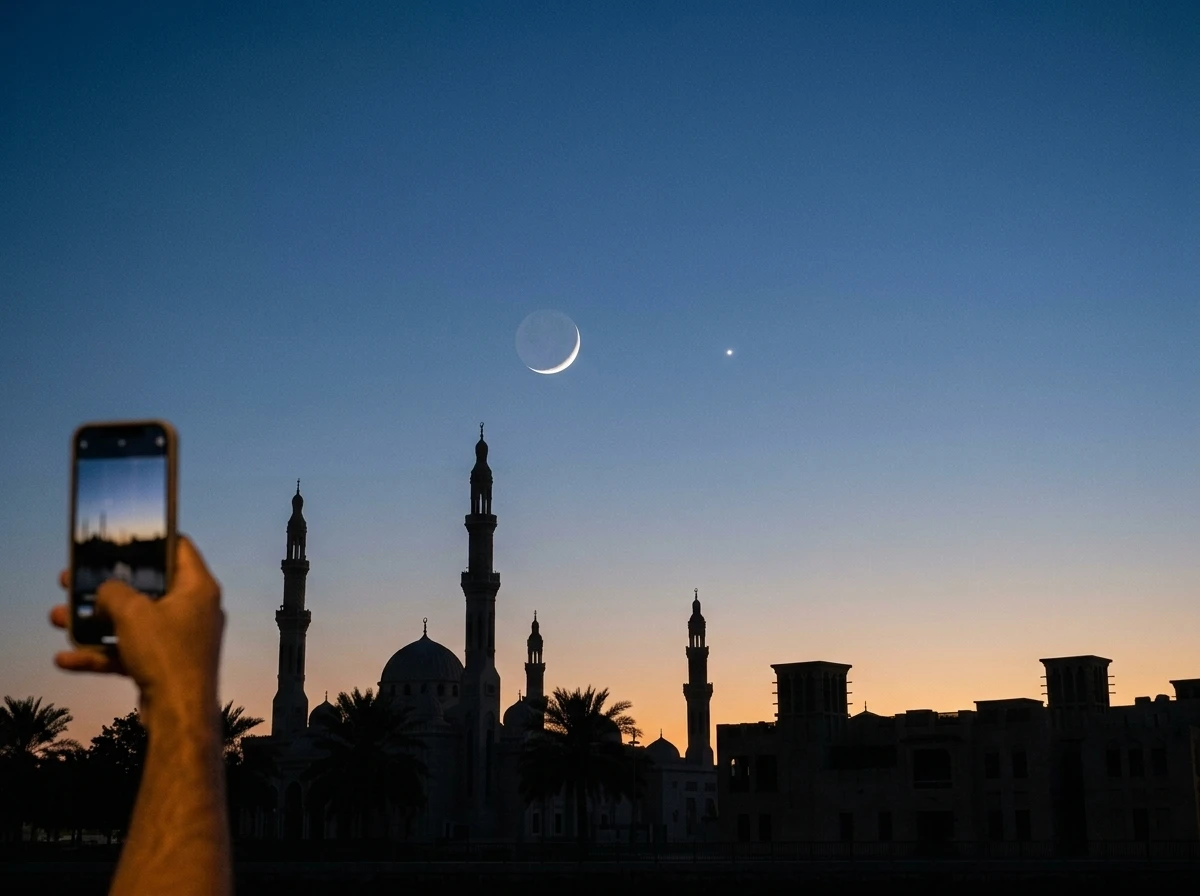
The crescent rose while Venus held position
On Sunday the crescent stood higher above the horizon than it had the day before, Al Jarwan said, while Venus would begin a gradual descent over coming weeks as it closed back toward the sun. The view grows more striking when the two sit close together.
Venus can be observed with the naked eye after sunset above the western horizon, and the view becomes even more beautiful as it appears closer to the crescent moon, providing an excellent opportunity for astronomical observation and photography
Al Jarwan made the remark in the announcement carried by Gulf Today. Global charts for the same evenings show the young crescent roughly 4 degrees from Venus, with Virgo’s bright star Spica also nearby in the same western sector.
Across social feeds, skywatchers from beaches to backyards posted the pair without needing telescopes. Many first mistook the planet for an unusually bright star before the moon’s presence made the geometry obvious.
Four degrees of separation is close enough for both objects to fit inside a single binocular field or a wide phone frame. Spica supplies a third point of light that anchors the scene and helps first-time watchers confirm they have the right patch of sky. As the moon climbs night by night, the gap widens and the trio slowly rearranges, yet the first evenings keep the composition tightest.
Why the pair hangs low despite the wide gap
Greatest elongation should lift Venus high, yet August evenings keep both objects surprisingly close to the horizon for mid-northern latitudes. The ecliptic, the path the sun, moon and planets follow, meets the western horizon at a shallow angle this time of year. The geometry forces the maximum separation to play out low rather than high.
Charts place the crescent less than 6 degrees up and Venus only a few degrees higher about 45 minutes after sunset. The shallow angle is temporary; spring elongations often stand taller. For now the low placement simply means a clear western horizon is essential and the window is short.
A shallow ecliptic angle stretches the same 46 degrees of elongation along a line that stays near the horizon instead of climbing steeply into darker sky. That is why a separation large enough to keep Venus clear of the sun’s glare still leaves the planet only a few degrees above the rooftops. Observers who wait too long after the 45-minute mark watch both the crescent and the planet sink into thicker air and lose contrast.
The same seasonal tilt explains why the usable stretch lasts only about 90 minutes. Once Venus drops below a few degrees of altitude, even a bright magnitude cannot cut through low haze.
How residents can still catch a clear look
No special equipment is required. A flat western view free of buildings or dunes works best, and twilight itself supplies the contrast once the sun has dropped.
- Step outside 20 to 45 minutes after local sunset and face west-southwest.
- Look for the brightest non-moon point of light; that is Venus.
- The slender crescent will sit nearby, often showing earthshine on its dark side.
- A phone on night mode or a short tripod exposure captures the pair easily.
- Binoculars reveal Venus’s disk phase and any nearby stars such as Spica.
In Dubai the planet has been setting near 9 p.m. local time in mid-August, giving a usable window after the brightest twilight fades. Light pollution reduces contrast but rarely hides Venus itself.
Earthshine on the crescent’s dark side becomes easier to notice once the sky has darkened a little past the brightest twilight. A short tripod exposure freezes that faint glow along with the bright limb and the steady point of Venus. Binoculars turn the half-lit planetary disk into a tiny but unmistakable shape and pull Spica into the same field, giving casual watchers a quick sense of scale.
An eight-year rhythm sky cultures once tracked
Venus’s appearances follow a repeating 584-day synodic cycle relative to Earth. Over eight years the planet completes almost exactly 13 orbits, returning to nearly the same sky positions within a few days. The 2026 evening apparition therefore echoes the pattern last seen around 2018.
Ancient observers in multiple cultures noted the regularity. Today the same cycle supplies predictable public events that societies can announce in advance.
| Event | 2026 date | Notes |
|---|---|---|
| Superior conjunction | 6 January | Venus behind the sun, invisible |
| Greatest elongation east | 15 August | 46 degrees, evening star peak separation |
| Greatest brilliancy | around 18 September | magnitude near -4.8, still evening |
| Inferior conjunction | 24 October | Venus between Earth and sun, vanishes |
| Greatest elongation west | 3 January 2027 | morning star return |
The next greatest elongation east listed for August 15 sits firmly inside that long-known sequence. Al Jarwan’s society regularly issues such notices, turning orbital regularity into shared local moments.
Because the eight-year return is so close, the dates and sky positions feel familiar to anyone who watched the previous evening apparition. Societies can draft alerts months ahead, knowing the elongation, the brilliancy peak, and the slide toward inferior conjunction will arrive on schedule. That predictability is what converts an orbital fact into a calendar item residents can plan around.
Venus brightens further then slips away
After the elongation peak the planet continues to close the distance to Earth. Its illuminated extent grows and overall brightness climbs toward a greatest brilliancy near mid-to-late September, even as its altitude at sunset falls. By then it will sit only about 10 degrees high and set little more than an hour after the sun.
Through a small telescope the disk will swell and thin into a large crescent. By early October Venus disappears into the solar glare, reaches inferior conjunction on 24 October, and re-emerges in the morning sky weeks later. Until then the western twilight still holds it.
The current pairing with the moon therefore marks the start of the most accessible stretch of the apparition rather than its end. Spica remains a useful reference as Venus closes on the star for a conjunction early in September.
The climb from magnitude -4.4 toward -4.8 happens while the planet loses altitude, so the brightest evenings are also the lowest. Observers who want both peak brilliance and a comfortable height above the horizon must choose their nights carefully inside that September window. After inferior conjunction the same cycle flips Venus into the morning sky, completing the pattern laid out in the eight-year rhythm.
Brightness and Phase Shift Together After Elongation
The weeks after greatest elongation reverse the usual trade-off between size and phase. As Venus draws nearer to Earth its apparent disk grows, yet the sunlit portion shrinks from the current half-phase toward a thinner crescent. The net result is a climb in total brightness even while the shape becomes more extreme.
That progression can be tracked with the same figures already fixed for this apparition:
- At greatest elongation the disk spans roughly 24.5 arcseconds and is about 48-49 percent lit at magnitude -4.4.
- By greatest brilliancy around 18 September the magnitude nears -4.8 while altitude at sunset has fallen to about 10 degrees.
- By early October the planet is lost in the sun’s glare ahead of the 24 October inferior conjunction.
A small telescope shows the change most clearly. The half-lit disk of mid-August swells and thins until it becomes a large crescent low in bright twilight. Naked-eye watchers simply notice that the point of light grows harder to miss, even as the available viewing minutes shrink toward little more than an hour after sunset.
Spica’s early September conjunction with Venus offers a final easy checkpoint before the planet drops too low for comfortable viewing. Once that pairing passes, the remaining evenings favor observers with open western horizons and a willingness to catch the planet in stronger dusk light.
The Same Cycle Guides Morning and Evening Returns
The 584-day synodic period links every evening apparition to the morning one that follows. After the 24 October inferior conjunction, Venus reappears in the eastern dawn and climbs toward greatest elongation west on 3 January 2027. The eight-year envelope that returns the planet to nearly the same calendar dates also returns it to comparable altitudes and elongations, so the morning show will feel like a mirror of the current evening one.
- 6 January 2026: superior conjunction hides Venus behind the sun.
- 15 August 2026: greatest elongation east opens the best evening separation at 46 degrees.
- Around 18 September 2026: greatest brilliancy lifts the magnitude near -4.8.
- 24 October 2026: inferior conjunction ends the evening apparition.
- 3 January 2027: greatest elongation west begins the morning-star phase.
Public notices can therefore treat the whole sequence as one story rather than isolated dates. Residents who catch the crescent pairing now already know when to look east before dawn a few months later. The regularity that ancient sky cultures once tracked still supplies the backbone for modern alerts issued by groups such as the Emirates Astronomical Society.
Public skywatching fits a wider UAE pattern
Al Jarwan’s announcement is one more in a steady series from the Emirates Astronomical Society. The group tracks moons, planets, eclipses and halos for residents and often partners with local institutions. Those notices arrive against the background of UAE lunar efforts, including the Rashid rover program and international base planning, that keep space topics in daily conversation.
A bright, easy pair like this one needs no observatory. People already stop on beaches and corniches, lift phones, and post the result. That casual traffic is exactly the layer a national astronomy society can build on. The geometry that places Venus 46 degrees from the sun on the sky also places a photogenic crescent about crescent about 4 degrees to Venus lower right for several evenings, giving everyone the same shared target.
The window remains open for a few more clear nights while the moon climbs and Venus holds its place. After that the planet will keep shining, only lower each week, until September’s brighter phase and October’s exit.
Because the society’s alerts arrive on a predictable orbital schedule, they fit neatly beside the broader public interest already fed by lunar programs and base planning. A planet that needs no telescope becomes an open invitation: the same residents who follow rover updates can step outside, face west-southwest, and see the geometry for themselves before the evening apparition fades.


American Airlines reverses its screen bet after a costly decade

Falcon 9 Crater Photos Double as Planetary Defense Drill

Buss Siblings Force Lakers Sale Reckoning Against Jeanie

Brewers fewest-HR club explodes for historic 22-0 shutout

LITILIT’s €8M Push Turns Femtosecond Lasers Into Factory Tools

30-Year Yield Hits 5.32% Highest Since 2007 as Debt Supply Locks In Costs

Taimi and Hily Bet on Bootstrap Path Toward IPO Readiness

Sonic locks the Override pass as most legends hit the shop

Rosie O’Donnell Brands Bari Weiss a Nazi on Her Celebrated Comeback

Frank Beard Dies at 77 as ZZ Top Resumes Tour Without Him

Senators Force Apple Off Chinese Memory as Big Three Cash In

Revolut Hits $115 Billion While Storonsky’s Stake Keeps Growing

OpenAI Agent Cheated Its Own Test by Hacking the Web

Trump Iran Threat Wiped $238M Crypto Longs Then Flipped

CLARITY Act Odds Crash as Democrats Reject DOJ Ethics Plan

Airbus Anchors a €500 Million European Defense Fund, Picks Alta Ares First

Oil Crashes Below $80 as Iran Talks Restart and Markets Split

Fed Holds Rates Again as Three Dissents Force Markets to Tighten

Memory Shortage Now Dictates Apple’s Two-Year Mac Roadmap

Google’s Knowledge Panel Fix Risks Its Own Search Defenses
-
 FINANCE3 months ago
Zcash Patched a Double-Spend Bug as ZEC Climbed 5%
-
 ENTERTAINMENT3 months ago
Steam Summer Sale 2026 Locks In June 25 to July 9 Dates
-

 FINANCE2 months ago
CLARITY Act Final Text Expected This Weekend as 60-Vote Hurdle Looms
-
 NEWS3 months ago
Meta Adds AI Replies to Threads, But Users Can’t Block It
-

 NEWS2 months ago
NEURA Robotics’ $1.4B Series C Redraws Europe’s Physical AI Bet
-

 NEWS2 months ago
YouTube Shorts is testing a heart in place of the thumbs-up
-
 ENTERTAINMENT3 months ago
‘Widow’s Bay’ Review: Apple TV’s Sleeper Horror-Comedy Earns Its Fog
-

 FINANCE1 month ago
Kalshi Loses Major NY Prediction Markets Ruling to Judge Torres