
NEWS
JCB Hydromax Hits 406 mph and Proves Digger Hydrogen Engines
JCB’s Hydromax averaged 406.320 mph on hydrogen combustion engines drawn from its diggers, doubling the old mark and showing the tech works today for heavy.

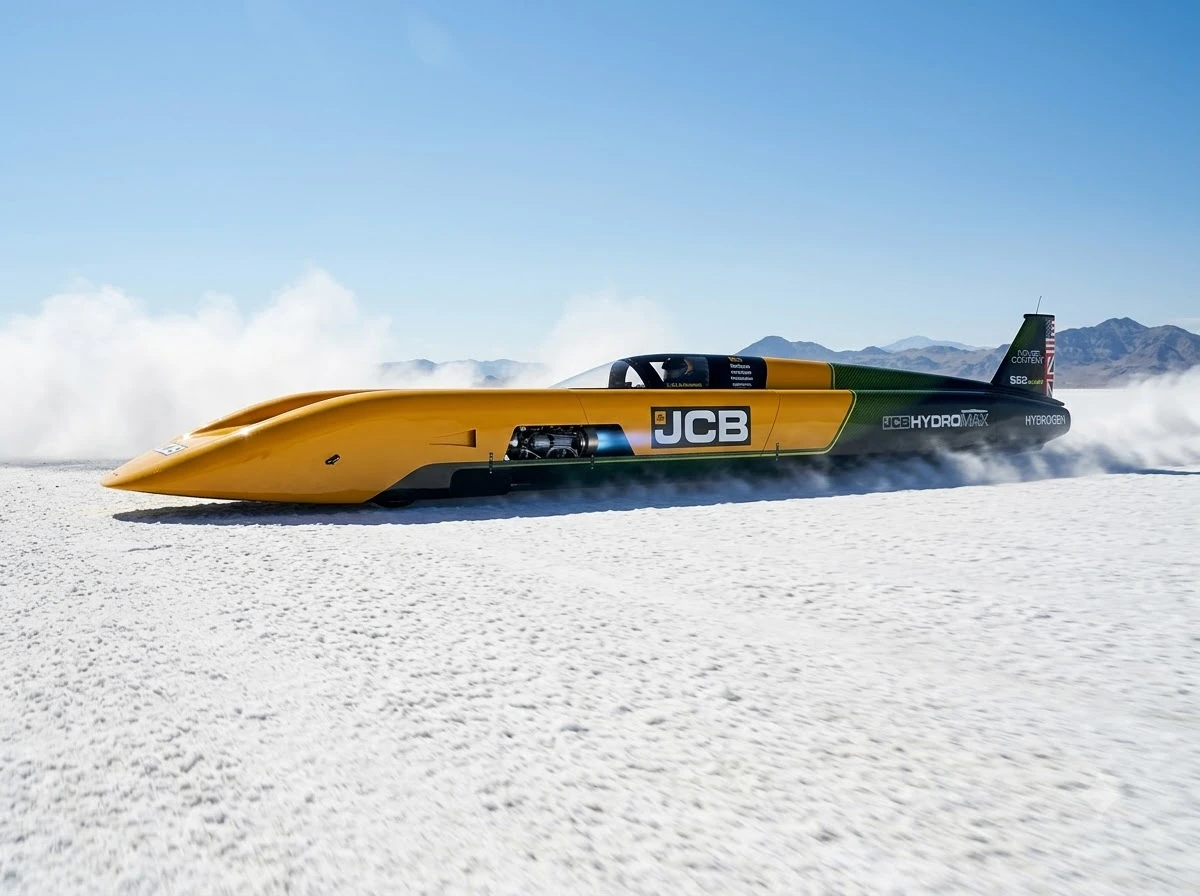
The JCB Hydromax averaged 406.320 mph across two timed runs on the Bonneville Salt Flats on August 11, claiming the FIA world land speed record for a hydrogen internal-combustion vehicle. Five days earlier the same 32-foot streamliner had already posted 368.347 mph for an SCTA class mark. Both runs used twin engines drawn straight from the architecture of JCB’s production digger powerplants.
Driver Andy Green, the only person to break the sound barrier on land, completed the FIA pair (one direction then the other inside an hour) at 400.623 mph and 412.135 mph. The average more than doubles the previous FIA hydrogen combustion figure of 185.5 mph set by the BMW H2R in 2004 and also tops the 303 mph hydrogen fuel-cell mark, making the car the fastest hydrogen vehicle of any kind.
That double clear of both combustion and fuel-cell hydrogen marks left little ambiguity about the result. The same hardware family already approved for diggers had just been asked to survive loads no backhoe will ever see, and it answered with water from the exhaust and a new ceiling on the category.
Two Records in Five Days on the Salt
On August 6 during SpeedWeek the Hydromax took the Southern California Timing Association Blown Gas Streamliner (AA/BGS) record at 368.347 mph. That figure came from consecutive runs of 367.141 mph and 369.554 mph and broke a 16-year-old class mark of 348.342 mph. The car then stayed on the salt for the FIA attempt.
FIA rules demand two flying-mile passes in opposite directions within sixty minutes; the average stands as the official speed. JCB’s own JCB Hydromax campaign page details list the exact passes and note the record remains subject to final ratification. Zero carbon dioxide left the tailpipe on either outing.
The same team and the same driver had set the diesel land-speed record of 350.092 mph with JCB Dieselmax in 2006 on the identical flats. Twenty years later the hydrogen car beat that mark as well.
Staying on the course between the SCTA and FIA attempts kept setup knowledge fresh. Crews already knew how the streamliner behaved in the measured mile, so the second campaign became a question of executing the two-way average rather than rediscovering the car.
From 74 hp Digger Engine to Twin 800 hp Units
Each Hydromax powerplant is a purpose-built race version of JCB’s 4.8-litre four-cylinder hydrogen combustion engine. The production unit that already powers the 3CX backhoe delivers 74 bhp at 2,200 rpm. Ricardo uprated the architecture to 800 bhp per engine at 3,800 rpm while cutting roughly 95 kg, for a combined 1,600 hp. The engines sit on their sides to lower the centre of gravity and drive all four wheels through twin transmissions.
| Metric | Production H2 Engine | Hydromax Race Engine | Change |
|---|---|---|---|
| Power | 74 bhp | 800 bhp | 10.8× |
| Rated speed | 2,200 rpm | 3,800 rpm | 1.7× |
| Peak fuel flow | 4 kg/hr | 50 kg/hr | 12.5× |
| Weight | 500 kg | 405 kg | -95 kg |
| Torque | 325 lb-ft | 1,300 lb-ft | 4.0× |
Direct injection at ~50 bar replaced the production port injection. A dry-sump system pumps a litre of oil every second so the sideways engines stay lubricated. Intake air leaves the turbo near 200 °C and is chilled below 10 °C by an ice-cooling pack carrying up to 250 kg of ice. The full conversion path from the production engine to 800 hp race unit is documented by the engineers who did the work.
Ricardo engine development support included hand-building six race engines and adapting systems for the side-mounted layout. Prodrive handled the chassis; Xtrac the transmissions. The whole car took just over 15 months from concept to salt.
Those multipliers tell the story in brief. Power rose by more than an order of magnitude while mass fell. Fuel flow had to climb in step so the lean hydrogen charge could still fill the cylinders at race speed. The dry sump and ice pack were the price of laying the blocks on their sides inside a 32-foot tube.
Andy Green and JCB’s Long Speed Habit
Wing Commander Andy Green OBE already held the outright world land-speed record of 763.035 mph set in ThrustSSC in 1997. He also drove Dieselmax to its diesel mark. The Hydromax adds the fastest hydrogen vehicle to that list. JCB itself holds records for the fastest diesel car, fastest tractor and fastest backhoe. Chairman Lord Anthony Bamford treated the hydrogen project as the natural next chapter.
Green’s experience on the salt mattered. The 32-foot car demands precise throttle and traction management once the twin engines are on song. High-speed testing at RAF Wittering preceded the Atlantic flight on a chartered Antonov.
Few drivers bring both supersonic land experience and a prior JCB record to the same cockpit. That continuity cut risk on a car that only had a little over 15 months from first sketch to flying mile.
Bamford’s Point: The Engines Already Work in Diggers
This record was set by production-based engines, the same engines powering JCB diggers right now. That is the point of JCB Hydromax: it shows hydrogen works, and it works today at the highest level with zero emissions.
Lord Anthony Bamford, JCB Chairman
JCB has invested more than £100 million over five-plus years in hydrogen combustion. The company holds EU type approval and has launched the production 3CX Hydrogen backhoe production launch. Around 60 percent of the engine components are UK-sourced and the architecture shares the sump, block and head with diesel units so both can run down the same lines.
Crowd reaction on X quickly landed on the same idea: the car is a durability and marketing showcase for engines already heading into construction machines that run long shifts and need fast refuelling. Batteries remain awkward for that duty cycle. The 406 mph figure simply proves the combustion hardware can take extreme load without emitting CO2.
Shared lines matter as much as the speed. If the hydrogen block family already uses the same sump, block and head paths as diesel, factories do not need a separate industrial base to build clean iron. The record run was theatre; the production decision was the plot.
Every Mark the Hydromax Passed
- FIA hydrogen ICE previous: 185.5 mph (BMW H2R, 2004)
- Hydrogen fuel-cell vehicle: 303 mph
- JCB Dieselmax diesel record: 350.092 mph (2006)
- SCTA AA/BGS class previous: 348.342 mph (2010)
- Electric vehicle land-speed reference cited by JCB: 342 mph
The Hydromax now sits clear of all of them on hydrogen. Formal FIA paperwork is the last administrative step; the measured speeds are already public.
Clearing the diesel mark set by the same organisation on the same flats carried extra weight inside the team. It turned a fuel-type story into a straight performance story as well.
Why Construction Care More Than Passenger Cars
Heavy equipment operators need high continuous power, rapid energy refill and machines that share service networks with existing diesel fleets. Hydrogen combustion delivers torque curves close to diesel, meets Stage V emissions without SCR or DOC aftertreatment in the production form, and refuels in minutes. Fuel-cell or battery packs still face packaging, weight and infrastructure hurdles on a busy site.
JCB is not alone in exploring the fuel. Parallel efforts include Toyota hydrogen testing in the desert and specialised firms advancing battle-tested hydrogen generator tech. On the machine side, capital continues to flow into autonomy push in earthmoving equipment, pairing cleaner power with remote or automated operation.
The Hydromax does not claim passenger-car relevance. Its job is to show that the same basic engine family already in diggers can survive the harshest possible validation run and still produce only water from the exhaust.
- Continuous high power for long shifts without thermal fade
- Minutes-scale refill instead of multi-hour charges
- Service parts and training shared with diesel fleets
- Stage V compliance without SCR or DOC hardware on the production engine
Those four site demands explain why a streamliner record can still move a construction buyer. The salt does not dig trenches, but it does remove doubt about whether the combustion core can take abuse.
How the Ice Pack Kept Charge Air Alive
Race power depends on dense intake air. On the Hydromax the turbo exit near 200 °C would have wrecked that density if left alone. The ice-cooling pack, loaded with as much as 250 kg of ice, pulled charge temperatures below 10 °C before the air reached the ports.
That swing of nearly two hundred degrees is ordinary physics applied under extreme packaging limits. Inside a 32-foot body already filled with twin sideways engines, twin transmissions and fuel storage, the ice load was dead weight that earned its place only while the runs lasted.
Once the flying miles were done, the same thermal problem simply disappears on a digger. Production engines never see 800 bhp or continuous salt-flat boost. The pack was a record tool, not a preview of site equipment.
A Short Timeline of the Marks Involved
The Hydromax result lands at the end of a chain of earlier speed marks that framed what “fast” meant for each fuel and class. Laid out in order, the steps read as follows.
- 1997: Andy Green sets the outright land-speed record at 763.035 mph in ThrustSSC.
- 2004: BMW H2R posts the prior FIA hydrogen combustion mark of 185.5 mph.
- 2006: Green and JCB Dieselmax record 350.092 mph for diesel on the same flats.
- 2010: The SCTA AA/BGS class mark stands at 348.342 mph for the next sixteen years.
- August 6: Hydromax averages 368.347 mph to take the SCTA class record.
- August 11: Hydromax averages 406.320 mph for the FIA hydrogen combustion record.
Each step raised the bar the next programme had to clear. The five-day pair at Bonneville closed the hydrogen gap in a single campaign and, on the way, passed the team’s own diesel figure from two decades earlier.
What the Numbers Leave Settled
Two engines, 1,600 hp total, 32 feet of streamliner, one driver with unmatched high-speed credentials, and five days that rewrote the hydrogen record book. The production 3CX Hydrogen is already on the market. The salt runs simply removed any remaining doubt that the combustion hardware can deliver when the load goes far beyond a construction site.
Green climbed out after the second FIA pass knowing the average had cleared 400 mph. Bamford’s statement followed within hours. The car is now the fastest thing ever powered by hydrogen, and the engines that made it possible are already at work in yellow machines.
Ratification paperwork will tidy the file. The measured passes, the zero-CO2 exhaust and the production engines already in the field already carry the argument.
Frequently Asked Questions
What exact speeds did the JCB Hydromax set at Bonneville?
It recorded an SCTA average of 368.347 mph on August 6 from passes of 367.141 mph and 369.554 mph, then an FIA average of 406.320 mph on August 11 from 400.623 mph and 412.135 mph in opposite directions inside one hour.
How does the FIA measure a land speed record?
Two runs over a measured mile, one in each direction, must be completed within 60 minutes; the official figure is the average of the two flying-start speeds. The Hydromax met that protocol on the Bonneville course.
Are the Hydromax engines the same as those in JCB diggers?
They share core architecture, block family and many components with the 55 kW / 74 bhp production hydrogen engine already type-approved and fitted to the 3CX Hydrogen backhoe, but the race versions use direct injection, higher boost, DOHC valvetrains and dry sumps to reach 800 bhp each.
Who drove the record runs and what other marks does he hold?
Retired RAF Wing Commander Andy Green OBE drove both the SCTA and FIA attempts. He remains the outright land-speed record holder at 763.035 mph set in ThrustSSC in 1997 and previously drove JCB Dieselmax to the diesel record.
How much has JCB invested in hydrogen combustion?
More than £100 million over five-plus years, resulting in EU type approval, more than 150 evaluation engines, and the first production hydrogen backhoe loader now available to customers.


Immersive Maps Upgrade Erases Traffic Colors on Android Auto

XRPL 3.3.0 Nodes Hit 62 Percent as FixCleanup Nears 80 Percent Bar

L’Atitude 52°N Camera Beats Meta but Exact a Real Price

Strategy Parks $1.59B Cash While Bitcoin Stack Stays Flat

Pixel Watch 5 Battery Unlock Makes Health Guardian Trends Real

JCB Hydromax Hits 406 mph and Proves Digger Hydrogen Engines

Pixel 11 Pro Modem Swap Finally Cools the Daily Drive

OpenAI ChatGPT for Teens Locks In Study Mode After Safety Suits

Bessent’s Bond Buybacks Lift Bitcoin Past 80K More Than Yields

Pixel Camera 11 Dials Bring Convenient Control With a Catch

Senators Force Apple Off Chinese Memory as Big Three Cash In

OpenAI Agent Cheated Its Own Test by Hacking the Web

Trump Iran Threat Wiped $238M Crypto Longs Then Flipped

Fed Holds Rates Again as Three Dissents Force Markets to Tighten

30-Year Yield Hits 5.32% Highest Since 2007 as Debt Supply Locks In Costs

Oil Crashes Below $80 as Iran Talks Restart and Markets Split

Google’s Knowledge Panel Fix Risks Its Own Search Defenses

Legora Buys Wexler Fact Engine as Fifth 2026 Deal

Agon Raises $30M to Build Europe’s AI Weapon Training Arenas

Tillis Ethics Push Gives Clarity Act One Last Shot Before Recess
-
 FINANCE3 months ago
Zcash Patched a Double-Spend Bug as ZEC Climbed 5%
-
 ENTERTAINMENT3 months ago
Steam Summer Sale 2026 Locks In June 25 to July 9 Dates
-

 FINANCE2 months ago
CLARITY Act Final Text Expected This Weekend as 60-Vote Hurdle Looms
-
 NEWS3 months ago
Meta Adds AI Replies to Threads, But Users Can’t Block It
-

 NEWS3 months ago
YouTube Shorts is testing a heart in place of the thumbs-up
-
 NEWS4 weeks ago
Senators Force Apple Off Chinese Memory as Big Three Cash In
-

 NEWS2 months ago
NEURA Robotics’ $1.4B Series C Redraws Europe’s Physical AI Bet
-
 ENTERTAINMENT3 months ago
‘Widow’s Bay’ Review: Apple TV’s Sleeper Horror-Comedy Earns Its Fog