
NEWS
SoftBank’s $200M Gravis bet unlocks earthmoving for the AI buildout
SoftBank’s record $200M Series A makes Gravis a $1B robotics unicorn, targeting the construction labor bottleneck that slows data centers and infrastructure.

SoftBank has put $200 million into Zurich-based Gravis Robotics as the sole investor in a Series A that values the ETH Zurich spinout at roughly $1 billion and ranks as the largest of its kind in construction robotics. The round, announced 17 August 2026, funds a global push to turn existing excavators and heavy machines into autonomous systems that dig, load and reshape sites without a driver in the cab.
The deal arrives as infrastructure demand from data centers, energy grids and housing collides with a chronic shortage of skilled operators. Gravis’s software-first retrofit approach targets that exact choke point.
A $1 billion unicorn after one SoftBank check
Gravis called the investment the largest Series A in construction robotics history. SoftBank Group, through SoftBank Investment Advisers, wrote the entire check. Post-money valuation sits near $1 billion, making Gravis Europe’s newest robotics unicorn according to multiple reports including EU-Startups.
The company had raised a $23 million round in November 2025 co-led by IQ Capital and Zacua Ventures, with participation from Pear VC, Holcim and others. That earlier capital supported deployments across the UK, US, EU, Latin America and Asia. The SoftBank money multiplies the runway for hiring, market entry and fleet scale.
| Round | Date | Amount | Lead / key | Post-money |
|---|---|---|---|---|
| Earlier funding | November 2025 | $23 million | IQ Capital, Zacua Ventures | Not disclosed |
| Series A | August 2026 | $200 million | SoftBank (sole) | ~$1 billion |
Ryan Luke Johns, CEO and co-founder, said the capital lets Gravis “hire the best builders and engineers, put Gravis-powered autonomy on every major jobsite, and scale faster than anyone thought possible.”
How the Gravis Rack turns iron into robots
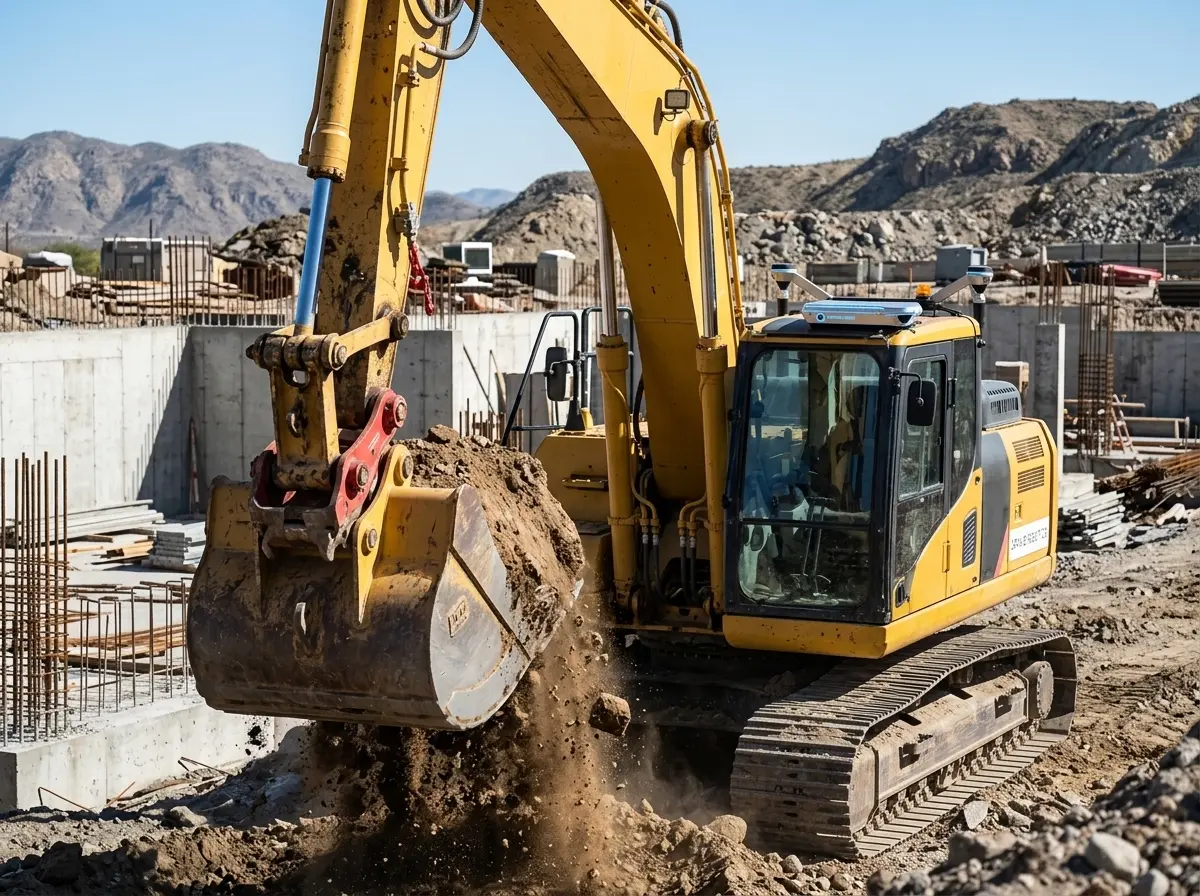
Gravis does not build new excavators. It sells the Gravis Rack, a roof-mounted autonomous control kit with onboard compute, cameras and lidar, plus rear masts carrying more sensors and a high-precision GNSS system that can tighten location data to under an inch. A companion Slate tablet lets crews monitor feeds, overlay hazard cues such as buried pipes, and switch modes.
The software runs as an operating system across mixed fleets. Supported brands already include Caterpillar, Case, Develon, John Deere, JCB, Hitachi, Sumitomo, Yanmar and Volvo. The same core models adapt from compact machines to units five times larger without custom reprogramming for each chassis.
- Full autonomy for driving, trench digging, bulk excavation, truck loading and stockpile management
- Gravis Copilot mode that keeps the operator in the cab with real-time 3D guidance and hazard detection
- Continuous background surveying and hazard mapping while work proceeds
- Claimed productivity lift of up to 30 percent versus peak manual operation on several projects
CTO and co-founder Dominic Jud described the core technical bet: “Skilled operators read the earth through subtle physical feedback – listening to the engine strain, sensing the machine vibration and reacting to hydraulic resistance. Our AI takes that same physical input and grounds it in machine telemetry, responding to varying subterranean forces and soil mechanics at microsecond speeds. We didn’t try to simplify the world for our software; we gave it the physical intuition to handle real job sites with precision that goes beyond what any human can feel from inside the cab.”
Training relies on vast simulation of soil types from soft clay to rock-filled ground so the system bridges the sim-to-real gap for the chaotic conditions of live civil sites.
Why earthmoving became the AI economy’s bottleneck
Construction remains one of the least automated major industries. Machines still operate much as they did decades ago while demand for new housing, transit, climate-resilient works and especially AI data centers and power infrastructure accelerates. Labor shortages compound the lag: aging workforces and difficulty attracting skilled operators leave projects waiting on dirt to move.
Gravis frames earthmoving as the foundational step every project shares. Johns put it directly: “Whether we are building housing, modernizing energy grids, or scaling data centers, every project starts with moving earth. That foundational work has been the bottleneck slowing down the entire built environment.”
The company cites a trillion-dollar-scale earthmoving and mining market and points to Europe’s large contractors, many of whose revenues come from international work, as a natural proving ground and launchpad. Systems are already live with customers and partners including Holcim, Taylor Woodrow and HD Hyundai across four continents, covering highways, utilities, oil and gas, quarries and data-center prep.
Snapshot of the pressure points
- Productivity claim: up to 30% gain versus skilled manual operation on measured projects
- Market framing: Gravis cites a 1.6-trillion-dollar earthmoving industry and a broader construction bottleneck
- UK pipeline: Britain’s infrastructure pipeline is cited at $716 billion, with Gravis already on active sites
- Labor reality: construction faces structural operator shortages across major markets
Crowd conversation on X quickly noted the contrast with flashier humanoid and warehouse robotics bets: the underrated play sits in the messy dirt that every data-center pad and power line still requires.
SoftBank’s physical AI wager
Masayoshi Son has flagged robotics as a core channel for SoftBank alongside earlier stakes in OpenAI, Alibaba and others. Dai Sakata, Managing Director of SoftBank Group, said: “Physical AI is central to SoftBank’s vision for the next phase of AI. Gravis is bringing AI-powered autonomy to construction, helping build smarter, more efficient infrastructure, and we look forward to supporting its mission.”
Physical AI is central to SoftBank’s vision for the next phase of AI. Gravis is bringing AI-powered autonomy to construction, helping build smarter, more efficient infrastructure, and we look forward to supporting its mission.
Sakata’s comments sit against SoftBank’s wider moves, including earlier reports of interest in acquiring Gravis at a lower valuation and plans for a robotics-focused vehicle sometimes linked to data-center construction automation. The Gravis check fits a second-order logic: software that multiplies the output of existing heavy fleets can accelerate the physical sites that house the AI compute SoftBank also backs.
Earlier SoftBank-linked discussions of a large US robotics manufacturing push and separate industrial robotics deals reinforce the pattern. Construction autonomy becomes an input to the AI infrastructure race rather than a side bet.
Who gains on the jobsite
Contractors keep their existing fleets and dealer relationships. Two-thirds of global heavy-equipment demand sits outside the top three manufacturers, so a brand-agnostic rack avoids forcing a closed ecosystem. Rental giants gain a new product: Flannery Plant Hire, the UK’s largest operated heavy-equipment rental provider, is already partnering for turnkey autonomous excavators.
Operators are not simply replaced. Johns has stressed the goal is higher productivity per person, with one operator able to supervise multiple machines from a safer location once full autonomy engages, or to use Copilot assistance while remaining in the cab. Morgan Sindall Construction has described Gravis machines as productive as a skilled driver and, in some cases, better for overall team efficiency.
OEMs and dealers can offer the kit through existing channels, as seen with Develon integrations and Swiss dealer Kibag. The model spreads risk and speeds distribution compared with waiting for fully autonomous machines from the factory.
European peers are also raising capital for related automation. Readers tracking other European construction robotics raises will recognize the same labor and productivity pressures that Monumental and others are attacking from different task angles.
The scale path already under way
Gravis has systems deployed on dozens of sites and recently won selection to lead an $8 million UK government-backed CAM Pathfinder project with Flannery. The trial retrofits excavator fleets for trenching, bulk excavation and truck loading to support Britain’s large infrastructure pipeline. A separate rental partnership lets contractors hire machines already fitted with the Rack.
- Late 2022: Founded as ETH Zurich spinout; co-founders Ryan Luke Johns (CEO), Dominic Jud (CTO) and board member professor Marco Hutter
- November 2025: $23 million raise and landmark deals with Holcim, Taylor Woodrow, HD Hyundai; first large-scale autonomous excavation on an active UK airport infrastructure site
- 2025-2026: Live in seven countries; mixed-fleet and OEM-integrated deployments; Flannery rental model
- 2026: $8 million UK CAM Pathfinder selection; SoftBank $200 million Series A at ~$1 billion valuation
Funds will expand the team, enter more international markets and increase the number of machines running commercially. The prior Gravis’s earlier $23 million raise already proved the technology on real crews; the SoftBank round is designed to industrialize it.
Archie Muirhead, partner at IQ Capital and an earlier investor, said the team identified the skilled-operator shortage “at a time when demand for new infrastructure from compute to energy is accelerating” and that the technology is already delivering measurable gains across four continents.
Frequently Asked Questions
What does Gravis Robotics actually sell?
Gravis sells a retrofit kit called the Gravis Rack plus software that turns existing excavators and heavy equipment into machines capable of full autonomy or AI-augmented operation. Contractors keep their current fleets instead of buying new purpose-built robots.
Who founded Gravis and where did the technology come from?
Co-founders Ryan Luke Johns (CEO) and Dominic Jud (CTO) spun the company out of ETH Zurich in 2022. Robotics professor Marco Hutter is a co-founder and board member. The core research draws on reinforcement learning and control work for complex machinery at the university’s labs.
How much productivity improvement does Gravis claim?
The company reports up to a 30 percent boost in jobsite productivity compared with peak manual operation on several live projects, alongside safety gains from reduced cab time and continuous hazard mapping.
Which machine brands work with the Gravis system?
The Rack and software have been installed on equipment from Caterpillar, Case, Develon, John Deere, JCB, Hitachi, Sumitomo, Yanmar, Volvo and additional makers, covering roughly two-thirds of global demand that sits outside the top three OEMs.
What will Gravis do with the SoftBank money?
The company plans to grow its engineering and builder teams, accelerate commercial deployments on more continents, deepen OEM and rental partnerships, and put autonomous systems onto a larger share of the heavy fleets that currently move earth for infrastructure projects.


American Airlines reverses its screen bet after a costly decade

Falcon 9 Crater Photos Double as Planetary Defense Drill

Buss Siblings Force Lakers Sale Reckoning Against Jeanie

Brewers fewest-HR club explodes for historic 22-0 shutout

LITILIT’s €8M Push Turns Femtosecond Lasers Into Factory Tools

30-Year Yield Hits 5.32% Highest Since 2007 as Debt Supply Locks In Costs

Taimi and Hily Bet on Bootstrap Path Toward IPO Readiness

Sonic locks the Override pass as most legends hit the shop

Rosie O’Donnell Brands Bari Weiss a Nazi on Her Celebrated Comeback

Frank Beard Dies at 77 as ZZ Top Resumes Tour Without Him

Senators Force Apple Off Chinese Memory as Big Three Cash In

Revolut Hits $115 Billion While Storonsky’s Stake Keeps Growing

OpenAI Agent Cheated Its Own Test by Hacking the Web

Trump Iran Threat Wiped $238M Crypto Longs Then Flipped

CLARITY Act Odds Crash as Democrats Reject DOJ Ethics Plan

Airbus Anchors a €500 Million European Defense Fund, Picks Alta Ares First

Oil Crashes Below $80 as Iran Talks Restart and Markets Split

Fed Holds Rates Again as Three Dissents Force Markets to Tighten

Memory Shortage Now Dictates Apple’s Two-Year Mac Roadmap

Community Banks’ $1.3 Trillion Warning Is Stalling Clarity Act
-
 FINANCE3 months ago
Zcash Patched a Double-Spend Bug as ZEC Climbed 5%
-
 ENTERTAINMENT3 months ago
Steam Summer Sale 2026 Locks In June 25 to July 9 Dates
-

 FINANCE2 months ago
CLARITY Act Final Text Expected This Weekend as 60-Vote Hurdle Looms
-
 NEWS3 months ago
Meta Adds AI Replies to Threads, But Users Can’t Block It
-

 NEWS2 months ago
NEURA Robotics’ $1.4B Series C Redraws Europe’s Physical AI Bet
-

 NEWS2 months ago
YouTube Shorts is testing a heart in place of the thumbs-up
-
 ENTERTAINMENT3 months ago
‘Widow’s Bay’ Review: Apple TV’s Sleeper Horror-Comedy Earns Its Fog
-

 FINANCE1 month ago
Kalshi Loses Major NY Prediction Markets Ruling to Judge Torres