
NEWS
Mars Jellyfish Photo Fits a Decade of Cosmic Ray Hits
The viral 2023 Curiosity rover jellyfish shape matches years of documented cosmic-ray camera artifacts on Mars, not life, and follows the familiar public cycle.

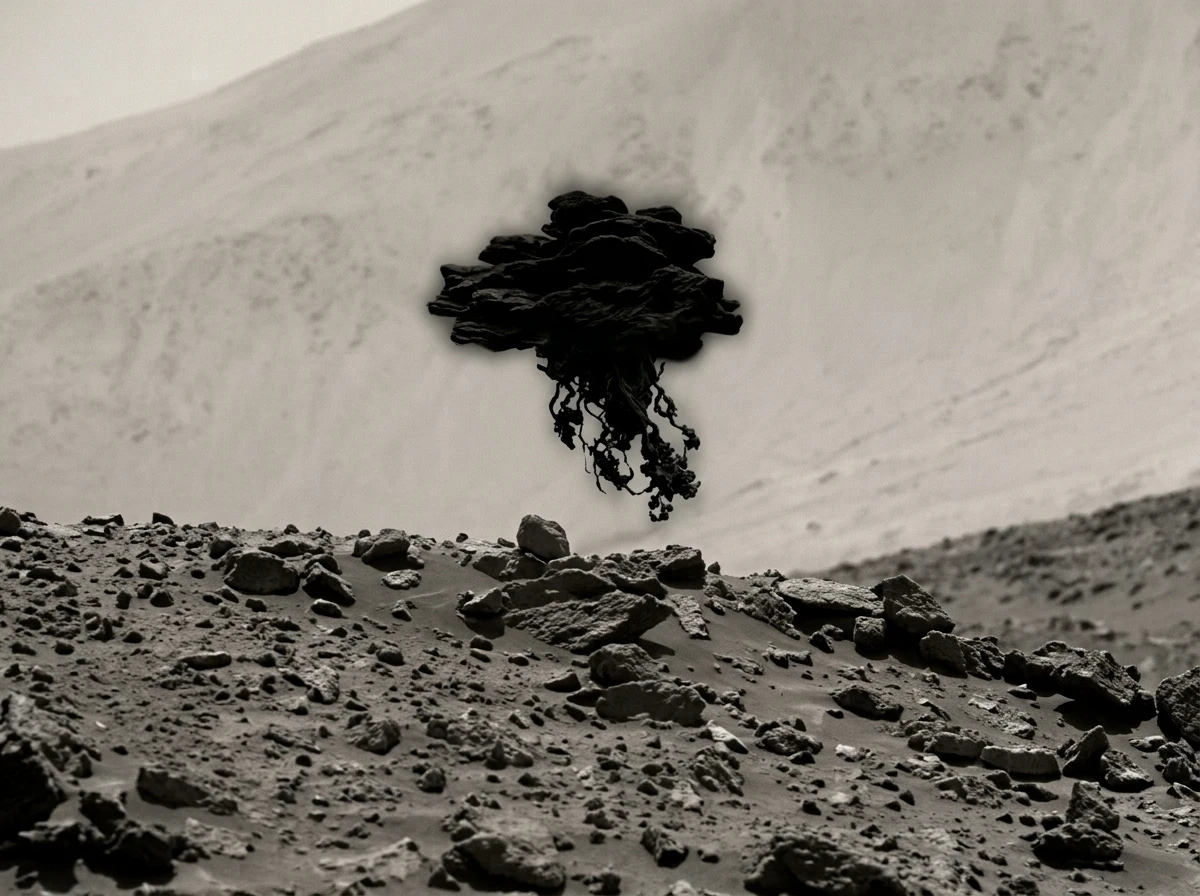
A dark silhouette resembling a jellyfish or War of the Worlds tripod appears on the horizon in a Curiosity rover photo from August 20, 2023. The shape covers roughly 15 pixels, vanishes from frames shot seconds earlier, and matches a long record of cosmic-ray hits on Mars cameras rather than any living form.
The image, taken by the right navigation camera at 22:27:46 UTC on sol 3924, sat largely unnoticed until Kari Sivertzen posted it on X on August 12, 2026. Headlines followed quickly. The physics of the sensor have not changed.
What changed is only the audience. A raw Navcam product waited in a public archive for nearly three years before a single post pulled it into the viral cycle. The earlier and later frames that bookend the odd shape were already there. So was the instrument history that explains it.
The Sol 3924 Frame That Waited Three Years
NASA hosts the original as a raw grayscale Navcam product. The full scene shows typical Gale Crater slopes and ridges. On the far left a compact dark form sits just above a rocky hill, with thin downward extensions that read as tentacles to human eyes primed for patterns.
It is the final public image Curiosity released that Martian day. The next available shot came nearly two hours later and pointed elsewhere. No stereo pair from the left Navcam covers the same instant.
| Image | UTC Time | Jellyfish Present |
|---|---|---|
| Navcam right | 22:27:21 | No |
| Navcam right | 22:27:33 | No |
| Navcam right | 22:27:46 | Yes |
The right navigation camera image from sol 3924 is the sole carrier of the shape. A later frame from the same camera about 78 minutes afterward shows empty terrain again.
That gap matters. The shape is confined to one exposure in a tight sequence. The camera kept the same pointing for the clean frames seconds before. Nothing in the surrounding terrain changed between those shots. The archive therefore supplies its own control images without any extra request to the rover.
Because the product is raw and grayscale, there is no color grade or contrast stretch hiding the edges. Viewers see the same pixel values the pipeline delivered. That transparency is why the horizontal row of pure black later became decisive.
Why the Shape Is Gone in Seconds
The clean earlier frames rule out a stationary rock or permanent structure. Anything physical large enough to cast that silhouette would have needed to arrive and leave in under half a minute, an unlikely feat for any known Martian process at that distance.
- Cosmic-ray strike on the CCD during bias or exposure, leaving a dark residual after processing
- Electronic or transmission glitch anywhere from readout to ground processing that flips a pixel block dark
- Transient dust or particle caught only in one exposure, though wind and left-camera data are missing for confirmation
Astrophysicist Dr. Joseph Farah examined the zoomed pixels and found a perfect horizontal row of pure black values with no anti-aliasing. That geometry is the signature of a sensor event, not optics or a distant object.
EarthSky summarized the pipeline risks: a pixel value can change inside the readout electronics, the flight computer, onboard compression, the downlink, or ground calibration. Any of those steps can produce a single-frame dark blob.
Each stage in that chain is a separate chance for a one-off error. A physical object on the surface would have to survive all of them and still vanish from the next public frame. A sensor or processing event only has to happen once.
| Checkpoint | What a surface object needs | What a sensor event needs |
|---|---|---|
| Frame at 22:27:21 | Already present or arriving | Nothing |
| Frame at 22:27:33 | Still present | Nothing |
| Frame at 22:27:46 | Present, then gone soon after | Single hit or glitch |
| Frame ~78 minutes later | Fully absent again | Nothing |
The table is only a restatement of the times already published. It shows why the multi-frame test is harder for a rock or craft than for a particle strike.
Cosmic Rays Have Hit These Cameras for Years
Mars offers almost no magnetic shield and an atmosphere only 0.5 percent the mass of Earth’s. High-energy particles arrive constantly. Curiosity’s Navcams and Mastcams record the strikes as bright white dots, streaks, or occasional dark marks.
In 2014 Justin Maki, then leader of the Navcam team at JPL, told reporters the team saw bright spots nearly every week across thousands of images. Most were cosmic-ray hits or sun glints off rocks. Dark artifacts appear less often but follow the same physics.
- 2014: Maki documents routine bright spots in Navcam frames near the Kimberley waypoint
- 2022 sol 3613: A similar dark navigational-camera shape appears and is later cited as a cosmic-ray parallel
- 2023 Hazcam video: NASA notes a small black artifact from a cosmic-ray strike on the sensor
- 2023 sol 3924: The jellyfish frame that waited three years for its audience
Farah located an earlier email from Maki confirming that streaks of this type come from cosmic rays striking during acquisition of a dark bias frame. The pattern is not new. Only the viral shape is.
Weekly bright spots across thousands of images set a baseline. Dark residuals are rarer, yet they share the same cause: charge deposited in silicon, then mishandled by subtraction or readout. The 2022 dark shape and the 2023 Hazcam note already sat in the public record before Sivertzen’s post. The sol 3924 frame simply joined a list rather than opening one.
Gale Crater’s thin air and weak shielding do not spare any camera on the rover. Navcam, Mastcam, and Hazcam all fly in the same radiation environment. A hit on one instrument is evidence that the others remain exposed too.
How a Particle Strike Becomes Tentacles
When a cosmic ray hits the silicon during the bias calibration step it deposits a localized charge. The processing pipeline subtracts that bias measurement from the real exposure. A bright charge deposit becomes a dark residual imprint.
- Charge diffusion moves the excess along pixel columns during readout
- Readout direction stretches the dark core into thin downward extensions
- Single-event nature means the mark lives in one frame only
- No anti-aliasing leaves razor-sharp pixel edges that look artificial
The result can look like a body with legs or tentacles. The same mechanism has produced other one-off dark shapes that never appear again. Without full engineering logs the exact particle energy remains unconfirmed, yet the multi-frame absence and pixel geometry leave little room for a surface object.
What I think happened is a cosmic ray struck the camera at the exact right moment and left this big old artifact in the image. It explains why the shape is so weird; just a perfect row of pixels with no anti-aliasing effect. And why it wasn’t present just 13 seconds earlier.
Dr. Joseph Farah, astrophysicist
Human pattern recognition fills gaps. A dark core plus thin vertical runs becomes a jellyfish or a tripod because those shapes are already stored in memory. The sensor never drew tentacles. Readout direction and charge diffusion did. The missing anti-aliasing then keeps the edges unnaturally crisp, which reads as “artificial” to eyes trained on optical blur.
That is why a 15-pixel feature can dominate a headline. The brain scales the pattern up. The data stay small, single-frame, and geometrically perfect in a way optics rarely are.
The Same Public Cycle Every Time
Sivertzen’s post gathered tens of thousands of views within hours. Replies ranged from “best Mars UFO I’ve seen” to careful notes that a 15-pixel blob cannot support distance or identity claims. One common misread placed Ingenuity near Curiosity; the helicopter flew in Jezero Crater, more than 3,700 kilometers away.
Daily Mail and similar outlets framed the shape as possible life. Skeptics on X answered with the earlier frames and the pixel row. The cycle matches earlier rover curiosities: the “face,” the “femur,” the “doorway,” the “dragon bones.” Each time the public eye finds biology or technology; each time the imaging team or independent analysts return to rocks, lighting, or radiation.
Even filmmakers keep the conversation alive. Parallel interest in disclosure and non-human intelligence shows up in places like Spielberg’s own alien beliefs shared at SXSW, yet the rover data still demand the same technical filter.
The frame taken 13 seconds earlier remains the cleanest rebuttal. No shape, same camera, same pointing.
Distance claims collapse for the same reason identity claims do. Fifteen pixels supply no reliable scale, no stereo depth from the left Navcam at that instant, and no second epoch that keeps the object in view. The Jezero mix-up shows how quickly separate missions blur once the image leaves the archive and enters reply threads.
- Face, femur, doorway, dragon bones: earlier public labels on rover scenes
- Jellyfish or tripod: the 2026 labels on the sol 3924 dark row
- Rocks, lighting, radiation: the recurring technical replies
- Adjacent frames and pixel geometry: the evidence that ends each round
Fifteen Pixels Cannot Carry Distance Claims
The shape covers roughly 15 pixels. That figure alone limits what anyone can say about size, range, or motion. A silhouette that small has no resolved texture, no cast shadow long enough to measure, and no paired left-Navcam view at the same second.
Claims that treat the form as a craft or organism therefore add information the file does not contain. The clean frames at 22:27:21 and 22:27:33 already remove the simplest physical story: a fixed object on the ridge. The later empty frame removes a slow passer-by. What remains is a transient confined to one exposure.
Farah’s horizontal row of pure black seals the point. Optical images of distant objects pick up some blur, some partial filling of edge pixels, some variation along a contour. A perfect block without anti-aliasing is what a detector event looks like after processing, not what a tripod on a hill looks like through a lens.
The public cycle still runs because the silhouette is suggestive. Suggestive is not the same as measured. The archive’s own timestamps and the zoomed pixel grid are the measurements that matter.
What the Open Archive Makes Possible
Every frame cited here was already public. The right Navcam product, the shot 13 seconds earlier, the empty view about 78 minutes later, Maki’s 2014 comments, the 2022 dark parallel, and the 2023 Hazcam note all sat in the open before the 2026 spike in attention.
That openness is why the rebuttal could form in hours rather than months. Skeptics did not need a new downlink. They needed the adjacent files and the known behavior of the bias subtraction step. The same archive that feeds viral posts also feeds the correction.
Curiosity’s continued traverse on Mount Sharp will add more raw products. Some will contain bright dots, streaks, or dark residuals. A few will again resemble biology or hardware to first glance. The filter stays the same: check the neighbors in time, zoom to the grid, and weigh the radiation environment Mars never turns off.
Ingenuity’s separate location in Jezero, more than 3,700 kilometers away, is a reminder that mission context also lives in the public record. Mixing platforms is easy in a reply thread and hard once the maps and timestamps are checked side by side.
What Earth Photographers Can Steal From This
PetaPixel closed its coverage with a practical note: next time an unexpected object appears in your photo, blame a cosmic ray. The lesson travels farther.
- Always check adjacent frames or burst sequences before declaring an anomaly real
- Zoom to the pixel level; perfect rows or blocks without anti-aliasing point to sensor or processing events
- High-radiation or high-altitude environments raise the odds of particle hits even on Earth
- Compression, transmission and calibration steps can introduce dark or bright blocks that never existed in the scene
Modern consumer cameras add their own layers of processing. Features such as modern phone camera controls let users lock exposure and white balance, yet they still cannot stop a charged particle from flipping a photosite. The Mars case simply makes the failure mode visible because the environment is harsher and the archive is public.
Burst mode on a phone is the everyday version of the 22:27:21, 22:27:33, and 22:27:46 trio. If the oddity lives in only one frame, treat it as suspect before treating it as subject. Full-resolution zoom is the everyday version of Farah’s pixel row test. Soft optical edges and hard processing edges do not look the same.
Calibration and compression on consumer pipelines differ in detail from the rover chain, yet they share the risk EarthSky listed: a value can change after the photons have already hit the sensor. The fix is not more certainty in a single file. The fix is more files, and a habit of reading them at the pixel scale.
Curiosity continues its work on Mount Sharp. More odd single-frame shapes will appear. Most will be radiation or electronics. A few will look like life. The archive already contains the pattern that sorts them.


Dolly Parton’s $450 Million Fortune Keeps Working After Her Death

SpaceX’s $60B Cursor Buy Immediately Costs It OpenAI Models

Rays Forever Home Wins County Vote as College and Taxpayers Carry the Load

Apple TV Hits $14.99 as Sports and Hits Bill Comes Due

Swift Telescopes Restart as Orbit Drop Accelerates

Oracle’s 2.8 GW Bloom Deal Exposes the AI Power Bypass

Galaxy S26 Beta 7 Ports Fold 8 AI as Stable Nears

Walmart Pays $50 Million to Close Federal Opioid Pharmacy Case

Space Mirror Demo Revives 1993 Russian Night-Light Test

Measles Death Dispute Deepens Distrust in Pennsylvania Outbreak

Senators Force Apple Off Chinese Memory as Big Three Cash In

OpenAI Agent Cheated Its Own Test by Hacking the Web

Trump Iran Threat Wiped $238M Crypto Longs Then Flipped

30-Year Yield Hits 5.32% Highest Since 2007 as Debt Supply Locks In Costs

Oil Crashes Below $80 as Iran Talks Restart and Markets Split

Strategy Parks $1.59B Cash While Bitcoin Stack Stays Flat

Capital Clusters and the Dual Tracks of European Tech Finance

Astute’s $1.2M bet makes B2B creator deals feed AI discovery

SpaceX Stock Rebound Tests Real Demand Before Huge Unlock

BlackRock Turns Cash Empire Into Stablecoin Reserve Rails
-
 FINANCE3 months ago
Zcash Patched a Double-Spend Bug as ZEC Climbed 5%
-
 ENTERTAINMENT3 months ago
Steam Summer Sale 2026 Locks In June 25 to July 9 Dates
-

 FINANCE2 months ago
CLARITY Act Final Text Expected This Weekend as 60-Vote Hurdle Looms
-
 NEWS4 months ago
Meta Adds AI Replies to Threads, But Users Can’t Block It
-

 NEWS3 months ago
YouTube Shorts is testing a heart in place of the thumbs-up
-
 NEWS4 weeks ago
Senators Force Apple Off Chinese Memory as Big Three Cash In
-

 NEWS3 months ago
NEURA Robotics’ $1.4B Series C Redraws Europe’s Physical AI Bet
-
 ENTERTAINMENT5 months ago
Extraction 3 Is Officially Coming to Netflix in 2027