
BUSINESS
Aavuus Targets the 1cm Debris Blind Spot With Finnish Lasers
Finnish startup Aavuus raised pre-seed funding from Maki.vc to build ground-based laser stations that detect space debris as small as 1 centimetre.

More than 1.2 million pieces of space debris larger than 1 centimetre are already circling the Earth, and the operators responsible for keeping satellites alive can only see a small fraction of them. On June 9, 2026, Finnish startup Aavuus announced Pre-Seed funding from Helsinki-based deep tech investor Maki.vc to build a global network of ground-based laser stations aimed squarely at that gap. The bet targets the 1 to 10 centimetre range, debris that is too small and too numerous for existing commercial radars to track routinely, yet large enough to destroy a functioning satellite on impact.
The funding round, which aggregates to roughly $1.0 million according to public deal trackers, lands at a moment when the low-Earth orbit economy is growing faster than the systems designed to keep it safe. Aavuus is positioning its laser-based sensing approach as infrastructure that satellite operators, launch providers, and insurers will need as the traffic keeps climbing.
The Blind Spot Above Us
ESA’s 2025 Space Environment Report puts the scale of the problem in plain terms. The agency’s debris office estimates that the actual number of space debris objects larger than 1 cm in size is over 1.2 million, with over 50,000 of those larger than 10 cm. The number tracked by space surveillance networks today is far smaller: about 40,000 objects in total, of which roughly 11,000 are active payloads. The rest is a working catalogue of spent rocket bodies, dead satellites, and fragmentation debris, none of it complete, all of it moving at orbital velocities that turn a single gram of mass into a destructive projectile.
What makes the gap dangerous is its shape. Radar systems can catalogue objects down to roughly 10 cm in low-Earth orbit under good conditions, and optical systems catch some smaller pieces, but the 1 to 10 cm range sits below the reliable detection floor of most commercial providers. ESA’s modelling tool MASTER shows that in the 550 km altitude band, where much of today’s broadband constellation traffic sits, the density of threatening debris is now on the same order of magnitude as the density of active satellites. The number of conjunction events that trigger collision avoidance procedures in low-Earth orbit goes up every year, the agency reports, and operators are now performing evasive manoeuvres as a regular part of operations.
That is the layer Aavuus is built to illuminate.
- 1.2 million+: ESA estimate of space debris objects larger than 1 cm in orbit
- ~40,000: objects currently tracked by space surveillance networks
- ~11,000: active payloads among those tracked objects
- 1 cm: minimum debris size Aavuus says its ground-based laser system can detect
- 550 km: altitude band where debris density now rivals active satellite density
A Laser Network Built From a Research Spinout
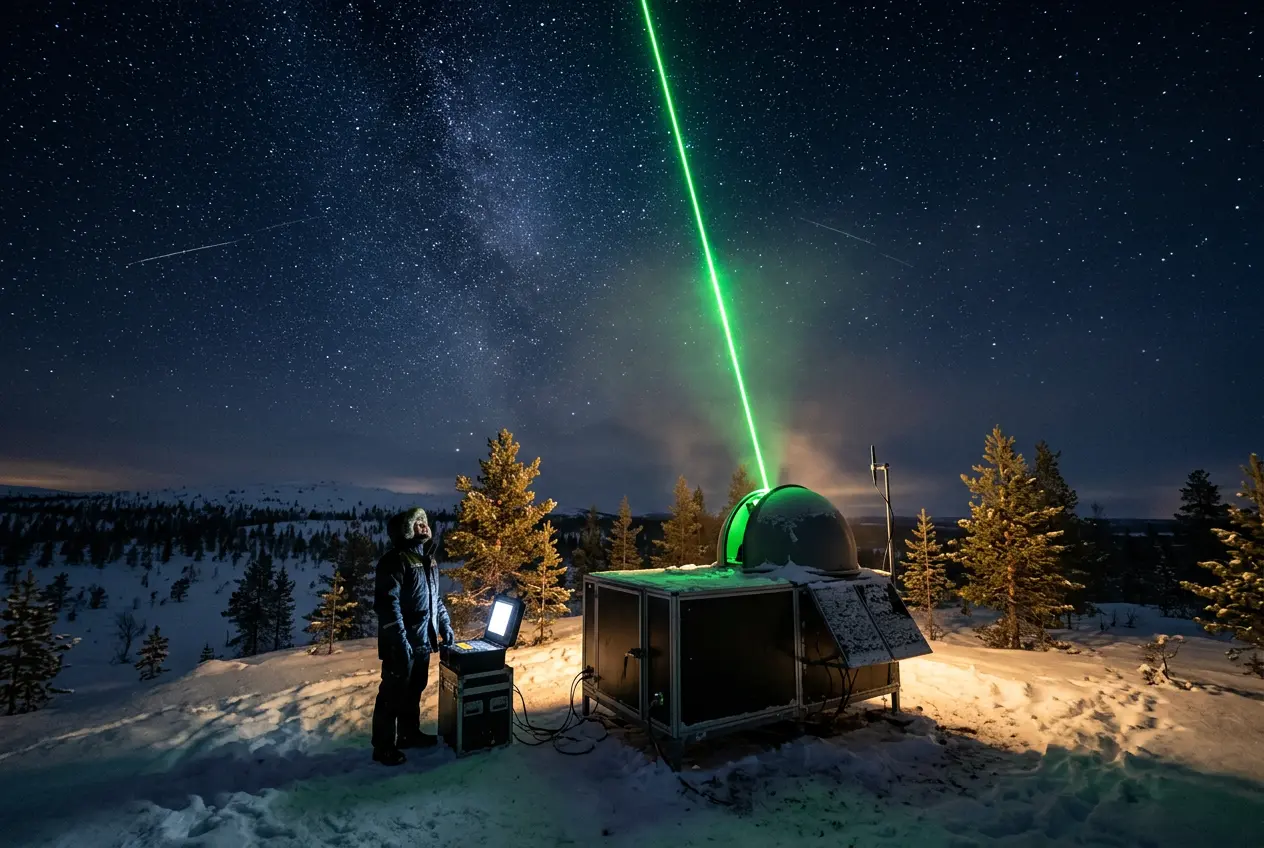
Aavuus is a spinout from the Finnish Geospatial Research Institute, the national research body that runs the country’s satellite laser ranging and space geodesy programmes. That lineage matters because laser ranging, the practice of bouncing a pulsed laser off a retroreflector on a satellite to measure its range to a few millimetres, is one of the few ground-based techniques that resolves small objects at long range. Most commercial tracking today relies on radar, which works well for large objects in lower orbits but loses sensitivity as the target shrinks or the orbit climbs. Aavuus is taking that institutional expertise and packaging it as a deployable commercial network.
The company’s own product description points to a modular ground architecture: stations that can be sited where the weather and airspace permit, using air-traffic-safe laser technology that simplifies the permitting process compared with systems that need to fly on orbit. The pitch to customers is precision: high positional accuracy on objects as small as 1 cm, plus analysis of their physical and material properties, delivered as a data feed rather than as a hardware sale. For a satellite operator weighing whether to burn fuel on an avoidance manoeuvre, the value of a sharper catalogue is the chance to skip the burn that is not needed, and to keep the assets that matter out of the path of the ones that can hurt them.
Maki.vc Backs the Bet on Ground-Based Sensing
The pre-seed round is led by Maki.vc, a Helsinki-based venture firm that invests in deep tech across the Nordics and Europe. Wilson Tukiainen of Maki.vc framed the case in unusually direct terms in the announcement.
The space economy is adding satellites faster than existing systems can keep up, and the gap between current tracking capabilities and what operators actually need is widening. The Aavuus team brings deep expertise in laser ranging and space geodesy to a problem that is becoming impossible to ignore. We believe they are building infrastructure that orbital safety will increasingly depend on.
That investment thesis lines up with the structure of the Finnish space cluster. Helsinki is already home to ICEYE, the synthetic aperture radar operator that has raised hundreds of millions in debt and equity to scale its own satellite constellation, and to a base of small suppliers feeding the European Space Agency’s programmes. Aavuus sits in the same talent pool, but on the ground-based sensing side of the value chain, a corner of the market where most of the publicly known commercial activity is concentrated in a handful of US-based players.
The $1.0 million round is small by launch-and-constellation standards, but consistent with a pre-seed for a company that has yet to ship a product. The capital buys time to build the first minimum viable product, prove performance against existing catalogues, and sign the early customers who will set the commercial reference for everyone who follows.
A Defence-Grade Commercial Hire
The same announcement carried a personnel move that signals where the company expects its first dollars to come from. Brian Dunne, a former US Army Aerospace Defence Officer, has joined Aavuus as Chief Commercial Officer. The company frames the hire as a response to growing demand from the defence sector, where space situational awareness has become a procurement priority in both the United States and Europe. Dunne appeared at the Nordic Space and Defence Summit in Stockholm in March 2026, speaking in a New Nordic Space case presentation session alongside companies working on optical communications, edge computing, and propulsion.
The defence angle is more than a go-to-market story. The hardware Aavuus plans to deploy, fixed laser ranging stations tied into a global data network, looks more like a security asset than a consumer product, and militaries are already the largest single buyers of orbital data. A commercial officer with operational military background is a fit for that customer, and a signal to the wider market that Aavuus intends to compete for those contracts on technical terms rather than on price alone.
Who Actually Buys This Data
Aavuus’s own website breaks the customer base into three groups, each with a different use case for a sharper debris catalogue.
| Customer segment | What Aavuus says it offers |
|---|---|
| Space launch providers | Precise, real-time debris awareness to optimise launch windows, reduce mission risk, and plan safer trajectories through congested orbits |
| Satellite operators | Actionable debris intelligence to protect assets, minimise downtime, and extend satellite lifespan |
| Space infrastructure insurers | Accurate third-party data to assess risk, price coverage, and resolve claims with confidence |
Launch providers need the data in the minutes before a flight, when a missed conjunction can scrub a mission. Operators need it continuously, in the form of a maintained catalogue that improves the quality of every manoeuvre decision. Insurers need it as an underwriting input and as evidence in the kind of loss event that becomes more common as the population in orbit grows. The three groups pay on different cadences and for different deliverables, and a supplier that can serve all three has a more durable revenue base than one that depends on a single buyer type.
The competitive field is small. US-based LeoLabs operates a global radar network that has signed contracts with the US Department of Defense and the Japan Air Self-Defense Force, and is the closest commercial analogue to Aavuus in scale. What Aavuus is betting on is that laser ranging can resolve smaller objects than radar can, in the size range that current systems leave dark, and that a ground-based network can be deployed at a cost that does not require a sovereign customer to underwrite it.
The Tracking Gap Is Already Costing Operators
For all the talk of mega-constellations and launch cadence, the operational reality in low-Earth orbit is a steady increase in the work needed to keep functioning satellites out of the way of debris they cannot see. ESA’s report describes the trend bluntly: conjunction events in busy low-Earth orbits are routine, and the number triggering avoidance procedures rises each year. Each avoided collision costs propellant, and propellant is the limiting factor on a satellite’s working life. A more complete catalogue does not just prevent rare catastrophes, it changes the economics of every satellite already in orbit.
This funding allows us to move from development work into execution. Our focus now is building the MVP, proving performance, and starting to work with customers who need better debris tracking data in real operations.
That quote, from Aavuus CEO Joonas Jokela, marks a deliberate narrowing of scope. The company is not promising a complete solution to orbital debris on the strength of a $1.0 million pre-seed. It is promising a working minimum viable product, a measurable improvement in catalogue quality, and a first set of customers who will use the data in production. The next eighteen months will determine whether the laser ranging approach can clear the bar that ESA’s own models imply, and whether the commercial model holds up against the cheaper, radar-based alternative. The rest of the space economy is unlikely to wait.
Frequently Asked Questions
What is Aavuus?
Aavuus is a Finnish space safety startup building a global network of ground-based laser stations to detect and track debris in low-Earth orbit, with a stated minimum detection size of 1 centimetre. The company is a spinout from the Finnish Geospatial Research Institute.
How much funding has Aavuus raised?
Aavuus raised a Pre-Seed round announced on June 9, 2026, led by Maki.vc. Public deal trackers put the total raised at $1.0 million.
Why is the 1 to 10 cm debris range such a hard problem?
Existing commercial radar systems are most reliable on objects above roughly 10 cm in low-Earth orbit, and optical systems catch some smaller pieces under good conditions. The 1 to 10 cm range sits below that reliable detection floor, but ESA’s 2025 Space Environment Report estimates that the population larger than 1 cm exceeds 1.2 million objects, and a fragment in that range can disable or destroy an active satellite on impact.
How does ground-based laser tracking differ from radar?
Laser ranging bounces a pulsed laser off a target and measures the return time to determine range, which can resolve smaller objects and yield more precise positional data than radar at long range. Aavuus describes a modular, ground-based architecture using air-traffic-safe laser technology, which the company says simplifies permitting and site selection compared with space-based sensors.
Who are Aavuus’s target customers?
The company lists three customer groups on its website: space launch providers, satellite operators, and space infrastructure insurers. Each uses the data on a different timeline, from minutes before launch to continuous catalogue maintenance to underwriting and claims work.


Replit Opens Its London Office Inside an AI Crowd

Straight Circle Trailer Lands Without a U.S. Date

Anemo Labs Bets £700,000 on an AI Sense of Smell

Nintendo Prices the Zelda 40th Switch 2 at $519

Copilot Capital Buys the Autopilot Already Running 90 GW

Ground A Raises €9.1 Million for a Pallet Laser

Gibney’s Musk Film Opens in Venice Without Its Subject

Torvalds Blames AI for a Full-Fat Linux 7.3-rc2

Dexter Returns Sharper, Older, and Stuck Between Killers

Meta’s Muse Agent Can Spend Before the Privacy Lock

Walter’s TWG Insists No Fraud as Insurer Probes Force Cleanup

30-Year Yield Hits 5.32% Highest Since 2007 as Debt Supply Locks In Costs

PCE Stays at 3.7% as Gas and Tariffs Outrun Coming Revisions

Evernorth S-4 Clears Path for Active XRP Treasury on Nasdaq

Astute’s $1.2M bet makes B2B creator deals feed AI discovery

Strategy Parks $1.59B Cash While Bitcoin Stack Stays Flat

Instinct Hits $2.5 Billion as AI Agent Access Sparks Trust Fights

CLARITY Act Cloture Opens a Door Ethics Still Blocks

Oracle’s 2.8 GW Bloom Deal Exposes the AI Power Bypass

Space Mirror Demo Revives 1993 Russian Night-Light Test
-
 FINANCE3 months ago
Zcash Patched a Double-Spend Bug as ZEC Climbed 5%
-
 ENTERTAINMENT3 months ago
Steam Summer Sale 2026 Locks In June 25 to July 9 Dates
-

 FINANCE2 months ago
CLARITY Act Final Text Expected This Weekend as 60-Vote Hurdle Looms
-
 NEWS4 months ago
Meta Adds AI Replies to Threads, But Users Can’t Block It
-
 ENTERTAINMENT5 months ago
Extraction 3 Is Officially Coming to Netflix in 2027
-

 NEWS3 months ago
YouTube Shorts is testing a heart in place of the thumbs-up
-

 NEWS1 month ago
Senators Force Apple Off Chinese Memory as Big Three Cash In
-

 NEWS3 months ago
NEURA Robotics’ $1.4B Series C Redraws Europe’s Physical AI Bet