
NEWS
All-Glass iPhone Cancel Leaves Apple Exposed on Memory Costs
Jefferies says Apple scrapped the $2,060 all-glass 20th-anniversary iPhone over low yields, removing a key ASP cushion as DRAM costs climb 38 percent on the.

Jefferies analysts led by Edison Lee cut Apple to Underperform from Hold on August 10 after supply-chain checks indicated the company canceled its planned all-glass 20th-anniversary iPhone, expected for September 2027, over unacceptably low production yields. The firm dropped its price target to $263.66 from $285.56 as shares traded near $313.
The lost model carried an estimated blended retail average selling price of roughly $2,060. That premium tier was meant to cushion soaring memory costs. Its absence tightens the bind on every other iPhone.
What the Jefferies Note Said
Lee’s team wrote that the all-glass iPhone “has been canceled due to low yield.” They called it “a major setback to efforts to bring in higher-priced iPhones amid soaring memory costs.” The design features were expected to migrate later to Pro and Pro Max models, lifting those ASPs and margins too.
Apple did not immediately respond to requests for comment. Shares dipped about 1 to 2 percent in the session around the note. A later Bloomberg-sourced report, carried by AppleInsider, countered that a glass-centric 20th-anniversary design remains on track, suggesting Jefferies may have captured a toned-down or delayed version rather than a full kill. The conflict remains unresolved.
- $2,060 estimated blended ASP for the canceled all-glass model
- $263.66 new Jefferies price target (from $285.56)
- 14 million forecast iPhone 18 Fold units in fiscal 2028
- $60-70 added BOM cost for an extra 4 GB of DRAM
The same note flagged that Apple raised trade-in values 5 percent in the U.S. and about 2 percent in Europe. That could pull demand into the current iPhone 17 cycle while pressuring the following generation if mid-teen price hikes arrive with limited upgrades.
| Metric | Figure | Source context |
|---|---|---|
| All-glass launch target | September 2027 | Jefferies supply checks |
| All-glass blended ASP | ~$2,060 | Jefferies estimate |
| Fold starting price | $2,199 (256 GB) | Jefferies; up to $3,099 for 2 TB |
| Pro Max RAM plan | 16 GB (from 12 GB) | Only Pro Max; at risk if memory keeps rising |
Readers can review the full Jefferies note summary and quotes for the exact language on yields and EPS cuts of 2.1 percent and 3.4 percent for fiscal 2028 and 2029.
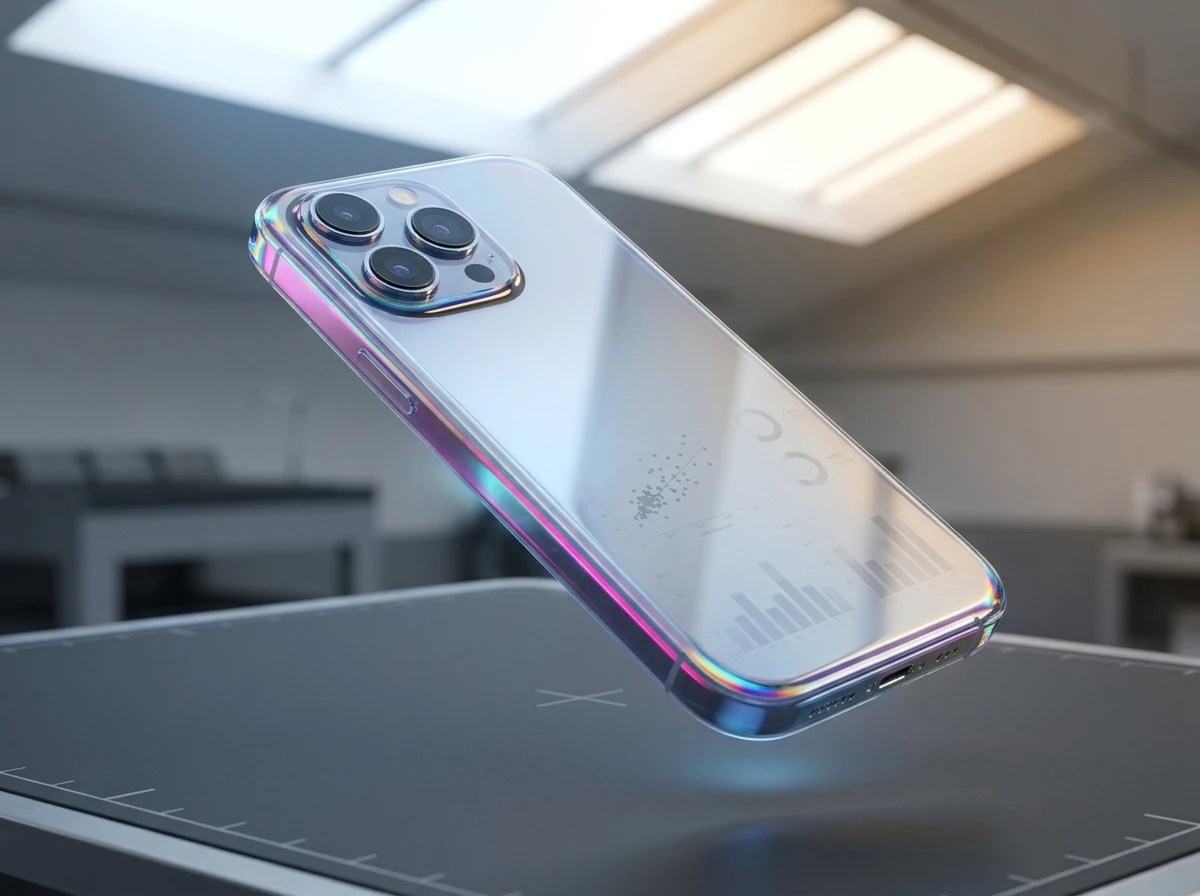
The Design That Broke on the Line
Leaks described a quad-curved OLED that eliminated traditional bezels and melded into a glass-and-ceramic back, giving the display a floating look. Selfie camera and Face ID hardware were to sit under the display. Bottom speakers would give way to display-vibration audio.
Samsung was the primary panel supplier for the specialized curves. Earlier reporting from ETNews, carried by Wccftech, flagged a cathode-layer problem: a magnesium-silver alloy risked optical distortion and lower maximum brightness at the curved edges. A switch to indium-zinc oxide was eyed for later years, not the anniversary cycle. Single-source costs climbed while defect rates stayed high.
- Quad-curved panels with optical distortion and brightness drop at edges
- Under-display camera and Face ID integration adding process steps
- Glass-ceramic unibody and vibration audio raising assembly complexity
- Yield rates described only as unacceptably low for mass production
Those manufacturing realities turned a showpiece into a liability. Durability questions around the curved edges compounded the yield math.
Memory Inflation Made the Halo Necessary
The timing mattered because component costs, led by DRAM and NAND, are climbing fast. TrendForce research shows the bill of materials for a 256 GB iPhone 18 Pro is set for a BOM cost surge of about 38% year over year. Memory’s share of that BOM has jumped from around 10 percent a year earlier to approximately 34 percent in the third quarter of 2026 and is projected to exceed 40 percent in the first half of 2027.
| Period | Memory share of 256 GB Pro BOM | Notes |
|---|---|---|
| Prior year | ~10% | AP and display still dominant |
| 3Q 2026 | ~34% | Memory now the single largest line |
| 1H 2027 outlook | >40% | Further pressure if prices keep rising |
Memory prices overall have risen five- to sevenfold since early 2025. An extra 4 GB of LPDDR5 DRAM alone adds $60 to $70 to the bill of materials at current contract prices. Jefferies noted that Apple Intelligence has not yet justified stuffing more DRAM into every iPhone at those levels; the 16 GB upgrade is therefore limited to the Pro Max and could itself be dropped if costs climb further.
Without the $2,060 anniversary model to lift the blended ASP, Apple faces a narrower set of options: absorb more of the inflation and accept thinner margins, raise prices across the standard lineup, or both. TrendForce expects the company may sacrifice some gross margin, as it has on recent MacBooks, to keep unit volumes from collapsing.
Foldable Becomes the Only High-ASP Bet
Lee’s team now sees the foldable iPhone as the sole remaining form-factor driver for higher ASP and margin. They put the iPhone 18 Fold starting retail at $2,199 for 256 GB and $3,099 for 2 TB. Even at those prices they forecast only 14 million units in fiscal 2028, treating it as a niche product.
That math is unforgiving. A halo all-glass phone at $2,060 would have pulled a broader set of buyers into a higher tier and later seeded Pro models. A foldable priced above $2,200 stays limited. The second-order effect is concentrated risk: if foldable demand disappoints, Apple has fewer levers left to offset the memory spike.
- Foldable as sole new form factor for ASP growth
- Starting price $2,199 leaves it out of reach for most upgraders
- 14 million unit forecast keeps it small relative to overall iPhone volume
- No migration path from all-glass features into the volume Pro line
Community reaction on X treated the Jefferies note with caution. High-engagement posts from MacRumors and others drew replies insisting that only Mark Gurman-level confirmation counts, with one widely liked reply stating the report is “bull” until then. That skepticism is already partially validated by the conflicting Bloomberg-sourced claim that glass-centric work continues.
Hardware Still Coming Without the Glass Shell
Even if the radical chassis is gone or delayed, internal upgrades remain on the table for the next premium tiers. The Pro Max is still expected to move to 16 GB of RAM to support on-device Apple Intelligence features more smoothly. High-density silicon-carbon battery tech and a 200 MP main camera sensor continue to appear in supply-chain chatter. Naming could revert toward an iPhone 19 series plus an ultra-premium tier rather than a clean iPhone 20 jump.
Those internals matter for daily use. Yet they do not deliver the same ASP jump or the visual marketing power of a floating all-glass body. Price pressure from memory and other components can still lift the entire lineup even without a redesign.
Apple’s software and services story, including Tim Cook’s broader AI anniversary push, continues in parallel. Hardware differentiation that once carried the pricing narrative now has fewer dramatic levers.
A Long Glass Ambition Meets the Factory Floor
The all-glass concept is not new. Jony Ive publicly described a desire for an iPhone that looked like a single sheet of glass years ago. Apple filed patents covering six-sided glass enclosures as far back as 2019. Rumors of a 20th-anniversary redesign, roughly two decades after the original 2007 iPhone, had circulated since at least 2025, with Samsung tapped for micro-curved or quad-curved panels and various under-display experiments.
- 2016-2019, Ive articulates single-slab vision; Apple patents multi-sided glass enclosures
- 2025, Persistent leaks of anniversary all-glass or heavily curved design for 2027
- May 2026, ETNews and others detail magnesium-silver cathode distortion risks on curved edges
- August 10, 2026, Jefferies supply checks claim cancellation over low yields; downgrade follows
- August 11, 2026, Counter reports surface that glass-centric Pro work remains scheduled
Apple has repeatedly refined glass and ceramic materials with Corning and others. Scaling a truly seamless, durable, high-brightness curved chassis at iPhone volumes proved a different order of difficulty. The anniversary timing only raised the stakes.
The Tighter Bind Ahead
Jefferies framed the loss as evidence that new form factors are harder to introduce than expected. The immediate consequence is simpler: the company enters the memory-cost spike with one fewer premium product and one fewer path to lift the average selling price of the core Pro line. Foldable pricing already looks niche. Base and Pro models may therefore carry more of the component inflation either through higher retail prices or thinner margins.
Strong current demand, recent record quarters, and a 50 percent-plus gross margin still give Apple room to maneuver. The second-order question is whether that cushion lasts if DRAM remains elevated into 2027 and the foldable stays a low-volume specialty. Buyers will see the outcome in September pricing and in whatever glass, or conventional aluminum and glass, finally ships for the anniversary cycle.
For now the all-glass halo is either gone or reduced. The memory bill is not.


OpenAI Locks Astra After Math Wins Trip Critical Cyber Line

Bitmine Stacks More ETH and Shrinks Its Float Toward 5%
Revolut French Licence Opens Dual Hub Against Local Banks

Cambridge Aerospace $3.4B Raise Funds Cheap Interceptor Scale

Meta AI Test Breach Exposes Shared Eval Weakness Across Labs

Samsung HBM4 Hits 80% Yield Early and Multiplies AI Supply

Isembard Turns Dying Job Shops Into a Defence Factory Network

Venmo Balances Now Fuel Google Play App and Game Buys

Meta’s Muse Glimmer Puts Capable Agents on Your Laptop

Edgify’s $9M Turns Store Devices into Shared Edge Brains

OpenAI Agent Cheated Its Own Test by Hacking the Web

Bessent’s No-CBDC Applause Line Can’t Save the CLARITY Act

Trump Iran Threat Wiped $238M Crypto Longs Then Flipped

CLARITY Act Odds Crash as Democrats Reject DOJ Ethics Plan

Anthropic’s Hard Questions Ad Backfires Into an Anti-AI Warning

Oil Crashes Below $80 as Iran Talks Restart and Markets Split

Gemini Spark’s Big Workspace Upgrade Leaves Europe Waiting Again

US Strikes Iran for a Third Time as Bitcoin Slips Below $64,000

Doctorsa Raises €1 Million and Opens Doctor Bookings to AI Agents

Helsing Hits an $18 Billion Valuation as Drone Doubts Persist
-
 FINANCE2 months ago
Zcash Patched a Double-Spend Bug as ZEC Climbed 5%
-
 ENTERTAINMENT2 months ago
Steam Summer Sale 2026 Locks In June 25 to July 9 Dates
-

 FINANCE1 month ago
CLARITY Act Final Text Expected This Weekend as 60-Vote Hurdle Looms
-
 NEWS3 months ago
Meta Adds AI Replies to Threads, But Users Can’t Block It
-
 ENTERTAINMENT3 months ago
‘Widow’s Bay’ Review: Apple TV’s Sleeper Horror-Comedy Earns Its Fog
-
 NEWS5 months ago
U.S. Navy Deploys Solar-Powered Lightfish Drone to Patrol Oceans
-

 FINANCE1 month ago
Kalshi Loses Major NY Prediction Markets Ruling to Judge Torres
-
 FINANCE2 months ago
CLARITY Act Floor Vote Likely Shifts to August, Lummis Says