
NEWS
Exynos 2600 Beats Liquid-Nitrogen Snapdragon With Copper Cooling

Samsung’s Exynos 2600 held its clock speeds under sustained load while a Snapdragon 8 Elite Gen 5 chilled with liquid nitrogen could not, and the difference came down to a slab of copper baked into the chip package rather than any exotic cooling rig. The passively cooled 2nm part posted a Geekbench 6 multi-core score of 10,444, edging the Snapdragon’s 10,207 on the test most people quote.
That viral framing, cryogenics beaten by a heatsink, undersells what the result signals. Samsung now owns a packaging trick its foundry can license to the same rivals it just outscored, and most Galaxy S26 buyers will never touch the chip that proved it works.
Why a Cryogenic Benchmark Lost to a Copper Block
Liquid nitrogen sits at roughly minus 196 degrees Celsius, and it is the tool overclockers reach for when they want a single peak number in a lab. It crushes temperature for a few seconds so a chip can sprint at its highest clock. What it cannot do is keep a smartphone stable through a 40-minute gaming session or a long 8K video export, because the cold never reaches the part of the stack that matters once the silicon is already hot and pulling its speed back.
That is the gap the Heat Pass Block (HPB, a copper heat-spreading layer built into the chip package) was designed to close. Instead of fighting heat after it spreads through the phone body, the block lifts it off the die first. The viral test came from hardware reviewer Geekerwan, whose comparison found the cooled Snapdragon 8 Elite Gen 5 still could not hold its single-core clocks while the cooler-running Samsung part stayed level.
The numbers underneath the story carry more weight than the spectacle does.
- 10,444 Geekbench 6 multi-core for the Exynos 2600, against 10,207 for the Snapdragon
- 16 percent improvement in thermal resistance from the new packaging, per the Exynos 2600 official specification sheet
- 2nm gate-all-around process, the first time a smartphone chip has shipped on that node
- Minus 196 degrees of cryogenic cooling, beaten on sustained load by a passive copper layer
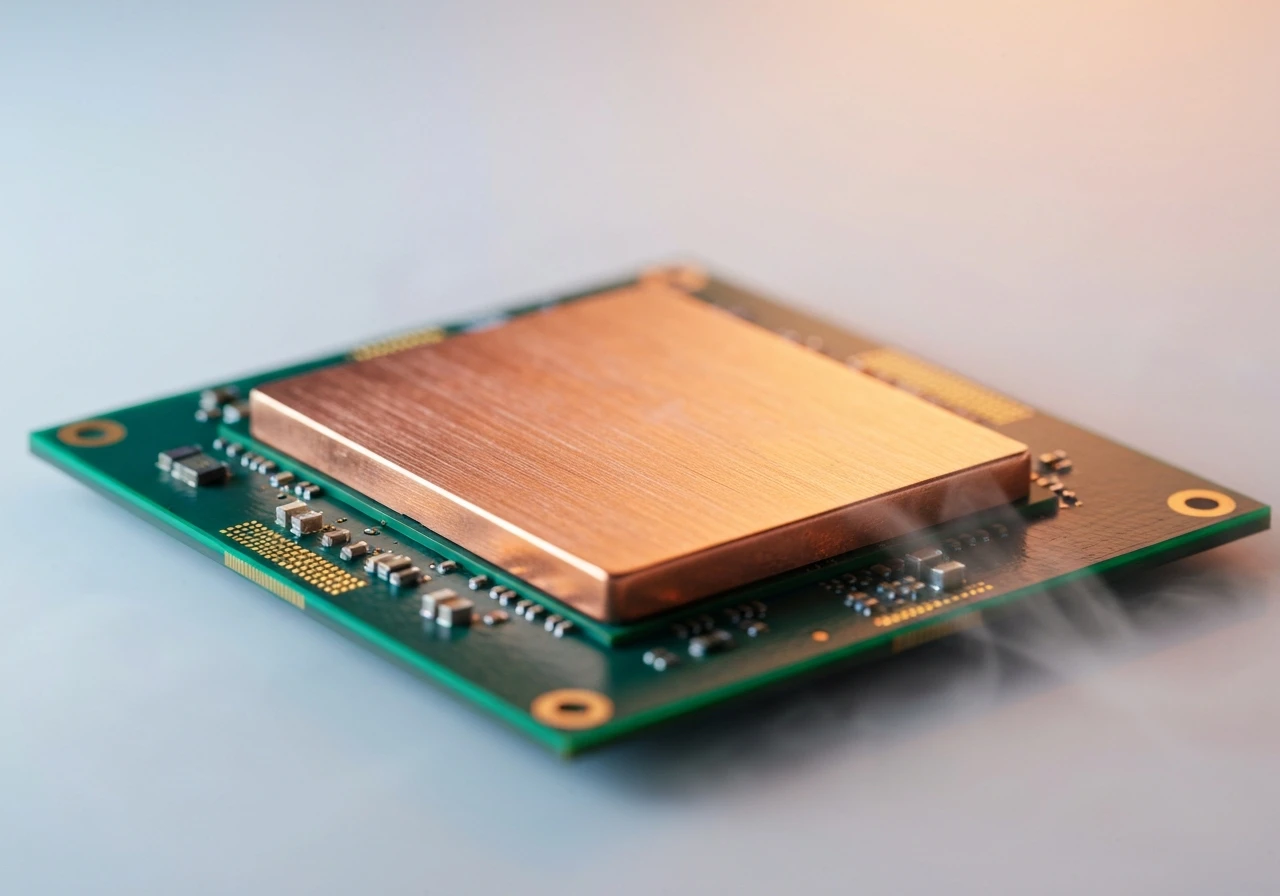
How the Heat Pass Block Reworks the Silicon Stack
Most flagships handle heat with a vapor chamber and thermal paste pressed against the outside of the chip package. Heat has to crawl out through several layers before any cooling solution can carry it away, and by the time it reaches the chamber, the cores have often already dialed back their speed to protect themselves.
Samsung moved the intervention point. The copper block sits directly on top of the processor die and shortens the path heat travels before it gets dissipated, helped by a high-conductivity epoxy molding compound (EMC, the resin that encases the chip) tuned for heat flow. The design also pushes the DRAM (dynamic random-access memory) module out beside the processor instead of stacking it on top, which spreads the hot spots out. According to Samsung’s figures, that combination cuts thermal resistance by up to 16 percent versus the prior generation, the number that turns into steadier clocks when a workload runs long.
It also changes what a node lead actually buys. Samsung reached 2nm first, ahead of the Qualcomm part built on a 3nm line, yet the more visible win came from packaging rather than transistors. When two flagship chips, both leaning on Arm’s Armv9.3 CPU core designs in Samsung’s case, separate on how fast each sheds heat, the foundry with the better thermal recipe holds a lever the process node alone does not provide.
Geekbench Tells a Split Story
The benchmark picture is genuinely mixed, and pretending otherwise does the reader no favors. Samsung’s 10-core layout takes multi-core by a slim 2.3 percent, while Qualcomm’s custom cores, clocked far higher, win single-core by roughly 15.6 percent, the test that maps most closely to app launches and everyday taps. Here is how the two chips line up on the figures that matter, with the scores drawn from public Geekbench 6 benchmark runs.
| Spec | Exynos 2600 | Snapdragon 8 Elite Gen 5 |
|---|---|---|
| Process node | 2nm GAA (Samsung) | 3nm (TSMC) |
| CPU layout | 10-core (1+3+6) | 8-core (2+6) |
| Peak clock | 3.8 GHz | 4.61 GHz |
| Geekbench 6 single-core | 3,105 | 3,588 |
| Geekbench 6 multi-core | 10,444 | 10,207 |
| Galaxy S26 regions | Europe, Korea, India | US, Canada, China, Japan |
So Qualcomm still has the faster individual core, Samsung has more of them, and the gap is small enough that behavior over time, not a one-shot score, decides the real-world winner.
Cooling Becomes the Battleground Rivals Want In On
This is where the story stops being a Samsung bragging point and turns into an industry shift. If a packaging trick can offset a higher clock and a node lead, every chipmaker wants it, and Samsung happens to be the one selling it. The company runs a foundry, so the same cooling layer it built for its own silicon can be offered to outside customers through Samsung Foundry’s advanced packaging services.
The early signals point one way. Reporting on Qualcomm’s next-generation roadmap suggests its first 2nm part could adopt a similar packaged-cooling approach, and MediaTek has been named as another likely taker. We covered the wider scramble when Android rivals began circling Samsung’s chip-cooling layer, and the pattern has held since.
- Leaked schematics for Qualcomm’s first 2nm flagship reportedly show an HPB-style cooling layer
- MediaTek is cited as a probable adopter, widening the market beyond Samsung’s own phones
- The first non-Samsung chips using the technique are expected in the second half of 2026
That timing is the tell. A proprietary fix competitors are lining up to license inside a year is not a one-off marketing stunt. It behaves like a component, and components get sold.
The Catch Most Buyers Will Never Feel
Now the part the headline conveniently skips. The thermal advantage only exists in the phones that carry this chip, and the map is narrow. Samsung put the Exynos in the base Galaxy S26 and S26+ across Europe, South Korea and India, while buyers in the United States, Canada, China and Japan get the Snapdragon version instead.
The split goes further at the top of the range. The Galaxy S26 Ultra, the model most enthusiasts actually buy, ships with Snapdragon globally, including in the regions that get Samsung’s silicon lower down the lineup. So the phone best positioned to show off a sustained-performance edge is the one Samsung chose not to build around its own chip, and the cooling story making headlines is not available in any Galaxy S26 sold in the United States.
The same processor is expected to spread across Samsung’s wider hardware, including the next Galaxy Z Flip foldable’s rumored 2nm chip, which keeps the technology in play for buyers outside the Snapdragon regions. It leaves Samsung with an odd situation: a real engineering win it cannot show to a large slice of its biggest market, and a flagship Ultra running the chip it just outscored.
The Exynos 2700 Aims Cooling at the Memory
Samsung is not treating the copper block as the finish line. The roadmap points toward a side-by-side packaging design for the Exynos 2700 that would cool not just the processor but the memory sitting beside it, a harder problem as on-device artificial intelligence pushes more work through the chip.
That direction feeds a bigger bet. Samsung has floated a plan to bring high-bandwidth memory into a phone chip, and our look at how the Exynos 2800 could be the first smartphone processor with stacked HBM lays out why that matters. Stacked memory runs hot, and high-bandwidth memory (HBM, dense layers of DRAM stacked vertically for huge data throughput) runs hotter still.
The cooling work happening now is the groundwork for silicon that would be impossible to keep stable otherwise. If a copper block already beat liquid nitrogen on sustained load, the open question is whether packaging can keep pace with the heat AI workloads are about to dump onto a phone.
If it can, the next two Exynos generations turn a benchmark curiosity into a platform; if it cannot, the same trick that wins headlines today becomes the bottleneck that caps what an on-device model can do.
Frequently Asked Questions
Which Galaxy S26 Models Use the Exynos 2600?
The base Galaxy S26 and S26+ use the Exynos 2600 in Europe, South Korea, India and most of the world outside North America. The United States, Canada, China and Japan get Snapdragon versions of those models, and the Galaxy S26 Ultra ships with Snapdragon in every market.
What Is Samsung’s Heat Pass Block?
Heat Pass Block is a copper heat-spreading layer built directly onto the chip package, sitting on top of the processor die. It shortens the path heat travels before it is dissipated, which keeps clock speeds steadier under long workloads. Samsung says it improves thermal resistance by up to 16 percent versus the prior generation.
Did the Exynos 2600 Really Beat a Liquid-Nitrogen-Cooled Snapdragon?
In reported sustained-load testing, yes. Liquid nitrogen produces high peak scores for short bursts but does not stop a chip from throttling over a long session. The passively cooled Exynos held its clocks while the cryogenically cooled Snapdragon 8 Elite Gen 5 could not maintain its single-core speed.
Is the Exynos 2600 Faster Than the Snapdragon 8 Elite Gen 5?
It depends on the test. The Exynos wins Geekbench 6 multi-core by about 2.3 percent (10,444 to 10,207). The Snapdragon wins single-core by roughly 15.6 percent (3,588 to 3,105), thanks to its higher 4.61 GHz peak clock. Real-world results often come down to which chip holds its speed longer under heat.
Will Other Chipmakers Use the Same Cooling Technology?
Reports indicate Qualcomm’s first 2nm flagship and MediaTek are likely to adopt HPB-style cooling, supplied through Samsung Foundry, with the first non-Samsung phones using it expected in the second half of 2026.


Galaxy Ring’s FDA Sleep Apnea Clearance Faces a Familiar Wait

kausable’s €12 Million Seed Joins a Quiet Bet Against AI Scaling

Bitcoin ETFs Shed $225 Million as Treasury’s Biggest Buyers Retreat

telli Raises $15 Million Seed to Rival Billion-Dollar AI Giants

PageMind Raises €1.2 Million to Crack AI Shopping Search

Hackers Hijack Robinhood CEO’s X to Push Fake Memecoin

Apple’s Trade Secrets Suit Against OpenAI Is Europe’s Problem Too

Adobe’s Patch Leaves WhatsApp’s Own Security Gap Untouched

Reddit and Publishers Weigh Blocking Google Over AI Traffic Losses

CuspAI’s $2.6 Billion Bet Echoes AI Drug Discovery’s Playbook

CLARITY Act Final Text Expected This Weekend as 60-Vote Hurdle Looms

Fed Minutes Cite AI Demand as Inflation Risk, Put a 2026 Hike Back on the Map

Kalshi Loses Major NY Prediction Markets Ruling to Judge Torres

Marker AI Writing Startup Lands $13M Seed Led by Index Ventures

Dota 2 Esports World Cup 2026: Spirit Defends $2M Title In Paris

Meta’s Muse Spark 1.1 Beats Rivals on Price, Trails on Coding

CS2 Premier Season 5 Lands With Cache and a C4 Damage Rework

Trump Calls Iran ‘Islamic Republic of Japan’ as Ceasefire Ends

ARC Intelligence Closes €4M Seed Round in Roughly a Week

Finto Picks Munich Over Silicon Valley After YC, Raises $3.4M
-
 FINANCE2 months ago
Zcash Patched a Double-Spend Bug as ZEC Climbed 5%
-
 ENTERTAINMENT2 months ago
Steam Summer Sale 2026 Locks In June 25 to July 9 Dates
-
 NEWS2 months ago
Meta Adds AI Replies to Threads, But Users Can’t Block It
-
 FINANCE3 weeks ago
CLARITY Act Final Text Expected This Weekend as 60-Vote Hurdle Looms
-
 ENTERTAINMENT2 months ago
‘Widow’s Bay’ Review: Apple TV’s Sleeper Horror-Comedy Earns Its Fog
-
 NEWS7 months ago
FolderFresh Review: This Free Tool Automates Windows File Organizing
-
 NEWS4 months ago
U.S. Navy Deploys Solar-Powered Lightfish Drone to Patrol Oceans
-
 FINANCE2 weeks ago
Fed Minutes Cite AI Demand as Inflation Risk, Put a 2026 Hike Back on the Map