
NEWS
INLEAP Photonics Places a Factory Bet on Laser Defences
INLEAP Photonics lifted total funding to about €20 million so it can series-build eye-safe laser drone defences, not another high-power lab turret.

INLEAP Photonics closed a UVC Partners-led seed round that lifts total capital to about €20 million for laser counter-drone production. The Hanover company will put the new money into manufacturing, testing, quality checks, sales, and service.
Chief executive Dr.-Ing. Marius Lammers said the technology has reached the market and that order intake is strong. He would not break out how much of the €20 million is new cash, nor revenue or a valuation.
A Seed Round That Lifts Total Capital to €20 Million
An HTGF note on the close is careful with the figure. The firm said INLEAP had secured approximately €20 million in total after a seed led by UVC Partners, with HTGF, Poland’s Balnord, Estonia’s Sentris, and Denmark’s Scale Capital also in the round.
That is not the same as a fresh €20 million cheque. Lammers has said the company collected €20 million in all since it was founded about three years ago. The latest round still changes the job. The money is meant to move FASTLIGHT SHIELD from first customer projects into identical, certifiable units.
THE ROUND IN FIGURES
- Total capital: About €20 million after the UVC-led seed, on top of earlier HTGF money.
- Intercept time: The company and STARK say the laser can stop a drone in under one second.
- Steering claim: INLEAP’s product pages say the beam can be steered up to 2,500 times faster than conventional systems.
- Fielding date: The unmanned-ground version is slated for trials in the third quarter of 2026 and deliveries from 2027.
Lammers said the firm will now invest in manufacturing, quality assurance, sales, and service so it can deliver at greater scale. He also said INLEAP intends to become a leading European provider of laser effectors. Those are production words. They are not lab words.
The Beam Steers Faster Than Conventional Turrets
INLEAP is a 2023 spin-off from Laser Zentrum Hannover. Co-founders Lammers and Dr.-Ing. Felix Wellmann, the chief technology officer, built FASTLIGHT as an industrial steering stack for jobs such as additive manufacturing and battery-cell work. The defence product, FASTLIGHT SHIELD, puts that steering on a laser effector and aims at identified weak points on a drone rather than pouring energy across the whole airframe.
That architecture is the wager. High-energy laser programmes in Israel, the United Kingdom, Australia, and at German primes chase 50 kW to 100 kW class beams and site-sized power plants. INLEAP says it can use commercially available industrial laser sources, stay mobile, and still hit a small airframe fast enough for urban and civilian sites. In February it presented an eye-safe laser drone defence system as it came out of stealth.
WHAT THE EFFECTOR IS BUILT TO DO
- Speed: Wellmann said industrial steering lets the prototype intercept agile targets within milliseconds, a claim the Bundeswehr is still testing in the field.
- Safety pitch: The company markets SHIELD as eye-safe and usable around people, airports, and other sensitive sites, which is the civilian half of the dual-use story.
- Fit: Product pages describe retrofit-ready integration and compatibility with standard industrial laser sources, so INLEAP is selling a steering and control stack more than a giant custom beam.
The same industrial-to-product path is visible among European photonics scaleups building optical hardware for new markets. INLEAP’s twist is to point that hardware at small unmanned aircraft instead of at chips, cars, or factory lines.
Why Polish and Baltic Funds Joined the Round
UVC Partners led. Amanda Birkenholz, a partner at the firm, framed the cheque around dual use, not around a single ministry contract.
Drone defence is no longer a purely military issue. Airports, energy facilities and data centres require the same level of protection as defence installations. INLEAP Photonics is the only team whose technology meets the requirements of both environments: eye-safe for civilian use and robust enough for deployment in conflict zones. For us, this dual-use capability is the key lever for scaling.
Amanda Birkenholz, Partner, UVC Partners
The rest of the cap table is a map. Balnord is a Polish fund. Sentris is Estonian. Scale Capital is Danish. HTGF, the German public-private early-stage house, is following on after it led the first cheque. Company materials say Balnord’s investment is a first step into Poland, the Nordics, and the Baltics, where demand for sovereign drone defence is rising fastest.
WHO PUT MONEY IN
| Investor | Country | Role in the cap table |
|---|---|---|
| UVC Partners | Germany | Lead on the seed |
| HTGF | Germany | Pre-seed lead, then seed follow-on |
| Balnord | Poland | New seed investor, Baltic-Nordic wedge |
| Sentris | Estonia | New seed investor |
| Scale Capital | Denmark | New seed investor |
| Ventis Capital | Germany | Pre-seed, not named on the seed |
Poland is already shopping. The Armament Agency opened market talks on a laser directed-energy weapon, LSBSE, in two classes with minimum ranges of 1 km and 3 km. It asked for prices on 150 sets of each class, which is 300 units if both lots were ever bought, plus ten years of running costs. Twenty firms registered. That process is not a contract for INLEAP. It is the kind of eastern-flank demand that makes a Polish fund a logical name on a German laser cap table.
The HTGF note also tied the round to a drone attack at Leipzig/Halle Airport. Lammers has said the company could have prevented that incident. He has not published a forensic reconstruction, and the system is still in military trials, so that line sits as a founder’s claim, not as a closed case.
Laserdome, a Ground Robot, and a Navy Boat
The 2026 calendar is denser than the seed headline. In April, INLEAP and the Bundeswehr Cyber Innovation Hub began Laserdome, a six-month test of FASTLIGHT SHIELD on training grounds, with soldiers in the loop. Robert Hoffmann, the Hub’s project lead, said the work is about mobile lasers to protect high-value assets. Reporting around the programme has linked that need to sites such as Arrow 3 batteries, though the Hub has not named the targets in public.
On 23 April, at Hannover Messe, INLEAP and STARK announced a long-term pact to put FASTLIGHT SHIELD into STARK unmanned systems, including the Vanta unmanned surface vessel family. Lower Saxony minister-president Olaf Lies stood with them. Jan-Patrick Helmsen, STARK’s chief sales officer, said new tools have to drop into existing systems and existing tactics, not sit on a stand.
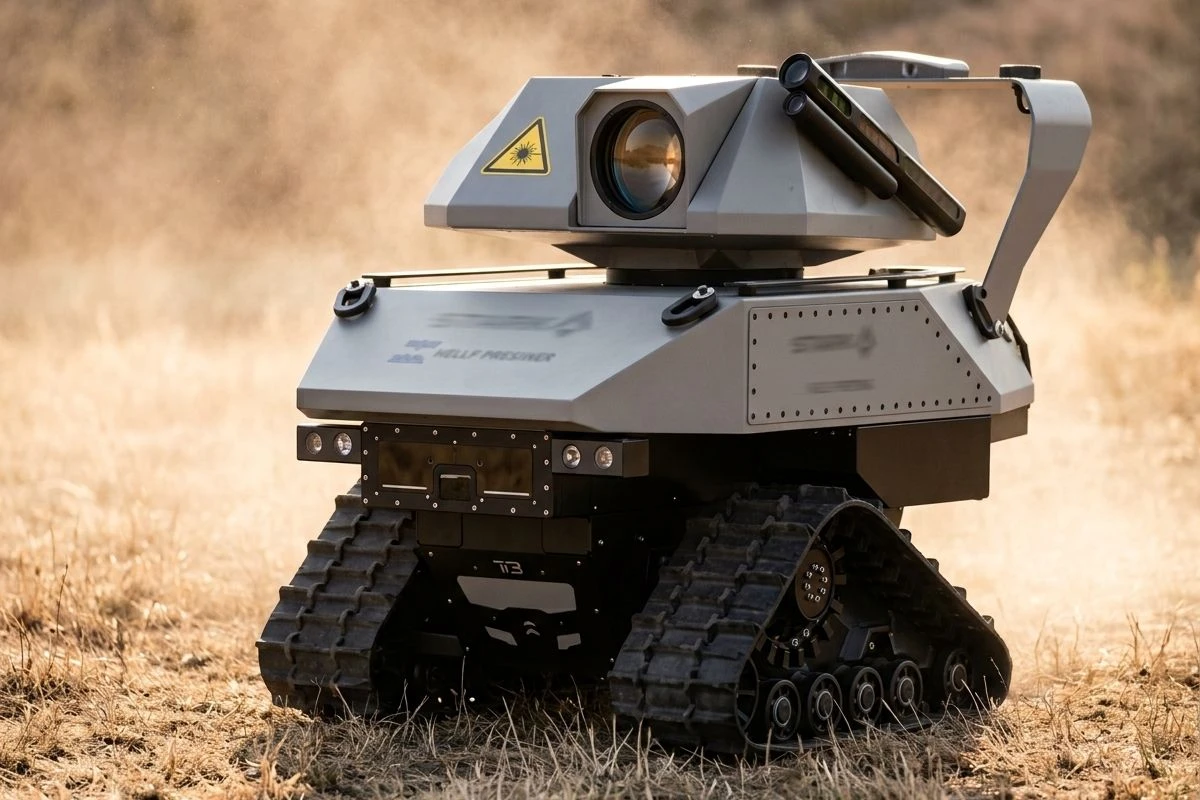
On 12 May, at Erding Air Base, INLEAP showed a laser effector on an unmanned ground vehicle for the first time. The hull came from Hentschel System. The C-UAS software came from STARK. The pitch was NATO UAS Class I and II, no ammunition, under one second. Lieutenant General Christian Freuding, inspector of the German Army, and Rear Admiral Christian Bock, head of the Bundeswehr Drone Innovation Centre, were in the room. INLEAP said that mobile kit should be ready for national and collective-defence trials in the third quarter of 2026, which is now, and ready for delivery from 2027.
THE 2026 FIELD PATH
- Summer 2025: Completes an HTGF-led pre-seed and keeps the defence product in stealth.
- 11 February 2026: Comes out of stealth as a defence-tech company and shows FASTLIGHT SHIELD.
- April 2026: Starts the six-month Laserdome trial with the Cyber Innovation Hub.
- 23 April 2026: Signs the STARK partnership at Hannover Messe, including the Vanta boat family.
- 12 May 2026: Shows the Hentschel-mounted ground robot at Erding Air Base.
- 23 June 2026: Leads a BMVg study on short-term laser emissions under the Federal Immission Control Act.
- 1 September 2026: Closes the UVC-led seed that takes total capital to about €20 million.
An August clip treated the effector as already bound for Mykolaiv this year and for Hannover airport next year. The public file does not back those destinations. Laserdome is a trial. The ground robot is a first integration. Delivery from 2027 is a company date, not a verified combat tour.
WHAT WE KNOW
- Trials: FASTLIGHT SHIELD is in a six-month Bundeswehr field series that began in April 2026.
- Partners: STARK is integrating the effector on unmanned platforms; Hentschel supplies the ground hull shown at Erding.
- Ministry work: INLEAP is leading a BMVg legal-and-safety study on laser use on Bundeswehr sites.
WHAT IS UNCONFIRMED
- Order book: Lammers cites strong intake and does not publish unit counts or contract values.
- Combat use: Claims of a 2026 Mykolaiv deployment and a Hannover airport install are not in company or ministry notices.
- New-money split: The €20 million figure is total capital; the exact size of the UVC cheque is undisclosed.
The legal work is part of the same factory bet. A laser that can run near troops, runways, and towns has to clear German immission rules, not only a range demo. That is why the ministry study sits on the calendar beside the fundraising.
Cheap Drones Still Beat Most Missiles on Price
The economic case for any laser effector is ugly arithmetic on the other side of the shot. Makers of high-energy lasers quote electricity costs of $1 to $10 per engagement. The International Institute for Strategic Studies has put typical short-range air-defence missiles above $100,000 each. Dr Andreas Schwer, chief executive of Electro Optic Systems, has said a 100 kW class system can cost about EUR 40-50 million, or under EUR 30 million in quantity, and that his firm’s kit can take 20 drones a minute once it is installed.
INTERCEPT COST COMPARISON
| Method | Published cost marker | What runs out |
|---|---|---|
| High-energy laser shot | $1 to $10 in electricity, per industry quotes | Power, cooling, and dwell time |
| Short-range missile | Can exceed $100,000, per IISS | The round itself |
| EOS-class 100 kW site | About EUR 40-50 million per system, per Schwer | Capital, generators, and crew |
| INLEAP FASTLIGHT SHIELD | No euro-per-shot figure released | Electricity; intercept claimed in under one second |
INLEAP has not priced a shot, a turret, or a service contract in public. The bet is that a lower-power, high-speed steering stack can live on a truck, a boat, or a small robot and still be cheap enough to fire all day. Kinetic interceptors are not waiting. Autonomous killer drones and gun-based C-UAS are already in the field in several armies, and some assessments put those kinetic tools three to five years ahead of directed energy in NATO use.
German laser houses are crowding the same corridor. Rheinmetall, MBDA Deutschland, Trumpf, and FiberBridge Photonics have all shown C-UAS laser work this year. INLEAP’s opening is speed of steer, industrial sources, and a claim that the beam can run near civilians. It still has to beat weather, power budgets, and a certification pile before it replaces a magazine of cheap interceptor drones.
What the New Money Will Buy
The raise is a plant-and-people round. Company materials say the cash goes into series production for FASTLIGHT SHIELD and the industrial FASTLIGHT line, more test capacity, more core laser work, and a larger sales and service net in Germany and other European markets. Extra sites in Germany and abroad are planned. Quality assurance and certification for industrial and security-critical settings sit on the same list, which is the unglamorous half of dual use.
WHERE THE CASH GOES
- Production: Standard manufacturing and test steps so each effector is built and approved the same way.
- People: Sales, customer support, and service in Germany and in the Polish, Nordic, and Baltic markets named with Balnord.
- Paper: Quality systems and certification for factories, airports, energy plants, and data centres, plus the BMVg emissions study already under way.
HTGF’s Dr. Koen Geurts, who backed the company at pre-seed, has called laser effectors a fast-growing segment with few players and said INLEAP’s aim is to become a global leader in laser-based C-UAS. That pre-seed funding completed in summer 2025 paid to push a tested prototype toward field use. The seed is supposed to pay for volume.
Volume is also the hard part in industrial lasers. Lithuania’s LITILIT has been pushing femtosecond lasers into factory tools with the same problem INLEAP now has: a precise beam is a science project until every serial unit is identical. Wellmann has stressed that each defence unit must be made, tested, and approved under the same conditions. Laserdome ends around October 2026. The ground robot is supposed to be on trial in this quarter. Deliveries from 2027 are the first date that turns a seed round into hardware on a ramp.
Until those identical units exist, the €20 million is a wager on a production line, a safety file, and a service bench. The company has told partners the unmanned-ground version is due for delivery from 2027.
Frequently Asked Questions
When Was INLEAP Photonics Founded, and Where Is It Based?
INLEAP Photonics GmbH was founded in 2023 and is based at Hans-Böckler-Allee 20, 30173 Hannover. The management bench around Lammers and Wellmann also includes chief financial officer Katharina Haas and chief sales officer Frank Feldkeller.
What Is the Difference Between FASTLIGHT, FASTLIGHT SHIELD, and FASTLIGHT HELD?
FASTLIGHT is the industrial beam-steering product for factory processes. FASTLIGHT SHIELD is the defence effector built on that stack for drone defence. HTGF’s funding note also shows FASTLIGHT HELD, described as High Energy Laser Drone, as a second labelled hardware line in the same family.
What Are NATO UAS Class I and Class II in This Product?
The Erding demonstration was framed as a counter to NATO Class I and Class II unmanned aircraft, the small and tactical bands that cover most commercial quadcopters and many battlefield reconnaissance and attack drones, rather than large high-altitude systems.
What Did the Pre-Seed Round Look Like Before UVC Led the Seed?
HTGF led a pre-seed in summer 2025 with Ventis Capital and private investors, then INLEAP left stealth on 11 February 2026. HTGF, set up in 2005, says it has financed around 800 startups, recorded 200 exits, and holds more than €2 billion in fund volume.
Why Is German Environmental Law Part of a Laser Defence Story?
On 23 June 2026 INLEAP said it was leading a BMVg project study on the risk of short-term emissions under the Federal Immission Control Act, known as BImSchG, for laser use on Bundeswehr sites. A beam that is legal on a range still has to clear noise, light, and safety rules before it can sit next to a runway or a barracks.
Disclaimer: This article is news reporting and analysis of a completed private funding round and of related defence-technology programmes. It is informational only and does not constitute investment advice, legal advice, or advice on defence procurement or weapons safety. Readers who may invest in private companies or defence contractors should consult a qualified financial adviser, and organisations considering counter-drone purchases should consult qualified procurement, legal, and range-safety professionals. Figures, trial statuses, and delivery dates reflect the cited company, investor, and ministry materials as of 2 September 2026 and may change.


Flower Labs Puts Endeavor 1.0 on Customer Servers

Cummins Bets on Emerald to Scout the Next Power Shift

Holifya Raises €2 Million to Wrap Italy’s GLP-1 Care

INLEAP Photonics Places a Factory Bet on Laser Defences

Instarc Takes €1.25 Million After a Quiet July Recap

nordIX Bets €21 Million on ID Finance’s Spanish Loans

Space Cargo Buys Into France’s Zero-G Flight Company

The $399 Omni Walks Away, Then Asks for a Dock

TECNO’s 0mm Bezelless Phone Still Needs a Rim

The Ryobi Tools That Unblocked a Garage Workbench

30-Year Yield Hits 5.32% Highest Since 2007 as Debt Supply Locks In Costs

Walter’s TWG Insists No Fraud as Insurer Probes Force Cleanup

Strategy Parks $1.59B Cash While Bitcoin Stack Stays Flat

Astute’s $1.2M bet makes B2B creator deals feed AI discovery

BlackRock Turns Cash Empire Into Stablecoin Reserve Rails

The 20% Savings Ideal Meets a 2.7% Reality Check

SpaceX Stock Rebound Tests Real Demand Before Huge Unlock

Amber’s €7M locks Mittelstand knowledge inside Europe

PCE Stays at 3.7% as Gas and Tariffs Outrun Coming Revisions

Monzo chair Gary Hoffman exits after board revolt fallout
-
 FINANCE3 months ago
Zcash Patched a Double-Spend Bug as ZEC Climbed 5%
-
 ENTERTAINMENT3 months ago
Steam Summer Sale 2026 Locks In June 25 to July 9 Dates
-

 FINANCE2 months ago
CLARITY Act Final Text Expected This Weekend as 60-Vote Hurdle Looms
-
 NEWS4 months ago
Meta Adds AI Replies to Threads, But Users Can’t Block It
-

 NEWS3 months ago
YouTube Shorts is testing a heart in place of the thumbs-up
-

 NEWS1 month ago
Senators Force Apple Off Chinese Memory as Big Three Cash In
-

 NEWS3 months ago
NEURA Robotics’ $1.4B Series C Redraws Europe’s Physical AI Bet
-
 ENTERTAINMENT5 months ago
Extraction 3 Is Officially Coming to Netflix in 2027