
BUSINESS
Iran War Sends Gas Prices Soaring, Rattles Global Energy Markets

The Iran war has triggered the largest oil supply disruption in history, and American families are already paying the price. 22Since the U.S. and Israel attacked Iran on February 28, gasoline and crude oil prices have spiked and continued to rise, with the national average hitting about $4 per gallon as of late March, up from roughly $3 before the war.
What started as a military conflict has quickly become an economic crisis felt from the gas pump to the grocery store. Here is everything you need to know about how this war is shaking global energy markets, and what it means for your wallet.
How the Strait of Hormuz Became the World’s Biggest Problem
6 About 20% of the world’s oil and liquefied natural gas flows through the Strait of Hormuz every day, making it one of the most crucial oil supply routes on the planet. This narrow waterway between Iran and Oman is the lifeline for Middle Eastern energy exports. 4 Starting on March 4, 2026, Iranian forces declared the Strait “closed,” threatening and carrying out attacks on ships attempting to transit. 43 Export volumes of crude and refined products are currently at less than 10% of pre-conflict levels.
The scale of this shutdown is staggering. 7The IEA assesses that the current episode is the largest supply disruption in the history of the global oil market, with flows through Hormuz collapsing from 20 million barrels per day to a trickle and Gulf production cuts of at least 10 million barrels per day.
24 According to reports, around 1,900 ships are currently stranded in the strait, and based on United Nations data, around 20,000 seafarers are stuck on boats waiting for the impasse to be resolved.
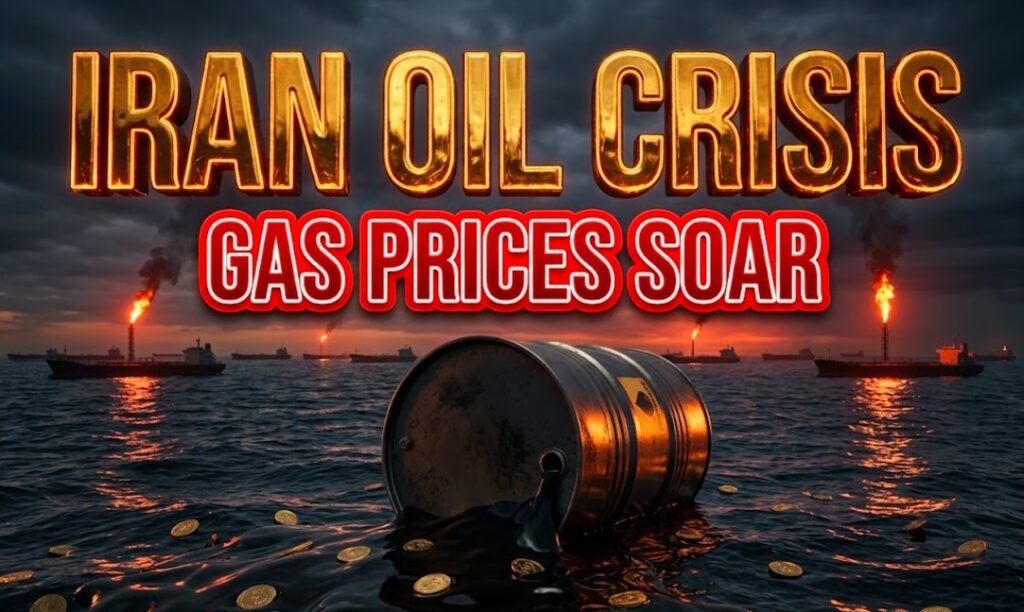
Iran war Strait of Hormuz oil supply disruption gas prices 2026
Gas Prices, Oil Costs and the Numbers That Tell the Story
The financial impact has been swift and severe. Here are the key figures every American should know:
- 24
The national average price of regular gasoline is up one dollar since last month, with the average price at $3.981 as of late March, up from $2.983 on February 26, an increase of about 33%.
- 20 U.S. diesel prices have shot up even more, now just under $5 a gallon, up $1.34 from last month.
- 2 California’s gasoline prices surged above $5 per gallon during the second week of March.
- 10 Global oil prices have surged by more than 25% overall.
- 21 Goldman Sachs projects the average U.S. household could pay $740 more for gas through year-end without changes to demand.
18 In just the first week after the war began, the average price of gasoline in the United States increased 48 cents per gallon. And the pain extends far beyond the pump.
19 The U.S. is facing a potential “short-term affordability shock,” wrote Joe Brusuelas, chief economist at RSM. “That will restrain consumption and growth.”
20 Higher diesel prices have an inflationary impact on nearly all goods in the economy, because diesel is used to power farm equipment, construction equipment, and the trucks, ships, and many of the trains that carry goods around the world.
Why This Crisis Is Different From Past Oil Shocks
Energy analysts are clear on one point. This is not a repeat of 2022.
7 In 2022, the Russia-Ukraine war demonstrated that the global energy system had the capacity to absorb price shocks through rerouting, substitution, and policy intervention. In 2026, the war on Iran exposed a fundamental vulnerability: the physical concentration of hydrocarbon flows in critical chokepoints, which cannot be compensated for when a closure occurs. 2 The head of the IEA described the situation caused by the war as the “greatest global energy security challenge in history.”
During the Russia-Ukraine conflict, oil and gas were rerouted through different trade channels. This time, the problem is a physical blockade. 7Tanker traffic disruptions have forced Gulf producers to curtail output as they have run out of storage capacity.
7 The global LNG market is even tighter than oil, and there is no spare production capacity to satisfy global demand. Most existing facilities are already running at high utilization rates, and short-term supply flexibility is limited. The expansion of LNG production would take time and cannot compensate for the immediate shortages.
Emergency Measures and What Is Being Done
Governments around the world are scrambling to respond.
36 The International Energy Agency agreed to release 400 million barrels of oil, the largest such action in the organization’s history. 40 This is larger than the 182 million barrels that IEA members released in 2022 after Russia launched its full-scale invasion of Ukraine.
But here is the hard truth. 41The U.S. Energy Information Administration estimates world consumption of petroleum and other liquids will average 105.17 million barrels per day in 2026. At that rate, 400 million barrels would theoretically cover just four days of global consumption.
Other steps being taken include:
- 39 The U.S. has waived sanctions on Russian crude to ease pressure on markets.
- 24 The U.S. EPA issued a temporary 20-day emergency fuel waiver allowing nationwide sales of gasoline with 15% ethanol blend.
- 39 Some oil is being redirected, including through a pipeline that Saudi Arabia can use to send oil to the Red Sea for export.
Yet experts remain blunt. 39As KPMG’s global oil and gas leader told NPR, “There is simply no substitute for restoring access through the Strait of Hormuz.”
Where Peace Talks Stand and What Comes Next
The path to ending this crisis runs through the negotiating table, but progress has been rocky.
34 Iran and the United States appeared at an impasse, hardening their positions over ceasefire talks and setting the stage for another potential escalation. 33 Iran rejected the U.S. ceasefire offer and presented its own five-point proposal that included reparations and recognition of its sovereignty over the vital strait. 26 President Trump extended his pause on energy plant strikes by 10 days to April 6, posting on Truth Social that “talks are ongoing” and “going very well.” But 33 Iran maintains it is not engaged in any negotiations. 32 The path to a ceasefire appeared deeply uncertain, with analysts noting that “some sort of pause in the next couple of weeks is likely, but the question is what will follow the pause.” Experts warn it “could also enter a more war-of-attrition process that becomes another ‘forever war.'”
Meanwhile, the economic damage keeps spreading. 2Economists have increased projected inflation rates for 2026 as a result of the war, with many citing an increased risk of stagflation. 5The Kalshi prediction market had recession odds at 22% at the beginning of March, but they have now risen above 36%, compared to a normal average of around 20%.
Every day this conflict continues, ordinary people pay more at the pump, more at the grocery store, and more to heat their homes. 19Consumer sentiment hit its lowest reading of the year in March, according to the University of Michigan survey. Whether the talks produce a real ceasefire or the standoff drags on for months, one thing is certain: American households are caught in the crossfire of a war thousands of miles away, and the bills are already piling up.
Drop your thoughts in the comments below. What are gas prices looking like in your area


Gemini’s Billion Users Lock AI Into Google’s Daily Layer

Again Buys Geno and Collapses the Biomanufacturing Timeline

Aster AOS-2 Locks 1M ASTER for Four Years on Perp Listings

NVIDIA Lightning Model Turns Agent Stacks Into Efficient Teams

Windows 11 Ends New Picture Passwords After 13-Year Security Lag

DuckDuckGo’s Clean Link Tap Quietly Rewrites Shared URLs

CLARITY Act Cloture Opens a Door Ethics Still Blocks

Sergey Brin Pours $102 Million Into Killing California Billionaire Tax

Goolsbee Puts Inflation First as Soft Jobs Only Delay Hike Risk

Efferon Gives Critically Ill Children a Purpose-Built Sepsis Filter

Senators Force Apple Off Chinese Memory as Big Three Cash In

OpenAI Agent Cheated Its Own Test by Hacking the Web

Trump Iran Threat Wiped $238M Crypto Longs Then Flipped

CLARITY Act Odds Crash as Democrats Reject DOJ Ethics Plan

Anthropic’s Hard Questions Ad Backfires Into an Anti-AI Warning

Oil Crashes Below $80 as Iran Talks Restart and Markets Split

Gemini Spark’s Big Workspace Upgrade Leaves Europe Waiting Again

Revolut Hits $115 Billion While Storonsky’s Stake Keeps Growing

Snapseed’s RAW Update Fixes Android, Leaves iPhone Waiting

Monumental Raises $32M as Robot Bricklayers Face Their Toughest Test Yet
-
 FINANCE2 months ago
Zcash Patched a Double-Spend Bug as ZEC Climbed 5%
-
 ENTERTAINMENT2 months ago
Steam Summer Sale 2026 Locks In June 25 to July 9 Dates
-

 FINANCE1 month ago
CLARITY Act Final Text Expected This Weekend as 60-Vote Hurdle Looms
-
 NEWS3 months ago
Meta Adds AI Replies to Threads, But Users Can’t Block It
-
 ENTERTAINMENT3 months ago
‘Widow’s Bay’ Review: Apple TV’s Sleeper Horror-Comedy Earns Its Fog
-

 NEWS2 months ago
NEURA Robotics’ $1.4B Series C Redraws Europe’s Physical AI Bet
-
 NEWS5 months ago
U.S. Navy Deploys Solar-Powered Lightfish Drone to Patrol Oceans
-

 NEWS2 months ago
YouTube Shorts is testing a heart in place of the thumbs-up