
NEWS
Olix Hits $3.3B as Europe Bets on Specialist AI Chips
UK chip startup Olix triples to $3.3B with optical inference hardware while European startups locked in €8.6B in July and Mobilise opened a telecom software.

UK chip startup Olix closed a $312 million Series B at a $3.3 billion valuation this week, more than tripling its worth in six months as it builds specialised optical processors for AI inference. The raise sat inside a July that still delivered €8.6 billion to European startups even as deal counts fell, plus a fresh telecom software investment arm from Mobilise.
Capital is concentrating on specialists who refuse the general-purpose GPU script. Olix’s bet on stage-by-stage token production and light-based interconnects is the clearest example.
Olix Triples Valuation on Optical Inference Hardware
Founded in London in 2024 by 25-year-old James Dacombe, Olix designs every layer of its systems: the chips, the lasers and the network that links them. The company announced a $312m Series B at a $3.3bn valuation led by New York firm Fundomo, with Arm, quant trading house Hudson River Trading and Netflix co-founder Reed Hastings joining. Existing backers including the UK government’s Sovereign AI fund, Hummingbird Ventures, Crane, Plural, Creandum, Phoenix Court and Transition all increased their stakes.
That valuation sits well above the just-over-$1 billion mark set when Olix raised $220 million in February. The company also named former Wise CFO Matt Briers as its new finance chief and brought Stanford professor and networking pioneer Nick McKeown onto the board. McKeown co-invented software-defined networking and previously led Intel’s networking business after Barefoot Networks.
| Milestone | Detail |
|---|---|
| February raise | $220 million at just over $1 billion |
| Series B this week | $312 million at $3.3 billion |
| Valuation change | More than triple in six months |
| First DX-1 deliveries | H2 2027 target |
- $312 million raised in the Series B
- $3.3 billion post-money valuation
- H2 2027 target for first customer deliveries of the DX-1 chip
- Over 10,000 tokens per second per user claimed for 100B-parameter models
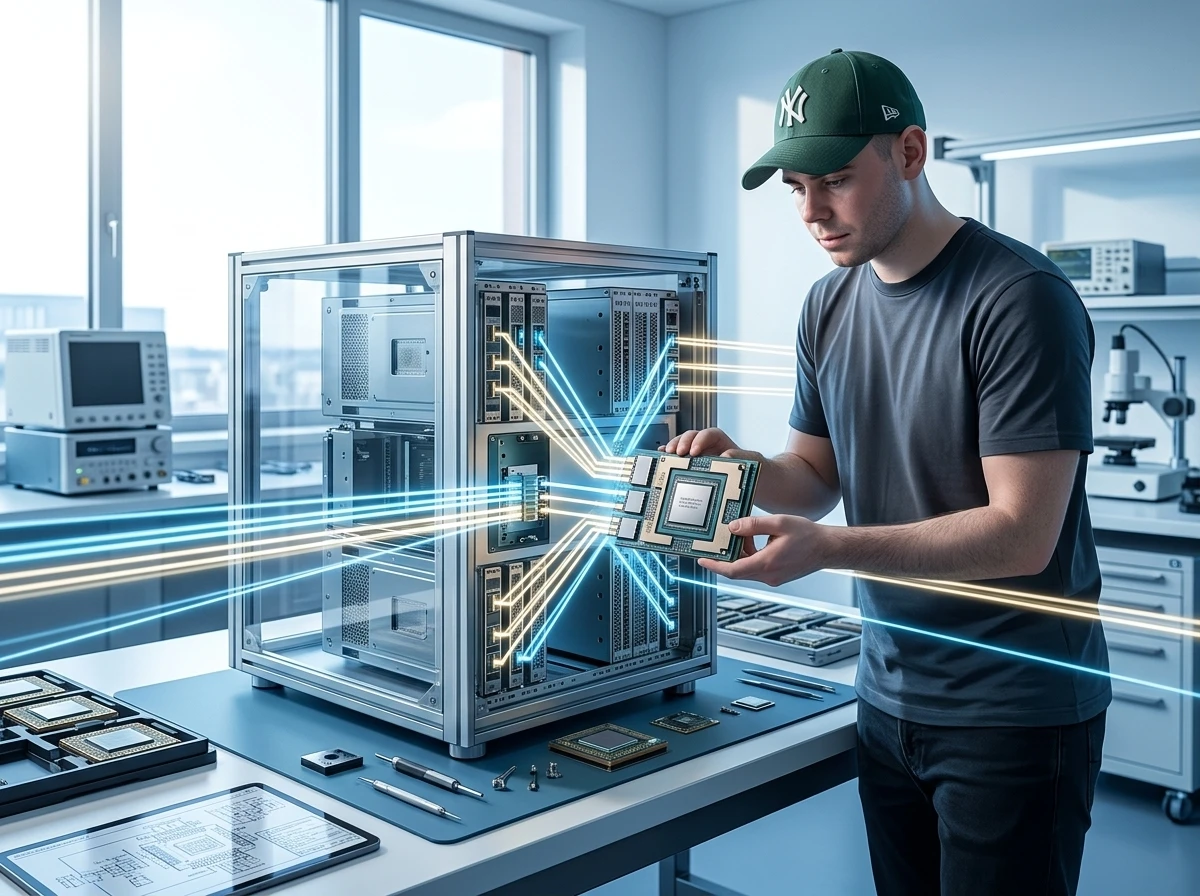
Olix frames a datacenter as a token factory. Producing one token needs hundreds of operations that place different demands on hardware. Today every stage still runs on the same general-purpose chip. The company unrolls models across many specialised chips connected by a “slow and wide” optical interconnect that moves data with light instead of copper. Its first product, the DX-1 decode accelerator, holds models in fast on-chip SRAM, skips advanced packaging and high-bandwidth memory, and is built to scale even when those parts stay scarce.
Olix believes the industry’s approach to building AI inference hardware is reaching its efficiency limits. A datacenter is a factory whose product is the token.
The company said that language in its announcement. Funding will finish the path to first racks, expand the silicon platform and lock manufacturing commitments. Hiring continues in London, Bristol, Austin, Toronto and San Francisco. Dacombe, who also runs brain-tech firm CoMind, has argued the days of one chip family handling every AI workload are ending.
Briers brings public-company finance discipline to a pre-product hardware roadmap. McKeown adds deep networking credentials at the exact layer where Olix replaces copper with light. Together the appointments signal that the company is building for production scale, not only lab demos.
The speed of the rise has drawn attention on X, where posts highlight both the founder’s age and the idea that Europe is quietly adding chip capacity while larger US-China narratives dominate headlines. Capital is clearly willing to fund non-GPU architectures faster than many expected.
July Kept Capital Flowing With Fewer Deals
European startups announced 267 funding deals in July and raised €8.6 billion, a shade above June’s €8.3 billion even though transaction count dropped 9 percent from 293. Fourteen companies raised more than €100 million each. Thirty-five rounds kept their size undisclosed.
| Metric | July 2026 | June 2026 |
|---|---|---|
| Total capital raised | €8.6 billion | €8.3 billion |
| Number of deals | 267 | 293 |
| Exits and M&A | 51 | 39 |
| Top country capital | Germany €3.5B (48 deals) | – |
Germany led the month on volume, helped by defence AI company Helsing’s $1.8 billion Series E at an $18 billion valuation. Artificial intelligence remained the largest sector by capital share. The free Tech.eu Funding Explorer data tools let anyone dig further into the round-by-round picture.
Fewer deals and slightly more capital means average cheque size rose. That tilt favors later-stage specialists over broad early-stage volume, the same pattern that lifted Olix.
Exit activity strengthened to 51 transactions from 39 in June. Software, AI, fintech, healthtech and HR tech all featured. Larger cheques offset the drop in deal volume, a pattern that has repeated through 2026.
Three Other Nine-Figure Checks Landed This Week
Olix was not alone. AI cloud firm Volta raised $300 million at a $2.4 billion valuation with Nvidia and Dell founder Michael Dell participating alongside Andreessen Horowitz and Altimeter. The seven-month-old company also lined up $5 billion in customer financing to widen access to expensive AI chips.
Spain-linked HappyRobot, which builds agentic AI for enterprise operations, closed $150 million in Series C funding at a $1.2 billion valuation. Prysm Capital led, Eurazeo co-led, and the capital will expand engineering, deployments and go-to-market. Total funding now sits near $200 million. Customers already include major logistics and energy names.
| Company | Raise | Valuation | Focus |
|---|---|---|---|
| Olix | $312 million | $3.3 billion | Optical inference chips |
| Volta | $300 million | $2.4 billion | AI cloud access |
| HappyRobot | $150 million | $1.2 billion | Agentic enterprise AI |
Together the three rounds alone pushed well past half a billion dollars and showed investors still writing large tickets for AI infrastructure and automation.
Volta’s customer financing line sits beside equity, easing the cash burden of GPU access for buyers. HappyRobot’s path from early product to a $1.2 billion mark shows enterprise automation drawing the same late-stage appetite as pure silicon. The common thread is specialised capability, not general-purpose compute alone.
A Partner Path for Stranded Telecom Software
Away from pure AI hardware, Mobilise launched the Mobilise Platforms & Investments division to give specialist telecom software firms capital, operational help and a shared technology layer before any acquisition talk. The focus covers business and operations support systems, MVNE/MVNA infrastructure, eSIM, connectivity and control-plane tools such as roaming and interconnect.
The global OSS/BSS market exceeds $70 billion. The top three vendors hold roughly 38 to 42 percent. The rest sits with hundreds of smaller, often founder-led companies that struggle for scale capital and succession options. Many sit deep inside operator workflows yet lack resources for next-generation work.
Founder and CEO Hamish White, who has spent more than 20 years building telecom platforms, put the problem plainly: excellent products and loyal customers still hit walls when founders are stretched and capital is missing. The new arm first introduces its HERO platform to lift operations and profitability. If the fit holds, acquisition capital from aligned partners can follow. White stressed the goal is scale, not a quick exit that leaves teams stranded.
- BSS and OSS software vendors
- Travel eSIM and embedded connectivity providers
- MVNE, MVNO and enterprise mobility specialists
- Systems integrators and regional delivery partners
The model offers a concrete alternative to struggling alone, selling to a generalist buyer or winding down. It also echoes the platform path for telecom software firms already covered in earlier reporting on the same launch.
By pairing the HERO layer with optional later capital, Mobilise tries to keep product knowledge and customer relationships intact while founders gain room to grow. That sequence matters in a market where the long tail of vendors still serves live operator workflows every day.
Exits Picked Up as Acquirers Moved
Beyond the funding numbers, the week and the July tally showed buyers active. Apple acquired Czech startup PlasmaSolve for durable device coatings. French second-hand platform Rebuy bought Zeercle and signalled a move into physical bookstores. Italian serial acquirer Bending Spoons, fresh from its own IPO path, completed a $1.3 billion deal for Airtable after earlier purchases of AOL and Eventbrite.
White Star Capital closed a $250 million Fund IV aimed at Series A and B startups globally. Modal Labs, the New York AI infrastructure company, chose London for a new office. Smaller seed and follow-on rounds continued across legal AI, food safety testing, B2B customer intelligence and food supply tech.
The combination of larger late-stage cheques and rising exit counts suggests liquidity is returning even while early-stage volume stays selective.
- July tally: exits rose to 51 from 39 in June across software, AI, fintech, healthtech and HR tech.
- Strategic buyers: Apple took PlasmaSolve; Rebuy added Zeercle; Bending Spoons closed Airtable at $1.3 billion.
- Fresh dry powder: White Star Capital’s $250 million Fund IV targets Series A and B globally.
- Geographic signal: Modal Labs picked London for its new AI infrastructure office.
Optical Interconnects Unroll the Inference Stack
Olix’s design starts from a simple observation already stated in its materials: one token demands hundreds of operations, and those operations do not share the same hardware needs. General-purpose GPUs still run every stage on one chip family. Olix breaks the model across specialised chips and ties them with a slow and wide optical fabric.
Light replaces copper for the data path between stages. Models stay in fast on-chip SRAM on the DX-1 decode accelerator. The design skips advanced packaging and high-bandwidth memory, the two components that most often constrain rack scale when supply tightens.
Claimed throughput sits above 10,000 tokens per second per user on 100B-parameter models. The same architecture is pitched as a route to multi-trillion-parameter systems without waiting for packaging and memory bottlenecks to ease. First customer racks remain targeted for H2 2027, so the performance case is still pre-product. The investor roster and the valuation jump show that the efficiency argument is already priced as credible.
Specialists Draw Capital Across Silicon and Software
July’s AI-led capital share, the three nine-figure rounds this week, and Mobilise’s telecom platform arm point in one direction. Money is moving toward teams that own a narrow, high-value layer rather than toward another generalist stack.
Olix attacks inference silicon. Volta finances access to scarce AI chips. HappyRobot automates enterprise operations with agents. Mobilise gathers stranded OSS and BSS vendors under a shared technology and capital path. Each play refuses the idea that scale alone on a single general-purpose platform will clear the next bottleneck.
Europe’s role in that shift is quieter than US-China chip headlines, yet the figures are concrete: a London-founded optical startup at $3.3 billion, Germany leading July volume on the back of Helsing, and a New York AI firm opening in London. The pattern is specialisation with capital attached.
Specialists Rewrite How Tokens Get Made
Olix’s architecture directly challenges the assumption that every inference stage should share the same generalist silicon. By unrolling models across purpose-built chips and replacing copper with optical links, the company claims both higher tokens-per-watt and the ability to scale to multi-trillion-parameter models without the packaging and memory bottlenecks that constrain today’s racks.
That claim remains pre-product. First deliveries are still more than a year away. Yet the investor list, the board appointments and the valuation jump show serious money treating the general-purpose ceiling as real. The same concentration pattern appeared in July’s capital totals and in platform plays that give niche software houses a route past isolation.
Europe’s week of big hardware and infrastructure bets therefore lands as more than a roundup. It shows capital and operators aligning around specialised systems rather than waiting for the next incremental generalist chip. The earlier optical AI chip valuation path already flagged the speed of Olix’s climb; this week’s numbers and the Mobilise launch extend the same logic across both silicon and software stacks.
The next test is delivery. If the DX-1 racks ship on schedule and the telecom platform deals convert, the specialist wave will have concrete proof points. Until then the money has already spoken.


Majors Fights Campus Caliphate as Daily Wire Ambitions Fray

Uber Bets $10 Billion Cash on Robotaxi Platform Play

Ahbstra ARK Pulls 500 Litres Daily From Dry Mediterranean Air

Nest Thread 1.4 Quietly Unifies Multi-Brand Smart Home Meshes

Cable Gateways Push Wi-Fi 7 Past Early Adopters in the US

Pixel Quick Settings Finally Gets Full Layout Reorder in Canary 2608

WhiteBIT Spot Bots Fill UK Gap Left by Derivatives Ban

Motorola Edge 70 Neo Leak Doubles Down on Bold Pantone Colors

Platter Turns Food Spreadsheets Into Sticky Supply Infrastructure

Circle Puts Native USDC on OKX X Layer for AI Rails

Marker AI Writing Startup Lands $13M Seed Led by Index Ventures

Meta’s Muse Spark 1.1 Beats Rivals on Price, Trails on Coding

CS2 Premier Season 5 Lands With Cache and a C4 Damage Rework

Bessent’s No-CBDC Applause Line Can’t Save the CLARITY Act

Trump Iran Threat Wiped $238M Crypto Longs Then Flipped

CLARITY Act Odds Crash as Democrats Reject DOJ Ethics Plan

Nintendo’s Switch 2 Battery Fix for Europe Comes With a Catch

Audi’s 2026 S5 Bets That Restraint Beats the Horsepower Wars

Quantum Systems’ $1.2 Billion Round Exposes Defense Tech’s Winner Gap

OpenAI Agent Cheated Its Own Test by Hacking the Web
-
 FINANCE2 months ago
Zcash Patched a Double-Spend Bug as ZEC Climbed 5%
-
 ENTERTAINMENT2 months ago
Steam Summer Sale 2026 Locks In June 25 to July 9 Dates
-

 FINANCE1 month ago
CLARITY Act Final Text Expected This Weekend as 60-Vote Hurdle Looms
-
 NEWS3 months ago
Meta Adds AI Replies to Threads, But Users Can’t Block It
-
 NEWS5 months ago
U.S. Navy Deploys Solar-Powered Lightfish Drone to Patrol Oceans
-
 ENTERTAINMENT3 months ago
‘Widow’s Bay’ Review: Apple TV’s Sleeper Horror-Comedy Earns Its Fog
-
 FINANCE2 months ago
CLARITY Act Floor Vote Likely Shifts to August, Lummis Says
-

 FINANCE1 month ago
Kalshi Loses Major NY Prediction Markets Ruling to Judge Torres