
NEWS
UK Tech’s H1 Billions Flowed to Ten AI Bets
UK tech secured €18.7 billion in H1 2026 but ten AI and cloud firms absorbed €12.3 billion, sharpening a winner-take-most split across the market.

UK tech companies raised €18.7 billion across 423 deals in the first half of 2026, holding their place as Europe’s largest funding market. Ten firms captured €12.3 billion of that total, about 66 percent, almost all of it tied to AI infrastructure, foundation models and adjacent compute plays.
The headline looks like strength. The distribution shows something sharper: capital is picking a handful of national-scale bets and leaving the rest of the field to share the remainder. Volume recovered. Breadth did not.
That split now defines the half. A short list of infrastructure and model companies absorbed the majority of cheques, while hundreds of other startups divided a thinner pool. The pattern is visible in every major tally of the period.
Ten Companies Took Two-Thirds of the Money
Tech.eu’s H1 ranking puts the concentration in plain view. Cloud and AI infrastructure led, followed by health AI and fintech. The same pattern appears in the wider European numbers, where funding recovered to €44.1 billion while deal count fell below 1,750.
| Company | Amount (H1 2026) | Focus |
|---|---|---|
| Nscale | €3.57B | AI GPU cloud, data centres, energy |
| Pure Data Centres | $2.7B | Hyperscale data centres |
| Isomorphic Labs | $2.1B | AI drug discovery |
| Wayve | $1.26B | Embodied AI for autonomous driving |
| Ineffable Intelligence | $1.1B | Foundation models, enterprise AI |
| ElevenLabs | $1.06B | AI voice and speech |
| Ebury | £550M | Cross-border payments and FX |
| Recursive Superintelligence | $650M | Frontier AI models |
| Oxford Quantum Circuits | £260M | Superconducting quantum computers |
| PhysicsX | $300M | Industrial AI simulation |
These ten account for the bulk of the UK total. Dealroom data put overall UK venture at roughly $17 billion for the half, with AI taking about 74 percent or $12.6 billion. Four rounds cleared the $1 billion mark.
The arithmetic leaves little ambiguity about where conviction clustered:
- €12.3 billion to the top ten names, or about 66 percent of the UK total
- €6.4 billion left for more than 400 other deals
- $12.6 billion into AI alone on the Dealroom reading, roughly three-quarters of UK venture
Capital did not spread evenly across stages or sectors. It stacked into a few verticals that investors now treat as national infrastructure.
Cloud Capacity Became the New Oil
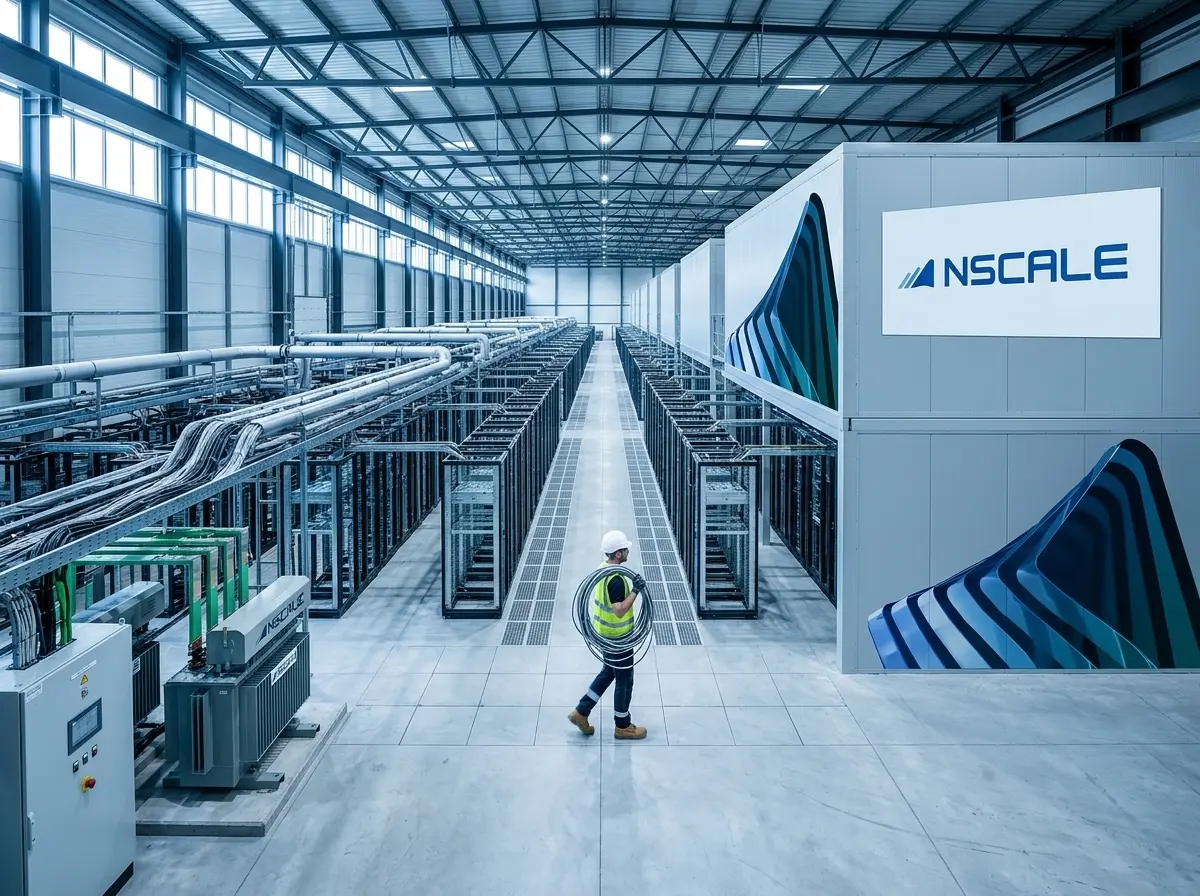
Nscale and Pure Data Centres alone explain why cloud topped the UK vertical table at €5.9 billion. Investors are treating power, land, cooling and GPUs as the scarce inputs for every other AI ambition.
Nscale, the London-based AI infrastructure hyperscaler, closed multiple financings that summed to €3.57 billion. One piece was a $2 billion Series C valuing it at $14.6 billion, led by Aker ASA and 8090 Industries with NVIDIA, Dell, Nokia, Citadel, Point72 and others. The capital funds vertically integrated GPU platforms, data centres and renewable-linked capacity across Europe, North America and Asia. Sheryl Sandberg, Susan Decker and Nick Clegg joined the board.
This is the fourth industrial revolution; the world is changing at a rapid pace. Over the next 5 years, Artificial Intelligence will be integrated into every industry, every product, and every job…. Nscale is leading this buildout. We are building this foundation that the market sits on, the engine of superintelligence.
Josh Payne, Nscale’s CEO and founder, said that in the company’s March announcement. Pure Data Centres secured $2.7 billion (reported around €2.3 billion in some European tallies) to expand energy-efficient hyperscale facilities for cloud and AI workloads in Europe and the Middle East.
- Nscale, end-to-end GPU cloud, data centres and energy for foundation and enterprise models
- Pure DC, design-build-operate hyperscale campuses for the same demand surge
- Supporting rounds, debt and equity packages that treat compute as industrial infrastructure rather than software
The money is flowing where physical constraints bind first. Model labs and enterprise buyers can only scale as fast as someone builds the racks, secures the power and locks in the accelerators. That is why cloud outran pure software on capital even when software still led on deal count across Europe.
Once two or three platforms race toward gigawatt-class capacity, land, grid connections and skilled construction labour tighten around them. Later entrants face higher costs and longer lead times for the same inputs.
A $1.1 Billion Seed Rewrote the Early-Stage Script
Artificial intelligence as a category took €3.2 billion in the UK per Tech.eu, second only to cloud. The rounds stretched from seed-stage ambition to late-stage platform scale.
Ineffable Intelligence, founded by former DeepMind researcher David Silver, raised $1.1 billion in seed funding at a $5.1 billion valuation. Sequoia and Lightspeed co-led, with NVIDIA, Google, DST, Index and the UK Sovereign AI Fund participating. It was described as Europe’s largest seed round, aimed at foundation models and large-scale infrastructure for advanced reasoning.
Recursive Superintelligence, another DeepMind-alumni effort, took $650 million for frontier models. ElevenLabs stacked three rounds to $1.06 billion for voice generation and multilingual audio. Wayve added $1.26 billion across two rounds for its end-to-end embodied AI that learns driving from real data rather than maps.
Isomorphic Labs, the DeepMind spin-out applying AI to drug design, closed $2.1 Billion in Series B funding led by Thrive Capital. Existing backers Alphabet and GV returned; new money came from MGX, Temasek, CapitalG and the UK Sovereign AI Fund. The capital advances its IsoDDE engine and moves candidates toward the clinic.
Several of those tickets cleared thresholds that once defined entire late-stage rounds:
- Ineffable Intelligence, $1.1 billion seed at a $5.1 billion valuation
- Isomorphic Labs, $2.1 billion Series B for AI drug design
- Wayve, $1.26 billion across two rounds for embodied driving AI
- ElevenLabs, $1.06 billion stacked across three rounds for voice and speech
- Recursive Superintelligence, $650 million for frontier models
These are not typical growth rounds. They are bets that a small number of UK-based labs can sit at the global frontier. Seed and early growth labels still appear on the term sheets, yet the cheque sizes and investor syndicates match platform-scale contests already underway in the United States and Asia.
The Rest of the Field Competes for the Remainder
After the top ten, roughly €6.4 billion remained for more than 400 other UK deals. Fintech still saw activity, with Ebury raising £550 million for international payments, FX and trade finance. Healthtech outside Isomorphic included names such as Oviva. Quantum and industrial AI appeared via Oxford Quantum Circuits (£260 million) and PhysicsX ($300 million).
The arithmetic is blunt. Most seed and Series A companies are competing inside a thinner pool. Software remained the most active category by deal count across Europe, yet the capital weighted heavily toward capital-intensive verticals. Early-stage non-AI founders face longer raise cycles and more selective checks.
Observers on X noted the same pattern elsewhere: one post highlighted that a third of German VC this year went to just two companies. The selection pressure is continental.
For teams outside the AI infrastructure and foundation-model lane, the half delivered fewer large outcomes and more competition for each remaining pound. Follow-on paths still exist in fintech, healthtech, quantum and industrial software, but the share of total capital available to them shrank as the mega-rounds cleared.
Sovereign Cash Meets Silicon Valley Cheques
US and global investors supplied the bulk of the mega-round capital. NVIDIA’s strategic stakes appear across Nscale, Ineffable, Wayve and others, often paired with preferred access to next-generation GPUs. Thrive, Sequoia, Lightspeed, Alphabet, Temasek and Middle Eastern capital all wrote large tickets.
The UK government joined through its Sovereign AI vehicle. Isomorphic received a UK Government’s Sovereign AI Fund investment as part of the Series B. The same fund participated in Ineffable. Britain’s sovereign venture fund for AI startups targets £1 million to £20 million equity cheques plus compute credits and visa support, aiming to keep breakthroughs onshore.
The mix creates a hybrid: American and Gulf scale capital plus a thin layer of state co-investment. It accelerates the winners. It also deepens reliance on external supply chains for chips, talent and later-stage follow-on.
State cheques in the £1 million to £20 million band cannot match a $2 billion Series C on their own. Their role is catalytic: signalling, co-investing and attaching compute credits or visa support so that breakthroughs stay anchored in the UK even when the largest tickets arrive from overseas syndicates.
Europe’s Catch-Up Problem Gets Steeper
The UK took more than three times Germany’s €6.3 billion and more than France’s €6.0 billion. Six of Europe’s ten largest H1 deals were British. The UK AI mega-rounds inside Europe’s H1 rebound therefore set the pace for the whole region.
| Market | H1 2026 funding | Share of the story |
|---|---|---|
| United Kingdom | €18.7 billion | Largest market; six of Europe’s ten biggest deals |
| Germany | €6.3 billion | Less than one-third of the UK total |
| France | €6.0 billion | Behind the UK by a similar margin |
| Europe overall | €44.1 billion | Funding up, deal count below 1,750 |
That lead carries a cost. Capital that might have seeded a wider set of European experiments is instead stacking into London-centric infra and model companies. Grid capacity, planning permission and skilled labour become binding constraints faster when two or three players are racing to gigawatt scale. Talent clusters tighten around the same few employers.
If the big bets pay off, the UK gains durable platforms in compute, autonomous systems and AI therapeutics. If any stumble, the market has fewer alternative growth engines. The second-order effect is already visible in deal counts and the share of capital locked into a short list of names.
H1 2026 did not just fund the UK tech scene. It sorted it.
How the Winners Lock In Scarce Inputs
The concentration is not only about who raised. It is about what those rounds secure before rivals can.
Mega-rounds in cloud and foundation models buy priority access to GPUs, power contracts, land banks and specialised staff. NVIDIA’s repeated appearance across Nscale, Ineffable, Wayve and related syndicates illustrates the point: strategic capital often travels with preferred supply. Once a platform locks multi-year capacity, later entrants pay more or wait longer for the same components.
The same dynamic reaches talent. DeepMind alumni founded more than one of the half’s largest AI raises. Board additions at Nscale drew high-profile operators from global tech and policy. As a handful of employers absorb senior researchers, infrastructure leads and go-to-market executives, the residual pool for everyone else thins.
Physical build-out reinforces the loop. Nscale’s vertically integrated GPU platforms and renewable-linked capacity, and Pure Data Centres’ hyperscale campuses across Europe and the Middle East, consume planning slots and grid headroom that are finite in any given region. Software deal count can stay high while the inputs that turn models into products grow scarcer and more expensive for teams outside the lead pack.
Fewer Engines Remain If a Flagship Stumbles
Sorting has a downside that only appears when one of the flagships misses. With roughly two-thirds of UK capital sitting in ten companies, and AI alone near three-quarters of the Dealroom total, the market’s upside and its concentration risk travel together.
A smooth path for the infrastructure and model leaders would leave the UK with durable platforms in compute, autonomous systems and AI therapeutics. Those platforms could then pull supply chains, follow-on capital and skilled labour into their orbit for years. The half’s hybrid funding mix, pairing overseas scale with sovereign co-investment, is built for exactly that outcome.
A stumble at any of the largest names would remove a disproportionate share of growth narrative and later-stage demand in a single stroke. The remaining €6.4 billion spread across more than 400 deals is not structured to replace a multi-billion infrastructure or foundation-model franchise overnight. Fintech, quantum and industrial AI still produced meaningful rounds, yet none matched the cloud and frontier-model tickets that dominated the league table.
Europe’s wider picture sharpens the exposure. When six of the region’s ten largest deals are British and the UK alone outpaces Germany and France by more than three times each, continental diversification offers less ballast than the headline €44.1 billion recovery suggests. The selection pressure already noted in German VC, where a third of capital went to two companies, shows the same narrowing elsewhere. H1 did not only enlarge the UK lead. It made the region’s growth story more dependent on a short list of outcomes.
Frequently Asked Questions
How much did UK tech raise in total in H1 2026?
Tech.eu recorded €18.7 billion across 423 deals. Dealroom’s parallel tally put UK venture near $17 billion, with AI alone at $12.6 billion or roughly three-quarters of the total.
Which company raised the most in the UK in H1 2026?
Nscale led with €3.57 billion across three announcements, including a $2 billion Series C that valued the AI infrastructure company at $14.6 billion and brought NVIDIA, Aker and major financial sponsors on board.
Why did cloud and data centres attract more capital than pure AI software?
Investors treated physical capacity (power, land, GPUs, cooling) as the scarce resource required by every foundation model and enterprise deployment. Nscale and Pure Data Centres together absorbed several billion dollars for exactly that build-out.
Did the UK government invest directly in any of the top rounds?
Yes. The UK Sovereign AI Fund participated in Isomorphic Labs’ $2.1 billion Series B and in Ineffable Intelligence’s $1.1 billion seed, alongside larger tickets from Thrive, Sequoia, Alphabet and NVIDIA.
How does H1 2026 compare with prior UK half-years?
The €18.7 billion (or ~$17 billion) total more than doubled some 2025 half-year figures and put the full year on track well above 2025’s $23.7 billion, though deal counts stayed lower than the 2021-2022 peak periods.


Majors Fights Campus Caliphate as Daily Wire Ambitions Fray

Uber Bets $10 Billion Cash on Robotaxi Platform Play

Ahbstra ARK Pulls 500 Litres Daily From Dry Mediterranean Air

Nest Thread 1.4 Quietly Unifies Multi-Brand Smart Home Meshes

Cable Gateways Push Wi-Fi 7 Past Early Adopters in the US

Pixel Quick Settings Finally Gets Full Layout Reorder in Canary 2608

WhiteBIT Spot Bots Fill UK Gap Left by Derivatives Ban

Motorola Edge 70 Neo Leak Doubles Down on Bold Pantone Colors

Platter Turns Food Spreadsheets Into Sticky Supply Infrastructure

Circle Puts Native USDC on OKX X Layer for AI Rails

Marker AI Writing Startup Lands $13M Seed Led by Index Ventures

Meta’s Muse Spark 1.1 Beats Rivals on Price, Trails on Coding

CS2 Premier Season 5 Lands With Cache and a C4 Damage Rework

Bessent’s No-CBDC Applause Line Can’t Save the CLARITY Act

Trump Iran Threat Wiped $238M Crypto Longs Then Flipped

CLARITY Act Odds Crash as Democrats Reject DOJ Ethics Plan

Nintendo’s Switch 2 Battery Fix for Europe Comes With a Catch

Audi’s 2026 S5 Bets That Restraint Beats the Horsepower Wars

Quantum Systems’ $1.2 Billion Round Exposes Defense Tech’s Winner Gap

OpenAI Agent Cheated Its Own Test by Hacking the Web
-
 FINANCE2 months ago
Zcash Patched a Double-Spend Bug as ZEC Climbed 5%
-
 ENTERTAINMENT2 months ago
Steam Summer Sale 2026 Locks In June 25 to July 9 Dates
-

 FINANCE1 month ago
CLARITY Act Final Text Expected This Weekend as 60-Vote Hurdle Looms
-
 NEWS3 months ago
Meta Adds AI Replies to Threads, But Users Can’t Block It
-
 NEWS5 months ago
U.S. Navy Deploys Solar-Powered Lightfish Drone to Patrol Oceans
-
 ENTERTAINMENT3 months ago
‘Widow’s Bay’ Review: Apple TV’s Sleeper Horror-Comedy Earns Its Fog
-
 FINANCE2 months ago
CLARITY Act Floor Vote Likely Shifts to August, Lummis Says
-

 FINANCE1 month ago
Kalshi Loses Major NY Prediction Markets Ruling to Judge Torres