
NEWS
Ukraine’s SunRay Laser Weapon Burns Russian Drones Out of the Sky

Ukraine just unveiled the weapon that could rewrite the rules of modern air defense. It is called SunRay, a silent, invisible laser that sets enemy drones on fire within seconds. Built for a fraction of what Western systems cost, this homegrown device could become the backbone of Ukraine’s new anti-drone shield as the country faces relentless aerial attacks from Russia.
What Is SunRay and How Does It Work?
15 Ukraine has developed its first domestic laser weapon, capable of neutralizing Russian drones cheaply and effectively, as journalist Simon Shuster reported in The Atlantic on February 10, 2026. 10 The device was developed by a Ukrainian team whose company name was withheld for security reasons. It resembles a hobbyist’s telescope fitted with cameras and mounted on the roof of a pickup truck. During testing, the operator tracked a small drone and, on command, fired an invisible, silent beam that ignited the target within seconds, causing it to fall.
The laser makes no sound and produces no visible light. 11In simple terms, SunRay concentrates light on a small spot of the drone until its skin and electronics overheat, like a kid using a magnifying glass to scorch a leaf on a sunny day. 11As long as there is electrical power, the system can keep firing without worrying about running out of missiles.
Here is what makes SunRay stand apart from traditional defense systems:
| Feature | SunRay Laser | Patriot Missile System |
|---|---|---|
| Cost per unit | A few hundred thousand dollars | Millions of dollars per missile |
| Ammunition | Unlimited (electricity only) | Finite missile supply |
| Sound/Visibility | Silent, invisible beam | Loud, visible launch |
| Portability | Fits in a car trunk | Large, fixed installation |
| Development cost | A few million dollars | Billions in R&D |
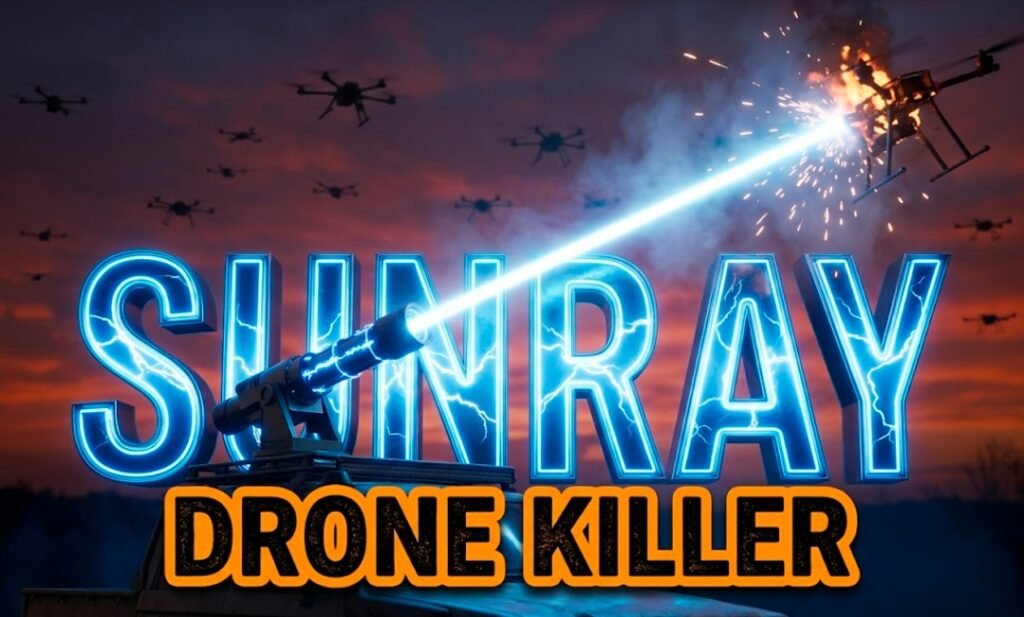
Ukraine SunRay laser weapon mounted on pickup truck burning drone
The Man Behind Ukraine’s Anti-Drone Revolution
The story of SunRay starts with an unlikely figure. 16Pavlo Yelizarov’s background is anything but conventional. Like President Zelensky, Yelizarov spent much of his career in television, serving as lead producer of one of Ukraine’s most popular political talk shows. When Russia invaded in 2022, he quit and started building combat drones with friends in his old TV studio, pooling personal savings to buy components.
15 Yelizarov, the newly appointed Deputy Commander of the Air Force, earlier commanded the Lazarus Group, a special unit focused on drone warfare. 15 The Atlantic reported that Russian Shahed drones destroyed the Lazarus Group’s main production facility several months ago, destroying approximately $35 million worth of weaponry and equipment.
He almost turned down the new air defense job. 15Initially reluctant to lead the national defense against Shahed attacks after the loss, Yelizarov was persuaded by Defense Minister Mykhailo Fedorov to “get in the game and show what he is capable of.”
“Many American companies are driven by money. We have another component at play: the need to survive. That’s why we are moving faster.” Pavlo Yelizarov, Deputy Commander, Ukrainian Air Force
Why Ukraine Desperately Needs Cheaper Air Defense
The math of drone warfare is brutal for defenders. 34A Patriot air defense missile costs $3 million to $4 million, while a Shahed costs about $130,000 to $150,000, Zelenskyy noted. Spending millions to destroy something worth a fraction of that price is not sustainable.
23 Over just three winter months, Russia used more than 14,600 guided aerial bombs, 738 missiles, and almost 19,000 strike drones against Ukraine, according to President Zelensky. 23 In February 2026 alone, Russia fired 288 missiles and launched 5,059 drones, raising pressure on power grids and causing widespread outages. 12 Thousands of explosive-laden quadcopters bombard towns like Kherson and Nikopol every week, killing at least 2,514 civilians in 2025 alone.
The cost gap is staggering. 16Systems like Wild Hornets’ Sting and the military’s Octopus interceptor have shown that $2,500 drones can hunt $35,000 Shaheds at hit rates of 80 to 90 percent. 16Laser systems like SunRay could eventually reduce per-shot costs to near zero, limited mainly by electricity.
5 By comparison, the HELIOS laser system developed by Lockheed Martin for the US Navy was produced under a $150 million contract. 6 Ukrainian engineers are building SunRay for a fraction of this cost and will likely sell units to the Ukrainian government for several hundred thousand dollars each.
Ukraine’s Plan for a Homegrown Iron Dome
SunRay is just one piece of a much bigger puzzle. 16It is part of Ukraine’s broader race to build a bootstrapped version of Israel’s Iron Dome, relying on domestic innovation because Western air defense deliveries remain insufficient.
11 Kyiv plans to make SunRay the core of a national anti-drone shield that could start operating by summer 2026. 16 President Zelensky wants the shield operational by summer 2026.
The layered defense approach includes:
- SunRay laser systems for short-range, silent drone kills
- P1-Sun interceptor drones at roughly $1,000 per unit
- Electronic warfare tools for jamming drone signals
- Mobile fire groups with small arms and short-range rockets
- Western missile systems reserved for the most advanced threats
16 Yelizarov’s biggest challenge is not technology. It is integration. He needs to organize dozens of competing systems from hundreds of manufacturers into a unified command structure that can decide in real time whether to fire a $1,000 interceptor drone, a laser, or a million-dollar missile at an incoming threat. 10 Lasers require line of sight and sustained tracking, and their performance can be limited by the target’s speed, distance, and maneuvers. For mobile use, the system must combine stabilization, sensors, computing, and a power supply robust enough to support repeated firings.
Ukraine’s Drone Expertise Goes Global
The conflict in Ukraine has turned the country into the world’s foremost laboratory for drone warfare and drone defense. That hard-earned expertise is now in global demand.
29 More than 200 Ukrainian military experts are in the Gulf region and wider Middle East helping governments defend against Iran’s drone attacks. Zelenskyy told the United Kingdom Parliament that 201 Ukrainian anti-drone experts are in the region and another 34 are ready to deploy. 30 More than 10 European and Middle Eastern countries have reached out to Ukraine requesting support for their defensive capabilities. 30 Israeli officials have also shown interest, with Prime Minister Benjamin Netanyahu reportedly requesting talks with Zelensky about potential cooperation on drone defenses.
Ukraine is quickly becoming a drone defense export power. 33Zelensky has said Russia has fired more than 57,000 Iranian-designed Shahed-type drones over the four years of war. That painful experience is now being converted into technology and knowledge that nations around the world want to buy.
As SunRay moves from prototype to production, it represents something far bigger than a single weapon system. It is proof that survival can drive innovation faster than any corporate research budget. For the people of Ukraine, who have endured four brutal winters of drone and missile strikes on their homes, hospitals, and power plants, this silent beam of light carries the weight of hope. Drop your thoughts in the comments below and let us know what you think about Ukraine’s new laser defense technology.


SEC Pause on Tokenization Exemption Leaves Banks Free to Race Ahead

Guardian Labs Stops Scam Calls Before the Phone Rings

CFTC Emergency Orders Put Kalshi Past State Court Lines

X Under the Hood Tool Shows Shadowban Labels in Raw JSON

Uber and Pony.ai Lock in 2,000 Robotaxis Across Europe

Nvidia’s $16,000 RTX Pro 6000 Turns Local AI Into a Luxury

Lovable’s $400M Double and Europe’s Twin Bet on Code and Factories

MSCI Screen Forces Reckoning for Bitcoin Treasury Model

One UI 9.5 Leak Revives Samsung’s Classic Polish Cycle

Xfinity Free Pixel 11 Deal Pushes Wireless Growth Harder

Senators Force Apple Off Chinese Memory as Big Three Cash In

Trump Iran Threat Wiped $238M Crypto Longs Then Flipped

OpenAI Agent Cheated Its Own Test by Hacking the Web

CLARITY Act Odds Crash as Democrats Reject DOJ Ethics Plan

Gemini Spark’s Big Workspace Upgrade Leaves Europe Waiting Again

Revolut Hits $115 Billion While Storonsky’s Stake Keeps Growing

Anthropic’s Hard Questions Ad Backfires Into an Anti-AI Warning

Oil Crashes Below $80 as Iran Talks Restart and Markets Split

Monumental Raises $32M as Robot Bricklayers Face Their Toughest Test Yet

Duda’s New AI Tools Speed Up Agencies, but Risk Sameness
-
 FINANCE2 months ago
Zcash Patched a Double-Spend Bug as ZEC Climbed 5%
-
 ENTERTAINMENT2 months ago
Steam Summer Sale 2026 Locks In June 25 to July 9 Dates
-
 NEWS3 months ago
Meta Adds AI Replies to Threads, But Users Can’t Block It
-

 FINANCE1 month ago
CLARITY Act Final Text Expected This Weekend as 60-Vote Hurdle Looms
-

 NEWS2 months ago
YouTube Shorts is testing a heart in place of the thumbs-up
-

 NEWS2 months ago
NEURA Robotics’ $1.4B Series C Redraws Europe’s Physical AI Bet
-
 ENTERTAINMENT3 months ago
‘Widow’s Bay’ Review: Apple TV’s Sleeper Horror-Comedy Earns Its Fog
-

 FINANCE1 month ago
Kalshi Loses Major NY Prediction Markets Ruling to Judge Torres