
NEWS
YouTube Pulls AI Labels Front and Center, Starts Auto-Tagging Slop

A study published late last year put roughly 21% of the first videos shown to a fresh YouTube account in the bucket researchers called AI slop. On May 27, YouTube responded by yanking its AI-disclosure badges into the most visible real estate on the page and switching on a back-end system that will tag photorealistic AI videos whether the creator ticks the box or not.
The shift quietly retires the two-year-old policy that left disclosure entirely to creators. It does not change which videos earn money, which ones the recommendation engine pushes, or which channels keep their YouTube Partner Program revenue share. The badge is louder; the economics stay where they were.
Labels Move From Footnote to Front Row
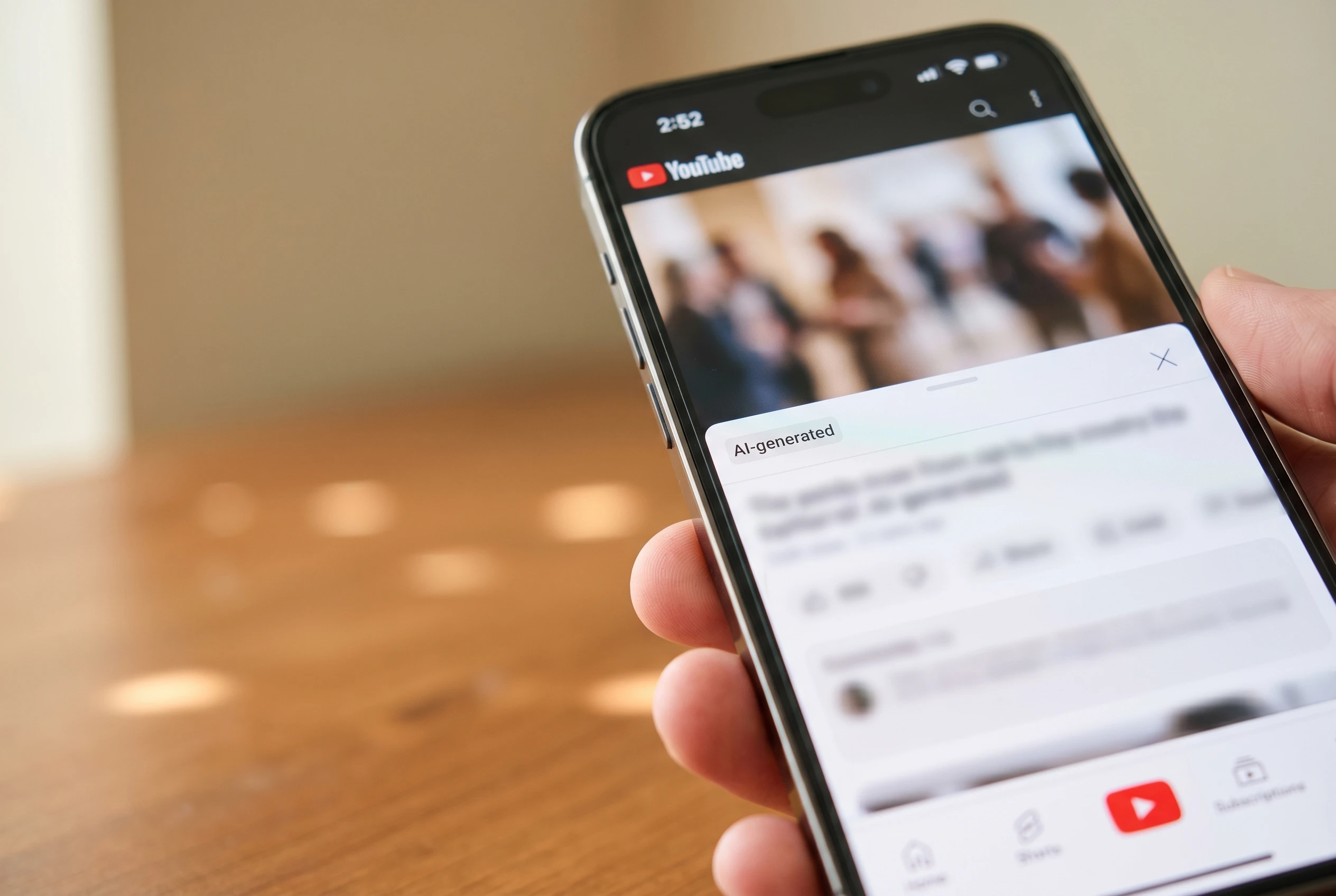
For long-form videos, the disclosure now sits directly below the player and above the description box, in the path of any viewer scanning for context. For Shorts, the label appears as an overlay on the video itself, sharing space with the title and creator handle that already crowd the bottom of every vertical clip.
| Surface | Old Label Position | New Label Position |
|---|---|---|
| Long-form video | Inside expanded description | Below player, above description |
| Shorts | Inside expanded description | Overlay on the video itself |
| Animated, stylised, or clearly unrealistic content | Inside expanded description | Unchanged |
The split is deliberate. Photorealistic and meaningfully altered content gets the front-row treatment, while cartoons, sketch edits, and stylised material stay tucked into the description menu most viewers never open. In YouTube’s own promo clip the new badge looks sizable; on a phone held in vertical orientation it sits roughly where the timestamp and view count cluster lives today, small enough to miss during a fast scroll.
What changed underneath the design refresh: the labels were always there. The friction was that viewers had to reach for them. Now the badge reaches for the viewer, at least on the two surfaces where AI fakery does the most damage.
The Slop Problem That Forced the Move
Video-editing firm Kapwing dropped a report in late 2025 that put a number on what creators had been muttering about for a year. Out of 500 videos recommended to a freshly minted YouTube account, 104 were AI-generated low-effort content. A wider sweep of the platform’s top 15,000 channels surfaced 278 outlets producing nothing but AI slop, pulling in a combined 63 billion views and an estimated $117 million in annual ad revenue.
The pressure was not only statistical. In January, Runway ran 1,043 participants through a mix of real clips and Gen-4.5 outputs and asked them to call which was which. Accuracy hovered close to chance. YouTube itself signalled the limits of human curation last month, surfacing a viewer-side survey that asked, in plain language, whether a given video felt like AI slop. The slop-rating prompt was a tacit admission that creator self-reporting alone could not keep pace with the volume.
Four forces pushed the timing of this week’s update:
- Generative tools got cheap. Veo 3, Sora 2, and Runway Gen-4.5 dropped the production cost of a passable AI clip from days to minutes.
- Disclosure rates stayed low. YouTube has not released numbers, but reporting from Music Business Worldwide noted that the bulk of AI-generated music videos circulating in early 2026 were not self-tagged.
- C2PA adoption became real. Major model providers including OpenAI, Google, and Adobe started shipping content credentials by default through 2025.
- EU AI Act labelling obligations for synthetic media bite in August, putting every large platform on a deadline to systematise rather than depend on creator honesty.
How YouTube’s Detection Signal Works
YouTube has not published the technical paper behind the new classifier. The company’s announcement on the YouTube Blog describes only internal signals capable of identifying significant photorealistic AI use, which is corporate language for a classifier trained on a mix of provenance metadata, encoder artefacts, and frame fingerprints.
Three inputs are confirmed in part or in full. C2PA metadata, the open content-provenance standard maintained by the Coalition for Content Provenance and Authenticity, now ships with files created in Adobe Photoshop, OpenAI’s Sora, Google’s Imagen and Veo, and any conforming pipeline. When the metadata flag reads fully generated by AI, YouTube treats the disclosure as locked. First-party watermarking covers anything routed through Veo or Dream Screen, the platform’s own generation tools, which embed identifying signals that bypass creator override. And a photorealism classifier, the new piece, evaluates frames for visual signatures consistent with diffusion or video-generation output.
The locked-label list matters because it shifts power. Until May 27, a creator could publish a video, decline to tick the AI box in YouTube Studio, and rely on the platform not investigating. After this update, the disclosure now sticks automatically to any clip carrying C2PA fully generative metadata, any output from Veo or Dream Screen, and anything the new classifier flags as photorealistic AI above an undisclosed confidence threshold. Studio’s appeals page lets creators contest the classifier verdict. The metadata route and the first-party watermark route are closed.
What Creators Can Override, What They Cannot
The appeal mechanism sits inside YouTube Studio’s video details page. A creator who believes the system mis-tagged a real video can change the disclosure status and submit reasoning. YouTube has not specified the review timeline, the volume of appeals it expects, or how it intends to handle edge cases like AI upscaling, AI noise reduction, or AI-assisted colour grading applied to otherwise authentic footage.
Closed paths stay closed. A creator who runs an interview clip through Dream Screen’s stylisation feature, even for a few seconds, picks up the AI label and keeps it. Files arriving with C2PA fully generative metadata get the same treatment, regardless of any subsequent re-editing or transformation in another tool.
That leaves several live questions surfaced in the first 24 hours after the announcement. Is voice cloning treated as photorealistic AI when the visual track is real? Are AI-generated thumbnails enough to flag the whole video? Does the classifier distinguish between a fully synthesised newscaster and a real anchor in front of an AI-generated background? YouTube’s blog post does not answer them. The early read among creator forums is that the classifier targets the video frame rather than the thumbnail, but the company has not put that on the record.
The Sentence Buried in the Fine Print
One line in YouTube’s announcement does most of the load-bearing work for the platform’s economics. Quoted verbatim:
A disclosure label alone does not change how a video is recommended or whether it’s eligible to earn money.
That is the policy. A video tagged AI-generated still appears in suggestions, still runs pre-roll, still counts toward Partner Program payouts, still feeds the channel’s revenue share. The label is informational. It is not punitive.
For the AI slop industry surfaced by the Kapwing study, that distinction matters more than the new placement. The 278 channels producing roughly $117 million a year in ad revenue do not lose the business model on May 27. They acquire a small badge added to their thumbnails and player frames. The arithmetic does not shift.
YouTube’s case for keeping monetisation untouched runs in two directions. Treating the AI label as a downranking signal would, in the company’s framing, punish legitimate uses of generative tools, including animation, accessibility dubbing, and creative remixing. Separating labelled-and-ranked-normally from demonetised-for-low-quality lets the platform escalate enforcement through other policy levers, including spam, repetitive content, and misleading metadata, without tying provenance and quality together.
Where This Sits in YouTube’s AI Year
The label refresh is the third public AI policy move from YouTube in May. Earlier in the month the platform opened its likeness-detection tool to every creator aged 18 and above, letting them flag and request removal of AI videos that misuse their face or voice. A week later, at Google I/O, the company announced Gemini Omni remixing for Shorts and an Ask YouTube conversational search layer, both pitched at deeper AI integration inside the consumer product.
Read together, the three moves describe a platform building rails for AI content rather than fighting it. The classifier applies the label, the likeness tool catches misuse of real people, and the Veo and Dream Screen pipelines pull creators into YouTube’s own generation stack with permanent disclosure attached as a side effect. None of the three moves touches the revenue mechanic that funds the slop economy.
If the classifier holds up through six to twelve months of false-positive complaints, YouTube will have built the disclosure infrastructure the EU AI Act needs by August without leaning on creator honesty. If it overshoots, the appeals queue becomes the next bottleneck, and what looks today like provenance enforcement starts to read more like a moderation backlog with a confidence threshold bolted on top.


Dolly Parton’s $450 Million Fortune Keeps Working After Her Death

SpaceX’s $60B Cursor Buy Immediately Costs It OpenAI Models

Rays Forever Home Wins County Vote as College and Taxpayers Carry the Load

Apple TV Hits $14.99 as Sports and Hits Bill Comes Due

Swift Telescopes Restart as Orbit Drop Accelerates

Oracle’s 2.8 GW Bloom Deal Exposes the AI Power Bypass

Galaxy S26 Beta 7 Ports Fold 8 AI as Stable Nears

Walmart Pays $50 Million to Close Federal Opioid Pharmacy Case

Space Mirror Demo Revives 1993 Russian Night-Light Test

Measles Death Dispute Deepens Distrust in Pennsylvania Outbreak

Trump Iran Threat Wiped $238M Crypto Longs Then Flipped

30-Year Yield Hits 5.32% Highest Since 2007 as Debt Supply Locks In Costs

Oil Crashes Below $80 as Iran Talks Restart and Markets Split

Strategy Parks $1.59B Cash While Bitcoin Stack Stays Flat

Astute’s $1.2M bet makes B2B creator deals feed AI discovery

SpaceX Stock Rebound Tests Real Demand Before Huge Unlock

BlackRock Turns Cash Empire Into Stablecoin Reserve Rails

The 20% Savings Ideal Meets a 2.7% Reality Check

Amber’s €7M locks Mittelstand knowledge inside Europe

Walter’s TWG Insists No Fraud as Insurer Probes Force Cleanup
-
 FINANCE3 months ago
Zcash Patched a Double-Spend Bug as ZEC Climbed 5%
-
 ENTERTAINMENT3 months ago
Steam Summer Sale 2026 Locks In June 25 to July 9 Dates
-

 FINANCE2 months ago
CLARITY Act Final Text Expected This Weekend as 60-Vote Hurdle Looms
-
 NEWS4 months ago
Meta Adds AI Replies to Threads, But Users Can’t Block It
-

 NEWS3 months ago
YouTube Shorts is testing a heart in place of the thumbs-up
-

 NEWS1 month ago
Senators Force Apple Off Chinese Memory as Big Three Cash In
-

 NEWS3 months ago
NEURA Robotics’ $1.4B Series C Redraws Europe’s Physical AI Bet
-
 ENTERTAINMENT5 months ago
Extraction 3 Is Officially Coming to Netflix in 2027