
NEWS
Meta Muse Glimmer Puts Full Agents on One Consumer GPU
Meta’s 30B Muse Glimmer open-weight model fits agentic workflows on one 24 GB card under Apache 2.0, shifting serious local AI from hobby to daily tool.

Meta released Muse Glimmer on August 10, a roughly 30-billion-parameter open-weight model built for agentic work that fits on a single consumer GPU. The weights sit on Hugging Face under Apache 2.0, free for commercial use, modification and redistribution.
The model is distilled from Meta’s closed Muse Spark 1.2 flagship and targets schedule management, file organization, local coding and reliable function calling without a network connection.
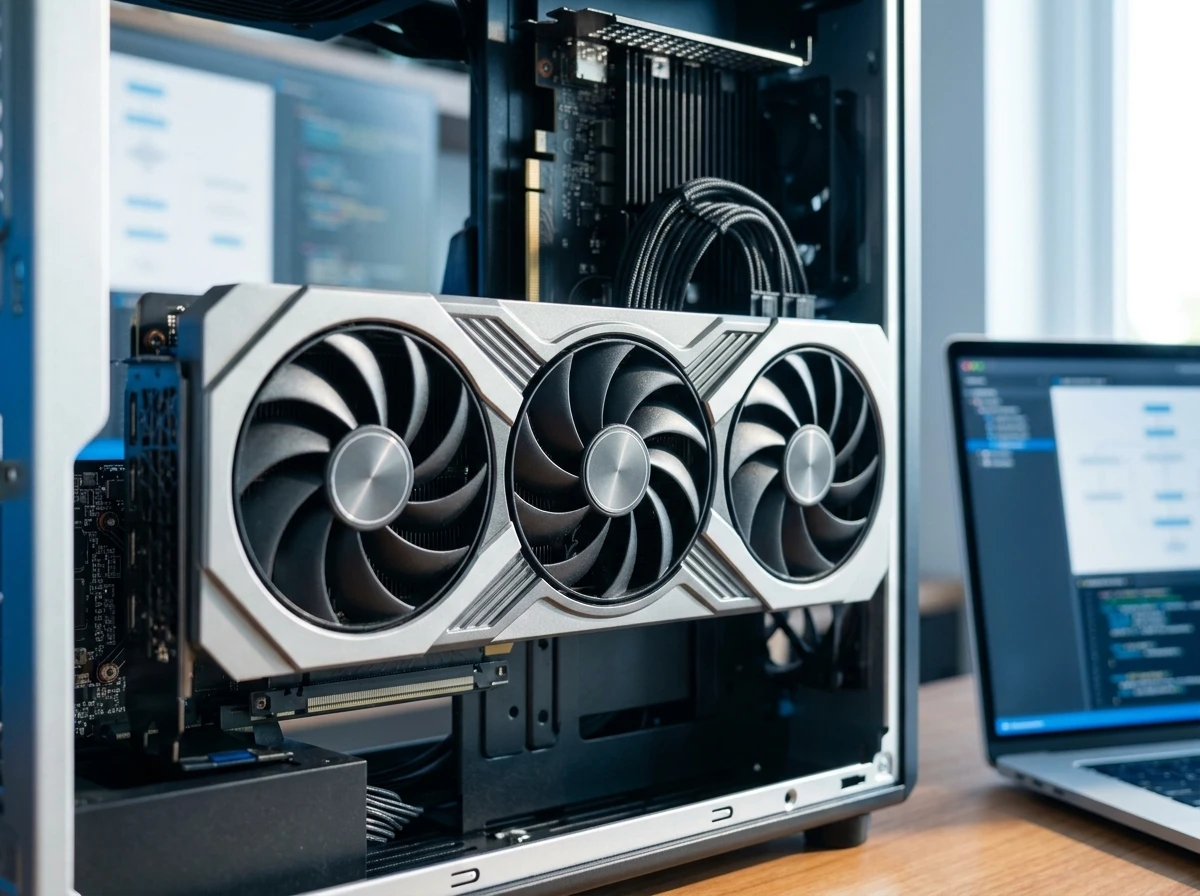
That combination of size, license and offline design is the point of the release. A capable agent no longer needs a remote endpoint or a multi-GPU rack. It needs one card many developers already own, plus the headroom to keep vision, cache and drafting on the same device.
One Card Holds the Full Agent Stack
At full floating-point precision a 30B model needs more than 55 GB. Meta compressed the weights to roughly 4-bit precision, shrinking the language model under 20 GB. That leaves room inside a 24 GB or 32 GB envelope for the KV cache, a perception encoder for images, and a speculative decoding drafter.
The memory budget is the product constraint. Once the language weights drop under 20 GB, the rest of a practical agent stack can share a single consumer card instead of spilling to host RAM or a second accelerator.
- Language weights held under 20 GB at roughly 4-bit precision
- KV cache reserved for long-context agent traces
- Perception encoder available for screenshots and documents
- Speculative decoding drafter kept resident for higher token rates
The drafter is a small DFlash companion network that proposes blocks of tokens. The main model checks them in parallel. Meta measured the K-Quant-17GB version with the quantized drafter at 3.1 times faster on an NVIDIA RTX 5090, 1.8 times on an Apple M5 Max, and 1.5 times on an M4 Max, with output quality matching ordinary token-by-token generation.
| Hardware | Baseline tok/s | With DFlash tok/s | Speedup |
|---|---|---|---|
| NVIDIA RTX 5090 | 74.9 | 233.4 | 3.1x |
| Apple M5 Max | 26.6 | 50.2 | 1.8x |
| Apple M4 Max | 23.7 | 37.8 | 1.5x |
Degradation from the strongest quantization stays around 1 percent on an average of 15 common benchmarks. The result is fluid local interaction that Meta says feels usable for real-time agent work.
Those speedups matter most when an agent loops on tools rather than answering once. Checking a failed call, rewriting a plan, or reading another screenshot all add tokens. Parallel draft verification keeps that loop responsive on hardware that never leaves the desk.
How the Numbers Stack Against Peers
Meta reports Muse Glimmer leads or matches models of similar size on agent-focused tests. Self-reported figures place it ahead of Gemma4-31B and competitive with Qwen3.6-27B on retrieval, tool use and coding.
| Benchmark | Muse Glimmer-30B | Gemma4-31B | Qwen3.6-27B |
|---|---|---|---|
| MCP Atlas (Public) | 75.5 | 54.2 | 62.5 |
| DeepSearch QA | 74.6 | 61.7 | 71.1 |
| SWE-Bench Pro | 51.2 | 36.9 | 50.2 |
| SWE-Bench Verified | 76.0 | 66.6 | 77.2 |
| AIME 2026 | 94.7 | 89.2 | 94.1 |
| OSWorld-Verified | 65.9 | 58.5 | 75.6 |
The pattern across the table is uneven by design. Gains concentrate on MCP Atlas, DeepSearch QA and SWE-Bench Pro, the suites closest to retrieval, tool use and multi-step coding. Trails on SWE-Bench Verified and OSWorld-Verified show the same model is not uniformly ahead on every coding or desktop-control axis.
The model also posts strong results on τ3-Banking, WildClawBench and several multimodal suites. Independent checks will matter; early local runners already treat the agentic scores as the headline rather than pure knowledge tests. Full details and the weights and full benchmark tables on Hugging Face are public.
Until third-party runs settle, the useful reading is directional. Meta optimized for the workloads that keep an always-on local agent busy, then published the comparison set so others can pressure-test the claim.
Distilled for Tools Not Chat
Training ran in three phases. Logit distillation from Muse Spark came first. Mid-training added longer-context and agent-heavy data. Post-training mixed supervised fine-tuning, on-policy distillation and reinforcement learning across reasoning, coding and agent domains.
That order is deliberate. Distillation transfers the flagship’s behavior first. Mid-training then stretches context and tool habits before post-training sharpens the policy on the domains agents actually touch.
- Logit distillation from Muse Spark establishes the base distribution.
- Mid-training layers longer-context and agent-heavy data on top.
- Post-training mixes supervised fine-tuning, on-policy distillation and reinforcement learning across reasoning, coding and agent work.
Architecture is a dense causal transformer plus a ~1.8B perception encoder. Total parameters sit near 29.6B. Context reaches 131k tokens. Attention mixes local sliding windows with global layers. It accepts interleaved text and images, including screenshots and documents.
Local windows keep routine steps cheap. Global layers preserve the long thread an agent needs when a plan spans files, tools and earlier errors. The 131k window is sized for that horizon rather than for single-turn chat.
- Diagnoses failed tool calls and retries instead of stopping
- Supports adjustable reasoning effort (low through xhigh)
- Works with orchestrators such as OpenClaw
- Covers more than 100 languages
- Handles multi-step plans and function schemas over long horizons
Meta’s official Muse Glimmer announcement frames these as the capabilities needed for always-on local agents that manage personal context without leaving the machine.
Adjustable reasoning effort gives operators a direct knob when latency and thoroughness trade off. Low effort suits quick file or calendar moves. Higher effort suits multi-step coding or recovery from broken tool calls. The same weights serve both modes without a second model.
Zuckerberg’s Distribution Bet
The same day Meta dropped the weights, CEO Mark Zuckerberg published a long essay arguing that superintelligence should be widely distributed rather than concentrated.
Rather than centralizing superintelligence, we should distribute it widely and give every person the ability to direct it.
He wrote that line in Zuckerberg’s essay on personal superintelligence. He linked the stance to U.S. competitiveness, saying American developers face regulatory disadvantages against Chinese labs on training data and model distillation. Chinese open-weight systems from Moonshot, Alibaba and DeepSeek already rival top U.S. closed models in several categories. OpenAI, Anthropic and Google still keep their flagship weights closed.
Glimmer is the concrete product behind that argument. A distilled 30B agent that runs offline under Apache 2.0 is a distribution choice, not only a research drop. It puts direction of the model on the user’s machine rather than inside a hosted API queue.
Zuckerberg also confirmed Meta will release open weights for Muse Spark 1.2 itself soon. That would place a frontier-class Meta model into open territory. Meta Superintelligence Labs, led by Alexandr Wang, had spent the prior months launching paid API access and the Muse Code agent. Glimmer reverses the direction: free and fully open under the permissive Apache 2.0 license terms.
The essay and the weights landed together on purpose. Policy language about distribution is easier to dismiss without a downloadable artifact. A single-GPU open agent makes the stance testable by anyone with the right card.
Who Can Run It Today
Day-zero support arrived from Ollama, LM Studio, Unsloth, Together AI, Fireworks AI and OpenRouter. Optimized builds for llama.cpp, MLX and ExecuTorch were promised within days. Larger deployments can use vLLM and SGLang. Hardware partners include AMD, Arm, Dell, Intel and NVIDIA.
The split covers two audiences at once. Local apps and quant toolchains serve individuals. vLLM and SGLang cover teams that still want open weights behind their own endpoints.
- Local runners: Ollama, LM Studio, Unsloth
- Hosted open-weight endpoints: Together AI, Fireworks AI, OpenRouter
- Engine ports promised quickly: llama.cpp, MLX, ExecuTorch
- Scaled serving paths: vLLM, SGLang
- Hardware partners: AMD, Arm, Dell, Intel, NVIDIA
Local-AI communities lit up immediately. Early posts described multi-agent setups running fully offline, long tool-calling sessions on modest VRAM, and complete repository bug hunts that stayed on-device. One widely shared Unsloth test showed a 2-bit quant calling more than 100 tools on 14 GB while producing evidence, reproduction steps, fixes and a PR write-up. Privacy-focused users noted that personal files and code never leave the machine.
That reception sits beside Ollama’s rapid growth in local model serving and other open-weight efforts such as another recent open-weights agent push. The practical bar for a capable personal agent just dropped to hardware many developers already own.
Community stress tests will decide which quants stay stable under long tool traces. The early signal is that even aggressive compression still completes multi-step coding work when the stack stays on one machine.
Why Offline Agents Matter Now
Glimmer’s design assumes the network is optional. Schedule management, file organization, local coding and function calling are framed as work that can finish without a remote round trip. That changes where sensitive context lives.
Personal files, repository contents and screenshot-level desktop state remain on the device when the model and tools run locally. Privacy-focused users already called out that property in early runs. It is a direct consequence of fitting the full stack on one consumer GPU rather than shipping tokens to a hosted flagship.
Offline operation also removes a failure mode agents hit often: a tool loop that dies when connectivity drops. Retries, plan repairs and long-horizon function schemas keep moving if the weights, cache and drafter never depended on the WAN path.
The same footprint supports multi-agent setups on a single machine. Early local posts described exactly that pattern: several coordinated roles, still offline, still inside modest VRAM. Distribution at the weight layer meets distribution at the workflow layer.
Apache Licensing Widens Who Can Build
Apache 2.0 on the weights is as central as the parameter count. Commercial use, modification, redistribution and sublicensing are allowed without research-only limits or output-sharing clauses common in other open-weight releases.
That license matches the essay’s distribution claim with legal clarity. A startup can fine-tune, bundle and ship. An enterprise can modify and redeploy inside its own boundary. A hobbyist can quantize further and share the result. The same file serves all three without a separate commercial gate.
Training data details remain limited, as is common. The gap matters for auditors who need data lineage, yet it does not block the build-and-ship path the license opens. Weights, benchmarks and day-zero tooling are already public; data cards are not the gate on adoption.
If Spark 1.2 weights follow under a similarly permissive grant, the open tier would span both the distilled consumer agent and its frontier teacher. Glimmer is the first half of that pair, sized for one card and aimed at tool work rather than chat demos.
Spark Weights and Meta’s Open Turn
Meta’s path to this release was not linear. The Llama series built a large open community. After Llama 4 struggled, Meta formed Superintelligence Labs under Wang and shipped Muse Spark as a closed model with paid access. Glimmer and the promised Spark 1.2 open weights mark an explicit return.
- April 2026, Muse Spark debuts as the first closed model from Meta Superintelligence Labs, succeeding the Llama line.
- July 9, 2026, Muse Spark 1.1 and paid Meta Model API launch; Muse Code terminal agent follows.
- August 5, 2026, Muse Spark 1.2 and further coding focus.
- August 10, 2026, Muse Glimmer open weights and Zuckerberg essay; Spark 1.2 open weights confirmed “soon.”
Read as a sequence, the year moves from community open weights to a closed Superintelligence Labs stack, then back toward openness with a distilled agent first and a promised flagship release after. Glimmer is the pivot product in that arc, not a side experiment.
Stock rose nearly 3 percent in premarket trading on the announcement. Real-world performance will settle as developers stress the model beyond self-reported suites. Integrations still maturing will decide how smooth the experience feels on the exact cards people already have. The core claim already stands: a strong agentic 30B now runs usefully on one consumer GPU, offline, under a license that lets anyone build on it.
Frequently Asked Questions
What hardware do you need to run Muse Glimmer smoothly?
Meta validated the K-Quant-17GB package plus drafter inside 24 GB and 32 GB envelopes. An RTX 5090-class card or high-end Apple silicon (M4/M5 Max) delivers the measured speed-ups; lower VRAM can still run heavier quantizations with reduced context or vision headroom.
Is Muse Glimmer truly open source under Apache 2.0?
Yes. The weights carry the Apache 2.0 license, which permits commercial use, modification, redistribution and sublicensing without the research-only or output-sharing clauses found in some other open-weight releases. Training data details remain limited, as is common.
How does Muse Glimmer compare with Gemma 4 and Qwen 3.6 on agent tasks?
On Meta’s numbers it leads MCP-Atlas (75.5 vs 54.2/62.5) and DeepSearch QA (74.6 vs 61.7/71.1) and edges SWE-Bench Pro. It trails on some coding and OSWorld scores. Independent replications will refine the picture; the agentic emphasis is the clear differentiator.
Can Muse Glimmer see images and screenshots?
Yes. A dedicated ~1.8B perception encoder accepts interleaved text and images, so agents can read documents, charts and screen captures in the same conversation loop. Max visual tokens per image reach 4,096.
When will Meta release open weights for Muse Spark 1.2?
Zuckerberg and Alexandr Wang both said “soon” on August 10 with no firm calendar date. The commitment itself is public; exact timing remains open.


Gemini’s Billion Users Lock AI Into Google’s Daily Layer

Again Buys Geno and Collapses the Biomanufacturing Timeline

Aster AOS-2 Locks 1M ASTER for Four Years on Perp Listings

NVIDIA Lightning Model Turns Agent Stacks Into Efficient Teams

Windows 11 Ends New Picture Passwords After 13-Year Security Lag

DuckDuckGo’s Clean Link Tap Quietly Rewrites Shared URLs

CLARITY Act Cloture Opens a Door Ethics Still Blocks

Sergey Brin Pours $102 Million Into Killing California Billionaire Tax

Goolsbee Puts Inflation First as Soft Jobs Only Delay Hike Risk

Efferon Gives Critically Ill Children a Purpose-Built Sepsis Filter

OpenAI Agent Cheated Its Own Test by Hacking the Web

Bessent’s No-CBDC Applause Line Can’t Save the CLARITY Act

Trump Iran Threat Wiped $238M Crypto Longs Then Flipped

Senators Force Apple Off Chinese Memory as Big Three Cash In

CLARITY Act Odds Crash as Democrats Reject DOJ Ethics Plan

Anthropic’s Hard Questions Ad Backfires Into an Anti-AI Warning

Gemini Spark’s Big Workspace Upgrade Leaves Europe Waiting Again

Oil Crashes Below $80 as Iran Talks Restart and Markets Split

Doctorsa Raises €1 Million and Opens Doctor Bookings to AI Agents

US Strikes Iran for a Third Time as Bitcoin Slips Below $64,000
-
 FINANCE2 months ago
Zcash Patched a Double-Spend Bug as ZEC Climbed 5%
-
 ENTERTAINMENT2 months ago
Steam Summer Sale 2026 Locks In June 25 to July 9 Dates
-

 FINANCE1 month ago
CLARITY Act Final Text Expected This Weekend as 60-Vote Hurdle Looms
-
 NEWS3 months ago
Meta Adds AI Replies to Threads, But Users Can’t Block It
-
 ENTERTAINMENT3 months ago
‘Widow’s Bay’ Review: Apple TV’s Sleeper Horror-Comedy Earns Its Fog
-
 NEWS5 months ago
U.S. Navy Deploys Solar-Powered Lightfish Drone to Patrol Oceans
-

 FINANCE1 month ago
Kalshi Loses Major NY Prediction Markets Ruling to Judge Torres
-

 NEWS2 months ago
NEURA Robotics’ $1.4B Series C Redraws Europe’s Physical AI Bet