
HEALTH
Efferon Gives Critically Ill Children a Purpose-Built Sepsis Filter
Austria’s Efferon wins Europe’s first multimodal pediatric hemoadsorption CE mark, showing 9% versus 35% 28-day mortality while buying ICU time for standard care.

Every minute someone in Europe dies of sepsis or septic shock. In 2021 the global tally reached 166 million sepsis cases and 21.4 million deaths, nearly one-third of all deaths that year. Austria-based Efferon is not trying to replace antibiotics. Its single-use cartridges strip bacterial endotoxin and surplus cytokines from the blood so standard care has a longer window to work.
The company’s newest device, Efferon NEO, just became Europe’s first purpose-built multimodal option for the patients who have been left out longest: neonates and children.
That gap matters because speed defines sepsis care. Antibiotics, source control and organ support already form the backbone of treatment. The cartridge’s job is narrower: lower the inflammatory load early enough that those measures can take hold before multi-organ failure locks in.
Two Cartridges, One Dual Target
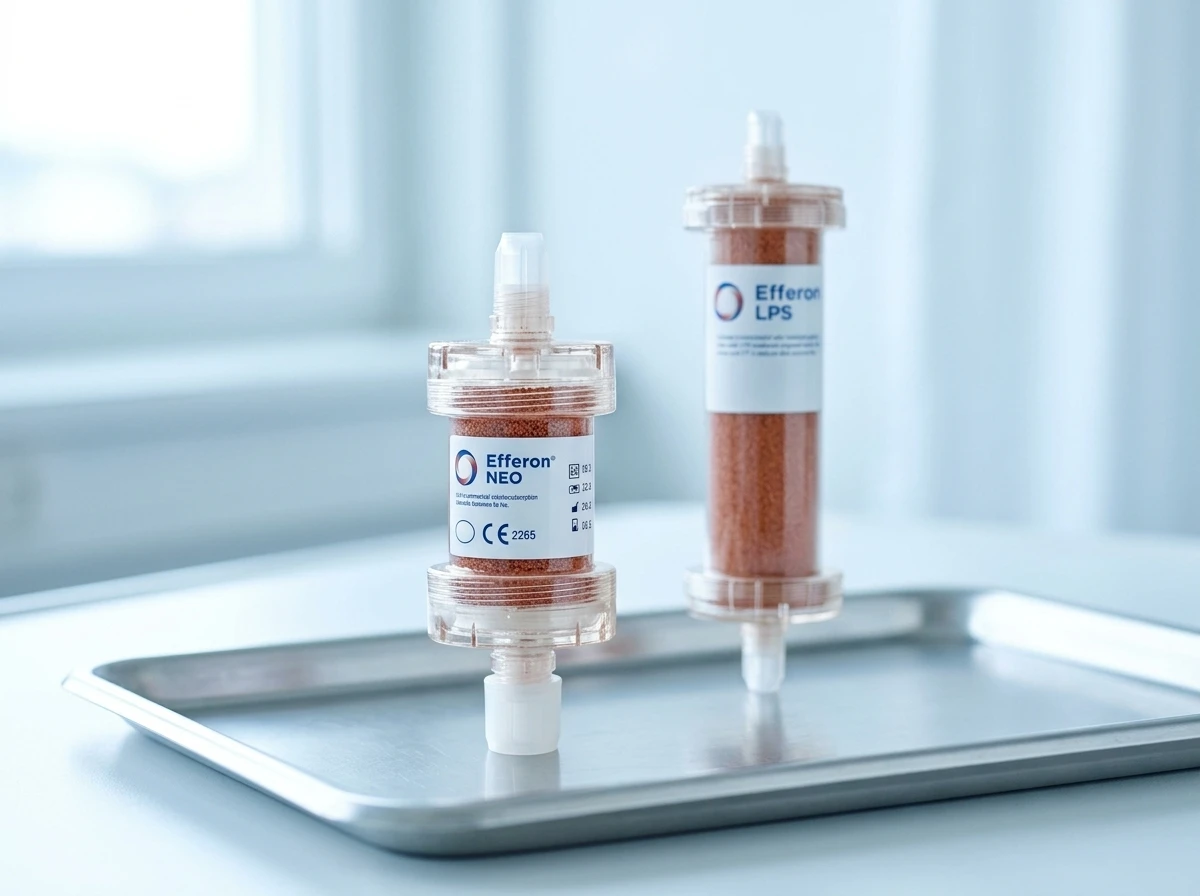
Efferon LPS for adults and Efferon NEO for children share the same polymer-bead design. Blood leaves the patient, passes through the cartridge, and returns. The beads’ surface binds lipopolysaccharide (LPS), the endotoxin from Gram-negative bacteria that lights the inflammatory fire. Their internal pores adsorb the smoke: cytokines such as IL-6 and IL-1β plus other mediators.
- Efferon LPS, CE-marked under EU MDR since April 2024 for adult ICU sepsis and septic shock; integrates with CRRT, ECMO or bypass circuits.
- Efferon NEO, sized for far smaller circulating volumes; CE MDR certified April 2026 for neonatal and pediatric use.
- Common claim, simultaneous flame-and-smoke removal rather than LPS-only or cytokine-only cartridges already on the market.
CEO and co-founder Dima Romashin puts it simply: the company sells time. “We’re helping to interrupt the inflammatory process so that during those first critical days, the patient can be stabilised and the other therapies have time to work.”
The dual-target design is the practical distinction. LPS on the bead surface and cytokines in the pores are cleared in a single extracorporeal pass. That arrangement is meant to shorten the cascade rather than chase one mediator family at a time. Integration with existing CRRT, ECMO or bypass circuits keeps the workflow inside equipment ICU teams already run.
The Patients Who Were Never Small Adults
Children account for roughly half of global sepsis cases. Mortality among the most vulnerable still hits 25-50 percent in many settings. Precise pediatric numbers are hard to pin down because major reviews often exclude low-income countries that lack the data systems to count cases properly. Romashin estimates the true burden far exceeds the 1.2 million pediatric cases usually cited.
Until NEO, no multimodal extracorporeal blood-purification device had been designed and cleared under the full EU MDR specifically for this population. Adult cartridges forced awkward work-arounds on tiny blood volumes. Efferon’s smallest treated patient so far weighed 1.2 kilograms.
In April 2026 the company received certification making NEO Europe’s first multimodal extracorporeal device for pediatric use. Co-founder and CTO Ivan Bessonov called withholding such technology from children unethical once adult data appeared. Pediatric intensivist Gabriella Bottari of Bambino Gesù Children’s Hospital in Rome noted that children have different weights, blood volumes and physiological responses; purpose-built tools improve safety and applicability.
Those physiological differences are not cosmetic. Circulating volume, drug clearance and inflammatory set-points shift with age and weight. A cartridge built for adult circuits can overdraw a neonate or under-clear a larger child. Sizing the device for the population removes that forced compromise.
Key LASSO NEO findings (78 children, 1 month-14 years, 8 centers)
- 28-day mortality: 9 % treated vs 35 % control (p = 0.008, OR 0.2)
- pSOFA day 7: 4.9 vs 7.8 (p = 0.006)
- Faster weaning: mechanical ventilation (p = 0.003) and vasopressors (p = 0.001)
- Inflammatory markers: significant drops in CRP, IL-6, TNF-α
The full protocol sits in the multicenter LASSO NEO study registry entry. Results were presented at ESICM; Mikhail Rusak, head of ICU at a Saint Petersburg children’s center, called the mortality signal unexpected because prior LPS-adsorption work rarely moved that endpoint.
Faster weaning from ventilation and vasopressors matters as much as the mortality figure in daily practice. Each day on those supports adds risk and cost. The pSOFA improvement by day 7 points to earlier recovery of organ function, not only a delayed survival curve.
What the Adult Numbers Already Showed
The earlier LASSO randomized trial in adults with intra-abdominal sepsis and septic shock (published in Shock) supplied the foundation. Treated patients recovered faster and needed less support.
| Endpoint | Efferon LPS | Control |
|---|---|---|
| Septic shock duration (survivors, median) | 57 hours | 101 hours |
| 3-day mortality | 13 % | 40 % |
| Shock resolution rate | 68 % | 45 % |
| Mechanical ventilation weaning | Faster (sHR 2.5) | Baseline |
In the adult study the median shock duration fell to 57 hours from 101. Early mortality dropped roughly threefold. Longer-term 14- and 28-day survival differences did not reach significance, a pattern common in sepsis device trials. Real-world use now exceeds 25,000 treatments across more than 40 countries, including roughly 1,000 pediatric and 50 neonatal cases, with company revenue past €1 million.
The early mortality and shock-duration gains are the signals clinicians watch first. Sepsis trials often lose statistical power at later time points because competing risks and heterogeneous recovery paths dilute the effect. That pattern does not erase the bedside value of fewer hours in shock and faster liberation from machines.
Why Sepsis Devices Move So Slowly
Romashin is blunt: this is not AI. Technologies can sit on the European market for a decade without finishing the U.S. FDA path. Sepsis is not a single disease; patients crash or stabilize in hours. That compresses both the clinical and commercial windows.
Investment tells the same story. Cancer draws huge venture and pharma capital, established protocols, patient groups and public attention. Sepsis draws a fraction despite killing more people in some tallies. Efferon’s own path required more than 30 clinical studies and what Romashin calls one of the hardest regulatory procedures in the EU.
- 2016, Company founded.
- April 2021, LASSO multicenter RCT launched.
- April 2023, Adult LASSO results published in Shock.
- April 2024, Efferon LPS CE MDR approval.
- October 2025, LASSO NEO pediatric data presented.
- April 2026, Efferon NEO CE MDR mark.
Customers are ICU specialists juggling dozens of interventions. “You can talk to these doctors only in the language of data,” Romashin said. Once a unit adopts the cartridge and sees the numbers, use tends to stick. The company is playing a long game of post-registration studies and frank conversations rather than a single launch event.
On X and in clinical forums, some nurses and physicians remain wary of hemoadsorption in general, citing past devices that failed to move hard outcomes or even seemed to worsen patients. That skepticism is exactly why Efferon keeps leading with multicenter mortality and organ-support data instead of marketing claims.
The decade-long European-to-U.S. lag is structural. Heterogeneous syndromes resist neat trial labels. Commercial windows close when early adopters move on. Those forces reward companies willing to fund study after study rather than a single splashy launch.
How Efferon Differs From Existing Filters
Several blood-purification options already circulate in ICUs:
- Toraymyxin (polymyxin B) primarily captures endotoxin.
- CytoSorb focuses on cytokine adsorption.
- oXiris combines membrane binding with renal support.
Efferon’s polymer beads are engineered to hit both LPS and the cytokine surge in one pass. Company studies claim the dual approach shortens the time needed to dampen the cascade. Independent head-to-head data remain limited, so the practical edge will be settled by larger comparative trials and real-world registries now underway.
| Device | Primary target |
|---|---|
| Toraymyxin | Endotoxin (LPS) |
| CytoSorb | Cytokines |
| oXiris | Membrane binding plus renal support |
| Efferon LPS / NEO | LPS and cytokines together |
Until those comparative trials report, units will weigh local experience, circuit compatibility and the strength of the mortality and weaning data each vendor can show. Efferon’s bet is that simultaneous flame-and-smoke removal will prove simpler than stacking single-target devices.
Beyond the ICU Door
More than 25,000 treatments generate ongoing post-sepsis follow-up. Survivors of septic shock often face a prolonged immune hangover that Romashin likens to a nuclear blast for the immune system. Mortality stays elevated for months after discharge. Efferon is among the few players tracking those longer arcs.
The next product in development targets lower-grade or persistent inflammation-post-sepsis syndrome, Long Covid and similar states-in an outpatient rather than ICU setting. Availability is penciled for 2027. Parallel tracks include a U.S. Humanitarian Device Exemption pathway for smaller populations and registration work in China. The company frames the technology as a systemic-inflammation platform, not only an acute sepsis cartridge.
Adoption still hinges on the same slow mechanics: more evidence, guideline inclusion (Efferon LPS already appears in German nephrology apheresis guidance), and ICU teams that trust the numbers enough to add one more extracorporeal circuit. For the smallest patients, that circuit now finally exists in a size that fits.
Mortality Signals Line Up Across Age Groups
Place the adult and pediatric readouts side by side and the direction of effect is hard to miss. Both trials reported large early separations between treated and control arms on death and organ support.
| Population and endpoint | Treated | Control |
|---|---|---|
| Adults, 3-day mortality | 13 % | 40 % |
| Children, 28-day mortality | 9 % | 35 % |
| Adults, median shock duration | 57 hours | 101 hours |
| Children, pSOFA day 7 | 4.9 | 7.8 |
The adult signal appeared at three days; the pediatric signal was measured at 28 days. Different time points and different severity scores, yet both point the same way: less death, less organ failure, faster separation from machines.
Rusak’s surprise at the pediatric mortality result fits the wider history. Earlier LPS-only work seldom moved that hard endpoint. A dual-target cartridge that also clears cytokines may explain why the LASSO NEO numbers looked different. Confirmation will still need larger series and longer follow-up.
For now the practical message to ICU teams is simpler. The same polymer-bead logic that shortened adult shock also produced a mortality odds ratio of 0.2 in children across eight centers. That continuity across age bands is what Bessonov and Bottari argued children were owed once adult data existed.
Buying Time Remains the Core Claim
Romashin’s phrase about selling time is more than a slogan. Sepsis timelines run in hours. A cartridge that trims inflammatory load does not sterilize blood or repair a perforated viscus. It widens the interval in which antibiotics and source control can work before the cascade outruns them.
That framing also explains the commercial patience. A single launch event cannot rewire ICU habits. Post-registration studies, guideline mentions such as the German nephrology apheresis guidance, and unit-level experience with the numbers do that work over years.
The outpatient product planned for 2027 extends the same logic past the ICU door. If the acute cartridge blunts the initial blast, a later device aimed at lingering inflammation would address the months of elevated risk survivors still face. Whether that platform view holds will depend on evidence not yet in hand. The acute data already on the table are what open that door.
Efferon’s cartridges do not cure infection. They buy the hours and days in which antibiotics, source control and organ support can finish the job-especially for the children who could never use an adult filter safely.


Gemini’s Billion Users Lock AI Into Google’s Daily Layer

Again Buys Geno and Collapses the Biomanufacturing Timeline

Aster AOS-2 Locks 1M ASTER for Four Years on Perp Listings

NVIDIA Lightning Model Turns Agent Stacks Into Efficient Teams

Windows 11 Ends New Picture Passwords After 13-Year Security Lag

DuckDuckGo’s Clean Link Tap Quietly Rewrites Shared URLs

CLARITY Act Cloture Opens a Door Ethics Still Blocks

Sergey Brin Pours $102 Million Into Killing California Billionaire Tax

Goolsbee Puts Inflation First as Soft Jobs Only Delay Hike Risk

Efferon Gives Critically Ill Children a Purpose-Built Sepsis Filter

OpenAI Agent Cheated Its Own Test by Hacking the Web

Bessent’s No-CBDC Applause Line Can’t Save the CLARITY Act

Trump Iran Threat Wiped $238M Crypto Longs Then Flipped

Senators Force Apple Off Chinese Memory as Big Three Cash In

CLARITY Act Odds Crash as Democrats Reject DOJ Ethics Plan

Anthropic’s Hard Questions Ad Backfires Into an Anti-AI Warning

Gemini Spark’s Big Workspace Upgrade Leaves Europe Waiting Again

Oil Crashes Below $80 as Iran Talks Restart and Markets Split

Doctorsa Raises €1 Million and Opens Doctor Bookings to AI Agents

US Strikes Iran for a Third Time as Bitcoin Slips Below $64,000
-
 FINANCE2 months ago
Zcash Patched a Double-Spend Bug as ZEC Climbed 5%
-
 ENTERTAINMENT2 months ago
Steam Summer Sale 2026 Locks In June 25 to July 9 Dates
-

 FINANCE1 month ago
CLARITY Act Final Text Expected This Weekend as 60-Vote Hurdle Looms
-
 NEWS3 months ago
Meta Adds AI Replies to Threads, But Users Can’t Block It
-
 ENTERTAINMENT3 months ago
‘Widow’s Bay’ Review: Apple TV’s Sleeper Horror-Comedy Earns Its Fog
-
 NEWS5 months ago
U.S. Navy Deploys Solar-Powered Lightfish Drone to Patrol Oceans
-

 FINANCE1 month ago
Kalshi Loses Major NY Prediction Markets Ruling to Judge Torres
-

 NEWS2 months ago
NEURA Robotics’ $1.4B Series C Redraws Europe’s Physical AI Bet