
NEWS
AI Training Spikes Fry Gear and Force Rare Grid Alert
Spiky AI training loads damage transformers and UPS systems inside campuses while NERC’s rare Level 3 alert forces new modeling and controls on computational demand.

NERC issued its rare Level 3 Essential Action Alert on May 4 after data centers dropped more than 1,000 MW in seconds and AI training loads began frying their own transformers, batteries and cooling gear. Responses were due August 3. The same power pattern that trains frontier models is now the reliability constraint.
Customer-initiated load reductions and rapid oscillations left operators little time to react. Equipment sized for steady compute is wearing out early. Grid planners and campus builders face the same ironic bind: more capacity creates more of the volatility that delays the next cluster.
The Alert That Raised the Bar
The North American Electric Reliability Corporation called computational loads an immediate risk to the bulk power system. That category covers artificial intelligence training, cryptocurrency mining and conventional data centers. A prior Level 2 recommendation had already shown that most entities lacked processes for these loads.
Level 3 is uncommon. It requires registered entities to acknowledge receipt and report status on specific steps. It does not create new enforceable standards or automatic penalties, yet it sits one rung below mandatory reliability rules and feeds later standard development.
- 1,000+ MW customer-initiated drops observed in seconds
- 33 GW of U.S. data-center load reviewed; roughly three-quarters of models judged insufficient
- August 3, 2026 response deadline for the alert
- 24% projected rise in summer peak demand over ten years, driven largely by data centers
Transmission planners, planning coordinators, transmission owners, balancing authorities, reliability coordinators and transmission operators must act. The alert pairs with a voluntary reliability guideline for large loads that covers resource adequacy, firm versus flexible demand and behind-the-meter resources.
Spikes That Hit Like a Gear Crash
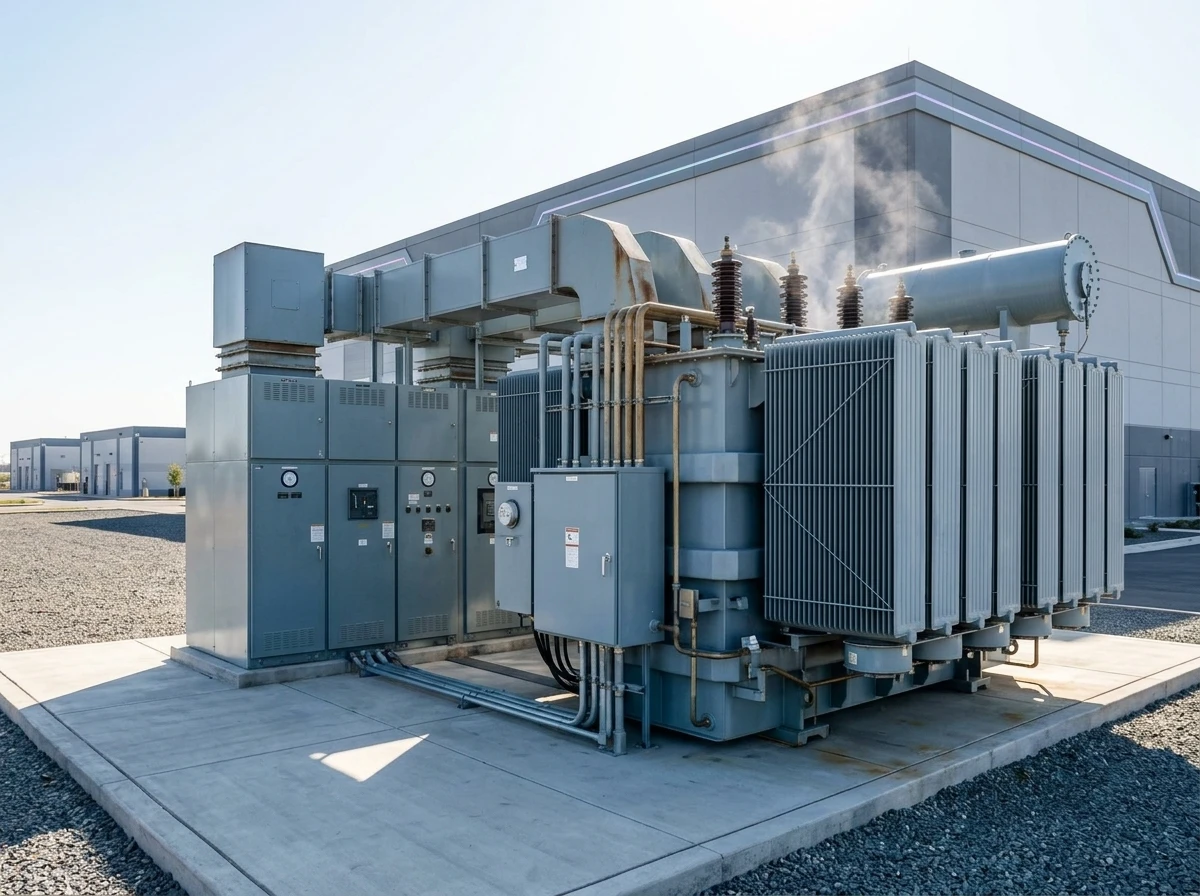
AI training does not draw power like a factory. Hundreds of thousands of GPUs can ramp together in milliseconds. Loads swing tens of megawatts inside a single block. One gigawatt campus can briefly pull 1.5 GW, a 50 percent overshoot above design.
Engineers compare the motion to shifting a high-performance engine from sixth gear straight into first. The shocks land on every piece of gear between the rack and the substation.
| Component | Failure mode | Observed effect |
|---|---|---|
| Medium-voltage transformers | Repeated thermal cycling and harmonics | Overheating, accelerated aging, multi-month replacement waits |
| UPS and batteries | Frequent ramp and high discharge rates | Wear in weeks or months instead of years |
| Gas turbines / generators | Rapid load following | Cracks at sites including xAI Colossus in Memphis |
| Liquid-cooling pumps and valves | Clustered thermal peaks | Mechanical stress, higher leak and failure rates |
| Switchgear and protection | Synchronized start-ups and trips | Unwanted protection trips, arc-flash risk to chips |
When a large transformer fails, global backlogs stretch timelines by months. Idle crews and delayed model roadmaps raise capital cost. Some operators report effective uptime nearer 80 percent than the 99.999 percent designs assume. Lost compute minutes can cost thousands to hundreds of thousands of dollars.
Why the Grid Sees a Domino Risk
Data-center protection is tuned tighter than ordinary industrial loads. Minor voltage or frequency dips trigger automatic disconnection to shield expensive GPUs. When many sites trip together, generation suddenly exceeds load. Frequency rises. More equipment can trip. Cascading blackouts become plausible.
NERC documented multiple events of this type since 2022. Operators cannot respond in real time when the drop finishes in seconds. Modeling that treated data centers as ordinary industrial demand missed the dynamic behavior. That gap is what the Level 3 actions target.
Crowd discussion on X has zeroed in on the same point: the scarce asset is no longer only the GPU. It is the power electronics and grid iron that can absorb millisecond-scale switches without breaking. Average megawatts matter less than the rate of change.
Builders, Utilities and Insurers Share the Bill
Hyperscalers and colocation developers absorb direct repair and delay costs. A West Texas campus planned with Microsoft moved power delivery from 2027 into 2028 after baking extra engineering time for reliability. Financiers already nervous about depreciation rates now face higher maintenance capex embedded in every gigawatt.
Utilities confront interconnection queues that already stretch years for multi-hundred-megawatt campuses. Feeder and transformer bank lead times do not match training schedules that shift on short notice. Ratepayers ultimately underwrite the transmission upgrades and any curtailment programs.
Insurers are reassessing risk models for high-density compute rooms. Equipment manufacturers face both windfall demand and liability questions when gear fails early. The pattern also sits inside broader regulatory scrutiny of AI systems; bank examiners now probe AI kill switches in routine exams, a parallel reminder that fast algorithms meet slow infrastructure rules.
- May 2025-ish prior Level 2, Industry recommendation on large-load interconnection and operations; responses revealed thin processes.
- May 4, 2026, Level 3 Essential Action Alert issued with seven required reporting steps.
- May 11, 2026, Acknowledgment deadline.
- August 3, 2026, Full response deadline; anonymized summary heads to FERC for U.S. entities.
- Ongoing, Standards project and possible Computational Load Entity registration criteria under development.
After the timeline, the practical pressure is already visible in siting choices and contract language.
Seven Actions and On-Site Counters
The alert lists concrete steps. Transmission planners and planning coordinators must build a detailed modeling-data list and push it into interconnection requirements. They must collect seasonal min/max megawatts, power factor, IT versus non-IT composition, expected ramp rates, protection settings, reconnect timing and on-site generation details. Planning coordinators revise the triggers that force stability and protection studies. Transmission operators create commissioning processes that test full load, no load and at least a 10 percent voltage step where possible, and install dynamic fault recording.
Those are the seven essential actions for computational loads. Entities without near-term computational load may defer, but anyone who could receive a request is expected to prepare.
On the campus side, operators are testing battery buffers, smarter job schedulers that stagger training starts, power electronics that damp harmonics, and cooling designs with extra thermal headroom. Some run dummy side computations simply to keep GPU power flatter; the practice burns extra electricity and draws criticism. Co-location with generation plus large batteries is rising as a design default. Regions with clearer interconnection queues and available transmission win siting decisions.
AI does create very unusual power demand. It’s like over-revving your car wears out the engine faster than keeping a constant speed.
Amber Villegas-Williamson, principal consultant at the Uptime Institute, made the comparison after surveying operators facing premature wear.
Signals That Show Whether the Pressure Eases
Watch four indicators. First, interconnection queues in high-load zones and any new pause or fast-track rules. Second, lead times and prices for large transformers and switchgear; multi-year waits already reshape project finance. Third, adoption rates of demand-smoothing software and on-site storage across training pipelines. Fourth, any enforceable ramp-rate limits, peak charges or ride-through requirements that move from guideline into standard.
Short-term fixes buy time: flatter peaks, hardened gear, tighter forecasts. Longer term, training schedules may shift to off-peak windows or distant regions that still have headroom, adding latency and network cost. Some capacity will simply wait for wires. The same industry that races for the next model parameter count is learning that the grid sets part of the calendar.
Rights and data questions already shape AI economics elsewhere; AI training rights tied to news fees show how access rules can rewrite cost structures. Power discipline is becoming the parallel constraint.
The alert does not announce rolling blackouts. It does mark the moment when computational load stopped being treated as just another industrial customer. Training at scale now has to respect the physics of ramps, harmonics and protection, or the physics will keep writing the schedule.


Uber Bets $10 Billion Cash on Robotaxi Platform Play

Ahbstra ARK Pulls 500 Litres Daily From Dry Mediterranean Air

Nest Thread 1.4 Quietly Unifies Multi-Brand Smart Home Meshes

Cable Gateways Push Wi-Fi 7 Past Early Adopters in the US

Pixel Quick Settings Finally Gets Full Layout Reorder in Canary 2608

WhiteBIT Spot Bots Fill UK Gap Left by Derivatives Ban

Motorola Edge 70 Neo Leak Doubles Down on Bold Pantone Colors

Platter Turns Food Spreadsheets Into Sticky Supply Infrastructure

Circle Puts Native USDC on OKX X Layer for AI Rails

Real Cops Keep Super Troopers Rolling After 25 Years

Marker AI Writing Startup Lands $13M Seed Led by Index Ventures

Meta’s Muse Spark 1.1 Beats Rivals on Price, Trails on Coding

CS2 Premier Season 5 Lands With Cache and a C4 Damage Rework

Taiwan Margin Debt Climbs 160% as Locals Borrow Into the TSMC Rally

Trump Iran Threat Wiped $238M Crypto Longs Then Flipped

Bessent’s No-CBDC Applause Line Can’t Save the CLARITY Act

Nintendo’s Switch 2 Battery Fix for Europe Comes With a Catch

CLARITY Act Odds Crash as Democrats Reject DOJ Ethics Plan

Audi’s 2026 S5 Bets That Restraint Beats the Horsepower Wars

Lissi Raises €3.5M to Scale EUDI Wallet Connectors Across Europe
-
 FINANCE2 months ago
Zcash Patched a Double-Spend Bug as ZEC Climbed 5%
-
 ENTERTAINMENT2 months ago
Steam Summer Sale 2026 Locks In June 25 to July 9 Dates
-

 FINANCE1 month ago
CLARITY Act Final Text Expected This Weekend as 60-Vote Hurdle Looms
-
 NEWS3 months ago
Meta Adds AI Replies to Threads, But Users Can’t Block It
-
 NEWS5 months ago
U.S. Navy Deploys Solar-Powered Lightfish Drone to Patrol Oceans
-
 ENTERTAINMENT3 months ago
‘Widow’s Bay’ Review: Apple TV’s Sleeper Horror-Comedy Earns Its Fog
-
 FINANCE2 months ago
CLARITY Act Floor Vote Likely Shifts to August, Lummis Says
-

 FINANCE1 month ago
Kalshi Loses Major NY Prediction Markets Ruling to Judge Torres