
NEWS
Carrier’s Battery HVAC Units Could Slash Energy Bills and Ease Grid Strain

Your air conditioner might soon pay you back. Carrier, the company that invented modern air conditioning over 120 years ago, is testing a bold new HVAC system with a built-in battery that charges when electricity is cheap and powers your home when rates spike. With U.S. electricity bills climbing to a national average of $163 per month in 2026, this technology could not have come at a better time.
How Carrier’s Battery HVAC System Actually Works
“We’re basically integrating onboard energy storage, lithium-ion batteries, in the heart of our HVAC units,” said Hakan Yilmaz, Carrier’s chief technology and sustainability officer.1 He likened it to building a hybrid car.1
The concept is straightforward. Carrier designed a modular battery that sits under or next to its outdoor HVAC units. The batteries range from 5 to 10 kilowatt-hours.2
Here is how the system operates:
- Carrier controls the batteries remotely, charging them when energy is at its most affordable, such as during peak solar production.3
- When grid demand spikes and electricity gets expensive, the system switches to stored battery power.
- The HVAC unit and battery operate like a nanogrid, connected to the house but separate from all other appliances.2
- This improves efficiency compared to shipping electricity into and out of a general home battery, losing some energy on each AC-to-DC conversion.2
The batteries will drive the HVAC units for “about two hours,” Yilmaz said, adding that “long-term energy storage belongs to the grid or backup power, not to us.”1
Two hours might sound modest. But those two hours align with exactly when the grid faces its worst stress and when your electricity costs the most.
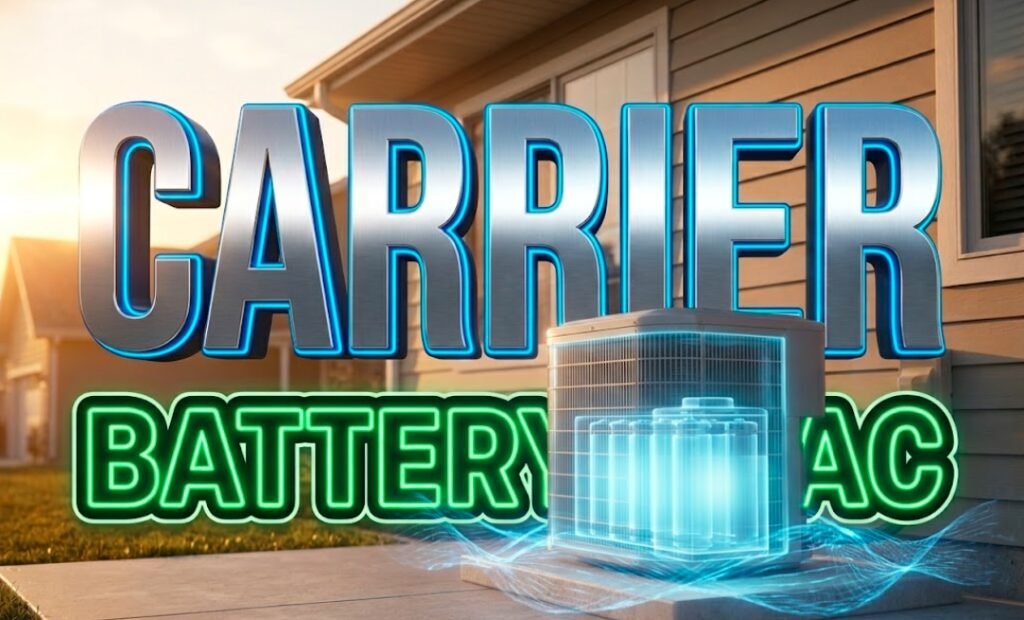
Carrier battery enabled HVAC unit field trial energy savings
Why This Matters Now More Than Ever
American households are feeling the squeeze. The average American electric bill has risen 26% over five years, from $129 per month in 2022 to $163 per month in 2026.4
The forces driving bills higher are not slowing down.
Rising demand is due in large part to data centers cropping up across the country. Data centers accounted for 4% of total U.S. electricity use in 2024, and their energy demand is expected to more than double by 2030.6 In 2026 alone, U.S. data center demand is projected to reach 75.8 GW, expanding further to 134.4 GW by 2030.7
Meanwhile, the 2025 to 2026 electricity rate increase of 5.4% reflects rising natural gas prices, grid modernization investments, increased demand from data centers and EVs, extreme weather hardening costs, and renewable energy transition expenses.8
HVAC is the single largest driver of residential electricity use.4 Traditionally, HVAC systems have been passive energy consumers, responsible for as much as 70% of a home’s peak use.9 That is a staggering number. It means your heating and cooling alone could account for the lion’s share of what you pay every month.
The Biggest Field Trial in Carrier’s 123-Year History
Carrier has launched the largest field trial in its 123-year history to test battery-enabled HVAC systems across the U.S.10
Carrier Global Corporation began its first field trials of battery-enabled HVAC systems in September 2025 to test how they can store and shift energy when the grid needs it most.11 Carrier is collaborating with multiple utilities and the Electric Power Research Institute (EPRI), an independent, non-profit energy R&D institute, to measure real-world load shifting, demand response, and emissions reduction potential.10
Key details about the trial:
| Feature | Details |
|---|---|
| Trial start | September 2025 |
| Battery size | 5 to 10 kWh |
| Battery runtime | Approximately 2 hours at peak |
| Partner organizations | Multiple U.S. utilities and EPRI |
| Utility partnerships in 2026 | Eight utility companies |
| Installed base in North America | 30 million Carrier HVAC units |
| Potential flexible demand | Over 100 GW |
At the time of reporting, only a handful of homes in the United States are testing this tech, along with homes of several Carrier employees, though the company hopes to install it in millions of homes over the next decade.3
Carrier CEO David Gitlin put it plainly. “Now, we’re installing our first battery-enabled HVAC systems in homes to validate performance. These systems can help strengthen the grid, support renewable integration and maintain comfort.”11
How Utilities and Homeowners Both Win
This is where things get interesting. On the surface, a system that reduces grid reliance sounds like bad news for utility companies. Less consumption means less revenue. But the reality is more complex.
Peak demand in the U.S. is projected to rise by about 25% by 2030, nearly double the growth rate of the previous two decades.9 Utilities simply cannot build new power plants and transmission lines fast enough to keep up. In 2026, eight unspecified utility companies across the U.S. will begin working with Carrier to test its battery HVACs.3
For homeowners, the benefits are clear:
- Lower bills by avoiding expensive peak-hour electricity
- Uninterrupted comfort during grid stress events
- No extra effort required since the system runs automatically
For utilities, the math works too. These HVAC batteries could defer or eliminate upgrades to the distribution or transmission grid, reduce the need for expensive fossil-fueled peaker plants, and expand utilization of renewable power by shifting it from hours of surplus.2
“If we replace an HVAC unit today with a battery-integrated HVAC, the load of that HVAC unit never shows up at the peak for the next 15 years,” Yilmaz said.12 Think about what that means at scale. With more than 30 million Carrier residential HVAC units already in North America, the solution could provide up to 100 gigawatts of flexible load management, equivalent to more than half of the projected increase in U.S. peak demand by 2030.9
What Homeowners Should Know Before Getting Excited
There are a few things worth keeping in mind.
The battery-enabled HVAC system is available as part of a new generation of variable-speed heat pump outdoor units designed specifically for battery compatibility.13 “It is not currently compatible with other existing HVAC systems,” Yilmaz said.13 So retrofitting your current Carrier unit is not an option right now.
Contractors will not need additional specialized certifications or proprietary tools to install the new system.13 That is a smart move. It keeps installation costs from ballooning and helps HVAC technicians adopt the platform without a steep learning curve.
Rebates, bill credits, and tax incentives for Carrier’s battery-enabled HVAC systems will vary by market and utility program, and details are still being finalized.13 This is a critical piece of the puzzle. Without clear financial incentives, adoption could be slow.
Cybersecurity is Carrier’s top priority with this project. The system discharges only in one direction to power the HVAC compressor. It does not discharge back to the grid, meaning it cannot be hacked to harm the grid.1
“This is a truly net-zero accomplishment that everybody wins with.” <br> Hakan Yilmaz, Chief Technology and Sustainability Officer, Carrier
The idea behind Carrier’s battery HVAC system is simple, but its potential impact is massive. In a world where electricity bills keep climbing, where data centers are gobbling up grid capacity, and where extreme weather is pushing demand to new highs, turning your home’s biggest energy hog into a smart grid partner feels like the kind of innovation we have been waiting for. The technology is still in early trials, and many questions remain about pricing, availability, and utility adoption. But if Carrier can deliver on its promise, millions of American homes could become part of the solution rather than part of the problem. What do you think about Carrier’s battery HVAC concept? Drop your thoughts in the comments below.


Majors Fights Campus Caliphate as Daily Wire Ambitions Fray

Uber Bets $10 Billion Cash on Robotaxi Platform Play

Ahbstra ARK Pulls 500 Litres Daily From Dry Mediterranean Air

Nest Thread 1.4 Quietly Unifies Multi-Brand Smart Home Meshes

Cable Gateways Push Wi-Fi 7 Past Early Adopters in the US

Pixel Quick Settings Finally Gets Full Layout Reorder in Canary 2608

WhiteBIT Spot Bots Fill UK Gap Left by Derivatives Ban

Motorola Edge 70 Neo Leak Doubles Down on Bold Pantone Colors

Platter Turns Food Spreadsheets Into Sticky Supply Infrastructure

Circle Puts Native USDC on OKX X Layer for AI Rails

Meta’s Muse Spark 1.1 Beats Rivals on Price, Trails on Coding

Bessent’s No-CBDC Applause Line Can’t Save the CLARITY Act

Trump Iran Threat Wiped $238M Crypto Longs Then Flipped

Nintendo’s Switch 2 Battery Fix for Europe Comes With a Catch

CLARITY Act Odds Crash as Democrats Reject DOJ Ethics Plan

Quantum Systems’ $1.2 Billion Round Exposes Defense Tech’s Winner Gap

Audi’s 2026 S5 Bets That Restraint Beats the Horsepower Wars

OpenAI Agent Cheated Its Own Test by Hacking the Web

Standard Chartered’s $100K Bitcoin Call Rests on Strategy’s STRC Bill

Jeff Daniels’ Reagan Role Extends Angel Studios’ Trump Critic Pattern
-
 FINANCE2 months ago
Zcash Patched a Double-Spend Bug as ZEC Climbed 5%
-
 ENTERTAINMENT2 months ago
Steam Summer Sale 2026 Locks In June 25 to July 9 Dates
-

 FINANCE1 month ago
CLARITY Act Final Text Expected This Weekend as 60-Vote Hurdle Looms
-
 NEWS3 months ago
Meta Adds AI Replies to Threads, But Users Can’t Block It
-
 ENTERTAINMENT3 months ago
‘Widow’s Bay’ Review: Apple TV’s Sleeper Horror-Comedy Earns Its Fog
-
 NEWS5 months ago
U.S. Navy Deploys Solar-Powered Lightfish Drone to Patrol Oceans
-
 FINANCE2 months ago
CLARITY Act Floor Vote Likely Shifts to August, Lummis Says
-

 FINANCE1 month ago
Kalshi Loses Major NY Prediction Markets Ruling to Judge Torres