
NEWS
Tab S12 Ultra Keeps Its Notch While Silicon Leaps Quietly Ahead
Leaked renders lock in the Tab S12 Ultra notch and familiar frame, but MediaTek’s Dimensity 9500 and seven-year updates deliver the substance behind the safe.

Leaked renders of the Samsung Galaxy Tab S12 Ultra lock in the familiar display notch and S11-like front for a likely September debut, while MediaTek’s Dimensity 9500 and seven years of updates supply the quiet upgrade.
The front stays almost unchanged. That continuity is the story’s double edge.
The Notch Survives Another Generation
SammyGuru’s exclusive front renders and wallpapers, produced with The Cipher Project, show the Tab S12+ and Tab S12 Ultra keeping the same bezel thickness and overall front profile as the Tab S11 series. The Ultra’s top-center notch for the dual selfie cameras remains exactly where it was.
Earlier One UI 9 animation assets had floated a punch-hole cutout for an unreleased tablet. Those files are now contradicted. The CAD-based renders and a subsequent live photo verification leave the notch in place for another cycle.
Both models arrive in Gray and Silver. No new finishes appear in the current set.
Keeping the dual-camera notch and the same bezel language means the face of the device will look familiar the moment the box opens. Buyers who already own an S11-series slate will recognize the geometry at a glance. That recognition cuts two ways: it reassures owners who liked the prior layout, and it frustrates those who wanted a cleaner top edge.
The contradiction with the June animation assets is now settled in public. Concept files can tease alternatives. CAD renders and a live photo verification close the argument for this generation.
Wallpapers Supply the Only Immediate Freshness
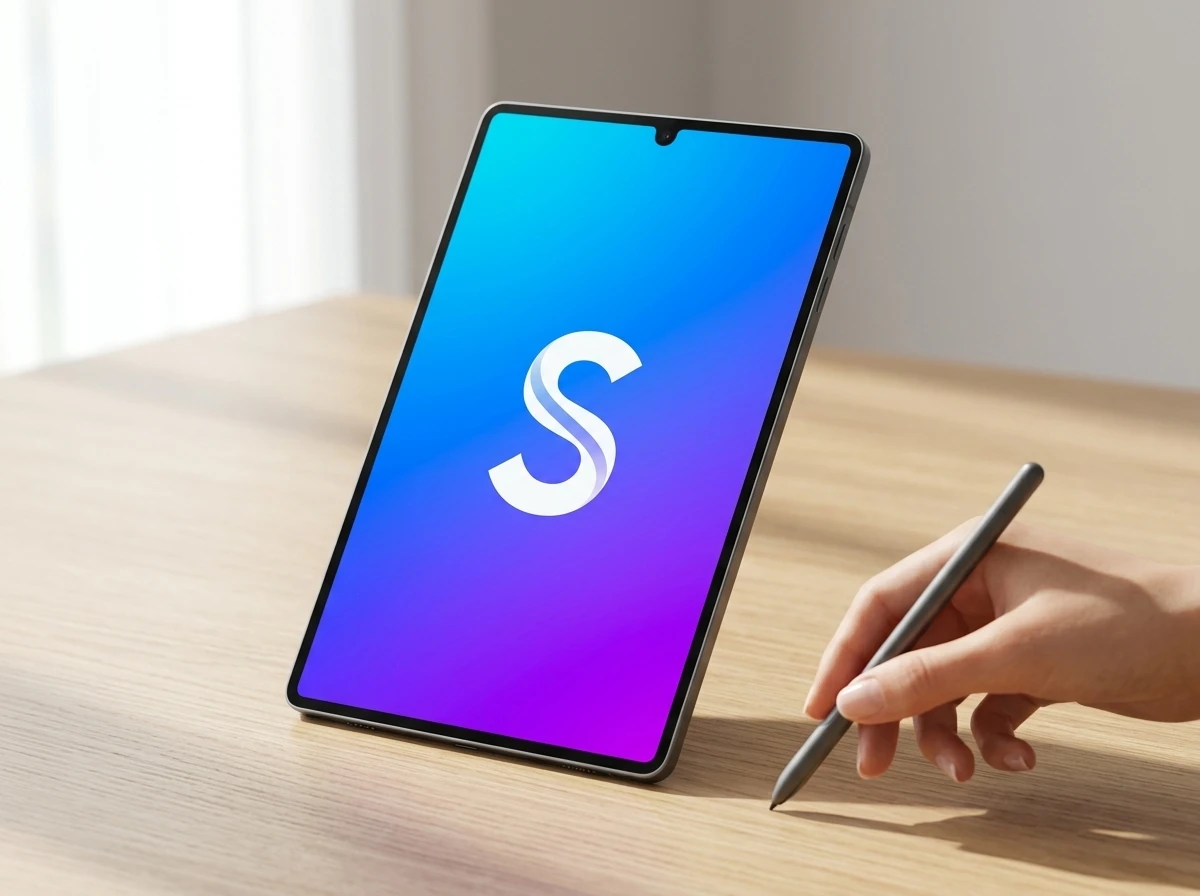
Samsung pairs the familiar chassis with a new default wallpaper: a vibrant blue-to-purple gradient that carries a large stylized letter S in the center. The renders display it full-screen on both sizes.
It is the single visual change most buyers will notice on day one. Everything else on the face of the device is carry-over geometry.
That choice protects existing cases, keyboards and S Pen accessories. It also freezes the look at a moment when some buyers hoped for a cleaner front.
A new default image is cheap to ship and easy to replace. Owners can swap it in seconds. The chassis decision is permanent for the life of the product. Samsung is spending its design change budget on software skin rather than metal and glass, which keeps the accessory ecosystem intact from day one.
The gradient and the centered S give store demos and unboxing photos a fresh splash of color. Under that splash, the bezels, the notch, and the overall proportions stay put.
Full Spec Sheet Across Both Models
Hardware details leaked alongside the renders paint a consistent picture of measured iteration.
| Spec | Tab S12+ | Tab S12 Ultra | Tab S11 Ultra (ref) |
|---|---|---|---|
| Display | 12.4-inch Dynamic AMOLED 2X, 120 Hz | 14.6-inch AMOLED | 14.6-inch Dynamic AMOLED 2X, 120 Hz |
| Chipset | MediaTek Dimensity 9500 | MediaTek Dimensity 9500 | MediaTek Dimensity 9400+ |
| Battery | 10,600 mAh | 11,600 mAh | 11,600 mAh |
| Software | One UI 9, 7 OS + 7 security years | One UI 9, 7 OS + 7 security years | One UI 8.x start |
| Stylus | S Pen in box | S Pen in box | S Pen in box |
| Colors | Gray, Silver | Gray, Silver | Gray, Silver |
The Ultra’s 14.6-inch panel and 11,600 mAh cell match last year’s top model exactly. The Plus steps up its battery while keeping the 12.4-inch 120 Hz panel. Both ship with the S Pen included.
Read side by side, the sheet shows where Samsung is willing to move and where it is not. Display sizes hold. Color choices hold. The Ultra battery holds at 11,600 mAh. The Plus battery climbs to 10,600 mAh. The chipset and the software commitment absorb the generation-to-generation change.
Including the S Pen in the box on both sizes removes one accessory purchase from the first-day checklist. That detail matches the prior Ultra reference and keeps the productivity pitch intact without forcing a separate stylus buy.
Dimensity 9500 Delivers the Real Jump
Samsung continues its MediaTek partnership that began with the Tab S10 series and strengthened on the S11. Both S12 models move to the Dimensity 9500.
MediaTek’s own Dimensity 9500 flagship platform page lists a third-generation all-big-core CPU: one C1-Ultra at 4.21 GHz, three C1-Premium at 3.5 GHz and four C1-Pro at 2.7 GHz on a 3 nm process. The G1-Ultra GPU and ninth-generation NPU 990 sit alongside it.
- 32 % higher single-core and 17 % higher multi-core performance versus the prior Dimensity flagship
- 33 % higher peak GPU with 42 % better power efficiency at peak
- 119 % faster ray tracing and first 120 fps ray-traced mobile scenes
- Doubled AI compute with on-device 4K image generation and 128K-token context
The press release cites a 32 percent single-core gain claim and up to 55 % lower ultra-core power at peak. JC Hsu, MediaTek corporate senior vice president, said the chip delivers “breakthrough on-device AI, top-tier performance and efficiency.”
For a 14.6-inch productivity slate those gains matter more than another camera-hole debate. Sustained multi-window work, on-device generative tools and cooler long sessions become realistic without a laptop.
The all-big-core layout puts a single 4.21 GHz C1-Ultra at the top of the stack, backed by three C1-Premium cores at 3.5 GHz and four C1-Pro cores at 2.7 GHz. That mix is built for bursts and for long multi-thread loads on a large canvas. The G1-Ultra GPU and the NPU 990 extend the same idea into graphics and on-device AI.
Efficiency claims sit next to the peak numbers. A 42 % better power figure at peak GPU load and up to 55 % lower ultra-core power at peak both point at cooler sustained work. On a thin slate that already carries a large panel, thermal headroom is part of the product story.
| Claim area | Dimensity 9500 figure |
|---|---|
| Single-core vs prior flagship | 32 % higher |
| Multi-core vs prior flagship | 17 % higher |
| Peak GPU | 33 % higher |
| GPU power efficiency at peak | 42 % better |
| Ray tracing | 119 % faster; first 120 fps mobile scenes |
| AI compute | Doubled; on-device 4K image gen; 128K-token context |
| Ultra-core power at peak | Up to 55 % lower |
Those percentages turn the chip into the generation’s main lever. The front of the tablet stays still. The silicon underneath does not.
Seven Years Reset the Ownership Clock
One UI 9 arrives day one. Samsung promises seven full generations of Android OS upgrades and seven years of security patches. That matches the longest phone commitments and extends far past typical tablet cycles.
A buyer in late 2026 could still receive major OS updates into 2033. The frozen exterior suddenly looks like a feature: cases and keyboards bought this year remain compatible for the entire support window.
That math changes the value conversation against shorter-support rivals and against last year’s still-capable S11 Ultra, whose body is already 5.1 mm thin Tab S11 Ultra body and 11,600 mAh.
Seven years of OS and seven years of security patches stretch the useful life of every accessory purchased with the tablet. A keyboard folio or a desktop dock bought in the launch window does not become an orphan after two seasons. It rides the same calendar as the device.
The comparison with the S11 Ultra grows sharper under that light. Last year’s top model already offers the thin body and the same 11,600 mAh class battery. The S12 Ultra answer is not a new silhouette. It is a newer chip and a longer software runway starting from One UI 9.
- Day-one software: One UI 9 on both S12 sizes
- OS upgrade depth: seven full Android generations
- Security depth: seven years of patches
- Practical horizon: major updates potentially into 2033 for a late-2026 buyer
That calendar is the quiet half of the product brief. It does not show up in a render. It shows up every time an owner decides whether to keep the slate or replace it.
Early Voices Split Between Relief and Fatigue
On X the dominant note is recognition of a safe formula. One widely shared summary called it “last year’s tablet with new guts” and asked whether the approach is smart continuity or a sign the line has grown too comfortable.
Samsung just showed its hand on the Galaxy Tab S12 Ultra, and it’s playing it safe…. Basically: if it ain’t broke, don’t touch it.
SpecScout wrote that assessment the day the renders landed. A German tech account called the notch retention “a completely wrong signal in everyday work.” Earlier June posts that celebrated a supposed punch-hole now look premature.
- Continuity fans see protected accessories and proven thinness
- Design hawks see missed chance for a cleaner modern front
- AI-focused users focus on the NPU and long software life
The same pattern appears around other 2026 Samsung hardware, including the S26 FE case colors and silver frame leaks that also recycle familiar industrial language.
The split is coherent rather than chaotic. One camp reads the frozen front as respect for a working formula and for the cases already on shelves. Another camp reads the same choice as a missed chance to retire the notch. A third camp largely ignores the bezel debate and watches the NPU 990 figures and the seven-year clock instead.
June’s punch-hole optimism now sits on the wrong side of the CAD evidence. That whiplash feeds the fatigue tone in some posts. It also hardens the relief tone among owners who never wanted to replace their keyboards and folios.
How the Carryover Design Protects the Ecosystem
The decision to hold bezel thickness, front profile, notch placement, and the Gray and Silver color pair is more than a styling habit. It is a compatibility contract with everything already sold for the S11 generation.
Cases, keyboards, and S Pen accessories that fit the prior Ultra’s proportions do not need a redesign cycle for the S12 Ultra. Retailers can keep selling the same lines. Owners can move a folio from an S11 Ultra to an S12 Ultra without a second purchase. Over a seven-year software window that reuse stops being a small convenience and becomes a cost argument.
The Plus side of the lineup follows the same logic at 12.4 inches. Shared colors and a shared chipset keep the family easy to explain. The battery step-up on the Plus is the one hardware consolation for buyers who stay below the 14.6-inch tier.
None of this requires a new finish or a new cutout. The renders show Samsung declining both. The ecosystem benefit is the mechanism behind that refusal.
- Same front profile keeps existing cases and keyboards aligned
- Same notch position avoids screen-masking surprises in landscape docks
- Same Gray and Silver pair lets accessory makers skip a color refresh
- S Pen in the box on both sizes preserves the stylus habit without a separate SKU chase
Design hawks still pay a visual price for that stability. The top-center dual-camera notch remains part of every video call and every full-screen demo. Samsung is accepting that complaint in exchange for accessory continuity and a thinner change-management load across the Tab S line.
Leak Timeline Shows Steady Confirmation
- June 2026, One UI 9 animations surface showing punch-hole tablet concepts
- July 16 2026, CAD renders and live photo confirm notch and 5.1 mm-class thinness
- August 8 2026, SammyGuru publishes full front renders plus wallpaper and core specs
- August 9 2026, Multiple outlets amplify the same package; Bluetooth SIG listings appear for regional variants
The path from June concept files to August’s full package is a straight narrowing of options. Punch-hole animations opened the door to a cleaner front. July’s CAD work and live photo closed it. August locked the wallpaper, the Dimensity 9500 pairing, and the dual-size Gray and Silver story. Bluetooth SIG listings on the following day added the usual signal that regional variants are already in motion.
Pricing and final regional availability remain unconfirmed. Consensus points to a September or October window, possibly near the Galaxy S26 FE.
Why the Quiet Upgrade Still Moves the Line
Strip the debate down to the levers Samsung actually pulled. The chassis language, the notch, the color list, the Ultra battery capacity, and the S Pen-in-box policy all carry forward. The Dimensity 9500, the One UI 9 start, and the seven-plus-seven support promise do not.
That split defines the bet. Owners who judge a tablet by its face will see a near-repeat of the S11 Ultra. Owners who judge it by sustained performance, on-device AI headroom, and how long the device stays current will see a different product. The MediaTek figures on single-core gain, GPU efficiency, ray tracing, and doubled AI compute exist to serve the second group.
The partnership arc from the Tab S10 series through the S11 and into both S12 models also matters as context. Samsung is not sampling MediaTek for a single season. It is stacking generations on the same supplier relationship, which makes the 9500 jump a continuation rather than a one-off experiment.
Launch timing still sits in a September or October window in the current consensus, with a possible neighbor in the Galaxy S26 FE cycle. Until pricing lands, the value case rests on the chip claims and the support calendar rather than on a new silhouette.
The Tab S12 Ultra therefore arrives as a deliberate bet: keep the shape that already works, feed it a markedly stronger and more efficient chip, and lock the buyer in for seven years. The notch stays. The wallpaper changes. The silicon and the support calendar do the actual moving.


Tab S12 Ultra Keeps Its Notch While Silicon Leaps Quietly Ahead

Apple Ultra Lineup Could Rewrite Pro Pricing and AI Habits

Windows 11 26H2 Packs Big Reversals Into a 174 KB Switch

Indiana Kills Working Variable Speed Signs After Safety Wins

Bill Maher Weight Jokes Hit Ariana After Her Break

NBA 2K26 Free Trial on Switch Continues Nintendo’s Sports Sampling Play

Apple Builds iPhone Windows Clipboard Sync Under DMA Pressure

Melissa Barrera Thrives After Scream Firing While Decrying Blacklist

Majors Fights Campus Caliphate as Daily Wire Ambitions Fray

Uber Bets $10 Billion Cash on Robotaxi Platform Play

Meta’s Muse Spark 1.1 Beats Rivals on Price, Trails on Coding

Bessent’s No-CBDC Applause Line Can’t Save the CLARITY Act

Trump Iran Threat Wiped $238M Crypto Longs Then Flipped

Nintendo’s Switch 2 Battery Fix for Europe Comes With a Catch

CLARITY Act Odds Crash as Democrats Reject DOJ Ethics Plan

Audi’s 2026 S5 Bets That Restraint Beats the Horsepower Wars

OpenAI Agent Cheated Its Own Test by Hacking the Web

Jeff Daniels’ Reagan Role Extends Angel Studios’ Trump Critic Pattern

Oil Crashes Below $80 as Iran Talks Restart and Markets Split

Anthropic’s Hard Questions Ad Backfires Into an Anti-AI Warning
-
 FINANCE2 months ago
Zcash Patched a Double-Spend Bug as ZEC Climbed 5%
-
 ENTERTAINMENT2 months ago
Steam Summer Sale 2026 Locks In June 25 to July 9 Dates
-

 FINANCE1 month ago
CLARITY Act Final Text Expected This Weekend as 60-Vote Hurdle Looms
-
 NEWS3 months ago
Meta Adds AI Replies to Threads, But Users Can’t Block It
-
 NEWS5 months ago
U.S. Navy Deploys Solar-Powered Lightfish Drone to Patrol Oceans
-
 ENTERTAINMENT3 months ago
‘Widow’s Bay’ Review: Apple TV’s Sleeper Horror-Comedy Earns Its Fog
-
 FINANCE2 months ago
CLARITY Act Floor Vote Likely Shifts to August, Lummis Says
-

 FINANCE1 month ago
Kalshi Loses Major NY Prediction Markets Ruling to Judge Torres